The sweater manufacturing process is a knitwear process, and it works differently from the cut and sew flow of woven shirts or knit T shirts. In many sweater factories the garment is not cut from a roll of fabric at all. Instead, the panels are knitted to shape on flat knitting machines, joined together by linking, mended, washed and then pressed to size. Yarn is the largest cost, the machine programme defines the style, and the wash and finishing steps decide the final feel and measurements.
This guide walks through the whole flow, from yarn and design to packing. It explains fully fashioned and cut and sew methods, knitting gauge, the main machines, linking and mending, washing and finishing, quality checks and the usual defects. It is written for merchandisers, knitwear managers, industrial engineers, designers and students. Practices vary between factories and yarn types, so treat it as a general map and follow each buyer’s specification.
Overview of the process
| Stage | Main activities |
|---|---|
| 1. Design and sampling | Style, yarn, gauge, stitch pattern, knit programme, sample approval |
| 2. Yarn | Selection, dyeing, winding, waxing, shade control |
| 3. Knitting | Flat knitting of panels, or knitting of fabric for cut and sew |
| 4. Joining | Linking, sewing, neck and collar attachment |
| 5. Mending | Hand repair of small knitting faults |
| 6. Washing and drying | Wet finishing, softening, extraction |
| 7. Finishing | Steaming, pressing, shaping, measuring, labels |
| 8. Inspection and packing | Final checks, folding, packing, shipment |
The named parts of the garment are shown in parts of a sweater, and the commercial background of the sector in Bangladesh is covered in the article on sweater and lingerie as growing subsections of the RMG sector.
Types of sweater construction
| Method | How it works | Features |
|---|---|---|
| Fully fashioned or shaped knitting | Panels are knitted to shape by adding or reducing stitches, then joined | Less waste, better fit and a neat finish, higher quality |
| Cut and sew | Knitted fabric is cut and sewn like a normal garment | Faster and cheaper, more waste, seams show more |
| Whole garment or integral knitting | The machine knits the full garment in one piece with almost no joining | Little sewing, less waste, higher machine cost and programming skill |
| Circular knit body with flat knit trims | Body fabric from a circular machine, rib trims from flat machines | Common for sweatshirts and lighter knitwear |
Fully fashioned sweaters are the classic wool and cashmere product. Cut and sew is common for fleece, sweatshirts and cheaper acrylic sweaters. A buyer should state the method, since it changes price, fit and lead time.
Stage 1: Design and sampling
The brand provides a tech pack with sketches, measurements, yarn type and count, gauge, stitch patterns, colours, trims, labels and wash details. The pattern includes yarn colour placement for jacquard and intarsia designs, and the measurements of each knitted panel. See the guide on what a garment spec sheet contains.
Knit programming
For flat knitting, a technician writes a machine programme with design software. The programme controls stitch type, shaping, colour changes, tension and the machine’s carriage movements. The same programme can be used for many sizes by changing the stitch counts and shaping steps. Because the programme defines the garment, errors here repeat in every piece, so the first samples are checked closely.
Sample stages
- Proto sample. First knit to check design and handle.
- Fit sample. Corrected for measurements and shape.
- Pre production sample. Made with approved yarn, wash and trims.
- Production sample from the line. Confirms bulk follows approval.
Because washing changes the size and handle of knitwear, samples must be washed as in bulk. The approval steps are explained in the guide to the fit approval process in garments.
Stage 2: Yarn
Choosing yarn
Sweater yarns include wool, merino, lambswool, cashmere, cotton, acrylic, viscose, nylon and blends, in many counts and twists. The guides on protein fibres, wool and silk properties, acrylic fibre properties and uses and wool processing explain the main fibres, and wool from sheep to yarn shows how wool yarn is made. For counts, see yarn count and the indirect yarn count system. Fancy and effect yarns are described in fancy yarns, types and uses, and twist effects in twist in yarn, TPI and twist multiplier.
Yarn dyeing
Most sweater yarn is dyed in hank, package or cone form before knitting. Shade control matters a great deal, because panels from different yarn lots look different when sewn together. Order enough yarn from the same dye lot for the whole style and colour, and keep a retained sample. See the guides on shade variation in fabric and the light box for colour matching.
Winding and waxing
Yarn is wound onto cones for knitting. Winding removes faults and builds clean packages. See the page on auto cone winding machines and objects of winding. Many yarns are waxed or lubricated during winding to reduce friction on the knitting machine. The right amount of wax or oil is important, because too much can cause stains and uneven washing, and too little can cause breaks.
Stage 3: Knitting
Flat knitting machines
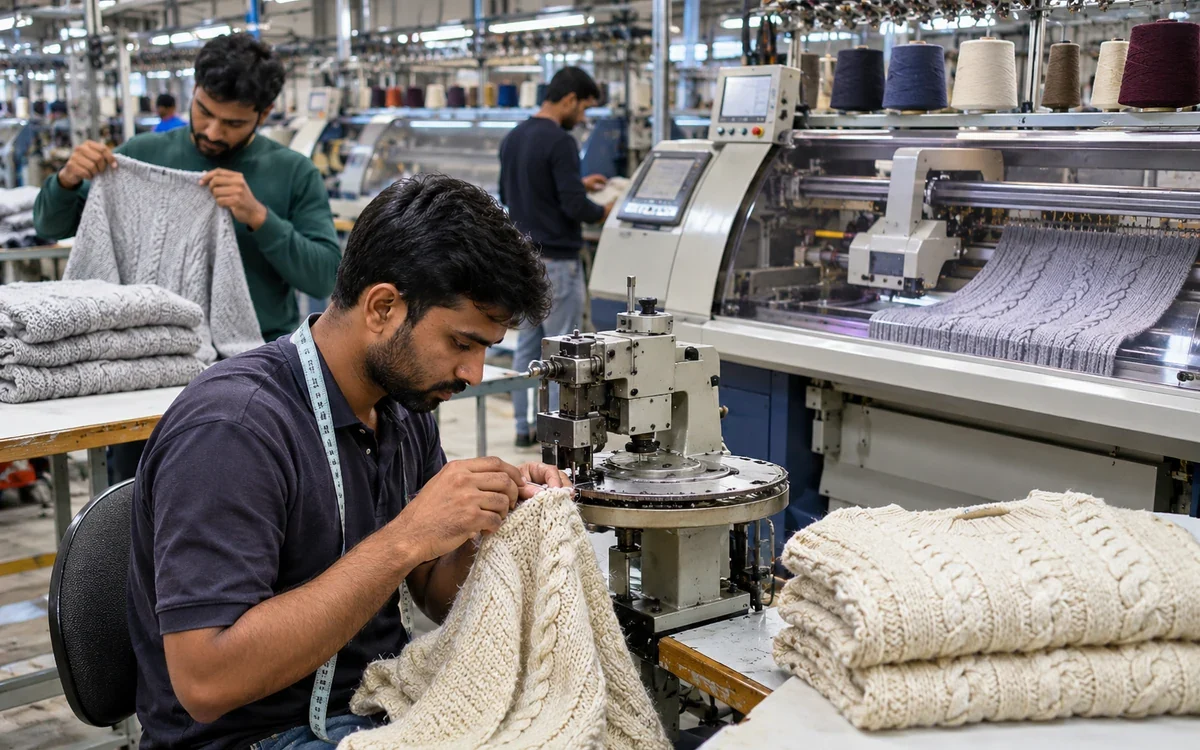
Computerised flat knitting machines have one or two needle beds set in a V shape, and a carriage that moves across the beds. The machine knits panels, such as front, back, sleeves, neckbands, cuffs and hem ribs, with shaping built in. Stitch patterns such as ribs, tuck, cable, jacquard, intarsia and plated yarns are possible.
Machine gauge is the number of needles per inch of the needle bed. A low gauge makes thick, chunky knitwear. A high gauge makes fine knitwear. As a rough guide, gauges such as 3 to 5 are chunky, 7 to 12 are common for standard sweaters and 14 or more are fine. Yarn count must fit the gauge. See the page on knitting machine gauge and fabric GSM and the guide to parts of a knitting machine.
Knitting the pieces
Each panel is knitted with stitch counts and shaping as set in the programme. Ribbed trims, such as hem, cuffs and neckband, are often knitted as part of the garment or as separate pieces. Quality checks at the machine include:
- Stitch length and tension
- Panel weight and size
- Yarn colour and lot
- Holes, dropped stitches, needle lines and floats
- Pattern alignment in jacquard and intarsia
Many factories weigh and measure the first panels after each setup, and sample panels through the shift to catch drift early. If panels vary in weight, the finished sweaters will vary in size and handle.
Circular knitting for cut and sew
For cut and sew styles, circular machines knit fabric, which is then finished and cut as for other knit garments. See interlock fabric, knitted rib fabric types and uses and terry cloth fabric for common structures, and knit fabric relaxation before cutting for handling.
Stage 4: Joining the panels
Linking
Linking machines join knitted panels by working loop by loop along the edge, so the seam is flat, elastic and almost invisible. A linking machine has a ring of points, called a dial, on which an operator places each loop of the panel edge, and the machine sews a chain stitch through each loop. The operator must match the loops of both pieces exactly, which takes training. Linking is used for shoulder joins, neckbands, collars, cuffs, sleeve attachment and some side seams.
Sewing and overlocking
Side seams, sleeve seams and some other joins are made on overlock machines, and cut and sew sweaters rely on overlock and coverstitch seams throughout. The guide on lockstitch versus overlock versus flatlock explains the stitch families. Seam strength and stretch should match the fabric, as discussed in sewing machine thread tension and types of sewing thread.
Neckbands, collars and trims
Neckbands, collars, plackets and cuffs are attached by linking or sewing. For collared styles, see the notes on parts of a collar. Buttons and zips are attached on buttonhole and button sewing machines. See buttonhole and bartack attaching machines and types of buttons in garments.
Stage 5: Mending
After joining, the garment goes to mending. Skilled workers repair small faults, such as dropped stitches, tiny holes, loose yarns and irregular loops, using hand tools and matching yarn. Mending is a key quality step in knitwear. A mender can save a piece that would otherwise be a reject, but too much mending signals problems at the knitting stage. Track mending rates by machine and style to find the source.
Stage 6: Washing and drying
Washing, or wet finishing, gives knitwear its final handle, softness and size. For wool and wool blends, washing is delicate, because heat, agitation and alkali can felt and shrink the fabric. For acrylic and cotton, washing is more forgiving.
Typical steps are:
- Pre wash or scouring. Removes oils and wax from the yarn.
- Washing and conditioning. Gentle machine action in controlled temperature and pH.
- Softening. Adds soft handle. See textile softener types comparison.
- Enzyme or special treatments. For cotton and viscose, a biopolishing step can reduce surface fuzz. See enzymes in textile processing.
- Hydro extraction. Spins out water at controlled speed.
- Drying. Tumble or flat drying, depending on the yarn and style.
Wash recipes must be tested on samples. Time, temperature, liquor ratio and mechanical action change the size and the handle. The guide to shrinkage control in the garment factory explains the principles, and the page on best practice in garment washing factories offers wash house guidance.
Stage 7: Finishing
After drying, sweaters are steamed, pressed and shaped.
- Steaming and pressing. Steam relaxes the knit and sets the final measurements. Pressing is done with care on a form or table, to avoid shine and flattening of the texture. See pressing and ironing in garment manufacturing.
- Blocking and shaping. Stretch to measurement on a form or board where required.
- Trimming and cleaning. Remove threads, lint and loose yarn.
- Labelling and tagging. See types of garment labels and hang tags in garments.
- Measuring. Check key measurements against the specification.
- Metal detection. Check for broken needles. See metal detection procedure in apparel.
- Folding and packing. Fold flat and pack as per the buyer’s method. See polybag in garment packing and garment packing methods, flat pack and hanger pack.
Knitwear is usually folded flat, not hung, since hanging can stretch the shoulders.
Quality control through the process
| Stage | Key checks |
|---|---|
| Yarn | Count, twist, shade, lot, strength, wax level |
| Knitting | Stitch length, panel weight, size, holes, needle lines, pattern |
| Linking | Loop matching, seam tension, symmetry, no twists |
| Mending | Quality of repair, no marks |
| Washing | Size change, handle, shade, no felting, no staining |
| Finishing | Measurements, shape, pressing, no shine |
| Labelling | Position, content, care wording |
| Final | Cleanliness, folding, metal detection, packing |
Check measurements before and after wash, using a tolerance chart such as the garment measurement tolerance chart. Inspection levels usually follow an AQL plan, as explained in AQL sampling plans for garment inspection. The guide to pilling box testing under ISO 12945-1 explains one test that matters greatly for knitwear.
Common sweater defects and causes
| Defect | Common causes | Prevention |
|---|---|---|
| Holes and dropped stitches | Needle damage, yarn breaks, wrong tension | Maintain needles, check yarn, monitor machine |
| Needle lines | Bent or worn needles | Replace needles, check settings |
| Shade difference between panels | Mixed yarn lots, dyeing variation | Use one lot per style and colour, retain samples |
| Size variation | Tension drift, panel weight variation | Control stitch length, weigh panels, monitor machine |
| Shrinkage and felting | Wrong wash, heat, agitation | Follow tested recipe, use suitable chemicals |
| Pilling | Short fibres, loose twist, friction | Select yarn well, finish properly, test |
| Distorted shape | Poor knitting tension, wrong pressing | Control tension, press and block carefully |
| Uneven linking | Operator error, loop mismatch | Training, templates, inline checks |
| Curling edges | Knit structure and tension | Use rib or suitable edge finishes |
| Oil or wax stains | Excess winding wax, machine oil | Control waxing, clean machines |
| Snagging and floats | Long floats in jacquard, rough handling | Design controls, careful handling |
| Seam breakage | Weak thread, wrong stitch, poor linking | Use right thread, test seam strength |
For a broader list, see knitting defects, causes and remedies and garment washing defects.
Cost and planning
Sweater cost depends mostly on yarn weight and price, knitting minutes, linking and mending labour, wash and finishing, trims and packing. Yarn weight per piece depends on gauge, size and stitch. A higher gauge uses finer yarn and takes longer to knit, and a lower gauge uses thicker yarn with faster knitting. See costing of knit garments for the cost structure used in knit factories.
Because the work flows across knitting, linking, mending, washing and finishing, balance matters. Plan machine capacity, linking operators and wash capacity together. See line balancing in the garment industry and bottleneck identification in a sewing line.
For the wider knitwear sector in Bangladesh, see knitwear in the RMG sector, contribution, export and SWOT analysis.
Final thoughts
The sweater manufacturing process begins with yarn and ends with a washed, pressed and shaped garment, and in between, the knitting programme, yarn lot and wash recipe decide most of the quality. Fully fashioned knitwear is knitted to shape and linked, cut and sew knitwear follows the usual garment flow, and whole garment knitting reduces joining almost to nothing.
To control it, approve yarn lots and shade early, check panel weights and sizes at the knitting machine, train linkers and menders, test wash recipes on samples, press carefully to measurement and inspect at every stage. Keep records of yarn lot, machine programme and wash recipe, so that reorders match the approved sample.
Frequently asked questions
Design and knit programming, yarn selection and dyeing, winding, flat knitting of panels, linking, mending, washing and drying, steaming and pressing, then inspection and packing.
It is a sweater whose panels are knitted to shape by adding or reducing stitches, then joined by linking. It gives a neat fit, less waste and a clean finish.
Linking joins knitted panels loop by loop on a linking machine, so the seam is flat and elastic with no raw edge.
Gauge is the number of needles per inch on the machine. A low gauge gives chunky knitwear and a high gauge gives fine knitwear, and the yarn count must suit the gauge.
Small knitting faults, such as dropped stitches and tiny holes, can be repaired by hand. Mending saves pieces, but a high mending rate shows a problem at the knitting stage.
Wool fibres have scales that interlock under heat, moisture and agitation, which causes felting and shrinkage. Controlled washing and yarn treatments reduce the risk.
Cut and sew sweaters are made from knitted fabric that is cut and sewn like other garments. Flat knit sweaters are knitted to shape on flat machines and joined by linking, with less waste.