
A fleece comes off a sheep as a dirty, greasy, tangled mat. A few weeks later it can be a soft sweater. The step that decides how good that sweater will be is the sorting of wool. Before anything is washed or spun, skilled workers spread the fleece out, look at it closely and divide it into parts. Fine and clean wool goes one way. Coarse, short and stained wool goes another way.
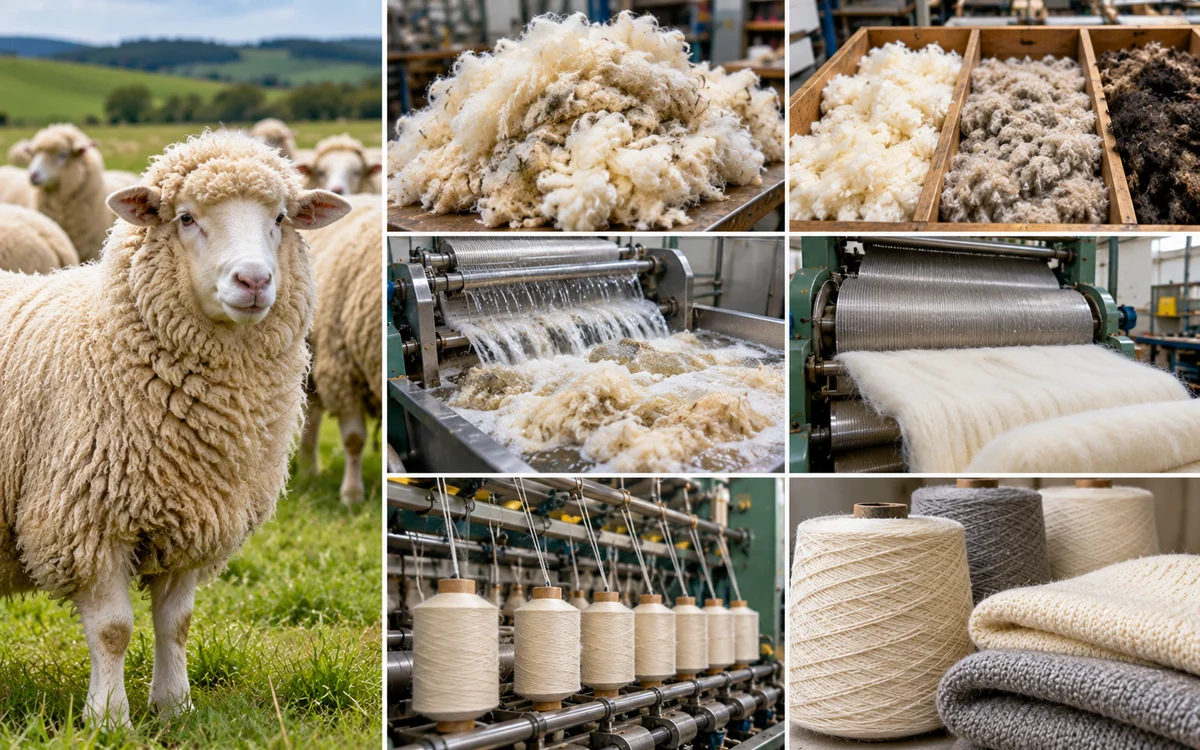
This guide explains the sorting of wool and then follows the whole path from sheep to yarn: shearing, grading, scouring, carding, combing and spinning. It also answers a common school question, why we wear woollen clothes in winter, and includes a worked yield example. For context on where wool fits among fibres, see our guide on the classification of textile fiber. If you are looking for wool products, our article on how to source merino wool socks is useful.
What is wool
Wool is the natural protein fibre that grows on sheep. The protein is keratin, the same family of protein as human hair and nails. Each fibre has a scaly outer surface and a curly, springy structure. Those two features give wool its warmth, its stretch and its habit of felting.
Other animals also give hair fibres that are sold as wool in a wide sense, such as goat (cashmere and mohair), alpaca, llama and angora rabbit. This article is about sheep wool.
Step 1: Shearing
Sheep are usually sheared once a year, often in spring, before the weather gets hot. A skilled shearer removes the fleece in one piece. A good shearer works carefully so that the fleece comes off whole and the sheep is not hurt. The fleece is thrown onto a table, and the dirty edges are removed.
Step 2: Skirting and classing
Right after shearing, the edges of the fleece, called the skirting, are taken off. They carry dung, burrs and short, low-quality wool. The main fleece is then looked over by a wool classer, who decides the grade of the whole lot.
Step 3: The sorting of wool
Sorting is the process of dividing the fleece into groups of similar wool. A fleece is not the same all over the sheep. The shoulders give the best wool. The back and sides give good wool. The belly, legs, tail and neck give shorter, dirtier and coarser wool. Sorters work at a slatted table that lets dust and dirt fall through. They pick up the fleece, check it and tear it apart along natural lines into portions.
What sorters look for
| Quality factor | What it means |
|---|---|
| Fineness | The thickness of the fibre, measured in microns. Finer wool is softer |
| Staple length | The length of the fibre. Longer wool makes stronger, smoother yarn |
| Strength (soundness) | Whether the fibre holds or breaks under pull. Weak spots come from illness or poor feeding |
| Crimp | The waviness of the fibre. More crimp usually means finer, bouncier wool |
| Colour | White wool is worth more, because it can be dyed any shade |
| Cleanliness | The amount of dirt, grease, seed and burrs in the fleece |
| Yield | The share of clean wool left after scouring |
| Character | The look and feel, such as softness and handle |
The sorted wool is divided into grades. Common sorting names include fine, medium and coarse, or numbers and letters that rise with quality. Different countries use different names, so always check what a grade means for your supplier.
Why sorting matters
Mixing fine and coarse wool in one yarn gives uneven yarn and rough cloth. Sorting keeps similar wool together so the mill can plan the blend and the price is fair. A well-sorted lot spins better, dyes more evenly and gives fewer faults in the cloth.
Step 4: Scouring
Greasy wool is not ready to spin. It holds wool grease (lanolin), sweat salts called suint, dirt and plant matter. Scouring washes it clean. The wool passes through a series of warm baths containing soap or detergent and mild alkali, then through rinse baths and rollers. Many mills reclaim the lanolin, which is used in skin creams and other products. For more on the idea of scouring in textiles, see our classification and objects of scouring page.
Scoured wool is dried in a hot air dryer at a controlled temperature. Too hot or too rough, and the wool turns yellow or felts.
Step 5: Carbonising
Some wool still holds bits of plant matter such as burrs and seeds after scouring. Carbonising treats the wool with sulfuric acid, which turns vegetable matter into brittle carbon. The wool is then dried and crushed so the carbon falls out. Carbonising is used when the plant content is high, because the acid can weaken wool if not controlled.
Step 6: Blending and oiling
Wool of different lots is blended to get a steady colour and quality. A small amount of oil is added before carding to reduce static and breakage.
Step 7: Carding
Carding opens the wool into a thin web with rotating drums covered in fine wire teeth. It removes tangles and short bits and starts to line up the fibres. The web is split into thin strands called slivers or rovings.
Step 8: Combing (for worsted)
Wool follows one of two routes.
- Woollen system: The carded wool is spun directly. The fibres lie in many directions. The yarn is fluffy, warm and bulky. It suits tweed, blankets and hairy knits.
- Worsted system: The carded sliver is combed. Combing removes short fibres, called noils, and lines the long ones in parallel. The yarn is smooth, strong and fine. It suits suits, fine knitwear and gabardine.
Step 9: Drawing and spinning
Slivers are drawn out to make them even and thinner. Then the strand is twisted and wound onto bobbins. The yarn is wound onto cones, ready for weaving or knitting. Our overview of the flow chart of spinning shows the general steps used across fibres.
Step 10: Weaving, knitting and finishing
Yarn is made into fabric, then finished. Wool finishing may include fulling (a controlled shrinking and felting), raising, pressing and shrink-resist treatment.
A worked example: wool yield and cost per clean kilogram
Mills buy greasy wool by weight, but they pay for the clean wool inside it. The yield is the percentage of clean wool left after scouring. It depends on breed, climate and farm. Yields can vary widely, from around 40 percent to 75 percent or more.
Say a mill buys 1,000 kg of greasy wool at 10 dollars per kilogram. The test shows a yield of 55 percent.
- Clean wool = 1,000 × 0.55 = 550 kg
- Total cost = 1,000 × 10 = 10,000 dollars
- Cost per clean kilogram = 10,000 ÷ 550 = 18.18 dollars
Now say another lot costs 11 dollars per kilogram greasy but has a yield of 65 percent.
- Clean wool = 1,000 × 0.65 = 650 kg
- Total cost = 1,000 × 11 = 11,000 dollars
- Cost per clean kilogram = 11,000 ÷ 650 = 16.92 dollars
The second lot costs more per greasy kilogram but less per clean kilogram. This is why mills test yield before buying. These prices are examples, not market rates.
Why we wear woollen clothes in winter
Wool keeps us warm for a few simple reasons.
- Trapped air: Wool fibres are crimped and springy, so they form a bulky layer with lots of tiny air pockets. Air is a poor conductor of heat, so the layer holds body warmth in.
- Moisture handling: Wool can take up a good amount of moisture vapour from the body before it feels wet. This keeps the skin drier than many other fibres.
- Warm when damp: Wool gives off a little heat as it takes up moisture, so it stays comfortable in cold, damp weather.
- Natural stretch and recovery: The crimp lets wool clothes stretch and spring back, so they hold their shape and seal gaps at the cuffs and neck.
In summer, thin wool can feel comfortable too, because it moves moisture away from the skin. But heavy wool is usually too warm in hot weather.
Wool fineness and common breeds
Fineness is measured as the average fibre diameter in microns (one micron is one thousandth of a millimeter). Lower numbers mean finer, softer wool. As a rough guide:
| Type | Typical fibre diameter | Typical use |
|---|---|---|
| Superfine merino | Under about 18 microns | Next-to-skin knits, fine suiting |
| Fine merino | About 18 to 21 microns | Knitwear, base layers, socks |
| Medium wool | About 22 to 30 microns | Jackets, blankets, upholstery |
| Strong or coarse wool | Above about 30 microns | Carpets, rugs, felt |
Merino sheep give the finest wool. Crossbred and long-wool breeds give stronger, lustrous fibre that suits carpets and outer garments. The ranges above are common guides, and wool trade bodies draw the lines in slightly different places.
Wool is not the same as hair. Hair fibres from goats, camels and rabbits have different scales and different feel. A label that says “wool” means sheep wool unless it names another animal.
Common wool faults found at sorting
Sorters look out for faults that lower the value of a fleece.
- Tender wool: A weak band in the fibre, caused by illness, cold or poor feed. The fibre breaks there during combing.
- Breaks and cotts: Matted, felted patches that cannot be opened.
- Dags and stains: Dung or urine marks that stay after scouring.
- Burrs, seeds and straw: Plant matter that lifts the cost of carbonising.
- Kemp: Short, hollow, white hairs that do not take dye. They show up as white specks in dark cloth.
- Coloured fibres: A few black or brown fibres in white wool spoil pale shades.
- Paint or tar marks: Farm marking products that are hard to remove.
A fleece with several of these faults is placed in a lower grade and priced down. Good farm practice, such as shearing in clean sheds and keeping sheep out of burr paddocks, reduces the faults before sorting begins.
Testing wool
Mills and traders use tests to turn the sorter’s eye into numbers.
- Fibre diameter: Measured with laser or optical instruments on small samples.
- Yield: The clean wool content after scouring a core sample.
- Vegetable matter: The share of burrs and seeds.
- Staple length and strength: Measured on staples taken from the fleece.
- Colour: Measured with a colorimeter for whiteness and yellowness.
Buyers read these numbers together with the sorter’s grade to decide how much to bid.
Properties of wool
- Warm and insulating
- Elastic and resilient, with good wrinkle recovery
- Absorbent, with a dry feel
- Flame resistant, because it chars and self-extinguishes in most cases
- Prone to felting and shrinkage in hot, rough washing
- Attacked by moths and some chemicals
- Dyes well, especially with acid dyes
- Can feel itchy in coarse grades
Care of woollen clothes
- Check the care label.
- Wash in cool water with a mild wool detergent, or dry clean.
- Avoid rubbing and twisting.
- Dry flat, away from direct heat.
- Store with moth protection, such as cedar, in a dry place.
Final thoughts
Great wool yarn starts long before the spinning frame. It starts with a shearer who takes off a whole fleece, a classer who reads its quality and a sorter who splits it into similar portions. After that come scouring, carding, combing and spinning. If you buy wool, ask about the grade, the micron and the yield. If you wear it, enjoy the warmth that comes from trapped air and springy fibres.
Frequently asked questions
Sorting of wool is the process of separating a fleece into groups of similar quality, based on fineness, length, strength, colour and cleanliness.
Sorting puts similar wool together so that the mill can spin even yarn, blend colours and set fair prices.
The shoulders and back usually give the best, finest and cleanest wool. The belly, legs and tail give the poorest.
Scouring is washing raw wool with warm water and detergent to remove grease, sweat salts and dirt.
Woollen yarn is carded and spun with the fibres in many directions, so it is bulky and fluffy. Worsted yarn is combed so the fibres lie parallel, so it is smooth and strong.
Wool traps air between its crimped fibres, and the trapped air stops body heat from escaping.
It depends on the mill, but the processing steps themselves take only days. Most of the time is spent on transport, testing and waiting between steps.


