Hand feel is one of the few fabric qualities a buyer judges the instant they touch a garment, before checking a single spec sheet. That instant judgment rides almost entirely on the softener choice made at finishing, which makes this one of the higher-impact decisions in the whole finishing process despite softener typically being a small percentage of total recipe cost.
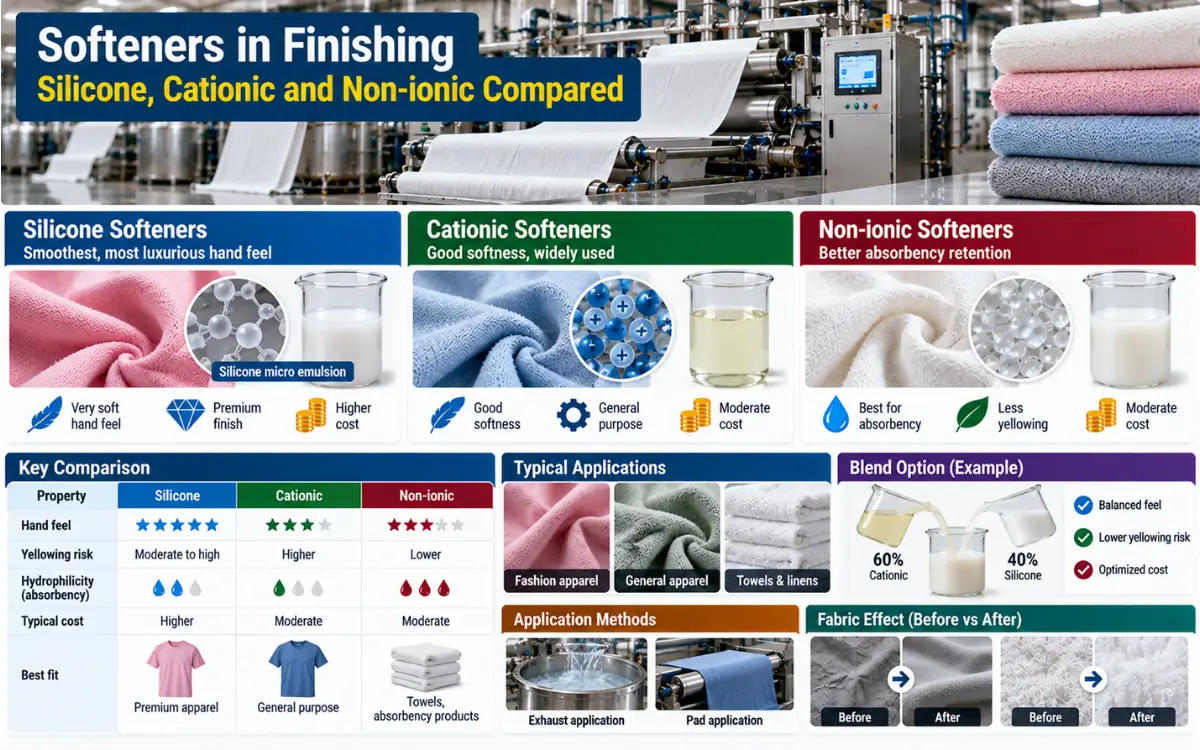
Silicone Softeners
Silicone softeners, particularly amino-modified silicone variants, deliver the smoothest, most luxurious hand feel of the three main categories, which is why they dominate premium apparel finishing where hand feel is a genuine selling point. Micro emulsion silicone products, with smaller particle size than conventional macro emulsions, penetrate fiber structure more effectively and generally deliver a superior feel with better durability through washing.
The trade-off is cost and a tendency toward yellowing on white or pale shades, particularly with amino-silicone types under certain finishing conditions, which is why silicone softener selection on light shades needs more careful product selection and process control than on darker shades where minor yellowing wouldn’t be visible anyway.
Cationic Softeners
Cationic softeners work well broadly across fiber types and offer good softness with reasonable cost, making them a common default choice where silicone’s premium feel isn’t specifically required. Their positive charge gives them good substantivity to most textile fibers, which carry a slight negative surface charge, helping the softener bond effectively during application.
Cationic softeners have their own yellowing tendency on white goods, generally considered more pronounced than non-ionic options, and can reduce fabric hydrophilicity (water absorbency) more than the other two categories, which matters for products like towels or performance wear where absorbency is a functional requirement, not just a comfort preference.
Non-ionic Softeners
Non-ionic softeners generally offer the best hydrophilicity retention of the three categories, making them the preferred choice for towels, and other absorbency-dependent products where maintaining water uptake matters as much as softness itself. They also tend to show less yellowing tendency than cationic softeners on white and pale goods.
The trade-off is hand feel, which is generally considered less luxurious than silicone and sometimes less pronounced than cationic softeners, positioning non-ionic softeners as the practical, functionality-first choice rather than the feel-first choice.
Comparing the Three at a Glance
| Property | Silicone | Cationic | Non-ionic |
|---|---|---|---|
| Hand feel | Smoothest, most premium | Good, moderate | Softer than untreated, less luxurious than silicone |
| Yellowing risk (white/pale) | Moderate to high (amino types) | Higher | Lower |
| Hydrophilicity impact | Reduces absorbency | Reduces absorbency more | Best absorbency retention |
| Typical cost | Higher | Moderate | Moderate |
| Best fit | Premium apparel, hand feel priority | General-purpose finishing | Towels, absorbency-critical products |
Where Each One Fits
Premium fashion apparel, particularly where the brand’s positioning depends partly on how the fabric feels in hand, generally justifies silicone softener’s higher cost, with product selection weighted toward micro emulsion types on white and pale shades specifically to manage yellowing risk. General-purpose apparel finishing, where softness matters but isn’t the primary selling point, often runs well on cationic softener at a more moderate cost. Towels, hospital and hospitality linens, and any product where absorbency is a genuine functional requirement should default to non-ionic softener, since a softer-feeling but less absorbent towel fails at its actual job regardless of how pleasant it feels off the shelf.
Blending Softener Types
Mills don’t always need to choose a single softener type exclusively. Blended formulations, combining silicone for feel with a portion of non-ionic or cationic component to manage cost or offset a specific weakness like yellowing risk, are common in commercial finishing recipes. Getting the blend ratio right requires trial and evaluation on the actual fabric and shade in question, since blend performance doesn’t always scale predictably from the individual components’ known properties, particularly on yellowing behavior where interaction effects between softener types and specific dye classes can produce results that a simple additive assumption wouldn’t predict.
A Worked Blend Cost Example
Say a mill is comparing three options for a mid-range apparel product: pure silicone softener at an illustrative cost of $6.00 per kilogram of active product dosed at 2% owf, pure cationic softener at $2.50 per kilogram dosed at 3% owf, and a blended formulation (60% cationic, 40% silicone by active content) at an illustrative blended cost of $4.00 per kilogram dosed at 2.5% owf.
Pure silicone: 0.02 kg × $6.00 = $0.12 per kilogram of fabric.
Pure cationic: 0.03 kg × $2.50 = $0.075 per kilogram of fabric.
Blend: 0.025 kg × $4.00 = $0.10 per kilogram of fabric.
On cost alone, cationic wins clearly. But if the product is a pale pink shade where cationic’s higher yellowing tendency risks a visible shade shift that would fail a buyer’s quality inspection, the blend’s modest $0.025 per kilogram premium over pure cationic, and meaningful \$0.02 per kilogram saving versus pure silicone, may represent the better overall choice once the cost of a potential rejected batch is weighed against the softener cost difference alone. This is the same logic covered in the chemical consumption benchmarking article: unit cost and dosage together determine real recipe cost, and real recipe cost needs to be weighed against quality risk, not treated as the only factor in the decision.
Application Method Affects the Comparison Too
The softener comparison covered above assumes exhaust application, where the softener is applied in a dyebath-style process with the fabric fully immersed, but pad application, where softener is applied via a padder mangle at a controlled, more precise add-on level, is also common and can shift the practical comparison between these three categories. Pad application generally gives more consistent, controllable softener pickup across the fabric width than exhaust application, which matters more for silicone softeners specifically, since achieving even distribution is part of what determines whether silicone’s premium hand feel actually comes through consistently across a full roll rather than varying noticeably from one section to another. Mills running high-value, hand-feel-critical fabric through silicone finishing often prefer pad application for exactly this reason, even though it requires different equipment and process setup than an exhaust-based softening step integrated into the dyeing cycle itself.
Testing Before Committing to a Recipe Change
Any softener change on an existing, running recipe deserves a proper trial before full production, checking hand feel against the buyer’s expectation, yellowing under accelerated aging or light exposure testing where the shade and end use warrant it, and hydrophilicity testing where the product category requires it. A softener swap that looks like a minor recipe tweak on paper can produce a noticeably different finished fabric, and catching that difference in a trial batch is considerably cheaper than catching it after a full production run has already shipped.
Frequently Asked Questions
Which softener type is best for towels?
Non-ionic softener, since it retains hydrophilicity (water absorbency) better than silicone or cationic options, which matters more for towels than achieving the smoothest possible hand feel.
Why do silicone softeners sometimes cause yellowing on white fabric?
Amino-modified silicone types in particular carry a yellowing tendency under certain finishing conditions, which is why product selection and process control need extra care specifically on light shades.
Can different softener types be blended in one recipe?
Yes, and blending is common to balance cost, feel, and yellowing risk, though the right blend ratio requires trial and evaluation on the actual fabric and shade rather than assuming a blend’s performance scales predictably from its individual components.
Does application method (pad versus exhaust) affect softener performance?
Yes, particularly for silicone. Pad application generally gives more even, controllable pickup across fabric width than exhaust application, which matters for whether silicone’s premium feel comes through consistently.