
Special purpose machines get a fraction of the attention lockstitch and overlock machines do in factory planning, mostly because they represent a smaller share of total machine count. That’s exactly why they cause disproportionate headaches when underplanned. A sewing floor with a bottleneck on core seaming can shuffle work between several similar machines. A bottleneck on the single buttonhole machine has nowhere to overflow to, and it stops the whole garment’s completion cold.
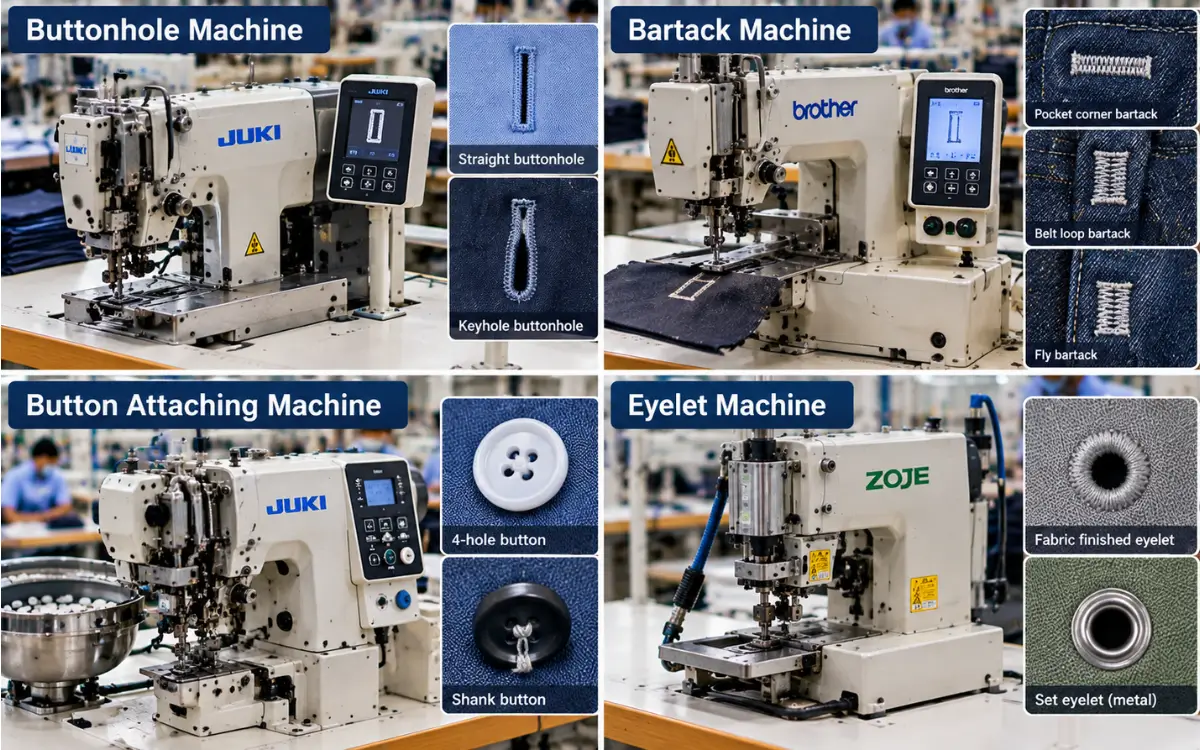
Buttonhole Machines
Buttonhole machines cut and stitch a finished buttonhole in a single automated cycle, typically producing either a straight, eyelet, or keyhole-style buttonhole depending on the machine’s cutting knife configuration and the garment’s requirements. Keyhole buttonholes, with a rounded end that accommodates a button’s shank without stressing the fabric, are standard on tailored jackets and coats, while straight buttonholes are more common on shirts and lighter garments where the button doesn’t carry the same structural load.
Setting a buttonhole machine correctly means matching stitch density, buttonhole length, and cutting position to the specific button size being used. A buttonhole cut too short forces the button through under tension, straining the surrounding fabric and the buttonhole’s own stitching over repeated use, while one cut too long lets the button shift and never sit properly closed.
Bartack Machines
Bartack machines stitch a small, dense reinforcement at points on a garment that take repeated stress: pocket corners, belt loop ends, and fly openings are the most common. The bartack stitch itself is a tight zigzag pattern concentrated in a small area, and stitch count, how many stitches the machine lays down per bartack, is the main variable that determines reinforcement strength.
Skipping bartacks or under-specifying stitch count at high-stress points is a common source of garment failure that shows up as a torn pocket corner or a popped belt loop well before the rest of the garment shows wear, since these points concentrate stress in a way the surrounding plain seam construction isn’t designed to absorb.
Button Attaching Machines
Button attaching machines sew buttons on with a set number of stitches through the button’s holes, and, for shank buttons, wrap thread around the shank to create the small gap needed for the button to sit properly over fabric layers when fastened. Stitch count and thread tension both affect how securely a button stays attached through repeated wear and laundering, and factories running high-volume basic garments typically standardize these settings by button type and fabric weight rather than adjusting per style.
Eyelet Machines
Eyelet machines create a reinforced hole, typically used for drawstrings, lace-up closures, or decorative applications, either by cutting and finishing the hole edge with thread in a single operation or by setting a metal or plastic eyelet component into a pre-punched hole. Which approach a factory needs depends on the garment category. Fabric-finished eyelets suit lighter garments where a metal eyelet would feel heavy or look out of place, while set eyelets suit heavier garments like outerwear and footwear-adjacent products where durability under repeated lacing tension matters more than a soft finish.
Deciding Which Special Purpose Machines You Actually Need
Not every factory needs every machine covered here, and buying a full set regardless of product mix wastes capital on equipment that will sit idle. The right approach works backward from the actual garments in production: a factory making basic knit tees may need button attaching capacity for a small percentage of styles and nothing else from this category, while a factory making tailored outerwear needs buttonhole, bartack, and possibly eyelet capacity as standard requirements across most of its product range.
Utilization matters as much as raw need here. A buttonhole machine used at 20 percent capacity across the week still needs to exist somewhere on the floor, but that’s a very different capital and space allocation decision than a machine running near full utilization on every style that comes through. Sizing special purpose machine count to blended utilization across the full product range, rather than to the peak demand of any single style, avoids both underprovisioning during a busy period and overpaying for idle capacity the rest of the time.
A Worked Utilization Example
Say a factory runs a product mix where 30 percent of daily styles require a buttonhole operation, and the line’s total daily output target across all styles is 1,000 pieces, meaning 300 pieces a day actually need buttonholing. If the buttonhole operation has an SMV of 0.4, and the line runs an 8-hour (480 minute) shift at 55 percent efficiency, the calculation from the machine requirement method covered elsewhere gives:
(0.4 × 300) ÷ (480 × 0.55) = 120 ÷ 264 = 0.45, rounded up to 1 machine.
Compare that to what happens if the same buttonhole SMV is mistakenly run against the full 1,000-piece daily output instead of the 300 pieces that actually need it: (0.4 × 1,000) ÷ 264 = 400 ÷ 264 = 1.5, rounded up to 2 machines. That’s a full extra buttonhole machine bought and floor-spaced for capacity that will never actually be used, purely from applying the wrong output figure to a special purpose machine’s calculation. This is precisely the mistake flagged earlier in this article, and it’s worth double-checking on every special purpose machine calculation specifically because the consequence of getting it wrong is a real, avoidable capital cost.
Where These Machines Fit in the Overall Machine Requirement Calculation
The SMV-based machine requirement calculation covered elsewhere applies to special purpose machines the same way it applies to core sewing operations, with one adjustment: since these operations often apply to only a subset of styles rather than every garment on the line, the target output figure in the calculation should reflect the volume of styles actually requiring that operation, not total line output. Running the full-line output figure against a buttonhole operation that only 30 percent of styles actually need will overstate machine requirement and lead to buying capacity that never gets used.
Frequently Asked Questions
Does every factory need a dedicated bartack machine?
Only if the product mix includes stress points like pocket corners or belt loops that need reinforcement. Sizing this to blended utilization across the actual product range, not peak demand from one style, avoids overbuying.
Why does buttonhole size matter beyond just fitting the button?
A buttonhole cut too short strains the fabric and stitching every time the button is forced through, while one cut too long lets the button shift. Both cause premature wear concentrated at that single point.
What’s the difference between a fabric-finished eyelet and a set eyelet?
Fabric-finished eyelets suit lighter garments where a metal component would feel heavy, while set eyelets suit heavier garments like outerwear where durability under repeated lacing tension matters more than a soft finish.
How do I calculate machine requirement for a buttonhole operation that only some styles need?
Use the volume of styles that actually require the operation in the calculation, not total line output, or the result will overstate requirement and lead to buying capacity that never gets used, as the worked example in this article shows.
