A sweater feels like one smooth piece of cloth. But look closer and you will see a neckline that has been shaped, ribbed edges that spring back and seams that were made in a very particular way. The parts of a sweater are quite different from the parts of a woven shirt, because sweaters are knitted, not cut from a roll of fabric and sewn.
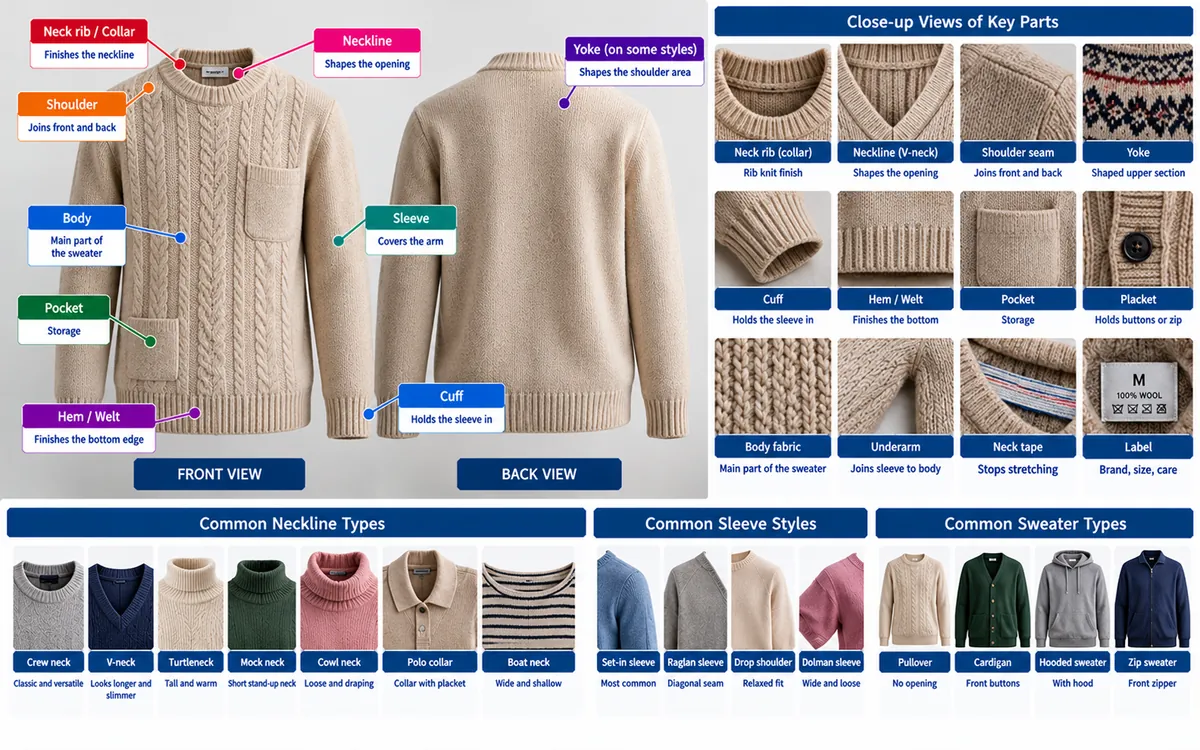
This guide explains each part of a sweater, from the collar to the hem. You will also learn the knitting terms that factories use, which will help if you ever read a tech pack or talk to a knitwear supplier.
How a sweater is different from a shirt
A shirt is made from woven fabric. The fabric is cut into flat pieces and sewn together. A sweater is made from knitted yarn, and there are two main ways to make one.
Cut and sew. The factory knits a large roll of fabric, then cuts pieces from it like a T-shirt. This is cheaper and faster. Most thin sweaters and sweatshirts are made this way.
Fully fashioned. The knitting machine makes each piece in its final shape. The front, back and sleeves come off the machine already shaped, and they are then linked together. This wastes less yarn and gives a better fit. Most wool and cashmere sweaters are made this way.
A third method is whole-garment knitting, where a machine knits the whole sweater in one piece with almost no seams. It is neat but needs special equipment.
Knowing which method was used explains many of the parts you will see below. For the basics of knit fabric itself, read our guide on what is knitted fabric.
Parts of a sweater at a glance
| Part | Location | Job |
|---|---|---|
| Neckline | Around the neck | Shapes the opening |
| Neck rib or collar | Neck edge | Finishes the neckline |
| Shoulder | Top of arm | Joins front and back |
| Yoke | Upper chest and back | Shapes the shoulder area |
| Body | Chest and back | Main part |
| Sleeve | Arm | Covers the arm |
| Cuff | Wrist | Holds the sleeve in |
| Hem or welt | Bottom | Finishes the edge |
| Placket | Front opening | Holds buttons or zip |
| Front | Storage | |
| Label | Inside neck | Brand, size, care |
Neckline and collar
The neckline is one of the first things people notice. There are several common types.
- Crew neck: A round neckline that sits close to the base of the neck.
- V-neck: A neckline that dips to a point on the chest.
- Turtleneck: A tall, tube-shaped neck that folds over or stands up.
- Mock neck: A short stand-up neck that does not fold.
- Cowl neck: A loose, draping neck that hangs in soft folds.
- Polo or collared: A folded collar with a small placket.
- Boat neck: A wide, shallow neckline that runs across the collarbones.
Neck rib
Most sweater necklines are finished with a band of rib knit. Rib is a stretchy fabric made from alternating raised and lowered columns of stitches. It stretches over your head and then springs back to fit your neck. A good neck rib returns to its shape after pulling. A poor one stays loose and gapes.
Neck binding
On some sweaters, a plain strip of fabric called binding covers the neckline seam. It is used on V-necks and round necks that are not ribbed. Binding adds strength.
Neck tape
A strip of tape runs along the back neck seam. It stops the seam from stretching and feels smoother against the skin.
Linking and the neck join
On fully fashioned sweaters, pieces are joined by a method called linking, where a machine or a person picks up each loop one by one and joins the two pieces without bulk. Linking gives the neck a neat, flat join. On cut-and-sew sweaters, an overlock machine joins the pieces and leaves a small ridge.
Shoulders and yoke
Shoulder seam
The shoulder seam joins the front and back panels at the top. It must lie flat and straight. A twisted shoulder seam pulls the sweater toward the back and gives a poor fit.
Shoulder tape
A thin tape is sometimes sewn into the shoulder seam to stop stretching. Knitted fabric is soft and heavy. Without tape, the shoulder can slope down as the sweater ages.
Yoke
On some sweaters the shoulder and upper chest are made from one shaped piece, called a yoke. Yoke sweaters are often patterned. A classic Nordic sweater has a decorated yoke in a circle shape, which hugs the shoulders and neck.
Sleeve styles
How the sleeve joins the body changes the look and fit.
- Set-in sleeve: Joined at the natural shoulder line. It gives the cleanest fit.
- Raglan sleeve: A diagonal seam runs from the neck to the underarm. It gives a relaxed look and is easy to knit.
- Drop shoulder: The seam sits lower down on the upper arm. This is a loose, modern look.
- Saddle shoulder: A strip of knitted fabric runs along the top of the shoulder to the neck. It is a traditional style.
Armhole
The armhole is the opening where the sleeve joins the body. In knitwear, it is shaped by decreasing stitches on the machine, which gives a smooth curve.
Sleeve cap
The sleeve cap is the curved top of the sleeve. It is knit slightly larger than the armhole and eased into it.
Underarm gusset
Some sweaters include a diamond-shaped piece of fabric under the arm to give more movement. This is called a gusset. It is common in hard-wearing work knits.
Cuffs
The cuff finishes the end of the sleeve. In a sweater it is nearly always made of rib knit. It hugs the wrist and keeps cold air out. Some sweaters have a longer, folded cuff that you can wear down or pushed up. A plain finished edge, without rib, gives a more relaxed look.
The body
Front and back panels
The body is made up of a front panel and a back panel. In cut-and-sew sweaters, the panels are cut from fabric. In fully fashioned sweaters, they are knitted to shape on the machine. Shaped panels have narrow lines of stitches called fashioning marks near the armholes and sides. These show where the machine has reduced stitches to shape the panel.
Side seams
The side seams join the front and back. Some sweaters have no side seams, because they are knitted in the round as a tube. Tube bodies hang evenly and have no ridges at the sides.
Intarsia and jacquard
Patterns on sweaters are made in two main ways.
- Intarsia: Blocks of color are knitted separately. The back stays clean because each color is only used in its own area.
- Jacquard: Colors are knitted in tiny patterns across the row. The unused yarn is carried behind the pattern. This creates floats on the inside, which can catch fingers if they are too long.
Pattern choice affects weight and warmth. Jacquard sweaters are thicker and warmer because of the extra yarn behind.
Hem or welt
The bottom edge of a sweater is called the hem or welt. Most sweaters have a rib hem, which pulls the body in slightly and holds it against the hips. Other styles use a plain turned hem, a split hem with side vents, or a rolled edge, which curls on its own when the fabric is stockinette stitch. A rolled edge looks relaxed but can curl more than you want.
Side vents
Some longer sweaters have small slits at the side seams. These allow the sweater to move when you sit or bend.
Fronts, plackets and closures
Cardigans and sweater jackets open at the front.
Placket
A placket is the strip of knitted fabric on the front opening. It carries buttons and buttonholes. In knitwear, the placket is often knit as one piece with the body, and the buttonholes are knitted in on the machine.
Buttons
Sweater buttons are usually larger and flatter than shirt buttons, because knit fabric is soft and heavy. A shank button, which has a loop on the back, is good for thick knits because it gives room for the fabric. Our guide on different types of buttons for clothes explains the main choices.
Zipper
Sporty sweaters use zippers. A zip is sewn to a supporting tape so that the stretching knit does not pull it out of shape. Read about the zipper’s own parts in our guide to the different parts of a zipper.
Pockets
Sweaters carry pockets in a few styles.
- Patch pocket: A flat piece of knit sewn on the outside.
- Inset pocket: A slit pocket with a knit lining inside.
- Kangaroo pocket: A large front pouch.
- Hidden pocket: A small pocket sewn inside the side seam.
Pocket openings are stretched by hands, so they are reinforced. A rib edge or a small bar tack is common.
Labels
Inside the neck or side seam are the main label, the size label and the care label. Many sweaters carry washing symbols that warn against hot water and tumble drying. Wool, in particular, needs gentle care. Learn what common labels check in our guide on trims and accessories inspection.
Yarn and gauge
Parts of a sweater also include things you cannot see. The yarn and gauge decide how the sweater feels.
Yarn type
Common sweater yarns include:
- Wool: Warm and elastic. Can feel scratchy in coarse grades.
- Merino wool: Finer than regular wool and softer on the skin.
- Cashmere: Very soft, from the undercoat of cashmere goats. Costly.
- Cotton: Cool and easy to wash.
- Acrylic: A synthetic fiber that imitates wool at a low price.
- Blends: Mixes such as wool and nylon, which add strength.
Gauge
Gauge in knitwear means how many needles the machine has per inch. A fine gauge uses more needles and makes a thin, smooth sweater. A low gauge uses fewer needles and makes a thick, chunky one. Gauge drives both the look and the price. Our guide on knitting machine gauge and fabric GSM explains how this works.
Common faults
- Pilling: Little balls of fiber on the surface. Short fibers and loose twist cause it.
- Holes or dropped stitches: A stitch has slipped out of place during knitting.
- Twisted side seams: The fabric was cut off-grain.
- Neck gaping: The neck rib is too loose.
- Uneven cuffs: One cuff is longer or tighter than the other.
- Shade variation: Different yarn lots create a color difference between panels.
- Shrinkage: Wool and cotton can shrink in the wash.
- Loose float threads: In jacquard sweaters, long floats at the back catch on rings and nails.
For a longer look at faults, see our guide on types of garment defects.
Quick quality checks for buyers
- Stretch the neck rib and let go. It should spring back.
- Pinch the fabric. It should feel dense, not thin.
- Look at the inside seams. Stitches should be neat.
- Check the shoulder seams. They should sit straight on your shoulder line.
- Hold the sweater up to light. Large gaps or thin spots signal a weak knit.
- Rub the surface gently. If fluff comes off easily, it will pill.
Final thoughts
Once you know the parts of a sweater, you can judge one in seconds. Look at the neck rib, the shoulder seam, the cuffs and the hem. These four places show how well the sweater was made. If they spring back, lie flat and look even, the rest of the sweater is usually well made too.
Frequently asked questions
The main parts are the neckline, shoulders, body, sleeves, cuffs and hem. Cardigans also have a placket and buttons, and some sweaters have pockets.
Ribbing is a stretchy knit fabric with alternating columns of stitches. It is used on cuffs, hems and necklines because it stretches and springs back.
It means each panel was knitted to shape and then linked together, instead of cutting shapes from a roll of fabric. This usually gives a better fit and less waste.
It depends on the shape. Common names are crew neck, V-neck, turtleneck, mock neck, cowl neck and boat neck.
They are the same garment. Sweater is the common word in the United States. Jumper is common in the United Kingdom and other places.
Gauge is the number of needles per inch on the knitting machine. Higher gauge gives a finer, thinner fabric. Lower gauge gives a thicker one.
Pilling happens when short fibers rub against each other and tangle into small balls. Soft, short fibers and loose twist make it more likely.