In the textile industry, product appearance is just as important as comfort and durability. A garment may be made from high-quality fibers and have excellent construction, but if it develops unsightly pills after only a few wears, consumers are likely to view it as a low-quality product.
Pilling is one of the most common fabric appearance issues. It occurs when loose fibers on the fabric surface become entangled through friction and form small balls known as pills. While pilling does not always affect the structural performance of a textile, it can significantly reduce its visual appeal and perceived value.
For this reason, fabric manufacturers, apparel brands, testing laboratories, and quality control teams rely on standardized testing methods to evaluate a fabric’s resistance to pilling before products reach the market.
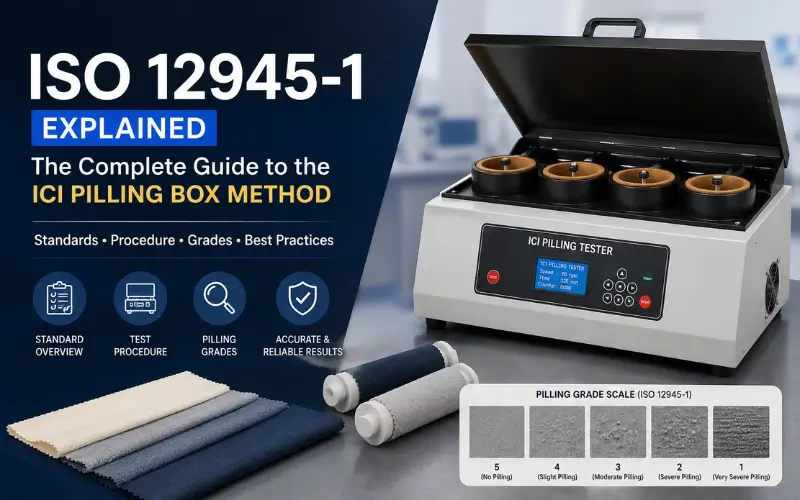
Among the various testing standards available, ISO 12945-1 is one of the most widely recognized methods for assessing fabric pilling performance. Commonly referred to as the ICI Pilling Box Test Method, this test simulates the random rubbing and wear that fabrics experience during everyday use, helping manufacturers predict how materials will perform over time.
Whether you are a textile engineer, laboratory technician, quality manager, or fabric supplier, understanding ISO 12945-1 is essential for ensuring consistent product quality and meeting customer expectations.
In this guide, we’ll explore what ISO 12945-1 is, how the ICI Pilling Box Method works, the testing procedure, grading system, key influencing factors, and best practices for obtaining reliable results.
What Is ISO 12945-1 and Why Is It Important?
ISO 12945-1 is an international textile testing standard developed to determine a fabric’s tendency to form pills, fuzz, or mat on its surface during wear.
The standard belongs to the broader ISO 12945 series, which focuses on evaluating the propensity of textile fabrics to surface pilling and related appearance changes. Specifically, Part 1 describes the use of the ICI Pilling Box Method, a testing technique that subjects fabric specimens to controlled tumbling action inside rotating cork-lined boxes.
The objective is simple: simulate real-life wear conditions in a laboratory environment and evaluate how well a fabric maintains its appearance after exposure to repeated friction.
The results help manufacturers compare materials, improve fabric constructions, validate finishing processes, and ensure products meet brand quality requirements before entering production.
Today, ISO 12945-1 is widely used throughout the global textile supply chain, including:
- Apparel manufacturing
- Knitwear production
- Sportswear development
- Home textile manufacturing
- Fabric research and development
- Independent textile testing laboratories
- Brand quality assurance programs
Because the standard provides a consistent testing framework, it enables manufacturers and buyers to evaluate fabrics using the same criteria regardless of where testing is performed.
Understanding Fabric Pilling, Fuzzing, and Matting
Although these terms are often used together, they describe different surface phenomena that can occur during fabric wear.
Pilling refers to the formation of small fiber balls on the fabric surface. These pills are created when loose fibers become entangled through abrasion and remain attached to the fabric.
Fuzzing occurs when fibers protrude from the fabric surface, creating a hairy or fuzzy appearance. Fuzzing often appears before actual pills develop.
Matting is the compression and entanglement of surface fibers, resulting in a flattened and felted appearance. This condition is commonly observed in wool and wool-blend fabrics.
In real-world use, these effects frequently occur together. A fabric may first develop fuzz, followed by pill formation, and eventually show signs of matting after prolonged wear.
Because consumers typically judge fabric quality by appearance, controlling these surface changes is a critical part of textile product development.
Purpose of ISO 12945-1
The primary purpose of ISO 12945-1 is to provide a standardized and repeatable method for evaluating fabric resistance to pilling, fuzzing, and matting.
Without standardized testing, fabric assessments would depend largely on subjective wear trials, which are often expensive, time-consuming, and difficult to reproduce.
The ICI Pilling Box Method offers several important advantages:
- Faster evaluation compared to real-life wear testing
- Consistent laboratory conditions
- Improved repeatability of results
- Easier comparison between fabric types
- Reliable support for product development decisions
- Greater confidence in quality assurance programs
For textile manufacturers, this means potential performance issues can be identified early, reducing the risk of customer complaints and costly product returns.
Typical Applications of ISO 12945-1
The ICI Pilling Box Method is suitable for a wide range of textile materials and end-use applications.
One of its most common applications is in the testing of knitted fabrics. Because knitted structures often contain more exposed fibers and greater yarn mobility than woven fabrics, they can be particularly susceptible to pilling.
The method is also widely used for:
- T-shirts and casual wear
- Sweaters and knitwear
- Sportswear fabrics
- Fleece materials
- Polyester and cotton blends
- Wool and wool-blend textiles
- Upholstery fabrics
- Home furnishing textiles
Many global apparel brands specify minimum pilling performance requirements as part of their supplier approval programs, making ISO 12945-1 testing a routine part of fabric qualification.
How the ICI Pilling Box Method Works
The ICI Pilling Box Method was developed to reproduce the random mechanical action that fabrics experience during everyday use.
When clothing is worn, fabric surfaces constantly rub against other materials, skin, and adjacent garment components. This repeated friction causes loose fibers to migrate to the surface, where they become entangled and form pills.
Rather than attempting to replicate every real-life wear condition, ISO 12945-1 creates a controlled laboratory environment that accelerates this process in a consistent and repeatable manner.
The Testing Principle
The principle behind the ICI Pilling Box Method is straightforward.
Fabric specimens are mounted onto polyurethane tubes and placed inside specially designed cork-lined boxes. As the boxes rotate, the specimens tumble freely and repeatedly come into contact with the abrasive cork surface and other parts of the testing environment.
This continuous tumbling action generates random friction similar to that encountered during normal garment wear.
Over time, fibers begin to loosen, fuzz appears on the fabric surface, and pills gradually develop. The degree of pilling observed after a specified testing period provides an indication of the fabric’s resistance to surface deterioration.
Because all specimens are tested under controlled conditions, results can be compared reliably across different fabric constructions, fiber types, and finishing treatments.
Equipment Used in ISO 12945-1 Testing
Accurate pilling assessment depends not only on following the standard correctly but also on using properly maintained testing equipment. Each component of the testing system plays a role in ensuring repeatable and reliable results.
ICI Pilling Box Tester
The core piece of equipment is the ICI Pilling Box Tester. The instrument contains multiple rotating test chambers designed to create controlled tumbling action. Modern testers often include digital controls, programmable timers, and automatic stop functions that improve testing efficiency and consistency.
Most laboratories prefer automated systems because they reduce operator intervention and help maintain compliance with international testing requirements.
Cork-Lined Test Chambers
One of the distinguishing features of the ICI Pilling Box Method is the use of cork-lined chambers.
The cork surface creates controlled friction during specimen tumbling. Since the condition of the cork directly affects test results, laboratories must regularly inspect and replace worn linings. Excessively worn or contaminated cork can alter abrasion intensity and reduce result consistency.
Polyurethane Tubes
Before testing, fabric specimens are wrapped around polyurethane tubes. These tubes provide a consistent support structure and help ensure that all samples are exposed to similar mechanical action during testing.
Proper mounting is important because wrinkles, uneven tension, or loose attachment can influence pilling development and lead to inaccurate assessments.
Assessment Equipment
After testing, specimens must be evaluated under controlled viewing conditions.
Laboratories typically use:
- Standard lighting cabinets
- Approved photographic rating standards
- Visual assessment boards
- Reference samples when required
Consistent lighting conditions are particularly important because pilling severity can appear different under varying light sources.
Conditioning Equipment
Textile materials are sensitive to environmental conditions such as temperature and humidity. Before testing, specimens are conditioned in a standard atmosphere to minimize variations caused by moisture content.
Proper conditioning ensures that results are comparable between laboratories and testing sessions.
Advantages of the ICI Pilling Box Method
Although several pilling test methods are available today, the ICI Pilling Box Method remains one of the most widely used in textile laboratories.
Its popularity stems from several practical advantages.
Simulates Real-Life Wear Conditions
The random tumbling action generates multi-directional friction, closely resembling the unpredictable wear conditions that garments experience during everyday use.
This makes the method particularly useful for evaluating apparel fabrics.
Good Repeatability
When testing conditions are controlled properly, the method delivers consistent and repeatable results. This allows manufacturers to compare different fabric constructions and finishing treatments with confidence.
Suitable for a Wide Range of Fabrics
The standard can be applied to many textile categories, including:
- Knitted fabrics
- Woven fabrics
- Wool fabrics
- Synthetic textiles
- Blended materials
- Home textile products
This versatility makes it a valuable tool across multiple sectors of the textile industry.
Relatively Simple Operation
Compared with some advanced abrasion testing methods, the ICI Pilling Box Method is straightforward to perform and does not require highly complex equipment.
This contributes to its widespread adoption in quality control laboratories worldwide.
ISO 12945-1 Test Procedure Step by Step
Understanding the testing procedure is essential for obtaining reliable and meaningful results. Although laboratories may have their own internal quality procedures, the overall process follows the requirements outlined in ISO 12945-1.
Sample Preparation and Conditioning
The first step involves selecting representative fabric specimens.
Samples should accurately reflect the material being evaluated and should be free from defects, creases, stains, or other abnormalities that could influence the test outcome.
Specimens are cut according to the dimensions specified by the standard. Care must be taken to ensure clean edges and consistent preparation across all test pieces.
Before testing begins, the specimens are conditioned under standard atmospheric conditions. This step allows the fabric to reach moisture equilibrium with the testing environment.
Skipping or shortening the conditioning process can introduce variability into the results, especially for moisture-sensitive fibers such as cotton and wool.
Mounting the Specimens
After conditioning, each specimen is carefully mounted around a polyurethane tube.
The fabric is wrapped smoothly around the tube surface without wrinkles or excessive tension. Proper mounting ensures uniform exposure during the tumbling process.
Any folds, distortions, or uneven tension can create localized wear patterns that do not accurately represent the fabric’s true pilling behavior.
Once mounted, the specimens are secured according to laboratory procedures before being placed into the pilling boxes.
Loading the Pilling Boxes
The mounted specimens are inserted into the cork-lined chambers.
The number of specimens tested typically depends on laboratory requirements and customer specifications. Multiple specimens are generally tested to improve confidence in the final assessment.
Before starting the test, technicians verify:
- Correct specimen mounting
- Proper chamber condition
- Cork lining integrity
- Equipment functionality
- Required testing parameters
These checks help prevent invalid results and unnecessary retesting.
Running the Test
Once preparation is complete, the pilling boxes are set in motion.
As the chambers rotate, the mounted specimens tumble continuously inside the cork-lined environment. During this process, friction causes fibers to migrate toward the surface, where fuzzing and pilling gradually develop.
The duration of the test depends on the evaluation requirements established by the standard or customer specification.
Many laboratories assess specimens after specific intervals to observe how pilling develops over time. This approach provides a more complete understanding of fabric performance throughout the testing cycle.
Because different fabrics exhibit different pilling characteristics, observing performance at multiple stages often provides valuable product development insights.
Removing and Preparing Specimens for Evaluation
After the required testing period is completed, the specimens are removed from the chambers and carefully inspected.
At this stage, technicians should avoid additional handling that could disturb the pills or alter the surface appearance.
The specimens are then prepared for visual assessment under standardized viewing conditions.
Proper handling during this phase is important because damaged or disturbed pills can affect grading accuracy.
Assessment and Grading
The final step is evaluating the degree of pilling, fuzzing, and surface change.
Unlike many physical textile tests that generate numerical measurements, ISO 12945-1 relies primarily on visual comparison.
The tested specimen is compared against standardized photographic references that represent different levels of pilling severity.
Assessors examine:
- Number of pills
- Size of pills
- Distribution of pills
- Degree of fuzzing
- Overall surface appearance
Based on this comparison, a grade is assigned that reflects the fabric’s resistance to pilling.
To improve consistency, many laboratories use trained assessors and controlled lighting environments. Some organizations also use multiple evaluators when assessing critical products to reduce subjective variation.
The assigned grade becomes the basis for quality evaluation, product approval, supplier qualification, or performance comparison.
Understanding ISO 12945-1 Pilling Grades
Completing the test is only part of the evaluation process. The real value of ISO 12945-1 lies in understanding what the results mean and how they relate to actual fabric performance.
Unlike tensile strength or tear resistance tests that produce numerical values, pilling resistance is assessed using a visual grading system. This approach allows laboratories and brands to evaluate how noticeable the surface changes are after testing.
The ISO 12945-1 grading scale ranges from Grade 5 (best performance) to Grade 1 (poor performance).
| Grade | Description | Surface Appearance |
| 5 | No pilling | Fabric surface remains almost unchanged |
| 4 | Slight pilling | Minor surface changes visible |
| 3 | Moderate pilling | Noticeable pills and fuzzing present |
| 2 | Significant pilling | Heavy pilling affects appearance |
| 1 | Severe pilling | Extensive pilling and severe appearance deterioration |
Grade 5: Excellent Pilling Resistance
A Grade 5 rating indicates that the fabric shows little or no visible surface deterioration after testing.
The fabric surface remains smooth, clean, and visually attractive. Very few fabrics maintain this level of performance, particularly after extended testing periods.
High-performance technical textiles and carefully engineered fabric constructions are more likely to achieve top ratings.
Grade 4: Good Pilling Resistance
Grade 4 is often considered an excellent commercial result.
Some minor fuzzing or isolated pills may be visible, but they do not significantly affect the overall appearance of the fabric.
Many apparel brands consider Grade 4 acceptable for premium garments and high-quality consumer products.
Grade 3: Moderate Performance
At Grade 3, pilling becomes clearly visible.
The fabric remains functional, but consumers may begin noticing appearance changes during normal use.
Many everyday garments fall within this range, particularly products made from blended fibers or fabrics designed primarily for comfort rather than appearance retention.
Grade 2: Poor Pilling Resistance
Grade 2 indicates significant surface deterioration.
Pills are numerous and easily visible, affecting the fabric’s visual appeal. Products receiving this rating often require redesign, fiber selection adjustments, or finishing improvements before commercial release.
Many brands consider Grade 2 unacceptable for most consumer-facing applications.
Grade 1: Severe Pilling
Grade 1 represents the lowest level of performance.
The fabric surface shows extensive pill formation, heavy fuzzing, and obvious degradation.
Materials receiving this rating are generally unsuitable for applications where appearance retention is important.
What Is Considered a Good Pilling Grade?
There is no universal pass-or-fail requirement because acceptance criteria vary among brands, product categories, and end-use applications.
However, many textile manufacturers use the following general guidelines:
| Grade | Typical Evaluation |
| 4–5 | Excellent |
| 3–4 | Acceptable for many applications |
| 3 | Borderline depending on product type |
| Below 3 | Often requires improvement |
For example:
- Premium apparel brands often require Grade 4 or higher.
- Sportswear manufacturers may establish different requirements based on fabric function.
- Home textile products may have separate acceptance standards depending on expected wear conditions.
Ultimately, grading should always be interpreted within the context of the product’s intended use.
Factors That Influence Pilling Test Results
One of the most interesting aspects of pilling behavior is that it is influenced by multiple variables. Two fabrics can look almost identical yet produce very different pilling results during testing.
Understanding these factors helps manufacturers improve fabric performance during product development.
Fiber Characteristics
Fiber type is one of the most important factors affecting pilling resistance.
Natural Fibers
Natural fibers such as cotton, wool, and linen generally exhibit unique pilling behaviors.
Cotton fibers tend to break away from pills relatively easily, which can sometimes reduce long-term pill accumulation.
Wool fabrics may develop fuzzing and matting due to their fiber structure, particularly when subjected to repeated abrasion.
Synthetic Fibers
Synthetic fibers such as polyester and nylon are typically stronger and more abrasion resistant.
While this durability offers many performance benefits, it can also contribute to pilling because the fibers remain attached to the fabric surface instead of breaking away.
As a result, pills can become larger and more persistent.
Blended Fabrics
Fiber blends often present the most complex pilling behavior.
For example, polyester-cotton blends may combine the durability of polyester with the comfort of cotton. However, the stronger synthetic fibers can anchor pills to the surface, making them more visible over time.
This is one reason why fabric developers pay close attention to blend ratios during product design.
Yarn and Fabric Construction
Even when the same fibers are used, yarn and fabric construction can dramatically influence pilling performance.
Yarn Twist
Yarns with higher twist levels generally hold fibers more securely within the yarn structure.
Because fewer fibers are able to migrate to the surface, the likelihood of pill formation may decrease.
Conversely, low-twist yarns often create softer fabrics but may increase pilling risk.
Fabric Density
Tighter fabric constructions typically provide better resistance to fiber movement.
Loose constructions may allow fibers to protrude more easily, increasing the potential for fuzzing and pill development.
Knitted vs Woven Fabrics
Knitted fabrics are often more susceptible to pilling than woven fabrics.
This is because knitted structures contain loops that allow greater yarn movement during wear.
Common examples include:
- T-shirts
- Sweaters
- Activewear
- Fleece fabrics
Woven fabrics generally provide more structural stability, although pilling can still occur depending on fiber selection and finishing treatments.
Finishing Processes and Testing Conditions
Fabric finishing plays a major role in determining final pilling performance.
Singeing
Singeing removes loose surface fibers before the fabric reaches the consumer.
By reducing protruding fibers, the process can significantly decrease pill formation potential.
Enzyme Treatments
Certain enzyme finishes help remove surface fuzz and improve appearance retention.
These treatments are particularly common in cotton-based fabrics.
Heat Setting
Heat setting stabilizes synthetic fibers and fabric structures, helping reduce dimensional changes and improving surface durability.
Environmental Conditions
Temperature and humidity can influence fiber behavior during testing.
This is one reason ISO standards emphasize specimen conditioning and controlled laboratory environments.
Without proper environmental control, results may vary from one test session to another.
The Human Factor in Pilling Evaluation
Although ISO 12945-1 is highly standardized, visual assessment still involves some level of human judgment.
Two trained assessors may occasionally assign slightly different grades to the same specimen, especially when the fabric falls between grading categories.
To improve consistency, many laboratories:
- Train evaluators regularly
- Use standardized lighting conditions
- Follow documented assessment procedures
- Utilize multiple assessors for critical evaluations
Some advanced laboratories are also exploring digital image analysis systems to support traditional visual grading methods.
However, visual assessment remains the industry-standard approach for ISO 12945-1 testing.
ISO 12945-1 vs Other Fabric Pilling Test Methods
While the ICI Pilling Box Method is widely used throughout the textile industry, it is not the only method available for evaluating fabric pilling resistance.
Different standards have been developed to simulate wear under varying conditions, and each method offers unique advantages depending on the fabric type and testing objectives.
Understanding these differences can help manufacturers select the most appropriate test for their products.
ISO 12945-1 vs ISO 12945-2 (Martindale Method)
ISO 12945-1 and ISO 12945-2 are often compared because both belong to the same standard series and evaluate fabric pilling behavior.
However, the testing principles are quite different.
The ICI Pilling Box Method uses random tumbling action inside rotating cork-lined chambers. This approach simulates the unpredictable friction fabrics experience during everyday wear.
The Martindale Method, on the other hand, uses a controlled rubbing motion. Fabric specimens are subjected to repeated multidirectional abrasion against a standard abrasive surface.
Key Differences
| Feature | ISO 12945-1 (ICI Pilling Box) | ISO 12945-2 (Martindale) |
| Test Principle | Random tumbling action | Controlled abrasion motion |
| Surface Contact | Cork-lined chamber | Standard abrasive material |
| Suitable Fabrics | Knits, apparel fabrics, fleece | Woven fabrics, upholstery, apparel |
| Evaluation | Visual grading | Visual grading |
| Equipment Complexity | Moderate | Higher |
| Testing Simulation | General wear conditions | Surface rubbing and abrasion |
When to Choose ISO 12945-1
The ICI Pilling Box Method is often preferred when:
- Testing knitted fabrics
- Evaluating casual apparel materials
- Assessing fleece fabrics
- Simulating general garment wear
- Comparing fabric development samples
Many apparel manufacturers rely on this method because it reflects the random nature of real-world fabric use.
ISO 12945-1 vs Random Tumble Pilling Method
Another commonly used approach is the Random Tumble Pilling Method.
This method subjects fabric specimens to more aggressive tumbling action inside a chamber where they are exposed to both abrasion and compressed air turbulence.
The objective is similar—accelerated pill formation—but the mechanical action differs significantly.
Comparison Overview
| Feature | ICI Pilling Box Method | Random Tumble Method |
| Abrasion Source | Cork-lined chambers | Cork liner and turbulent air action |
| Severity | Moderate | Generally more aggressive |
| Sample Mounting | Mounted on tubes | Free-moving specimens |
| Typical Applications | Apparel and knitted fabrics | Performance and durability evaluations |
| Ease of Testing | Relatively simple | More complex setup |
Different brands and testing laboratories may specify one method over another depending on product requirements.
Which Method Should You Choose?
There is no single “best” pilling test method.
The appropriate choice depends on:
- Fabric construction
- End-use application
- Customer requirements
- Brand specifications
- Regulatory or testing standards
For many apparel and knitted fabric applications, ISO 12945-1 remains one of the most widely accepted and practical solutions due to its balance of simplicity, repeatability, and industry recognition.
Best Practices for Accurate and Repeatable Results
Even the most advanced testing equipment cannot compensate for poor laboratory practices.
Consistent results depend on controlling variables throughout the testing process.
Proper Specimen Conditioning
Conditioning is one of the most overlooked aspects of textile testing.
Different moisture levels can affect fabric behavior, particularly for natural fibers.
Always ensure specimens reach equilibrium under the required atmospheric conditions before testing begins.
Maintain the Cork Linings
The cork lining is a critical component of the ICI Pilling Box Method.
Over time, cork surfaces wear down and lose their original characteristics.
Regular inspection and replacement help maintain consistent abrasion conditions and improve result reliability.
Follow Consistent Sample Preparation Procedures
Variations in specimen preparation can introduce unnecessary testing errors.
Laboratories should establish standardized procedures for:
- Sample cutting
- Mounting
- Labeling
- Conditioning
- Handling
Consistency at this stage contributes significantly to repeatable results.
Train Evaluators Regularly
Because grading relies on visual assessment, evaluator competency matters.
Periodic training sessions and calibration exercises can help reduce subjective differences between assessors.
Many laboratories also use reference samples to maintain grading consistency across testing personnel.
Perform Routine Equipment Maintenance
Preventive maintenance helps ensure long-term testing accuracy.
Routine inspections should include:
- Drive systems
- Rotating chambers
- Timers and controls
- Safety mechanisms
- Mounting accessories
Well-maintained equipment reduces downtime and improves confidence in test results.
Choosing the Right ICI Pilling Tester for Your Laboratory
Selecting the right equipment is essential for laboratories that perform pilling testing regularly.
While all compliant instruments should meet the requirements of ISO 12945-1, there can be significant differences in functionality, efficiency, and user experience.
Key Features to Look For
Compliance with International Standards
The tester should fully support ISO 12945-1 requirements and, ideally, accommodate additional pilling and snagging standards used by your customers.
Stable and Consistent Operation
Reliable motor performance and consistent rotation speed contribute directly to test repeatability.
Equipment stability becomes particularly important when testing large numbers of samples over extended periods.
User-Friendly Controls
Modern digital interfaces simplify operation and reduce the likelihood of setup errors.
Features such as programmable test cycles, automatic timing, and digital displays improve laboratory productivity.
Durable Construction
Laboratory equipment is a long-term investment.
Choosing a robust system designed for continuous operation can reduce maintenance costs and extend service life.
Testing Capacity
Laboratories with high sample volumes should consider equipment that allows multiple specimens to be tested simultaneously.
Higher throughput can significantly improve operational efficiency.
Why Modern Laboratories Prefer Automated Testers
The textile testing industry has increasingly adopted automated systems to improve consistency and efficiency.
Modern automated ICI Pilling Testers offer several advantages:
- Reduced operator intervention
- Improved repeatability
- Better process control
- Increased testing throughput
- Enhanced data management
- Lower risk of human error
For quality-focused laboratories, these benefits often justify the investment in advanced testing equipment.
Conclusion
Fabric appearance remains a critical factor in consumer satisfaction, and pilling is one of the most common issues that can affect how customers perceive product quality.
ISO 12945-1 provides the textile industry with a standardized and reliable method for evaluating fabric resistance to pilling, fuzzing, and matting. Through the ICI Pilling Box Method, manufacturers can assess fabric performance under controlled laboratory conditions and identify potential quality concerns before products reach the market.
From product development and supplier qualification to quality control and research applications, the standard plays an important role in helping brands maintain consistent product quality.
Achieving reliable results requires more than simply following the testing procedure. Proper specimen preparation, environmental conditioning, equipment maintenance, and evaluator training all contribute to accurate and repeatable assessments.
For laboratories seeking dependable ISO 12945-1 testing capabilities, investing in a high-quality ICI Pilling Tester can improve efficiency, support compliance, and enhance confidence in testing results. Modern automated systems further simplify testing workflows while helping laboratories maintain the consistency expected in today’s competitive textile industry.
Frequently Asked Questions
What is ISO 12945-1 used for?
ISO 12945-1 is used to evaluate a fabric’s resistance to pilling, fuzzing, and matting through the ICI Pilling Box Method.
What types of fabrics can be tested?
The method is suitable for a wide range of textiles, including knitted fabrics, woven fabrics, fleece materials, wool blends, synthetic fabrics, and many apparel textiles.
What is considered a good pilling grade?
In many commercial applications, a grade of 4 or higher is considered good performance. However, acceptance requirements vary depending on the product and brand specifications.
Why do synthetic fabrics often show more visible pilling?
Synthetic fibers are generally stronger than natural fibers and tend to remain attached to the fabric surface. As a result, pills can persist longer and become more noticeable.
Can ISO 12945-1 predict actual garment lifespan?
The test provides valuable information about fabric appearance retention, but it does not directly predict garment lifespan. Real-world performance depends on multiple factors, including usage conditions, laundering, and garment construction.
How often should pilling box components be inspected?
Regular inspection schedules should be established as part of laboratory maintenance procedures. Particular attention should be given to cork linings, rotating mechanisms, and specimen mounting accessories.