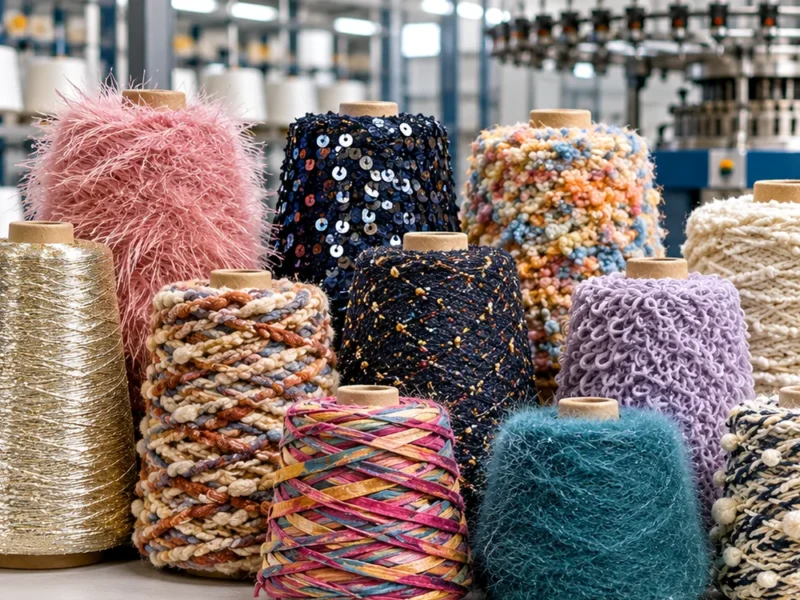
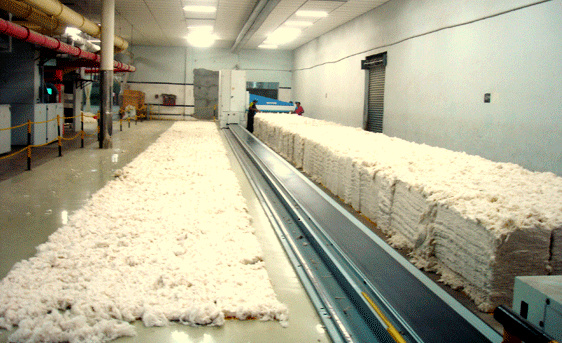
Take a piece of cotton sliver and pull it. It breaks at once, because the fibres simply slide past each other. Now twist the same fibres into a strand and pull again. It holds. That small act of twisting is what turns a loose bundle of fibres into a usable yarn. Twist in yarn is simple to see and hard to master, because the amount you put in changes almost everything about the result.
Twist in yarn affects strength, softness, hairiness, lustre, stretch and even how a knitted T-shirt behaves after washing. Too little twist and the yarn is weak and fluffy. Too much and it becomes hard, harsh and lively, which means it tends to curl and kink. This guide explains what twist is, how it is measured, how the twist multiplier works, what values spinners use for different jobs and how twist connects with production on the ring frame. There is a full worked example with every step calculated. If you would like to review the count system first, our page on calculating English yarn count will help.
What is twist?
Twist is the number of turns given to a yarn along its length. When a bundle of fibres is twisted, the fibres wrap around the yarn axis in a spiral. The spiral squeezes them together and raises the friction between them, so they hold each other when you pull. That is how short fibres, as short as a few centimetres, can form a strong yarn many kilometres long.
Twist is measured as turns per unit length:
- TPI is turns per inch. Used with English count (Ne).
- TPM is turns per metre. Used with tex.
- TPcm is turns per centimetre, used in some systems.
Conversion: 1 TPI = 39.37 TPM, because there are 39.37 inches in a metre. Put the other way, TPM = TPI ÷ 0.0254.
S twist and Z twist
Twist has a direction. The direction is named by the letter that the spiral resembles when you hold the yarn upright.
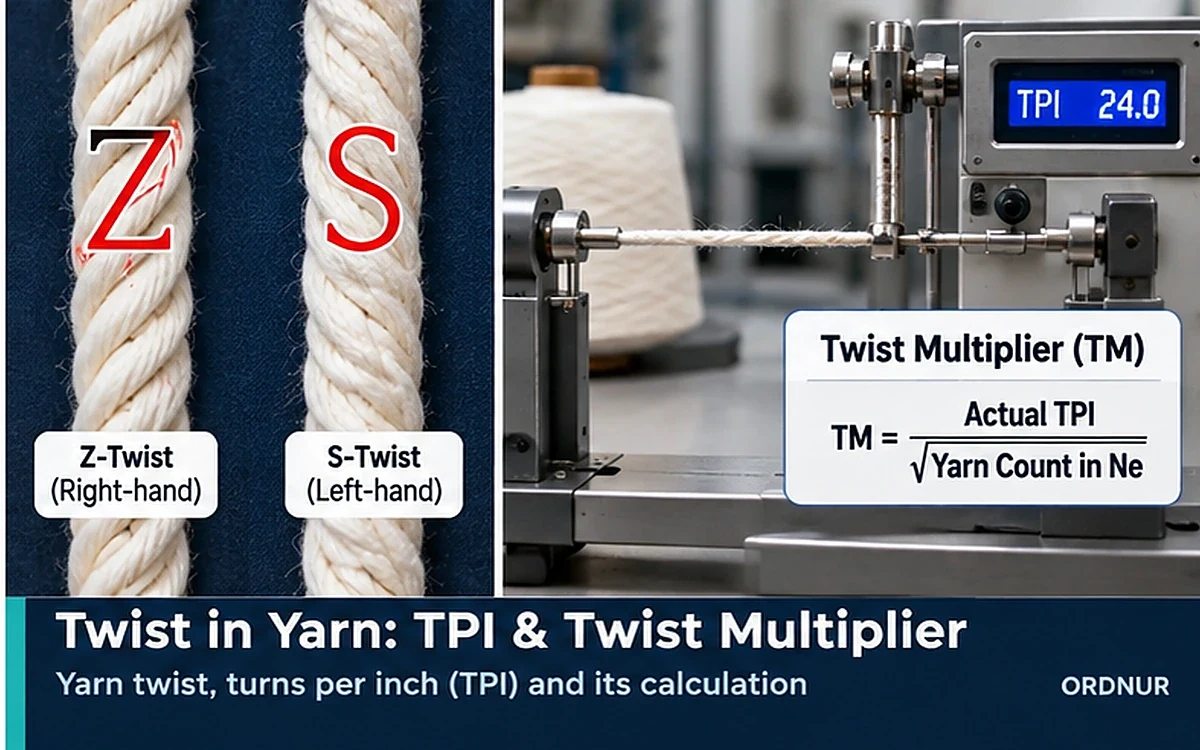
- S twist. The spiral slopes like the middle of the letter S, going up to the left.
- Z twist. The spiral slopes like the middle of the letter Z, going up to the right.
Most single yarns in cotton spinning have Z twist. When two or more yarns are plied together, the ply twist is normally opposite to the single twist, so a Z-twist single is plied with S twist. This is written Z/S. Plying in the opposite direction gives a balanced yarn that does not curl or untwist on its own.
You can check direction by holding a short piece of yarn and looking at the angle of the fibres. If the fibres run upward from left to right, it is Z twist.
Why twist matters
Twist works like a trade-off. It brings several benefits at first, and then it starts to cause problems.
| Property | Low twist | Medium twist | High twist |
|---|---|---|---|
| Strength | Low | Highest near the optimum | Falls after a point |
| Softness | Very soft | Soft to medium | Hard, wiry |
| Hairiness | High | Medium | Low |
| Lustre | Dull | Moderate | Higher in smooth yarns |
| Bulk | High | Medium | Low |
| Elongation | Higher | Medium | Often higher at very high twist |
| Production rate | High | Medium | Low |
| Tendency to curl and snarl | Low | Low | High |
| Typical use | Soft knit yarn, towels | General purpose | Crepe, voile, warp yarns |
Two things explain the strength curve. At first, more twist grips the fibres better, so strength rises. But as twist increases, the fibres lie at a steeper angle to the yarn axis, so less of their strength acts along the pull. At the same time, the outer fibres take more of the load than the inner ones. Past an optimum point, strength drops. Spinners aim for a twist level just below the peak, where strength is good and production is still high.
Twist multiplier: the key idea
A fine yarn needs more turns per inch than a coarse one to have the same feel. If you used the same TPI on a very fine yarn and a very thick one, the fine one would be too hard, or the thick one too soft. To compare yarns fairly, spinners use a number that takes count into account. It is called the twist multiplier (TM), also known as the twist factor or coefficient of twist.
For English cotton count:
TPI = TM × √Ne
and, turned around,
TM = TPI ÷ √Ne
For yarn in tex, a similar factor is used:
TPM = α ÷ √tex
Here α is the tex twist factor, a number around 3,000 to 4,500 for cotton yarns. The two factors are linked. Since tex = 590.5 ÷ Ne, one can show that α is about 957 times the English TM. For example, TM 4.0 equals α of about 3,830.
Why square root? Because twist needed for the same effect grows with the square root of the count, not directly with the count. A yarn four times finer needs only twice the TPI for the same twist level.
Typical twist multiplier values
The following are rough guides for combed and carded cotton yarns in the English system. The best value depends on fibre length, yarn count, spinning system and end use. Spinners fine-tune by trial.
| End use | Typical TM (English) |
|---|---|
| Soft hosiery and baby wear | About 2.8 to 3.2 |
| Knitting yarn for jersey | About 3.2 to 3.8 |
| Weft yarn for weaving | About 3.5 to 4.0 |
| Warp yarn for weaving | About 4.0 to 4.6 |
| Voile and high-twist fabrics | About 5.0 to 6.0 |
| Crepe yarns | 6.0 and above |
Yarn for knitting has lower twist than warp yarn, because knit loops need softness and flexibility, while warp yarn must survive tension and abrasion on the loom. Weft is somewhere in between.
For long-staple fibre such as extra-long cotton, a slightly lower TM can give the same strength, since longer fibres grip over greater lengths. Short fibre needs more twist.
Worked example 1: twist for a knitting yarn
A mill spins 30s Ne combed cotton for single jersey. The target twist multiplier is 3.4.
Step 1: Square root of the count.
√30 = 5.477
Step 2: Turns per inch.
TPI = TM × √Ne = 3.4 × 5.477 = 18.6 TPI
Step 3: Turns per metre.
TPM = 18.6 ÷ 0.0254 = 733 TPM
(You can also multiply: 18.62 × 39.37 = 733.)
Step 4: Check the tex.
tex = 590.5 ÷ 30 = 19.68 tex. The tex twist factor is α = TPM × √tex = 733 × 4.436 = 3,252. Divided by 957, this equals TM 3.4. The figures agree.
Worked example 2: twist for a warp yarn
A weaver needs 40s Ne warp yarn and picks TM 4.2.
- √40 = 6.325
- TPI = 4.2 × 6.325 = 26.6 TPI
- TPM = 26.6 ÷ 0.0254 = 1,046 TPM
The warp yarn is finer and has a higher TM, so it has about 43 percent more turns per inch than the 30s knitting yarn above (26.6 ÷ 18.6 = 1.43). That makes it stiffer and stronger, ready for the loom. You can see how the weave side uses yarn in our guide to the weaving process from yarn to fabric.
Twist and ring frame production
On a ring spinning frame, twist is given by the spindle, and the front rollers deliver the fibre strand. The more turns the spindle makes for each metre delivered, the higher the twist. So:
Twist (TPM) = spindle speed (rpm) ÷ delivery speed (m/min)
This means delivery speed = spindle speed ÷ TPM.
Worked example 3: delivery speed and output
Continue with the 30s yarn, 733 TPM. The spindle speed is 16,000 rpm.
Step 1: Front roller delivery speed.
Delivery = 16,000 ÷ 733 = 21.8 m/min
Step 2: Length per hour per spindle.
21.8 × 60 = 1,309.6 m/h
Step 3: Weight per hour per spindle.
The yarn is 19.68 tex, which is 19.68 g per 1,000 m, or 0.01968 g/m.
Weight = 1,309.6 × 0.01968 = 25.8 g/h (theoretical)
Step 4: Apply an efficiency of 95 percent.
25.8 × 0.95 = 24.5 g/h
For a frame with 1,200 spindles, the output is 24.5 × 1,200 = 29,400 g/h, which is about 29.4 kg/h, or roughly 706 kg in 24 hours, before allowing for twist contraction, stoppages and doffing.
Effect of raising twist
Suppose the TM is raised from 3.4 to 3.8, perhaps for a firmer yarn.
- TPI = 3.8 × 5.477 = 20.8
- TPM = 20.8 ÷ 0.0254 = 819
- Delivery speed = 16,000 ÷ 819 = 19.5 m/min
- Output per spindle = 19.5 × 60 × 0.01968 = 23.0 g/h (theoretical)
Compared with 25.8 g/h, output falls by about 11 percent (25.8 minus 23.0 is 2.8, and 2.8 ÷ 25.8 = 0.108). The extra twist costs production. This is why spinners avoid more twist than needed. For machine details, see our guide on the parts of a ring frame.
(Note: real yarn shortens a little as it is twisted, called twist contraction, and the spinning speed is also limited by traveller speed and yarn tension. The figures show the principle.)
Twist in plied and folded yarns
Plying means twisting two or more single yarns together. For a two-ply yarn made from Z-twist singles, the ply twist is S.
Ply twist is chosen to balance the twist in the singles, and the right level depends on the count, the number of plies and the end use. The resulting yarn is stronger, rounder and more even than a single yarn of the same total count. It is used for sewing thread, upholstery fabric, hand knitting and fine woven goods.
A balanced ply is one that lies straight when a piece is hung freely. If it curls, the ply twist is wrong for the singles.
Twist, spirality and knitted fabrics
Yarn twist affects knitted fabrics in a very practical way. A single yarn with a lot of residual twist wants to untwist. In a knitted loop, that tendency pulls the stitches sideways, so the wales slant. The fabric tube turns, and side seams in a T-shirt spiral around the body after washing. This fault is called spirality or torque.
To reduce it:
- Use yarn with lower and well-set twist, often by steaming the yarn to fix the twist.
- Use compact or ring yarn with balanced structure.
- Choose a knit structure that cancels torque, such as plated or two-ply designs for some uses.
- Compact the fabric and finish well.
Our guide to cotton fabric for T shirts shows how yarn and finishing connect with fit and shrinkage.
Twist in other yarn types
- Rotor (open end) yarn. Twist is inserted by the rotor in the yarn tail. The twist is lower on the yarn surface layers, since wrapper fibres wind around the core. Open end yarns often need more twist for the same strength.
- Air jet yarn. Strength comes mainly from wrapper fibres wound by air jets, not from true twist.
- Fancy yarns. Twist is used to create effects such as spirals and snarls. See our guide to fancy yarns.
- Filament yarns. Some have low twist to hold the filaments, while others, like crepe yarns, have very high twist.
For a comparison of spinning systems, read our page on ring, rotor and air jet yarns.
How twist is measured
Mills test twist on a twist tester.
- A yarn sample of a fixed length, such as 25 cm or 10 inches, is clamped at both ends.
- One clamp rotates to untwist the yarn until the fibres lie parallel.
- The number of turns is counted.
- The count is divided by the length to give TPI or TPM.
The test is repeated on several samples, and the average is reported. Twist is also tested during production to keep the process in control. Related yarn tests, such as count, strength and evenness, are covered in our overview of yarn making from fibre to yarn.
Common twist problems
| Problem | Likely cause | Fix |
|---|---|---|
| Hard, harsh handle | Too much twist | Lower the TM, check count |
| Weak, fluffy yarn | Too little twist | Raise the TM, check fibre quality |
| Snarling and kinks | High residual twist | Steam setting, balance the ply twist |
| Fabric spirality | Torque in single yarn | Lower twist, set the yarn, adjust knit |
| Low production | Twist too high | Reduce to the lowest TM that meets strength |
| Uneven twist | Spindle or traveller issues | Check machine, use the right travellers |
Final thoughts
Twist in yarn is the quiet decision that shapes almost every property of a thread, fabric or garment. It binds fibres together, sets strength and feel, controls hairiness and lustre, affects spirality in knits and ties directly to how many kilograms a spinning frame produces. The twist multiplier lets you compare yarns of different count on equal terms.
Remember the three formulas: TPI = TM × √Ne, TPM = TPI ÷ 0.0254 and delivery speed = spindle speed ÷ TPM. With these you can set twist, check a yarn and estimate output in minutes.
Frequently asked questions
Twist is the number of turns given to a yarn along its length. It makes fibres grip each other so that the yarn holds together and is strong enough to use.
TPI means turns per inch, the number of full twists in one inch of yarn. It is used with English count. TPM, turns per metre, is used with tex.
The twist multiplier (TM) is a number that links twist to yarn count. For English count, TM equals TPI divided by the square root of Ne. It lets you compare the twist of fine and coarse yarns.
They describe the direction of the spiral. In S twist the spiral slopes like the middle of the letter S, and in Z twist like the middle of the letter Z. Most cotton singles have Z twist.
Only up to a point. Strength rises with twist until it reaches an optimum, then falls. Very high twist also makes yarn hard and lowers production.
High residual twist in single yarns pulls the knitted loops sideways, which causes spirality. Lower twist, well-set yarn, compacting and good finishing reduce it.
Multiply the twist multiplier by the square root of the English count. For example, 30s Ne with a TM of 3.4 gives 3.4 × 5.477, which is about 18.6 TPI.