Ask a new line supervisor which machine handles which operation, and the honest answer is usually “whatever we’ve always used for that.” That works fine until a new style comes in that doesn’t fit the old pattern, and suddenly a seam that should have gone to flatlock is running on overlock because that’s what the operator nearest the bundle happens to run. Getting the assignment right isn’t complicated once the underlying stitch mechanics are clear, and getting it wrong shows up later as seam failure, excess bulk, or a finish that doesn’t match the product category’s expectations.
Lockstitch: The Default for Structured Seams
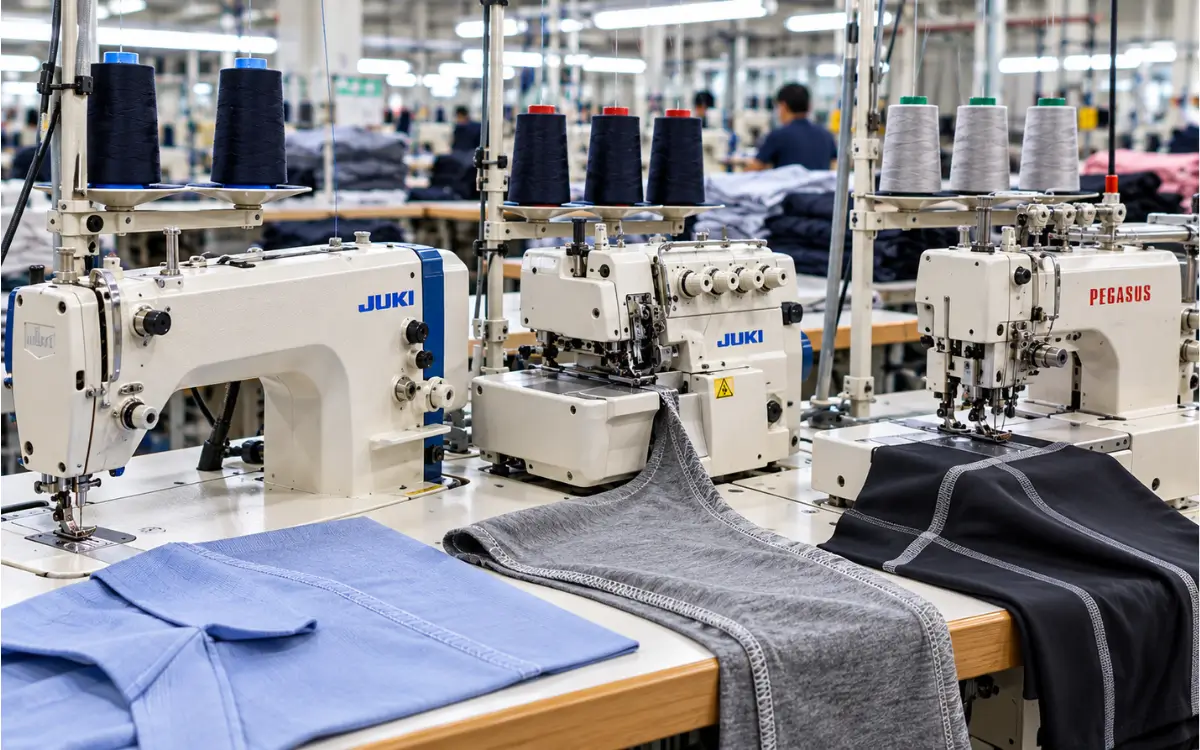
A lockstitch machine forms its stitch by interlocking a top thread and a bottom bobbin thread, producing the stitch most people picture when they think of a straight sewn seam. It’s the workhorse for structured, woven garment construction, and breakdown of single needle lockstitch machine features covers the mechanism in more technical detail: side seams on shirts and trousers, topstitching, and any operation where a clean, flat straight seam matters more than seam stretch.
Lockstitch, formally stitch class 301, doesn’t stretch. That’s a strength for wovens, where the fabric itself doesn’t stretch either, and a liability on knits, where a non-stretch seam on a stretch fabric becomes the first thing to fail under tension. Using lockstitch on a knit seam that needs to move with the body is one of the more common mismatches new factories make, usually inherited from operators trained primarily on woven construction.
Overlock: Edge Finishing and Knit Seams
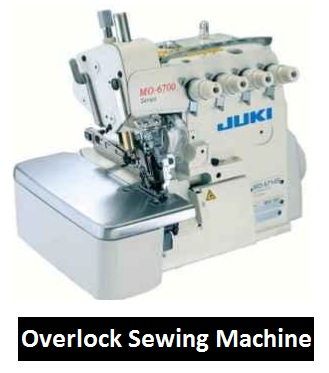
Overlock machines, sometimes called sergers outside industrial settings, and covered in more technical depth in overlock machine types and adjustment guide, trim the raw fabric edge and finish it with an interlocking thread structure in a single pass. That combination, trimming and finishing together, is what makes overlock the standard choice for knit garment seams, where both seam construction and raw edge finishing need to happen without adding a separate step.
Overlock machines come in several thread configurations, and the count matters for the operation. A 3-thread overlock finishes an edge without joining two fabric pieces, common for hemming knit fabric. A 4-thread or 5-thread overlock (stitch classes 504 and 401 depending on configuration) both joins a seam and finishes the edge, which is why 4-thread overlock is the default for actually constructing knit garment seams rather than just finishing an edge. Using a 3-thread machine where a 4-thread was needed produces a seam that finishes cleanly but doesn’t hold construction tension the way the garment needs.
Flatlock: Low-Bulk Seams for Skin-Adjacent Fabric
Flatlock machines produce a seam that lies flat against the fabric rather than creating a raised seam allowance, which is exactly why they dominate activewear, underwear, and any garment where a raised seam would cause chafing against skin during movement. The stitch class most associated with flatlock construction is 605 or 607, depending on thread count and coverage.
The trade-off for that flat profile is seam strength relative to overlock. Flatlock seams generally hold up well under the kind of stress activewear is designed for, but they’re not typically the right choice for structural seams carrying heavy load, like a waistband join on tailored trousers, where a stronger, bulkier seam is the better trade.
Needle and Thread Considerations Across the Three Types
Machine type isn’t the only variable that needs to match the operation. Needle size and thread type both need to be selected against the specific fabric weight and construction, and a factory that standardizes needle and thread choice purely by machine type, rather than by the fabric and operation running through it, tends to see more skipped stitches and thread breakage than one that adjusts these two variables job by job. Lockstitch operations on heavier woven fabric generally need a heavier needle and stronger thread than the same machine running a lightweight lining fabric. Overlock and flatlock, given their typically higher stitch speed and the multiple thread paths involved, are particularly sensitive to thread quality, since a lower-grade thread prone to breaking or shedding lint causes disproportionately more downtime on these machine types than on a simpler lockstitch operation.
Where Factories Commonly Get the Assignment Wrong
Running knit seams on lockstitch machines because the sewing floor has more lockstitch capacity available than overlock capacity at that moment. The seam looks fine off the machine and fails after the first few wears once tension reveals the non-stretch thread can’t move with the fabric.
Using flatlock for every “athletic-adjacent” garment regardless of where the seam actually sits on the body. A flatlock seam makes sense where skin contact and movement both matter. It’s not automatically the right choice for every seam on a technical garment, some of which still benefit from overlock’s stronger construction.
Underestimating how much thread configuration matters within overlock itself. Treating “overlock” as a single category rather than distinguishing 3-thread from 4-thread and 5-thread configurations leads to machines being assigned by availability rather than by what the specific seam actually needs.
Matching Machine to Operation: A Quick Reference
| Operation | Typical Machine | Why |
|---|---|---|
| Woven side seams, topstitching | Lockstitch (301) | Clean flat seam, no stretch needed |
| Knit garment seaming | Overlock, 4-thread (401/504) | Trims and finishes in one pass, some stretch |
| Knit edge finishing only | Overlock, 3-thread | Finishes edge without joining fabric |
| Activewear, underwear seams | Flatlock (605/607) | Low bulk, lies flat against skin |
| Structural seams under load | Lockstitch or heavy overlock | Seam strength over stretch |
Working Through a Full Garment’s Machine Assignment
Take a basic crew-neck knit t-shirt as an example, and walk through how its operations would actually get assigned across these three machine types. Shoulder seams typically run on 4-thread overlock, since they need both construction strength and edge finishing on a knit fabric that will see real stress at that seam. Side seams follow the same logic, 4-thread overlock again. Sleeve and neckline hems, where the fabric folds under and needs a clean, low-bulk finish that lies flat against skin, are classic flatlock territory. The neckline’s own seam, joining a ribbed collar to the body, often runs on flatlock as well for the same low-bulk, skin-contact reasoning. Topstitching, if the style calls for it around the neckline or hem for a branded look, runs on lockstitch, since it’s a decorative, non-stretch operation sitting on top of fabric that’s already been joined elsewhere.
Notice that a single simple garment touches all three machine types, which is exactly why a factory specializing in knitwear still needs meaningful lockstitch capacity for topstitching and detail work, not just overlock and flatlock, even though the bulk of construction seams on that garment run through the latter two.
Building the Right Machine Ratio for Your Product
The practical takeaway isn’t that one machine type is better than another. It’s that the right ratio of lockstitch to overlock to flatlock machines on a sewing floor depends entirely on the product mix running through it. A factory making mostly structured wovens needs a sewing floor weighted heavily toward lockstitch, with overlock present mainly for internal seam finishing. A factory making athletic knitwear needs the opposite balance, with flatlock representing a meaningful share of total machines rather than a handful set aside for occasional use.
Getting this ratio wrong doesn’t just waste capital on the wrong machine type. It creates bottlenecks on whichever machine type is undersupplied relative to what the actual product mix demands, which is exactly the kind of imbalance the machine requirement calculation method covered in a related guide is built to catch before it becomes a production problem.
Frequently Asked Questions
Can overlock machines replace lockstitch machines entirely?
No. Overlock trims and finishes edges but doesn’t produce the flat, non-stretch seam that structured woven construction and topstitching need, so most factories need real capacity in both machine types regardless of product focus.
Why does a knit t-shirt need lockstitch machines at all?
Mostly for topstitching and decorative detail work, as the worked garment example in this article shows. Even knit-focused factories typically need some lockstitch capacity for these operations.
What’s the difference between 3-thread and 4-thread overlock?
A 3-thread overlock finishes a raw edge without joining fabric, useful for hemming. A 4-thread overlock both joins two fabric pieces and finishes the edge, making it the standard choice for actual knit seam construction.
Is flatlock always better for activewear seams?
Not for every seam. Flatlock’s flat, low-bulk profile suits skin-contact seams well, but it’s generally not as strong as overlock for structural seams carrying heavier load, so the right choice depends on where on the garment the seam actually sits.