
Standard Minute Value (SMV) is the time, in minutes, that a trained operator needs to complete a task at a normal working pace, including allowances for rest and delays. Industrial engineers measure it by time study, then use it to set production targets, measure efficiency and calculate the cost of making a garment. SMV and SAM (Standard Allowed Minute) mean the same thing in most factories; both are basic time plus allowances. SMV differs by style, fabric, machine and method, so the same shirt can have different SMVs in two factories.

Standard Minute Value: SMV in Garments, Calculation, Importance
Industrial Engineering is concerned with the design, improvement, and installation of an integrated system of men, machinery, and materials. SMV is one of the most important tools used by IE.
The Main Objective of Industrial Engineering
- To Increase Productivity
- To eliminate waste and non-value-added activities
- To come up with the optimum use of scarce resources that would bring out the best results.
Importance of SMV in the Apparel Industry
The reason why we use these are given below:
- SMV is calculated for doing cost of garments
- It is used for the calculation of target and setting the right target
- To calculate the efficiency of workers
- SMV is calculated for making a plan and take effective factory production decisions.
For Calculating SMV – Standard Minute Value in Garments you must have a proper idea of the machine operating procedure and working process of workers. Close observation by an Industrial Engineer is required to calculate the right SMV for a particular product or style in your factory.
Basically, SMV is the sum of the basic time requirement and allowance applicable to it. Normally allowance is given at the rate of 10% based on efficiency.
Formulas of Calculating SMV
- Observed time = total of the observed cycle times ÷ number of cycles
- Basic time = observed time × rating (rating as a decimal: 90% = 0.90)
- SMV (= SAM) = basic time × (1 + allowance), for example × 1.10 for 10% allowance
- Garment SMV = sum of the SMVs of all its operations
- Costing SMV for buyers = SMV × 1.05 (a 5% uplift many factories add; confirm your own policy)
Calculation of SMV in Garments
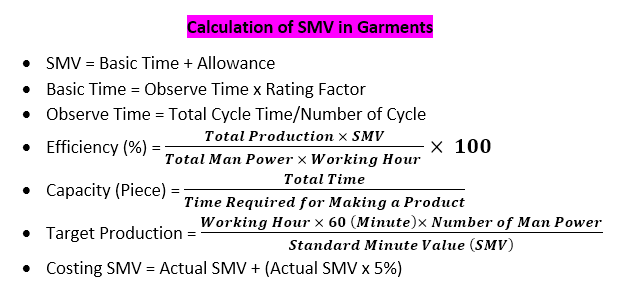
SMV = (Basic Time + Allocated Allowance)
The formula of Basic Time = Observe Time x Rating Factor
Basic Time
Basic time is the most likely time required to make garments considering observed time and applicable rating factors.
Observe Time
Time is taken to do work when an observer is observing closely and recording the worker’s work speed.
Calculation of Observe Time = Total Cycle Time is divided by the Number of Cycles
Cycle Time
Cycle Time is the time between starting a garment manufacturing and finishing those garments.
Rating Factor
The rating factor is assigned based on an evaluation of worker performance which is conducted through eye judgment. A worker can be fast, or slow and the rating is on a scale of 100% to lower.
Costing SMV is calculated for sending SMV information to buyers. Normally 5% additional time is added to the actual SMV.
Costing SMV = Actual SMV + (Actual SMV x 5%)
Time study of one operation
Operation: join shoulder seams of a polo shirt. A stopwatch observer times 10 cycles.
| Cycle | 1 | 2 | 3 | 4 | 5 | 6 | 7 | 8 | 9 | 10 | Total |
|---|---|---|---|---|---|---|---|---|---|---|---|
| Time (seconds) | 24 | 26 | 25 | 23 | 27 | 25 | 24 | 26 | 25 | 25 | 250 |
| Step | Calculation | Result |
|---|---|---|
| Observed time | 250 s ÷ 10 cycles | 25 s = 0.417 min |
| Rating | Operator is slightly slower than normal | 90% |
| Basic time | 25 s × 0.90 | 22.5 s = 0.375 min |
| Allowance | Personal needs, fatigue and delay | 12% |
| SMV (= SAM) | 0.375 × 1.12 | 0.42 min |
| Hourly target at 100% efficiency | 60 ÷ 0.42 | 143 pieces |
| Hourly target at 80% efficiency | 143 × 0.80 | 114 pieces |
Allowance table (label it “illustrative; use your own factory study”)
| Allowance | Typical share of basic time |
|---|---|
| Personal needs | 5% |
| Fatigue | 3% |
| Delay and machine or bundle handling | 4% |
| Total used in the example above | 12% |
The existing article uses a flat 10%. Say that the share differs by factory, operation and working conditions, and that these figures are examples, not a standard.
Example of Calculation of SMV in Garments
Suppose for making a product the following assumption is there
- Observe Time = 25 Minutes
- Rating of Operator = 80%
- Considering Allowance = 10%
- Basic Time = 25minutes x 80% = 20 minutes
- Allowance = 20 x 10% = 2 Minute
So, SMV = 20 minutes + 2 minutes = 22 minutes for making a particular garments product
Calculation of Capacity of Single Operator in Garments
- If an operator works for 10 hours a day
- 30 minutes to make a product
Capacity = (1 operator x 10 hours x 60 minutes)/30 Minutes = 20 Pieces of Garments by an operator
If you assign 100 operators then your capacity will be = 100 operators x 20 pieces = 2000 pieces a day
Calculation of Efficiency Percent
- SMV 22 Minutes
- Working Hours 10 a Day
- Number of Operators 100 person
- Actual Production 2000 pieces
Efficiency (%) = (2000 pieces x 22 minute)/(100 operators x 10 hours x 60 minutes) x 100 = 73.33%
whereas,
Target = (10 hours x 60 minutes x 100 operators)/smv 22 minutes = 2727 Pieces of garments
Standard Allowed Minute (SAM) in Garments and Formulas
Standard Allowed Minute (SAM) is the standard time needed to complete a garment operation at a normal working pace, including allowances for personal needs, fatigue, and unavoidable delays.
SAM is also called Standard Minute Value (SMV) in the garment industry. Factories use it to plan production, calculate line efficiency, estimate labour costs, and determine machine and operator requirements.
SAM Formula
The standard formula is:
SAM = Basic Time + Allowance Time
First, calculate the basic time:
Basic Time = Observed Time × (Performance Rating ÷ 100)
Next, calculate the allowance:
Allowance Time = Basic Time × (Allowance % ÷ 100)
Therefore, the complete formula is:
SAM = Observed Time × (Performance Rating ÷ 100) × (1 + Allowance % ÷ 100)
This formula assumes that the allowance is calculated as a percentage of basic time.
Important Terms Used in SAM Calculation
1. Observed Time
Observed time is the actual time recorded while a worker completes an operation. It is usually measured through a time study using a stopwatch or another time-measuring tool.
2. Performance Rating
Performance rating compares the worker’s speed with the standard working pace.
- 100% means the worker performs at the standard pace.
- 120% means the worker performs 20% faster than the standard pace.
- 80% means the worker performs 20% slower than the standard pace.
The rating helps convert observed time into basic time.
3. Allowance Percentage
An allowance adds time for personal needs, fatigue, and unavoidable delays.
For example, a 10% allowance means adding 10% of the basic time to calculate SAM.
Example of SAM Calculation in Garments
Suppose a sewing operator completes a garment operation under the following conditions:
- Observed Time: 15 minutes
- Performance Rating: 120%
- Allowance: 10%
Step 1: Calculate Basic Time
Basic Time = Observed Time × (Performance Rating ÷ 100)
= 15 × (120 ÷ 100)
= 15 × 1.20
= 18 minutes
Step 2: Calculate Allowance Time
Allowance Time = Basic Time × (Allowance ÷ 100)
= 18 × (10 ÷ 100)
= 18 × 0.10
= 1.8 minutes
Step 3: Calculate Standard Allowed Minute (SAM)
SAM = Basic Time + Allowance Time
= 18 + 1.8
= 19.8 minutes
Alternatively, using the complete formula:
SAM = 15 × 1.20 × 1.10
= 19.8 minutes
Final Result
The Standard Allowed Minute (SAM) for this sewing operation is 19.8 minutes per piece.
This means that a trained operator working at the standard pace of 100%, with a 10% allowance included, is allowed 19.8 minutes to complete the operation.
Although the observed time was only 15 minutes, the operator worked at 120% of the standard pace. After adjusting for performance and adding allowances, the calculated SAM becomes 19.8 minutes.
Why SAM Calculation Is Important in Garment Manufacturing
An accurate SAM helps garment factories:
- Set realistic daily production targets.
- Calculate operator and sewing line efficiency.
- Estimate the number of operators required.
- Calculate labour costs per garment.
- Balance production lines and identify bottlenecks.
- Plan production capacity and delivery schedules.
Important Note: Always check how the factory defines allowances. The calculation above uses allowances as a percentage of basic time. If allowances are defined as a percentage of total allowed time, a different formula is required. Consistent methods are essential for accurate production planning.
SMV of Different Garments Manufacturing
- Men’s Long Sleeve Shirt is 23.15
- 5 Pockets Long Pant is 20.14
- T-Shirt is 8.41
- Cargo Pant is 36.28
- Polo Shirt is 10.39
- Trouser is 8.13
- Chino Short Pant is 37.42
- Cargo Short Pant with Bone Pocket is 31.92
- Cargo Short Pant without Bone Pocket is 24.06
- Cargo Crop Pant is 30.74
- Men’s Chino Pant is 24.15
- Nano Chino Pant is 28.93
- Leggings is 4.64
- Blouse Manufacturing is 4.73
- Hoodies Manufacturing is 15.99
- Jogger is 19.61
- Lingerie is 4.52
- Shimmer Dress is 17.60
- Ladies Overall is 32.93
- Kids Overall Hoodie is 21.60
- Brooke Short Pant is 9.32
- Brooke Skirt is 7.90
- Brooke Hoodies is 15.66
- Cody is 28.14
- Chino Pant is 36.86
- Blazer is 21.85
- Shirt Manufacturing is 33.84
- Jacket Manufacturing is 44.97
- Garments (Pant) Finishing Process is 9.05
Hopefully, you understand what is Standard Minute Value and how you can calculate it. If you have any confusion then please let me know. I will try to clarify further in detail.
FAQ
What is SMV in garments?
SMV, or Standard Minute Value, is the time in minutes a trained operator needs to finish a task at normal pace, including allowances.
What is the difference between SMV and SAM?
In most factories there is none. Both are basic time plus allowances. Some companies keep SAM for the operation and SMV for the whole garment, so state which your factory uses.
How do you calculate SMV?
Average the observed cycle times, multiply by the rating to get basic time, then multiply by 1 plus the allowance.
What is a normal allowance in SMV?
It depends on the factory and operation. Examples range from about 10% to 15%, made up of personal needs, fatigue and delays.
How do you calculate production target from SMV?
Target = (operators × working minutes × efficiency) ÷ SMV.
Written by
Garments Business Analyst

Nice 😎👍 and Good Cool
It is very important, thank you.
You’re the best of best.
Awesome.
Nice to know SMV- good work/thanks
Thanks
excellent work
VERY INFORMATIVE,GOOD WORK ALSO
Good article, the smv for trousers looks a bit low.
thanks for your valuable feedback
I work in the field of production in Romania
How can we cooperate in the field of Operation Breakdown, SMV and Layout
Hello Dear,
Can you plz give a clear notion about the SMV for sweater/Heavy Knit?
Thanks in advance.
What is number of cycle, when calculating Observe time? Please reply this
Hello sir
Pls kindly advise SMV and line layout for PU Jacket, thank you so much .
Hi there, I came across your article and I just wanted to say how much I enjoyed reading it.