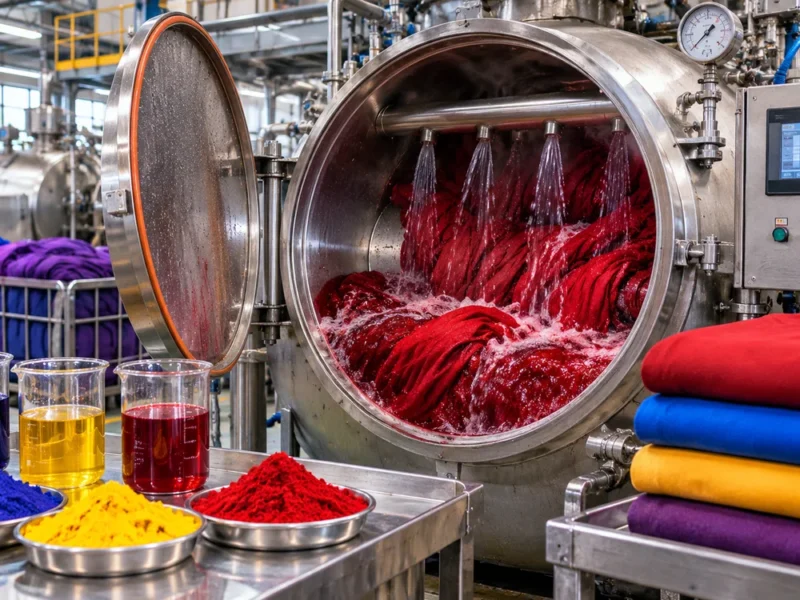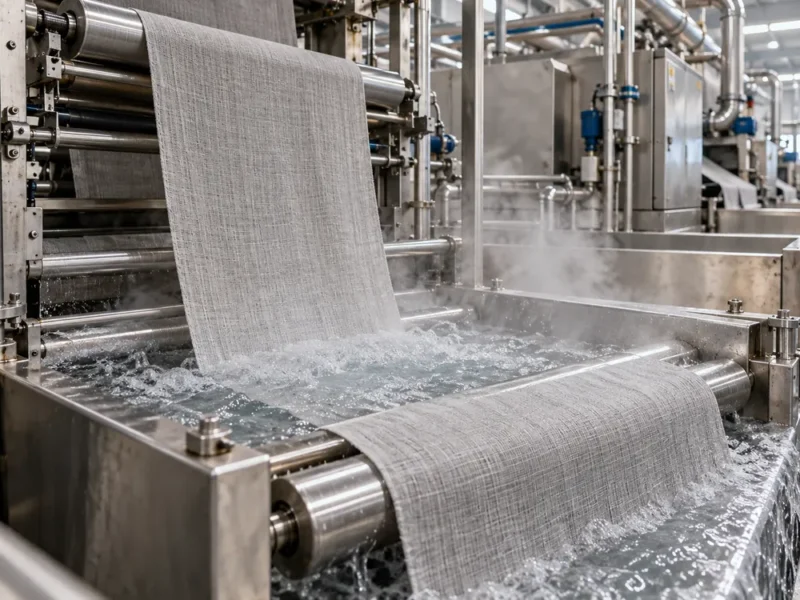
Two pieces of fabric can leave the weaving or knitting machine looking nearly the same. One feels stiff and dull. The other feels smooth and soft. The difference often comes from the last stage of the process, where textile finishes are applied. Finishing is what turns a plain, rough fabric into something a customer wants to wear.
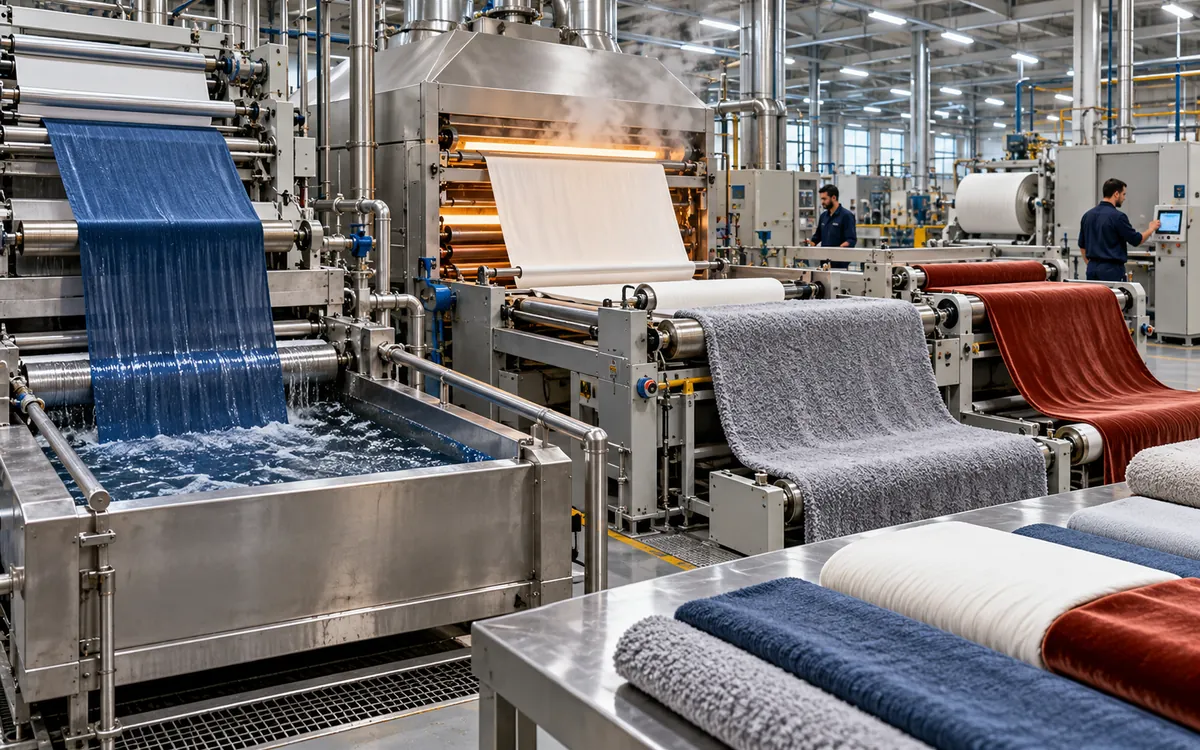
This guide explains the main textile finishes in plain language. It covers mechanical finishes, which change the fabric by physical action, and chemical finishes, which change it with treatments. For each one, you will see what it does, how it is done and where it is used. If you want to see where finishing sits in the full wet processing chain, our overview of wet processing is a good starting point.
What finishing is
Finishing is the group of treatments applied to fabric after it has been woven or knitted and, in most cases, after it has been dyed or printed. Its purpose is to improve the look, feel or performance of the fabric.
A finish can:
- Change the hand, meaning how the fabric feels.
- Change the appearance, such as luster or surface texture.
- Improve stability, for example by reducing shrinkage.
- Add a function, such as water repellency or flame resistance.
Finishes are grouped into two main families.
| Family | How it works | Examples |
|---|---|---|
| Mechanical (physical) | Uses machines, heat, pressure or friction | Calendering, raising, sanforizing, heat setting |
| Chemical | Uses chemicals applied to the fabric | Softening, resin finishing, water repellent, flame retardant |
Many fabrics get both kinds. A cotton shirting fabric might be mercerized (chemical), softened (chemical), stentered (mechanical) and sanforized (mechanical).
Mechanical finishes
Stentering and heat setting
A stenter, also known as a tenter frame, holds the fabric by its edges with pins or clips, stretches it to the right width and passes it through a hot oven. This sets the width, dries the fabric and corrects distortion in the weave or knit. For synthetic fabrics like polyester and nylon, the same machine is used to heat set the fabric. Heat setting locks the shape, so the fabric does not wrinkle or shrink later. Read more in our guides on stenter machines for textile finishing and stenter machine functions and settings.
Calendering
Calendering passes the fabric between heavy rollers, often heated, under pressure. The result depends on the roller setup.
- Plain calendering: Gives a smooth, flat surface.
- Glazing: Gives a polished shine, often with a starch or resin applied first.
- Embossing: The roller carries a pattern, which is pressed into the fabric.
- Moire: Two layers are pressed together to create a watered pattern. See our guide on moire fabric.
- Schreiner finish: Fine lines on the roller create a soft luster.
Compacting and compressive shrinkage
Knit fabric is stretched in knitting, so it tends to shrink after washing. A compactor pushes the fabric forward slightly, so the loops are packed closer. This reduces the shrinkage that happens later. For woven fabric, a similar process is called sanforizing, where the fabric is pressed against a rubber blanket that is stretched and then relaxed. Both processes lower shrinkage. Our guide on the compactor and calender machine for knit finishing goes into detail.
Raising (napping)
Raising pulls fibers from the surface to make a soft, fuzzy layer. The fabric passes over rollers covered with wire teeth or fine card clothing. Flannel, fleece and blankets are raised. Fabric weight and fiber type influence the result. Raised fabric traps more air, so it feels warmer.
Shearing and cropping
After raising, the surface can be cut level by a shearing machine, which works like a lawn mower. Shearing gives a smooth, even pile. It is also used to remove stray fibers from the surface.
Sueding, emerizing and sanding
Sueding rubs the fabric against rollers coated with abrasive material, such as emery. It breaks up the surface fibers to give a soft, suede-like touch, often called peach skin. It is common on microfiber and cotton twill.
Brushing
Brushing uses revolving brushes to lift and smooth the surface. It is lighter than raising and gives a soft feel.
Singeing
Singeing burns off loose surface fibers using gas flames or hot plates, passing the fabric very quickly. It gives a smooth, clean surface that takes dyes and prints well, and it reduces pilling. See our guides on gas singeing and the classification of singeing.
Tumbling and softening by machine
A tumble finish drops the fabric in a hot air stream inside a rotating drum. It relaxes the fabric and softens it without chemicals. Some mills use it on denim and knit fabric to give a lived-in feel.
Heat setting
For synthetics, heat setting is the mechanical finish that gives dimensional stability. The fabric is heated to a set temperature for a set time. The temperature depends on the fiber, and an error can damage the fabric. Always follow the supplier’s guidance.
Chemical finishes
Softening
Softeners are chemicals applied to fabric to give a smooth, silky hand. They coat the fiber surface and reduce friction. There are different types, including cationic, nonionic, anionic and silicone softeners. Each has strengths and limits, such as effects on color, water absorption and cost. Our guide on textile softener types comparison explains the differences.
Resin finishing (easy care)
Cotton wrinkles easily. Resin finishing treats cotton with cross-linking chemicals that hold the cellulose chains together, so the fabric resists wrinkles and recovers faster. It is used on shirts and trousers sold as wrinkle-free or non-iron. The fabric is padded with the resin, dried and then cured in an oven. Care is needed because poor control can reduce fabric strength, and some older resin chemistries release formaldehyde. Buyers set limits on free formaldehyde, so test results are important.
Mercerizing
Mercerizing treats cotton with strong caustic soda while it is held under tension. The fibers swell and become rounder, which increases luster, dye uptake and strength. Mercerized cotton looks smoother and richer in color. It is used for premium shirts and polo fabric. The process needs good washing to remove the alkali.
Water repellent finish
A water repellent finish makes water bead up and roll off the surface. Traditionally, fluorine-based chemicals, known as PFAS, were used. Because of environmental and health concerns, regulations and brands are moving to PFAS-free alternatives based on silicone, wax or special polymers. Our guide on PFAS-free water repellent textile finishes covers the options and trade-offs. Always check the current rules in your target market.
Flame retardant finish
Flame retardant treatments make fabrics slow to ignite and slow to burn. They are required for items such as workwear for certain industries, curtains and children’s sleepwear in some markets. Some fibers, like aramid, are naturally flame resistant. Others get a chemical finish. These treatments must meet legal standards, and the tests are strict.
Antimicrobial finish
Antimicrobial finishes reduce the growth of bacteria or fungus on fabric. They are used in sportswear, socks, hospital textiles and home furnishing. Claims should be supported by lab tests, and the chemical used should meet local safety rules.
Soil release and stain repellent
These finishes make it easier to wash out stains or help the fabric resist them. They are used on uniforms, tablecloths and workwear. Soil release finishes help water wet the fabric surface so detergent can remove oil.
Anti-pilling
Pilling happens when short fibers tangle into small balls. Anti-pilling treatments include singeing, enzyme polishing and certain resins. They reduce pilling on knit fabrics, especially blends.
Enzyme finishing and bio-polishing
Enzymes, particularly cellulase, can remove tiny surface fibers from cotton and viscose. This gives a cleaner, smoother surface and reduces pilling. It is also used on denim to create worn looks. Our guide on enzymes in textile processing explains how they work.
Optical brightening
Optical brightening agents (OBAs) absorb ultraviolet light and re-emit it as blue light, which makes white fabric look whiter. They are used on white and pastel fabrics. They do not remove stains. They only change how the eye sees the color.
Stiffening and sizing finishes
Starch, resin and polymers can be applied to give fabric a firm, crisp hand. This is used on collars, canvas and some home textiles.
Coating and laminating
Coatings apply a layer of polymer, such as polyurethane or PVC, to the surface of the fabric. They make the fabric waterproof or wind resistant. Laminating bonds a film or membrane to the fabric. Waterproof breathable jackets often use laminated membranes.
Comparing the main finishes
| Finish | Type | Main effect | Typical fabric |
|---|---|---|---|
| Stentering | Mechanical | Width and dimensional control | All |
| Calendering | Mechanical | Smooth or glossy surface | Cotton, synthetics |
| Compacting | Mechanical | Reduced shrinkage | Knits |
| Sanforizing | Mechanical | Reduced shrinkage | Woven cotton |
| Raising | Mechanical | Soft nap | Fleece, flannel |
| Sueding | Mechanical | Peach-skin feel | Microfiber, twill |
| Singeing | Mechanical | Clean surface | Cotton, blends |
| Softening | Chemical | Soft hand | All |
| Resin finish | Chemical | Wrinkle resistance | Cotton shirting |
| Mercerizing | Chemical | Luster and strength | Cotton |
| Water repellent | Chemical | Beads water | Outerwear |
| Flame retardant | Chemical | Slows burning | Workwear, curtains |
| Antimicrobial | Chemical | Reduces microbes | Sportswear |
| Enzyme polish | Chemical (bio) | Smooth surface | Cotton, viscose |
How finishes are applied
Chemical finishes use a few standard methods.
- Padding: The fabric passes through a bath of the chemical, then through squeeze rollers. The amount left on the fabric is called wet pick-up. After padding, the fabric is dried and often cured.
- Exhaust: The chemical is added to a dyeing machine, and it moves from the bath onto the fabric over time. Common for softeners on knits.
- Spray: Chemical is sprayed on the surface. Used for specialty finishes.
- Coating: A paste is applied with a knife or roller.
- Foam: The chemical is applied as a foam to use less water.
The right method depends on fabric, chemical and machine. Control of concentration, temperature, pH and speed matters for repeatable results.
Quality and compliance
Finishes can create quality problems if not controlled. Common issues include:
- Uneven application: Patchy softness or water repellency.
- Yellowing: Some softeners and resins yellow white fabrics.
- Odor: From residual chemicals.
- Loss of strength: From aggressive resins or poor curing.
- Reduced absorbency: Silicone and fluorine finishes repel water.
- Shade change: Some finishes alter dyed color.
- Rub fastness: Finishes can affect color fastness.
Buyers also set rules about restricted substances. Many follow lists such as ZDHC’s manufacturing restricted substances list. Our guide on ZDHC MRSL compliance shows how to approach this. For chemical choices in wet processing generally, see our guides on textile chemicals in wet processing and textile pretreatment chemicals.
Choosing a finish
Ask these questions.
- What does the end user need? Softness, wrinkle resistance, water protection or something else?
- What fiber is the fabric made of? Finishes work differently on cotton, polyester and blends.
- What does the buyer allow? Check restricted substance lists and test requirements.
- What machines do we have? Not every plant has a stenter, a compactor or a coating line.
- What does it cost? Include chemical, energy, water and time.
- How will we test? Plan tests for strength, shrinkage, hand feel and function.
Final thoughts
Finishing is where fabric gets its final character. Mechanical finishes adjust the structure and surface, while chemical finishes add feel and function. A good finishing plan matches the fiber, the end use and the buyer’s rules, and it controls the process tightly. When a fabric feels wrong, looks dull or fails a test, look at the finishing sequence first. It is often where the cause lies, and where the fix is cheapest.
Frequently asked questions
Textile finishes are treatments applied to fabric to improve its look, feel or performance. They can be mechanical, like calendering, or chemical, like softening.
Mechanical finishing uses machines, heat, pressure or friction. Chemical finishing applies chemicals to the fabric.
Mercerizing treats cotton with caustic soda under tension. It makes the fabric lustrous, stronger and better at taking dye.
Sanforizing is a process that reduces the shrinkage of woven cotton by compressing the fabric in the length direction before sale.
PFAS chemicals persist in the environment and raise health concerns, so laws and brands are moving to alternatives. Check current regulations for your markets.
Calendering passes fabric through heated rollers to give a smooth surface, a glossy finish or an embossed pattern.
Yes. Most fabrics get several, in a planned order. Some finishes can clash, so test the combination first.