A garment that shrinks unevenly after its first wash, twisting slightly at the seams even though it started perfectly square on the cutting table, usually has a story that traces back to the stenter. It’s one of the less glamorous machines in a finishing line, but few single settings decisions have as much downstream effect on a garment’s dimensional behavior as how correctly a stenter was run on that fabric.
What a Stenter Actually Does
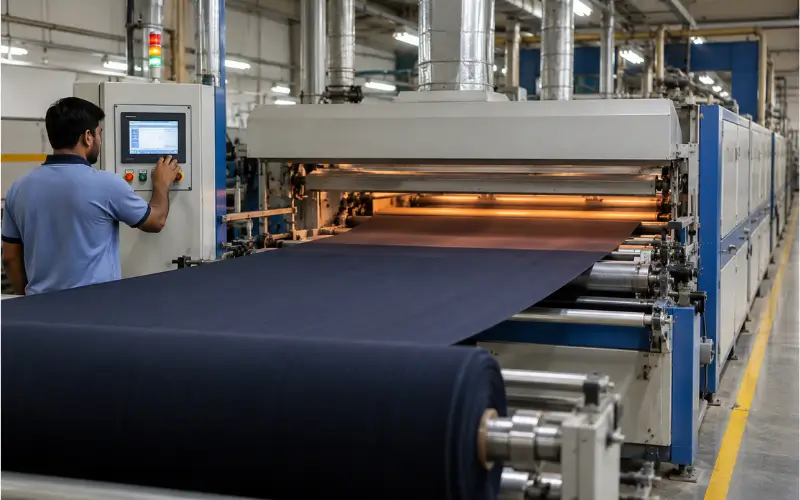
This machine has been covered from two angles worth reading alongside this article: stenter machine functions and stenter machines for textile finishing. A stenter pulls fabric through a heated chamber while gripping both selvedges with pins or clips mounted on continuously moving chains, stretching the fabric to a controlled, precise width and applying heat to set that dimension into the fabric structure. This heat-setting function is what gives finished fabric its dimensional stability, reducing how much the fabric will shrink or distort once it becomes a garment and goes through repeated washing.
Key Stenter Parts and Their Function
The pin or clip chains running along both sides of the machine grip the fabric selvedge and control both the fabric’s width as it moves through the chamber and its forward speed. The heating chamber, typically divided into multiple independently controlled zones, applies heat through hot air circulation, with zone-by-zone temperature control allowing a gradual heat profile rather than a single abrupt temperature jump. A padder mangle, positioned before the stenter chamber in many finishing lines, applies finishing chemistry evenly to the fabric before it enters the heat-setting chamber, meaning padder and stenter settings need to be coordinated rather than treated as fully independent steps.
Setting Chamber Temperature
Chamber temperature needs to match the specific fiber and finish being applied, since different fibers have different heat sensitivity and different finishing chemistry activates or cures at different temperatures. Running temperature too low fails to properly heat-set the fabric, leaving poor dimensional stability that shows up as excessive shrinkage later. Running temperature too high risks fiber damage, particularly on heat-sensitive synthetics, and can also affect shade on dyed fabric, since excessive heat can cause shade shift or sublimation issues on certain dye and fiber combinations.
Setting Overfeed
Overfeed refers to feeding fabric into the stenter chamber slightly faster than the chain speed pulls it through, creating a small amount of fabric slack that allows the fabric to shrink naturally in the length direction during heat setting rather than being held under tension it will simply pull back against once removed from the machine. Getting overfeed wrong in either direction creates problems: too little overfeed leaves the fabric under residual tension that releases as shrinkage after the garment is finished and washed, while too much overfeed can create unevenness or handling problems as the fabric moves through the chamber.
Setting Line Speed
Line speed determines how long the fabric actually spends in the heated chamber (dwell time), which needs to be balanced against chamber temperature to achieve the intended heat-setting effect. A faster line speed with the same chamber temperature reduces effective dwell time and can under-set the fabric, while a slower line speed increases dwell time and, if not compensated with a temperature adjustment, can over-process the fabric. Line speed, temperature, and overfeed function as an interconnected system rather than three settings that can be optimized independently of each other.
Bowing: A Common and Costly Fault
Bowing occurs when the fabric’s weft or course yarns, which should run perfectly perpendicular to the fabric’s length, instead curve into a bow shape across the fabric width. This typically stems from uneven tension or uneven heat exposure across the fabric width as it moves through the stenter chamber, sometimes from chain speed inconsistency between the two sides of the machine, sometimes from uneven heat distribution within the chamber itself. Bowed fabric causes visible pattern or print misalignment problems on printed and patterned fabric, and even on solid-color fabric it can cause garment panels cut from the fabric to twist slightly after washing, since the fabric’s grain wasn’t actually square when it was cut.
Shade Variation Across Fabric Width
Uneven heat distribution across the stenter chamber’s width doesn’t only cause bowing, it can also cause visible shade variation from one edge of the fabric to the other, particularly on darker or more heat-sensitive shades where minor temperature differences translate into visible color differences. Regular calibration checks on chamber temperature uniformity across the full width, not just at a single measurement point, catch this kind of drift before it shows up as a shade complaint on finished fabric.
Width and Residual Shrinkage Faults
A stenter set to an incorrect target width produces fabric that’s either too narrow, wasting fabric during cutting as pattern pieces need to be laid out within a smaller usable width, or too wide, which sounds less problematic but can indicate the fabric was overstretched during setting, a condition that often correlates with excessive residual shrinkage once the fabric is later washed, since overstretched fabric has more built-in tension to release. Residual shrinkage testing, checking how much a finished fabric sample shrinks after a standard wash cycle, is the practical way to verify a stenter’s settings are actually producing dimensionally stable fabric, rather than relying on width measurement alone immediately after finishing.
Illustrative Starting Parameters by Fabric Type
The table below gives illustrative starting points for a first stenter trial, to be adjusted based on actual trial results and the specific finish chemistry in use.
| Fabric Type | Relative Chamber Temperature | Relative Overfeed | Relative Line Speed |
|---|---|---|---|
| Woven cotton, medium weight | High | Low to moderate | Moderate |
| Woven synthetic blend | Moderate to high | Low | Moderate to fast |
| Knit cotton jersey | Moderate | Moderate to high | Moderate |
| Knit synthetic/spandex blend | Moderate, carefully controlled | High | Slower |
Synthetic and spandex-blend knits in particular warrant a cautious starting approach, since these fibers are more heat-sensitive and more prone to permanent distortion under combined heat and tension than cotton, making the trial-based verification approach covered below especially important rather than optional for these fabric types.
Operator Awareness and Routine Checks
Beyond the trial protocol covered above, day-to-day stenter operation benefits from operators who understand what the machine’s settings are actually doing, not just how to load fabric and start a run. An operator trained to recognize early signs of bowing or shade drift during a run, rather than only discovering the problem at final inspection well after a full batch has already run through the chamber, can flag a developing issue and pause the run for a settings check, catching a fault after a few meters rather than after the entire batch is complete. This kind of routine, in-process visual check, alongside periodic chamber temperature verification using a calibrated reference rather than relying solely on the machine’s own display, catches drift from calibration error or component wear before it accumulates into a batch-wide quality problem, and it’s a meaningfully cheaper quality control layer than relying entirely on end-of-batch inspection to catch problems that, by that point, already affect the fabric that’s been produced.
A Practical Approach to Stenter Trials
Any new fabric type, or any meaningful change in target width, weight, or finish chemistry, deserves a stenter trial run before full production, checking width accuracy, bowing, shade uniformity across the width, and residual shrinkage on a washed sample, rather than assuming settings that worked for a similar fabric will transfer directly. Fabric behavior under heat and tension varies enough between constructions, even within what looks like the same broad fabric category, that a proper trial catches problems while they’re still cheap to fix, before a full production run has already committed the fabric to a setting that isn’t actually right for it.
Stenter Energy Consumption
Beyond the quality considerations covered throughout this article, it’s worth noting that the stenter is typically one of the more energy-intensive machines on a finishing floor, given the sustained high-temperature heating its chamber requires across every meter of fabric that passes through. This connects directly to the utility cost considerations covered in Utilities and Energy guide, since a stenter running at higher-than-necessary temperature or slower-than-necessary line speed, beyond the quality risks already discussed, also carries a real avoidable energy cost. Getting settings right the first time through proper trials, rather than running conservative, overly cautious settings that happen to avoid visible faults but waste energy in the process, serves both the quality and cost sides of stenter operation simultaneously, and it’s exactly the kind of connection between machine settings and utility cost that the boiler and energy benchmarking article explore in more depth.
Frequently Asked Questions
What causes bowing in stenter-finished fabric?
Uneven tension or heat exposure across the fabric width as it moves through the chamber, often from chain speed inconsistency between the two sides of the machine or uneven heat distribution within it.
Why does overfeed setting matter on a stenter?
Overfeed allows fabric to shrink naturally in the length direction during heat setting. Too little leaves residual tension that releases as shrinkage later, while too much can cause handling unevenness through the chamber.
How is stenter setting quality actually verified?
Residual shrinkage testing on a washed sample, not just width measurement immediately after finishing, since the whole purpose of stenter heat-setting is controlling what happens after a real wash.
Does stenter operation affect energy cost as well as fabric quality?
Yes. The stenter is typically one of the more energy-intensive machines on a finishing floor, so running settings correctly on the first trial, rather than overly conservative ones, serves both quality and energy cost simultaneously.