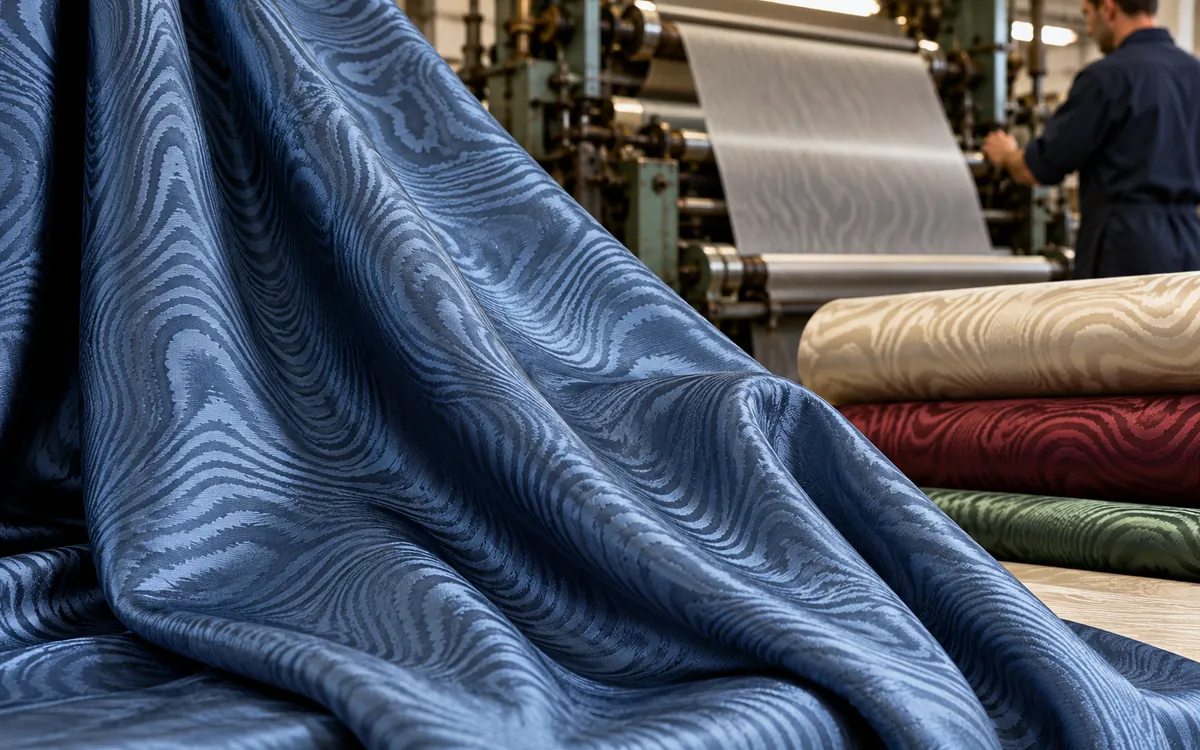
Hold a piece of moire fabric under a lamp and tilt it. The surface seems to shimmer, as if ripples of water are moving across it. The pattern looks printed, but it is not. There is no ink or dye in the design. The pattern comes from the way the fabric surface was pressed and how it reflects light. That is the charm of moire fabric, and also the reason it needs special care.
This guide explains what moire fabric is, how the pattern is made, which fabrics and fibers work best, where moire is used and how to look after it. It also covers the faults that buyers watch for. If you want a wider look at fabric types, our guide to common fabric types is a useful companion.
What is moire fabric
Moire (say “mwah-RAY”) is a fabric with a wavy, watery pattern on the surface. It is also called watered fabric. The word comes from French. The effect is found most often on silk, but it can be made on rayon, acetate, polyester and cotton.
The fabric underneath is usually a ribbed weave, like taffeta, faille or grosgrain. These weaves have fine ridges running across the fabric. The moire effect is made by finishing, not by weaving. The ridges are pressed in a way that flattens them in some places and leaves them raised in others. Light bounces off the flat and raised areas differently, so the surface seems to glow and change as you move.
How moire is made
Step 1: Choose the base fabric
The base fabric must have a clear rib or texture. Taffeta has a fine crosswise rib. Faille has a heavier one. Grosgrain is bolder still. A flat, smooth fabric like satin would not make a good moire, because it has no ridges to press.
Step 2: Calendering
Calendering is the key step. The fabric passes between heavy rollers under high pressure. For moire, two layers of the same fabric are laid face to face and fed through the rollers together. Slight differences between the layers, such as small shifts in the position of the ribs, cause the ribs to crush against each other in uneven ways. This leaves a random pattern of flat and raised areas. The result is the watered look.
The fabric is usually damp and the rollers are heated. The heat and moisture help set the pattern. Different roller types give different looks.
Step 3: Engraved rollers
Another way to make moire is with an engraved roller. A roller carved with a moire pattern presses the design into the fabric. This method gives a consistent, repeating pattern. It is used for large production runs and for synthetic fabrics. The first method gives a more random, natural pattern.
Step 4: Setting the pattern
For fabrics made from silk, the pattern relies on mechanical pressing and may fade with water. For thermoplastic fibers, such as acetate and polyester, the heat of the calender softens the fiber, and the pattern is set into it when it cools. The pattern is more permanent in these fabrics. Check the label or supplier information, because not all synthetic moire is permanent.
Our guide on textile finishes explains how calendering and other mechanical finishes work.
Types of moire
- Moire antique: A classic, with a strong, irregular water-like pattern. Often made on silk taffeta.
- Moire faille: Made on faille, with a bolder rib and a heavy hand.
- Moire taffeta: A crisp fabric with a lighter pattern. Used for gowns.
- Moire grosgrain: Bold ribbed fabric, often used for ribbons.
- Moire francaise: A style where the pattern is wavy and flowing.
- Moire anglaise: A style with a pattern in large waves.
- Cotton moire: A cotton version, often used for linings and furnishing.
- Printed or optical moire: An effect made on purpose by overlaying patterns.
The names can vary between suppliers, so ask for a sample before you order.
Moire fabric properties
| Property | Description |
|---|---|
| Appearance | Shimmering, wavy pattern |
| Hand | Crisp and smooth, slightly stiff |
| Drape | Holds shape, does not flow like crepe |
| Weight | Light to medium |
| Strength | Good, depends on fiber |
| Wrinkle | Silk wrinkles, synthetic resists |
| Breathability | Moderate, depends on fiber |
| Care | Delicate for silk and cotton versions |
Fibers used for moire
Silk
Silk moire is the classic and the most luxurious. It has a rich glow, and it takes dye well. It is expensive and needs care. Water can spoil the pattern.
Acetate and rayon
Acetate looks like silk at a lower price. It takes heat setting, so the moire pattern holds well. It is used in linings and evening wear. Rayon (viscose) is soft and cheaper, but it can lose its pattern when wet.
Polyester
Polyester moire is durable, wrinkle resistant and easy to care for. The calender can set the pattern permanently. It is the most common type in bridal and costume use.
Cotton
Cotton moire is less common. It is used in furnishing and some fashion items. The pattern is less sharp.
Uses of moire fabric
- Evening wear and gowns: Moire taffeta gives a structured, glossy look for skirts and bodices.
- Wedding and bridal wear: Used for sashes, bows and dresses.
- Ribbons and trims: Moire ribbon is popular in gifts and hair accessories.
- Home furnishing: Curtains, cushions and wall coverings use it for a formal feel.
- Upholstery: Chair seats and headboards.
- Costumes and theater: The shimmer shows well under stage lights.
- Accessories: Bags, belts and hat bands.
- Bookbinding and stationery: Moire paper and cloth are used for covers.
- Linings: Some jackets use moire lining for a quiet shine.
How moire behaves in sewing
Moire is a crisp fabric that holds structure, which suits tailored shapes. But it needs care in the sewing room.
- Needle: Use a fine, sharp needle. A blunt needle leaves holes that show on the surface.
- Stitch length: Medium length. Short stitches can pucker the fabric.
- Pressing: Use low heat. Press from the wrong side with a pressing cloth. Steam can spoil the pattern, especially on silk or cotton.
- Seams: Moire frays, so finish edges well.
- Pins: Use fine pins in the seam allowance only. Pin holes mark the fabric.
- Pattern matching: The moire pattern is random, so it does not need matching like a stripe, but the direction of the ribs should run the same way on all pieces.
- Cutting: Cut a single layer at a time when you can. The fabric is slippery.
Care of moire
- Dry clean silk and cotton moire. Water can flatten or blotch the pattern.
- Follow the label for synthetic moire. Some can be hand washed in cool water.
- Avoid steam and hot iron.
- Store hanging, or roll it. Avoid creasing, because folds can leave marks.
- Keep it away from rubbing surfaces. The finish can wear and look shiny.
Moire in the supply chain
For a manufacturer or buyer, moire is a specialty fabric.
- Lead time: The calendering step is separate and may add time.
- Minimum order: Mills often set higher minimums for finished moire.
- Consistency: The random pattern means no two meters are exactly alike. Buyers should agree on a standard sample and an acceptable range.
- Testing: Test colorfastness, shrinkage and pattern retention after washing or dry cleaning.
- Handling: Roll the fabric with care. Folds can mark the surface.
Our guide on fabric inspection procedure shows how fabric is checked on arrival.
Common faults
| Fault | Cause |
|---|---|
| Pattern fading after washing | Pattern not heat set, wet cleaning of silk |
| Uneven pattern | Roller pressure or moisture not uniform |
| Shiny crease marks | Folding in storage or hot pressing |
| Dull patches | Over-pressing or rubbing |
| Shade difference | Dye lot mismatch |
| Puckering seams | Wrong stitch or needle |
| Watermarks | Spots of water leave permanent rings |
| Pin or needle marks | Holes in a fine, tight weave |
| Pattern running in different directions | Pieces cut inconsistently |
Moire and the optical moire effect
The word moire is also used in physics and printing. When two regular patterns overlap at a slight angle, a third pattern appears, which looks like waves or ripples. In printing, this can happen when halftone screens are misaligned and ruin the image. In fabric, designers sometimes use this effect on purpose in printed patterns. The finish moire we discuss here is a physical effect on one fabric. The optical moire is an effect of overlapping patterns. They look similar but arise from different causes.
A short history of moire
Moire has been made for several centuries. The word is thought to come from “mohair”, an old name for a lustrous cloth, which French makers shaped into “moire”. For a long time the pattern was pressed by hand with heavy wooden or metal rollers, and only silk makers with skilled workers could do it well. That is why moire became linked with court dress, church cloth and fine ribbons. When steam power and metal calenders arrived, mills could press long lengths at once. Later, synthetic fibers made the effect cheap and lasting, and moire moved from palaces to bridal shops, stage costumes and home curtains.
Moire compared with similar fabrics
People often mix moire up with other shiny or patterned fabrics. This table shows the difference.
| Fabric | How the pattern is made | Is the pattern permanent |
|---|---|---|
| Moire | Pressed in by calendering | Depends on the fiber |
| Brocade | Woven in with extra yarns | Yes |
| Damask | Woven using weave changes | Yes |
| Jacquard | Woven on a jacquard loom | Yes |
| Printed taffeta | Printed with dye or pigment | Yes, within color fastness limits |
| Plain taffeta | No pattern, only a crisp rib | Not applicable |
The big point is that moire is a finish. A woven pattern is part of the structure and cannot wash out. A pressed pattern sits on the surface, so it needs more care. If a customer wants a pattern that lasts through many washes, a woven or printed design is safer.
A small worked example for a buyer
Say a small bridal brand wants 600 sashes in polyester moire taffeta. Each sash needs 1.2 meters of fabric at 112 cm width. Add 8 percent for cutting loss and pattern direction.
- Base need = 600 × 1.2 = 720 meters
- Loss allowance = 720 × 0.08 = 57.6 meters
- Order quantity = 720 + 57.6 = 777.6 meters, so round up to 780 meters
If the mill sells moire only in rolls of about 50 meters, the brand should order 16 rolls, which is 800 meters. The extra 20 meters acts as a buffer for sampling and for any roll with a fault. Because the pattern is random, the brand should also ask that all rolls come from one calender run, so the look matches across all 600 sashes.
Quality checks before cutting
Moire is easy to spoil at the cutting table, so a few checks help.
- Spread the fabric face up with no pulling. A stretched moire can show distorted waves.
- Check each roll under the same light. Mark any roll that looks flatter or glossier than the sample.
- Cut all pieces with the ribs running in one direction.
- Keep cut pieces flat or hang them. Do not stack them under heavy weight.
- Test the pressing temperature on a scrap before pressing a real piece.
Our guide on fabric inspection procedure shows a simple way to grade faults on a roll.
Buying tips
- Ask what the base fabric is and what fibers it contains.
- Ask if the pattern is permanent.
- Request a swatch and wash or press a small piece to test.
- Look at the fabric under moving light. The pattern should flow evenly.
- Check the weight, which affects drape.
- Check the width, because some moire is narrow.
- For trims and ribbons, check if the edge is finished.
Final thoughts
Moire fabric earns its beauty from pressure, not dye. A ribbed cloth passes through a hot calender, the ribs are crushed in a random way and the surface turns into a field of moving light. The effect is lovely but sensitive. Choose the fiber for the job, test the pattern for permanence, press with care and clean gently. A well-made moire garment or furnishing will shimmer for years.
Frequently asked questions
Moire fabric is a ribbed fabric with a wavy, watery pattern pressed into the surface by calendering. It is made of silk, rayon, acetate, polyester or cotton.
Two layers of a ribbed fabric are pressed together between heated rollers. The ribs crush unevenly and create the pattern. Engraved rollers can also press a pattern into the fabric.
Watered silk is a moire fabric made from silk. The terms are often used together.
It depends on the fiber. On acetate and polyester, heat setting makes it more permanent. On silk and cotton, the pattern can fade with water.
Silk and cotton moire should be dry cleaned. Some synthetic moire can be hand washed. Check the label.
Moire is used for gowns, bridal wear, ribbons, curtains, upholstery, bags and linings.
It is not hard, but it needs sharp needles, low heat pressing and care to avoid marks.