A mill can run a technically excellent dyeing recipe and still lose an order because a chemical supplier can’t produce the right ZDHC documentation. That’s become an increasingly common reality across the industry, since ZDHC MRSL conformance has shifted from a differentiator a few progressive brands asked for into something close to a baseline expectation from major buyers sourcing globally.
What the MRSL Actually Restricts
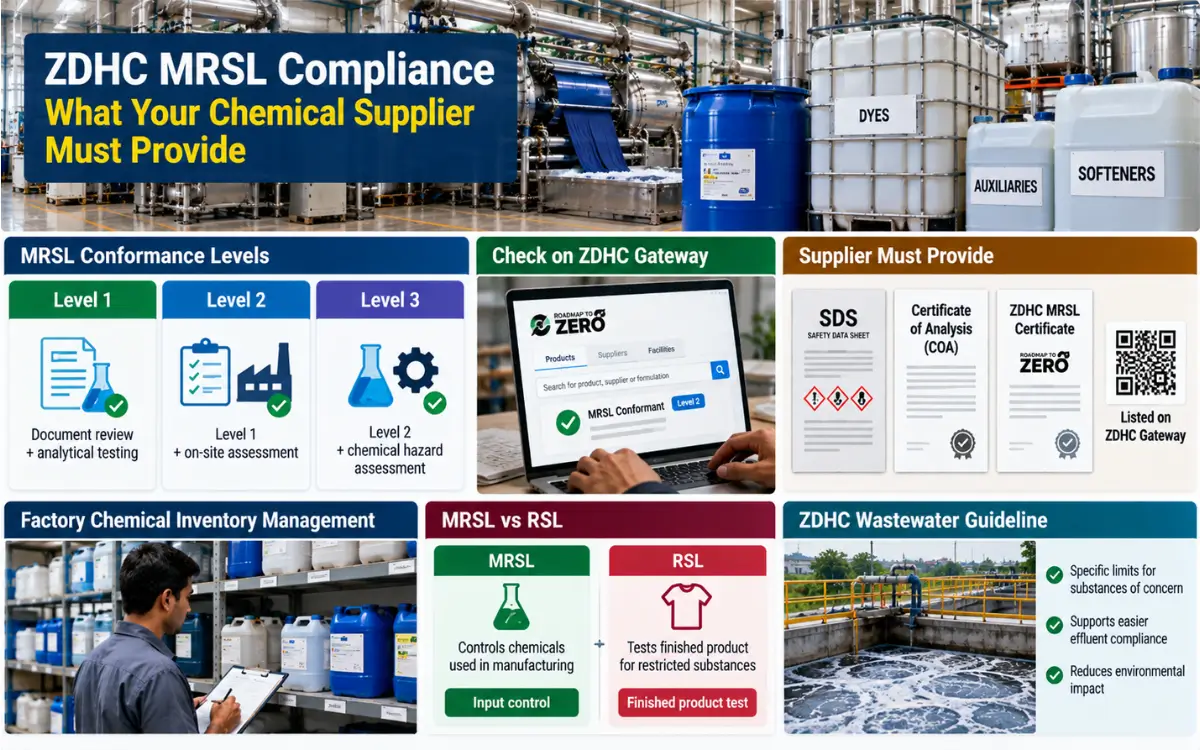
The ZDHC Manufacturing Restricted Substances List (MRSL) sets limits on hazardous substances in the chemical formulations used during manufacturing, textile, leather, and related processing, rather than testing the finished product itself. This distinguishes it from a Restricted Substances List (RSL), which tests finished garments and products for residual substances, and it’s a meaningful distinction: MRSL conformance is about controlling what goes into the manufacturing process, aiming to prevent hazardous substances from entering the supply chain and the environment in the first place, rather than catching problems after the fact in a finished product test.
How the Conformance Level System Works
ZDHC MRSL conformance is verified through a tiered system with three levels, each representing an increasing degree of verification rigor.
Level 1 conformance involves a document review of the chemical formulation’s safety data sheet for MRSL-relevant information, combined with analytical testing of the formulation, either screening plus analytical testing, or analytical testing alone, to verify the formulation doesn’t contain restricted substances above defined limits.
Level 2 conformance builds on Level 1 by adding an on-site assessment of the formulator’s management systems, verifying that the practices supporting MRSL conformance are genuinely embedded in how the formulator operates, not just demonstrated in a single formulation test.
Level 3 conformance represents the highest verification tier, adding chemical hazard assessment capability on top of everything verified at Levels 1 and 2, demonstrating the formulator has the internal capability to assess and manage chemical hazard on an ongoing basis rather than relying solely on external verification.
Conformance is verified by ZDHC-approved MRSL certifiers, third-party organizations accredited specifically for this verification, and results get published on the ZDHC Gateway, the digital platform brands, mills, and chemical suppliers use to search, verify, and manage this compliance information.
What This Means in Practice for a Chemical Supplier
A chemical supplier serious about serving factories with ZDHC-conscious buyers needs to have their relevant product formulations listed on the ZDHC Gateway with current, valid MRSL conformance certification at whatever level their target buyers require, since buyer requirements increasingly specify a minimum conformance level rather than just asking whether a product is “ZDHC compliant” in general terms. A supplier who can only point to marketing language claiming compliance, without a verifiable, current Gateway listing, isn’t actually meeting what most serious buyers now require as documentation.
It’s also worth understanding that MRSL conformance certification has an expiration and renewal cycle, and products can lapse from active, published status on the Gateway if certification isn’t kept current. A supplier’s Gateway listing should be checked as current at the point of any large order, not assumed valid based on a certification seen months earlier.
Setting Up Chemical Inventory Management at the Factory Level
ZDHC compliance isn’t purely a chemical supplier responsibility. Factories and mills using these chemicals need their own functioning chemical inventory management system, tracking what chemical products are actively in use, what documentation, safety data sheets and current MRSL conformance certificates, is on file for each one, and a clear process for retiring products from active use when they’re discontinued or when their certification lapses.
A functioning inventory system typically covers a chemical product register listing every active chemical by name, supplier, and intended use, current safety data sheets and MRSL certification documentation linked to each entry and reviewed for validity on a regular schedule, a defined approval process for introducing any new chemical product into the mill, checking Gateway status and conformance level before approval rather than after the chemical is already in use, and a periodic audit comparing what’s actually in use on the floor against what’s documented in the register, since gaps between documented and actual use are a common finding when this kind of audit is genuinely run rather than treated as a formality.
The ZDHC Wastewater Guideline
Beyond the MRSL itself, ZDHC’s wastewater guideline sets parameters for effluent quality from textile processing facilities, covering both conventional parameters and a specific list of chemical substances of concern. This connects directly to the chemical selection covered elsewhere, since chemical choices made at the dyeing and finishing stage directly affect whether a mill’s effluent can realistically meet these wastewater parameters without expensive additional treatment. Selecting MRSL-conformant chemistry upstream genuinely reduces the burden on effluent treatment downstream, which is one of the more concrete, practical arguments for treating ZDHC conformance as an operational advantage rather than purely a compliance cost.
RSL Versus MRSL: A Distinction Worth Keeping Clear
Buyers sometimes use “RSL compliance” and “MRSL compliance” loosely as if they’re interchangeable, but they verify different things. RSL (Restricted Substances List) compliance is verified by testing the finished product, checking that residual substance levels in the actual garment or fabric fall below defined limits. MRSL compliance is verified by testing and certifying the chemical formulations used during manufacturing, before they ever touch the finished product. A mill can, in principle, pass RSL testing on a finished garment while having used chemistry that wouldn’t pass MRSL conformance, since a substance might not persist in detectable quantities on the finished product even though it was present and potentially released into the environment during processing. This is exactly the gap MRSL compliance is designed to close, and it’s worth being precise about which one a specific buyer requirement is actually asking for.
What Non-Compliance Actually Costs
It’s worth being concrete about what’s at stake in skipping proper ZDHC documentation, since the cost isn’t abstract. A mill that can’t produce current Gateway conformance documentation during a buyer’s compliance audit risks losing that order outright, and increasingly risks being removed from a buyer’s approved supplier list entirely, a considerably more expensive outcome than the ongoing cost of maintaining proper chemical inventory management and working with Gateway-listed suppliers in the first place. For mills serving multiple buyers with varying compliance requirements, a single documentation gap discovered during one buyer’s audit can also trigger closer scrutiny from other buyers who hear about the finding through the fairly connected network of compliance auditors and sourcing teams that cover this industry, making the reputational cost of a compliance gap larger than the immediate lost order alone.
Preparing for a Buyer’s ZDHC Audit
Beyond the ongoing inventory management covered above, a mill should expect that a buyer’s compliance audit will ask to see specific, current evidence rather than accepting a general assurance that “we follow ZDHC.” A well-prepared mill can produce, on request, a current chemical inventory register cross-referenced to Gateway listing status for each active product, safety data sheets filed and organized by product rather than scattered across supplier email correspondence, and a documented approval process showing how new chemicals get vetted before entering active use. Auditors experienced in this space generally move quickly past a mill that can produce this documentation cleanly and spend considerably more time, and generate considerably more findings, at a mill where this information has to be assembled reactively during the audit itself, since that scramble is usually a reliable signal that the underlying management system isn’t as consistently applied as a mill’s verbal assurances suggest.
Running an internal mock audit periodically, treating your own chemical inventory and documentation the way an external auditor actually would, catches gaps before a real buyer audit does, and it’s a considerably cheaper way to discover a documentation gap than having a buyer discover it first.
How ZDHC Relates to Other Compliance Frameworks
Mills navigating buyer compliance requirements often encounter ZDHC alongside several other frameworks referenced elsewhere and in general industry conversation, and understanding how they relate avoids treating each one as a fully separate, disconnected obligation. LEED certification, covered in our Utilities and Energy guide, evaluates a facility’s energy and water performance broadly and doesn’t directly overlap with ZDHC’s chemical-specific focus, though a mill’s chemical choices do affect the effluent volume and treatment burden that connects to LEED’s water credit considerations. Bluesign, mentioned earlier in this article as an industry program with its own PFAS restriction timeline, operates its own approval system that in some respects parallels ZDHC’s MRSL conformance approach but isn’t identical to it, meaning a chemical approved under one program isn’t automatically approved under the other without separate verification. Mills serving buyers who reference multiple frameworks benefit from building a compliance approach that captures the genuine overlap between these systems, chemical inventory management and documentation discipline serves multiple frameworks simultaneously, rather than running entirely separate compliance processes for each individual buyer requirement that comes in.
Building Toward Compliance as a Practical Roadmap
For a mill starting from limited existing ZDHC documentation, a realistic path forward starts with auditing current chemical suppliers’ actual Gateway status rather than assuming existing relationships already meet requirements, prioritizing conversion to Gateway-listed, MRSL-conformant products for the highest-volume chemicals in use first, since these represent both the greatest compliance exposure and the greatest potential effluent quality benefit, and building the internal chemical inventory management system in parallel rather than treating supplier conversion and internal documentation as sequential projects. Buyers increasingly ask for both pieces together, verifiable supplier conformance and evidence of the mill’s own chemical management discipline, and building only one half of that picture leaves a real gap in what a serious buyer’s compliance audit will actually check.
Treating Compliance as an Ongoing Discipline
The roadmap above describes a starting path, not a destination a mill reaches once and then stops thinking about. Chemical formulations get discontinued and replaced, MRSL conformance certifications expire and need renewal, and buyer requirements themselves continue to evolve as ZDHC’s own framework updates over time. Mills that treat ZDHC conformance as a genuinely ongoing operational discipline, with the periodic internal audits and Gateway status checks covered throughout this article built into standing procedure rather than revisited only when a specific buyer audit prompts it, maintain a considerably stronger and more defensible compliance position than mills that treat their initial conversion project as a finished, permanent achievement.
Frequently Asked Questions
What’s the difference between ZDHC MRSL Level 1, 2, and 3 conformance?
Level 1 verifies the formulation through document review and testing, Level 2 adds an on-site assessment of the formulator’s management systems, and Level 3 adds documented chemical hazard assessment capability, each level building on the one before it.
Where can I verify a chemical supplier’s actual ZDHC conformance status?
The ZDHC Gateway, the platform where chemical suppliers list products with current, verifiable MRSL conformance certification. A supplier’s marketing claim alone isn’t sufficient documentation for most serious buyer audits.
Does a mill need its own chemical inventory system, or is supplier compliance enough?
Both matter. Buyers increasingly expect evidence of the mill’s own chemical management discipline, tracking what’s in use, current documentation, and an approval process for new products, alongside verifiable supplier conformance.
What happens if a mill fails a buyer’s ZDHC compliance audit?
It risks losing the order and, increasingly, removal from the buyer’s approved supplier list, a considerably more expensive outcome than the ongoing cost of maintaining proper documentation and working with Gateway-listed suppliers.