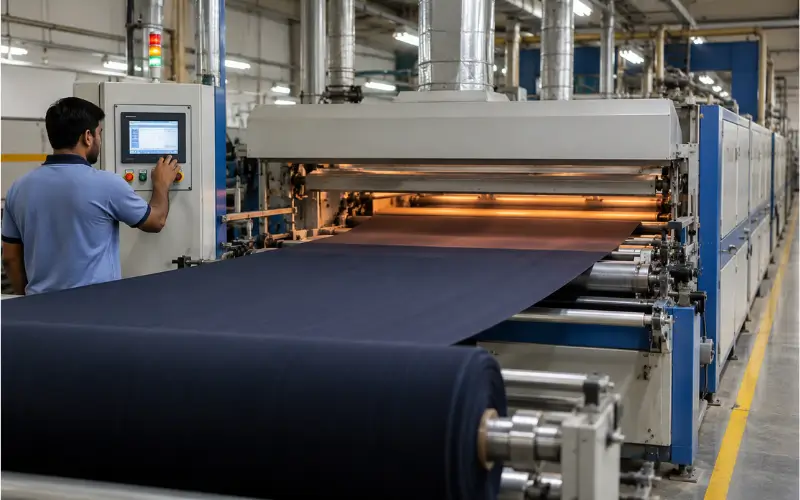
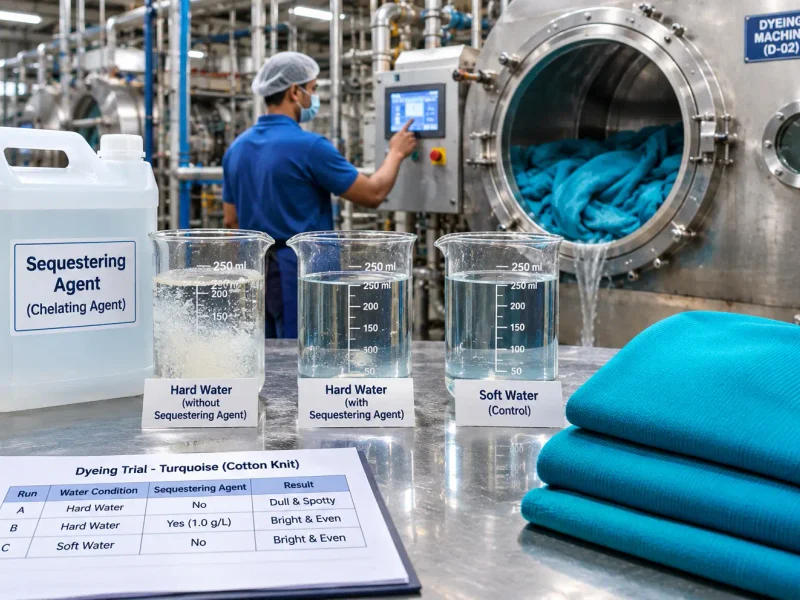
Before a warp yarn goes onto a loom, it is coated with a thin film of size. The film makes the yarn smoother and stronger, so it survives the rubbing and pulling of weaving. But the same film that helps in the weaving shed becomes a problem in the dye house. Size blocks water, dye and chemicals. The desizing process removes it, so the fabric can be scoured, bleached, dyed and finished evenly.
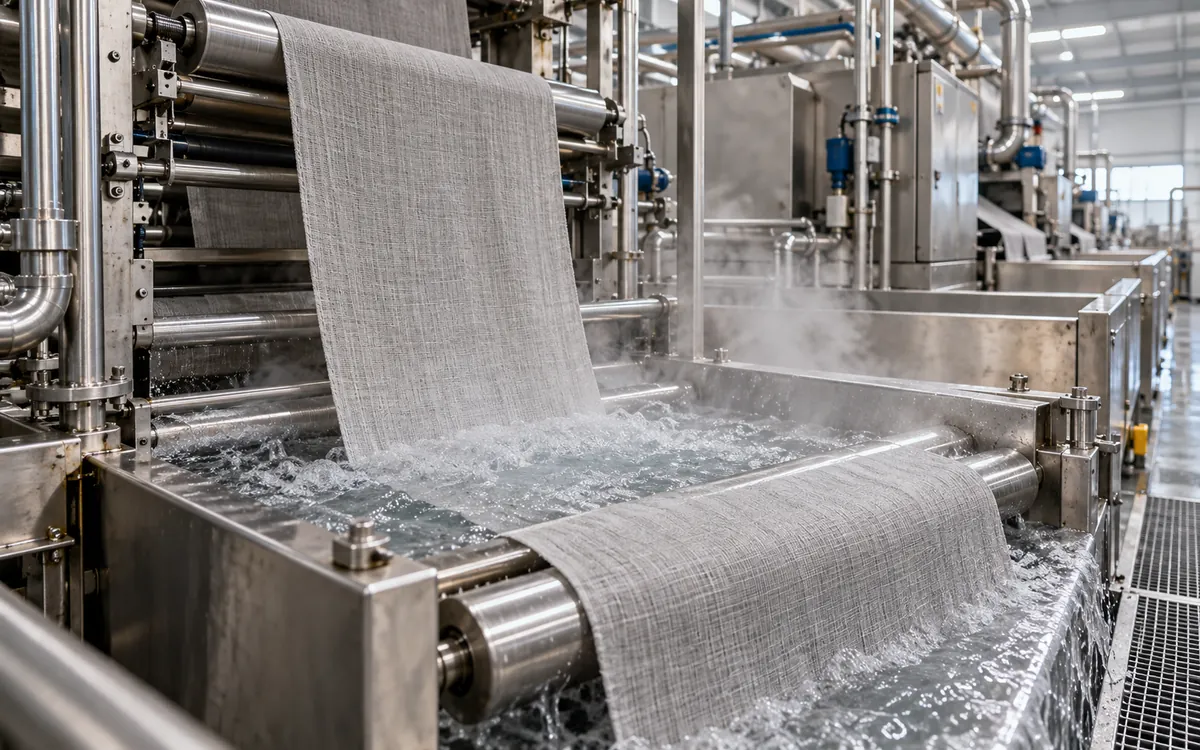
This guide explains the desizing process in simple steps. You will see why it is needed, which size materials are used, the main methods, a worked recipe with numbers and the tests that tell you when the job is done. We also list common problems and how to fix them. For the sizing step itself, see our guide on sizing, its purpose and modern process.
What is desizing
Desizing is the wet process that removes the size material from woven fabric after weaving. It is the first step in the preparation of grey woven fabric. Knitted fabrics are not sized, so they do not need desizing. A typical order for woven cotton is: singeing, desizing, scouring, bleaching, then dyeing or printing. The earlier steps are shown in our flow chart of weaving.
Why is desizing needed
- Size repels water, so the fabric cannot absorb dye, bleach or finish evenly.
- Left on the fabric, size causes stiffness, patchy dyeing and poor handle.
- Size can brown or burn during heat treatments, causing stains.
- It makes scouring and bleaching less effective, since the chemicals have to attack the size first.
- It can cause problems in printing, where paste must penetrate the fabric.
- Starch left in the fabric can attract insects and mould in storage.
What is size and what is it made of
Size is a film-forming material applied to warp yarns in a sizing machine. The mill picks the size based on the yarn, the loom and cost. Common size materials are:
| Size material | Type | Notes on removal |
|---|---|---|
| Starch (maize, potato, tapioca, wheat) | Natural | Removed by enzymes (amylase), acids or oxidising agents. Cheap, widely used for cotton |
| Modified starch | Chemically changed natural | Often removed with enzymes or hot water, depending on the type |
| Polyvinyl alcohol (PVA) | Synthetic | Removed by hot water washing, usually 80 to 95 degrees Celsius. Enzymes do not work on it |
| Carboxymethyl cellulose (CMC) | Semi-synthetic | Washes out with hot water, sometimes with a little alkali |
| Acrylic sizes | Synthetic | Removed with alkali and wash-off |
| Gelatin and other proteins | Natural | Removed with protease enzymes or alkali |
| Polyester sizes (for filament yarn) | Synthetic | Removed in hot, alkaline wash |
Most cotton in the world is sized with starch or a starch blend with PVA or acrylic. Knowing the recipe in the sizing mix helps you pick the right desizing method, so ask the weaving mill what was used.
Main methods of desizing
1. Rot steep desizing
The fabric is soaked in warm water and left in a pile for 12 to 24 hours. Natural bacteria grow and break down the starch. It is cheap but slow, hard to control and can smell. It also can weaken the fabric. Rarely used today.
2. Acid steep desizing
The fabric is treated with dilute acid, such as hydrochloric or sulfuric acid, for several hours. The acid breaks down starch into smaller parts that wash away. It can harm cotton if too strong or if allowed to dry, so it needs care and good rinsing. Used less today.
3. Enzymatic desizing
This is the most popular method for starch sizes. The enzyme alpha-amylase breaks starch into small sugars, which dissolve in water and wash off. It acts only on starch and is gentle on cotton. Different enzymes work at different temperatures and pH, from moderate (about 60 degrees Celsius) to high-temperature types (up to around 100 degrees or more). See our detailed guides on enzyme desizing and on recommendations for efficient enzyme desizing.
Typical conditions for a bacterial amylase:
- pH about 6 to 7.5
- Temperature 60 to 80 degrees Celsius for pad-batch and pad-roll methods, or higher with high-temperature enzymes in steaming
- Time from a few minutes in a hot steamer to 2 to 12 hours in a pad-batch
- A little salt (often calcium) can improve enzyme stability for some types
Always follow the enzyme maker’s data sheet.
4. Oxidative desizing
Oxidising agents such as hydrogen peroxide, persulphates, bromites or chlorites break down starch and many other sizes quickly. It is fast and also helps the next step of bleaching. The risk is damage to cellulose if the control is poor. It is used for combined desizing and bleaching, and for sizes that enzymes cannot handle, though persulphate or peroxide chemistry must be controlled carefully.
5. Hot water washing (for PVA and CMC)
Water-soluble synthetic sizes are removed by washing in hot soft water, often with a detergent, in several washing boxes. Counter-current washing cuts water use. PVA-rich wash water can be treated to recover the PVA, which is hard to biodegrade. Mills that use PVA often invest in recovery by ultrafiltration, since it can both save money and reduce pollution.
6. Alkali desizing
Dilute alkali, often caustic soda, swells and loosens certain sizes, like acrylics, and helps in washing them out. It is often combined with scouring.
Comparison of methods
| Method | Works on | Speed | Risk to fabric | Notes |
|---|---|---|---|---|
| Rot steep | Starch | Very slow | Medium | Hard to control, rare now |
| Acid steep | Starch | Slow | Medium to high | Needs careful rinse |
| Enzymatic | Starch only | Medium | Very low | Most common and gentle |
| Oxidative | Starch and many others | Fast | Medium | Control needed |
| Hot water wash | PVA, CMC | Fast | Low | Needs hot water and recovery |
| Alkali | Acrylics and some others | Fast | Medium | Often combined with scouring |
Machines and application systems
| System | How it works |
|---|---|
| Pad-batch | Fabric is padded with the enzyme bath, wound on a roll and turned slowly for hours. Low energy and low water |
| Pad-steam (J-box) | Fabric is padded then held hot in a J-shaped steamer for 30 to 60 minutes |
| Pad-roll | Fabric is padded, rolled and kept hot in a heated chamber |
| Jigger | Fabric passes back and forth through the enzyme bath in open width |
| Winch | Fabric in rope form circulates in the bath |
| Continuous washing range | Fabric passes through several wash boxes in sequence |
See our guide on jet, jigger and winch machines for the machines. Continuous ranges are used for large volumes.
Worked example 1: how much size is on the fabric
Size add-on is stated as a percentage of the unsized yarn weight. Take a woven cotton fabric where the yarn weights, before sizing, are as follows.
- Total yarn in 100 kg of unsized cloth: warp 55 kg and weft 45 kg
- Size add-on on warp: 10 percent of warp yarn weight
Weight of size
- 55 × 0.10 = 5.5 kg
Weight of grey fabric
- 100 + 5.5 = 105.5 kg (the weft is not sized)
Weight loss expected from desizing
- 5.5 ÷ 105.5 × 100 = 5.2 percent
So a laboratory weight-loss check after complete desizing should show a loss around 5 percent for this fabric, plus a little from other impurities. A much lower figure points to size left on the fabric. A much higher figure can mean damage to the cotton.
Worked example 2: an enzyme padding recipe
A mill desizes 1,000 metres of poplin, 1.5 m wide, with a grey weight of 120 GSM.
Fabric weight
- Area = 1,000 × 1.5 = 1,500 m²
- Weight = 1,500 × 0.120 = 180 kg
Liquor
- Pick-up: 70 percent
- Liquor taken up = 180 × 0.70 = 126 litres
- Prepare about 150 litres, to fill the trough and lines
Recipe (starting point)
- Alpha-amylase: 2 g/L
- Wetting agent: 1 g/L
- Sequestering agent: 1 g/L
- pH 6.0 to 7.0
- Temperature of bath: 60 degrees Celsius
Quantities for 150 litres
- Enzyme = 150 × 2 = 300 g
- Wetting agent = 150 g
- Sequestering agent = 150 g
Enzyme on fabric
- 2 g/L × 0.70 L/kg = 1.4 g per kg of fabric, or 0.14 percent on weight of fabric
Cost
If the enzyme costs 9 dollars per kg (illustrative):
- 0.3 kg × 9 = 2.70 dollars for the lot, or 0.0027 dollars per metre
The enzyme itself is cheap. The larger costs are in time, water and energy. The fabric is then batched for 4 hours at about 50 to 60 degrees, washed with hot water at 85 to 95 degrees and then tested.
Testing desizing
The simplest test is the iodine test. A drop of iodine solution on starch turns blue-black. If the fabric still has starch, it shows a dark spot.
| Test | How it works | Result |
|---|---|---|
| Iodine drop test | Add a drop of iodine solution on a wet sample | Blue-black spot means starch is present. No colour change means starch is gone |
| TEGEWA violet scale | Dip in iodine solution and compare colour with a scale from 1 to 9 | A rating of 1 is poor desizing. 7 to 9 means desizing is good. Mills set their own limit |
| Weight loss test | Compare dry weight before and after desizing | Check against the expected size weight |
| Absorbency test (drop test) | Time a drop of water to sink into the fabric | Fast absorption, a few seconds or less, shows size removal |
| Wicking test | Hang a strip in coloured water and see how high it rises | Higher is better |
| pH test of the fabric | Check the fabric after washing | Near neutral |
Test at several places across the width and along the length of the fabric. Size can be left in the selvedge or in folds.
Common problems and fixes
| Problem | Likely cause | Fix |
|---|---|---|
| Starch left after desizing | Low enzyme, wrong pH or temperature, short time | Check recipe, pH and time. Repeat treatment |
| Patchy desizing | Uneven padding, creases | Adjust pad pressure, open out the fabric |
| PVA still present | Water too cool, too few washes | Wash hotter, add more wash boxes |
| Fabric damage | Acid too strong or oxidiser uncontrolled | Reduce concentration, control time and temperature |
| Enzyme not working | Wrong enzyme for the size, enzyme killed by high heat or by chemicals | Confirm the size type, check enzyme tolerance |
| Yellow marks | Residual size heated in dryer | Wash off completely before drying |
| Uneven dyeing later | Remaining size | Retest after scouring, repeat desizing if needed |
| Foam | Too much detergent | Use low-foam products |
| High effluent load | Large amount of starch and sugar in wash water | Use counter-current washing and treat effluent |
| Slow batching time | Low temperature in cold weather | Keep the batch warm with covers |
Desizing and the next steps
Desizing alone does not fully clean the fabric. It removes size but leaves waxes, pectins and other natural impurities. These are tackled in the next step. See our guide on the scouring process and our overview of textile pretreatment chemicals. Some mills combine desizing and scouring in one bath to save time and water, while others combine desizing, scouring and bleaching for light fabrics. Trial lots decide whether this works for your fabric.
Environment and cost notes
- Desizing wash water carries starch, sugars and PVA, which raise the oxygen demand of the effluent. The wash water goes to the effluent plant.
- Counter-current washing and low-liquor methods cut water and energy use.
- PVA recovery can pay for itself where PVA sizes are used heavily.
- Enzymes are biodegradable and work at mild conditions. Using them lowers chemical load compared with acids and oxidisers.
- Match the desizing method with the sizing recipe from the weaver. Better communication lowers cost on both sides. For warp preparation, see our page on the warping machine.
Final thoughts
The desizing process is a quiet step, but it decides how well everything after it will work. Match the method to the size, check the pH, temperature and time, and test with iodine and absorbency before the fabric moves on. When the fabric is free of size, scouring, bleaching and dyeing become faster, cleaner and more even, and the finished cloth looks and feels better.
Frequently asked questions
It is the removal of size material, put on warp yarns before weaving, from woven fabric. It makes the fabric ready for scouring, bleaching and dyeing.
Size blocks water and chemicals, so without desizing the fabric would bleach and dye unevenly.
Enzymatic desizing with amylase is the most common because it is gentle, specific and works at mild conditions.
By washing in hot water, usually 80 to 95 degrees Celsius. Amylase enzymes do not break down PVA.
Put a drop of iodine solution on the fabric. A blue-black colour shows starch is still there.
No. Knitted fabrics are not sized, though they may need scouring to remove knitting oils.
Desizing removes the size applied for weaving. Scouring removes natural impurities such as wax and pectin, and added dirt.