Skipped stitches in sewing are gaps in a seam where the machine failed to make a stitch. The needle went down and came up, but the loop was not caught, so the thread is missing at that point. On a sewing line, skipped stitches are a daily headache. They weaken the seam, show up as defects at the end of the line and lead to rework. They also tend to come in waves: one machine runs well all morning, then starts skipping after a change of fabric or needle.
This guide explains what a skipped stitch is and how a lockstitch is formed, so you can see where it fails. It then goes through the causes in the needle, thread, machine and fabric, with a quick diagnosis table and a step by step check for the line. It ends with ways to prevent skipped stitches. It is written for mechanics, line supervisors and quality staff.
What a skipped stitch is
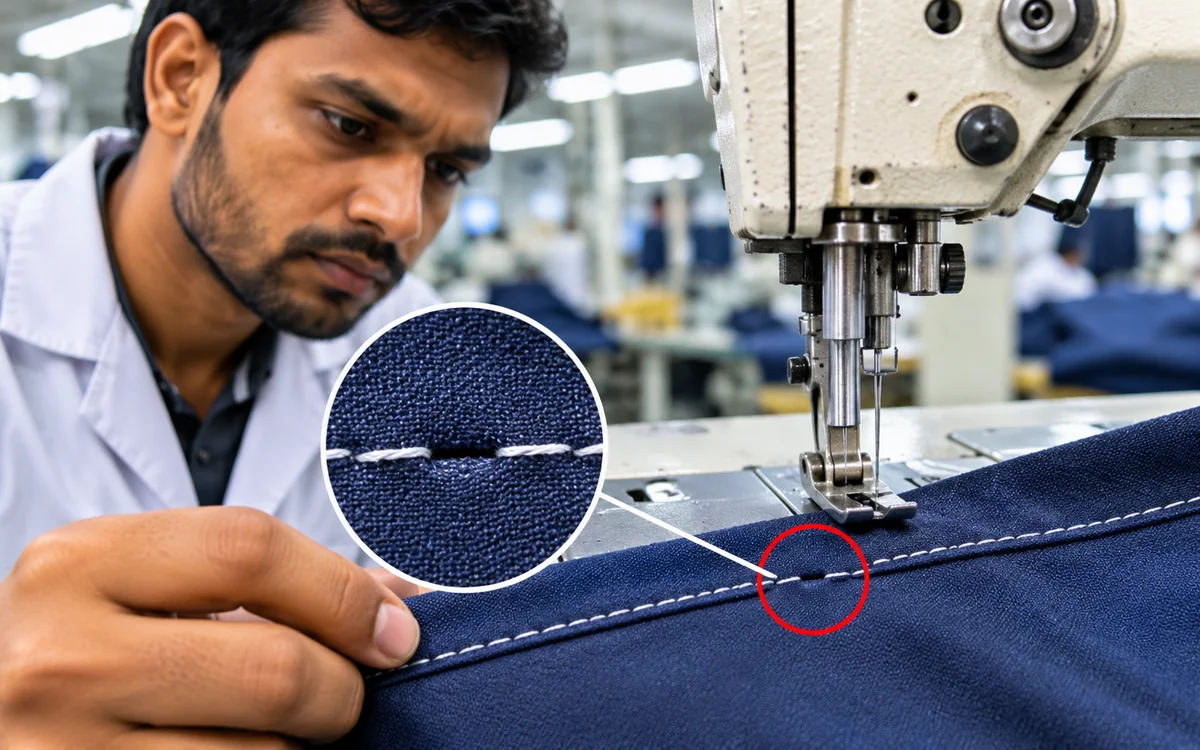
A skipped stitch, also called a missed or dropped stitch, is a place where a stitch should be but is not. You might see a long gap between stitches, a seam that opens when pulled, or a loose loop on one side of the fabric. A single skip may not be visible. A run of skips can leave a seam open.
Why it matters
- Weak seams. A missing stitch takes away strength, and the seam can burst in wear. See seam strength and slippage.
- Defects and rework. Skipped stitches are a common defect in end line checks. See DHU in a garment factory and sewing defects and their root causes.
- Lost time. An operator who has to stop, check, unpick and sew again loses output.
- Buyer inspection. Skipped stitches are listed as a defect by most buyers, often as a major one for seams that carry load.
How a lockstitch is made, and where it can fail
You do not need to be an expert to understand this part. A lockstitch machine uses two threads, the needle thread on top and the bobbin thread below.
- The needle goes down through the fabric, carrying the needle thread.
- As the needle starts to rise, the thread forms a small loop on one side of it.
- The hook (or rotary hook) swings past and catches that loop.
- The hook carries the loop around the bobbin thread.
- The take up lever pulls the loop tight, and the stitch sets in the fabric.
A skipped stitch happens at step 3. The hook is not able to catch the loop, because the loop is too small, in the wrong place, or not formed at all. So the cause is anything that stops the loop from forming well or stops the hook from being in the right place at the right time. That list includes the needle, the thread, the fabric, the feeding and the machine timing.
A quick diagnosis table
| What you see | Likely cause | First thing to try |
|---|---|---|
| Skips begin after a needle change | Needle not fully seated, wrong needle, wrong direction | Reinsert the needle fully and check type and size |
| Skips come and go, with a clean seam in between | Bent, blunt or damaged needle | Change the needle |
| Skips on stretch or knit fabric only | Wrong needle type for stretch fabric | Use a ballpoint or stretch needle |
| Skips at the start of a seam | Fabric lifting with the needle, short thread tails, speed too high | Check the presser foot, start slowly, check the throat plate |
| Skips when sewing thick seams or several layers | Needle deflected by thickness | Use a stronger needle, slow down, check the feed |
| Skips on thin or light fabric | Fabric flagging (lifting up with the needle) | Check presser foot pressure and the throat plate hole |
| Skips with one thread or one cone only | Poor thread or thread with lint or knots | Change the cone |
| Skips and thread breaks together | Rough thread path, tension too tight | Check guides and tension. See thread breakage in sewing |
| Skips on many machines at once | Fabric lot, finish or sizing issue | Check the fabric, and test with another fabric |
| Skips on one machine for all fabrics | Timing, hook damage or lack of oil | Call a mechanic |
Needle causes
The needle is the most common cause, and the first thing to check.
- Blunt or bent needle. A needle with a worn tip or a slight bend can fail to make a good loop. Fabric pulled during sewing bends needles, so skips often start after rough handling.
- Wrong needle size. A needle that is too small for the thread, or too large for the fabric, forms a poor loop. See sewing needle parts, size and point selection.
- Wrong needle type. Stretch fabrics, such as knits and spandex blends, need a needle made for them. A ballpoint or stretch needle has a shaped eye and a deeper scarf, which helps the hook catch the loop.
- Needle not seated fully. If the needle is not pushed all the way up into the needle bar, it sits too low, and the hook may miss the loop.
- Needle fitted the wrong way. The groove and the scarf must face the direction the machine maker says.
- Lint or sizing in the eye. Residue from fabric finishes can clog the needle eye and upset the loop.
- Old needle. A needle that has been sewing for too long loses its shape. Change needles on the factory schedule. See needle and sharp tools control procedure.
Thread and threading causes
- Missed thread guide. A thread that skips one guide in the path will not be tensioned properly, and the loop forms poorly. Rethread from the cone.
- Poor thread. Thread with weak spots, knots, lint or uneven thickness can cause skips. Some cotton threads shed lint that clogs the path.
- Wrong thread for the job. A very thick thread in a small needle, or a thread with too little lubrication, forms a poor loop. Polyester or core spun threads are often a better choice on many fabrics, but the right thread depends on the seam and the buyer. See sewing thread size, tex and ticket number.
- Tension too tight or too loose. Both can lead to skips. Make small changes and test on the real fabric.
- Bobbin problems. A badly wound bobbin, or a bobbin case with lint or a rough edge, can upset the loop.
Machine causes
- Timing off. The hook must pass the needle at the right moment. If the timing is wrong, the hook can miss the loop. This is a job for a mechanic.
- Damaged hook point. If the needle has hit the hook, the hook point can be damaged, and it will miss loops or split thread.
- Needle bar height or needle to hook gap wrong. The needle must be at the right height, and the gap between needle and hook must be correct.
- Wrong or worn presser foot, throat plate or feed dog. A throat plate hole that is too big lets thin fabric lift and drag down. See sewing machine presser feet types.
- Presser foot pressure wrong. If the pressure is too light, the fabric can flag. If too heavy, it can drag.
- Feed problems. Uneven feeding can pull the fabric away from the needle. See types of feed in sewing machines.
- Poor lubrication at the hook. A dry hook gets hot and can cause skips. Oil it as the maker says.
- Speed too high. Very high speed can leave too little time for the hook to catch the loop, especially on thick or stretch fabric.
- Loose parts. A loose needle clamp screw, hook screw or throat plate can all upset the stitch.
See the sewing machine maintenance schedule and the preventive maintenance checklist for the checks that keep these under control.
Fabric causes
- Stretch and knit fabrics. The fabric moves up and down with the needle, which makes the loop hard to catch. A ballpoint needle, the right foot and a smaller throat plate hole help.
- Thin or slippery fabrics. The fabric flags, so the loop is not formed well. Check the foot pressure and the throat plate hole.
- Thick fabrics and many layers. The needle is pushed aside, so the loop is not where the hook expects it. Use a stronger needle, slow down and check the feed.
- Sized, coated or finished fabrics. Resin, coating and sizing can build up in the needle eye and on the needle, and they change how the loop forms.
- Fused areas and bulky joins. Layers of interlining and seams crossing add thickness at one spot, and skips often happen there.
- Wet or hot fabric. Fabric straight from a press or a wash may behave differently.
Skipped stitches on overlock and chain stitch machines
Overlock and chain stitch machines use loopers in place of a bobbin and hook, but the idea is the same: a looper must pick up the needle loop. Skips on these machines often come from a bent or wrong needle, the needle not seated fully, the looper set at the wrong position, or the looper timing off. Thread tension, thread type and feeding also matter. Use the machine maker’s settings for the looper and needle positions, and ask a mechanic to adjust them. See overlock sewing machine types and lockstitch vs overlock vs flatlock.
A step by step check on the line
Work in this order. Change one thing at a time, and test on the real fabric.
- Look at the pattern of the skips. Where do they come? Always at the same spot, at the start, on thick parts, or at random?
- Change the needle. Use the right type and size for the fabric and thread, and push it fully up into the bar, facing the right way.
- Rethread the machine, starting from the cone and checking every guide.
- Try a fresh cone of the thread, and a fresh bobbin.
- Check the tension with a test seam, and make small changes.
- Check the presser foot, throat plate and feed dog for the stitch and the fabric.
- Check the presser foot pressure.
- Clean the hook and bobbin area, and oil as the maker says.
- Slow the speed to see if the skips stop.
- Test with a different fabric. If skips stop, the fabric is part of the cause.
- Call a mechanic to check timing, needle bar height, needle to hook gap and the hook point.
- Record the cause and the fix, and put the right needle, thread and settings in the style file.
If many machines skip at once, suspect the fabric lot or a new batch of needles or thread, and check those first. For a way to dig into repeat problems, see root cause analysis in garments.
How to prevent skipped stitches
- Choose the needle for the fabric and thread, and write it in the style file. Use stretch or ballpoint needles for knits.
- Change needles on a set schedule, and at once if one is bent, blunt or burred.
- Check the first piece of every new style and after any change of fabric or thread.
- Use good quality thread, from a reliable source, and keep records by lot.
- Train operators to guide the fabric and not pull it, to thread correctly and to report skips early.
- Keep machines clean and oiled on schedule. See TPM in garment factory sewing machines.
- Have a mechanic check timing and hooks during regular service, and after any needle strike.
- Test difficult fabrics early, such as stretch, coated and very thin fabrics, before bulk.
- Count skips in inline checks, and look for patterns by machine, operator, fabric and style.
Skips are also one of the faults that appear alongside puckering on difficult fabrics, so see seam puckering in garments.
Final thoughts
Skipped stitches in sewing happen when the hook fails to catch the needle thread loop. The cause may sit in the needle, the thread and threading, the machine settings and timing, or the fabric. Start with the cheapest checks: a new needle of the right type, correct threading and a fresh cone. Then look at tension, the foot and plate, the feed and the hook area, and call a mechanic for timing.
Change one thing at a time and test on the real fabric. Write the right needle, thread and settings in the style file, and check the first pieces of every new style. A few minutes of care at the start keeps a run of skipped stitches from reaching the end of the line.
Frequently asked questions
The main causes are a blunt, bent, wrong or badly fitted needle, wrong or poor thread, missed thread guides, wrong tension, presser foot and feed problems, difficult fabrics and machine timing or hook damage.
Yes. A blunt or slightly bent needle often fails to form a good loop, so the hook misses it. Changing the needle is the first thing to try.
Stretch fabric moves with the needle, which makes the loop harder to catch. Use a ballpoint or stretch needle, check the foot pressure and use a suitable throat plate.
It can. Poor thread, thread with lint or knots, a missed guide or thread that is too thick for the needle can all lead to skips. Try a fresh cone and rethread the machine.
Check the needle, the presser foot pressure and the throat plate hole, and start at a slower speed. Make sure the thread tails are the right length, and that the fabric is held flat.
Yes. If the hook does not pass the needle at the right moment, it can miss the loop. Timing and hook damage need a mechanic.
Follow your factory’s needle control schedule, and change a needle at once if it is bent, blunt or burred. The right interval depends on the fabric, the speed and the machine.