A machine that breaks down mid-shift doesn’t just cost the repair. It costs every minute the operator sits idle, every piece that doesn’t get produced that hour, and often a ripple effect on whatever operation downstream was waiting on that machine’s output. Most factories can name their maintenance mechanic’s monthly salary without hesitation. Far fewer can say what an hour of unplanned downtime actually costs the line, and that gap is usually why maintenance budgets stay thin even when the case for spending more on prevention is strong.
Why Preventive Maintenance Gets Deprioritized
New machines rarely break down in their first several months of operation, which creates a false sense that maintenance can be deferred. By the time real breakdowns start appearing, on machines that were never on a proper preventive schedule, the factory has already built production plans assuming full uptime, and the resulting disruption costs considerably more than a maintenance program would have.
A Daily Maintenance Routine
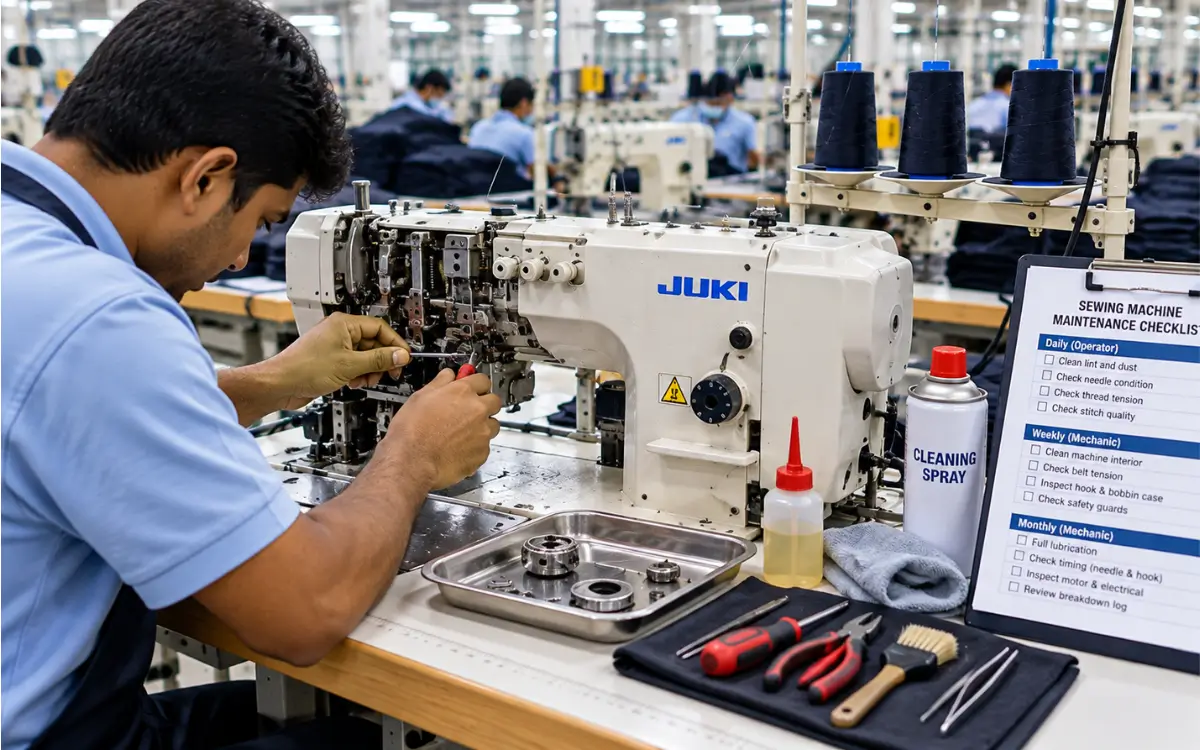
Daily maintenance, the layer worth reading alongside a broader sewing machine maintenance guide and preventive maintenance checklist, sits with the operator and takes only a few minutes, but it catches the small issues that compound into major failures if ignored. This includes cleaning lint and fabric dust from the machine’s bobbin area and feed dogs, checking and topping up oil where the machine uses a manual lubrication point, inspecting the needle for burrs or bending that can cause skipped stitches or fabric damage, and a quick visual check of thread tension and stitch quality on a scrap piece before starting production for the shift.
A Weekly Maintenance Routine
Weekly maintenance typically falls to a dedicated mechanic rather than the operator, and covers checks that daily inspection wouldn’t catch. This includes a more thorough cleaning of the machine’s interior mechanism, checking belt tension and condition, inspecting and cleaning the bobbin case and hook assembly more thoroughly than the daily quick-clean, and verifying that safety guards and emergency stops are functioning correctly.
A Monthly Maintenance Routine
Monthly maintenance covers the deeper mechanical checks that keep a machine running at full working life rather than degrading gradually. This includes full lubrication of internal moving parts per the manufacturer’s schedule, checking and adjusting timing between the needle and hook mechanism, inspecting motor condition and electrical connections, and reviewing each machine’s individual defect and breakdown log to spot patterns that point to a developing problem before it causes a full failure.
Putting a Number on Downtime Cost
The real cost of an hour of downtime isn’t the mechanic’s hourly rate to fix it. It’s the lost production value for that hour, plus any knock-on effect on the rest of the line.
A reasonable way to estimate it: take the operation’s SMV, the line’s target hourly output for that operation, and the garment’s contribution margin (selling price minus direct cost) per unit. Multiply expected units lost during the downtime hour by that contribution margin, and add the operator’s idle labor cost for the same period, since wages continue whether the machine is running or not.
Here’s a complete worked example using illustrative figures, which you should replace with your own line’s actual numbers. Say an operation produces 40 pieces an hour, the garment’s contribution margin is $1.20 per unit, and the operator’s fully loaded hourly wage is $1.50.
Lost production value: 40 units × $1.20 = $48.00 for the hour.
Idle labor cost: $1.50 for the hour, since the operator is still being paid while the machine is down.
Total cost of one hour of downtime: $48.00 + $1.50 = $49.50.
Compare that to a mechanic’s hourly rate of, say, $2.50. The repair itself might take only 20 minutes, costing under $1.00 in mechanic labor, but the $49.50 downtime figure is what actually should drive the maintenance budget conversation, not the small repair labor cost alone. Across a factory running, say, 15 unplanned breakdowns a month averaging 45 minutes each, that’s roughly 15 × 0.75 × $49.50 ≈ $556 a month in lost production value from unplanned downtime alone, a figure that usually dwarfs what a proper preventive maintenance program would cost to run. Run this calculation for your own line’s actual figures rather than relying on this illustrative example, since contribution margin and hourly output vary enormously by product and market.
Common Causes of Breakdown
A handful of causes account for the large majority of unplanned sewing machine breakdowns: inadequate lubrication leading to premature wear on moving parts, lint and fabric dust buildup that interferes with the bobbin and hook mechanism, needle damage from incorrect needle size or a burr that goes unnoticed until it causes a larger mechanical issue, and simple wear on consumable parts, belts and bobbin cases among them, that aren’t replaced on schedule because nobody’s tracking their expected working life against actual hours run.
Most of these causes are exactly what a proper preventive maintenance schedule is designed to catch before they escalate into a full breakdown, which is the core argument for treating maintenance as a production-uptime investment rather than a pure cost center.
Setting a Mechanic-to-Machine Ratio
A common question in maintenance planning is how many mechanics a given machine count actually needs. The right ratio depends on machine age, complexity, and how disciplined the preventive schedule above actually is in practice, since a factory running a strict preventive schedule needs less reactive repair capacity than one that only responds to breakdowns as they happen. As a starting point for planning purposes, many factories find that one mechanic can reasonably support a machine count in the range of several dozen well-maintained machines, though older machine fleets or factories without a mature preventive program often need a richer ratio to keep pace with reactive repairs alone.
Tracking Maintenance Performance Over Time
A maintenance program is only as good as the visibility a factory has into whether it’s actually working, and that requires tracking a small set of metrics consistently rather than relying on a general sense that “things seem to be running fine.” Mean time between failures, tracked per machine or per machine category, reveals whether breakdown frequency is genuinely improving as the preventive schedule matures, or merely feels better because a few visible problems got fixed while the underlying failure rate stayed flat. Average repair time, tracked separately from breakdown frequency, shows whether the maintenance team is getting faster at diagnosis and repair, which matters independently of how often breakdowns occur in the first place. And planned versus unplanned maintenance hours, tracked as a ratio, is often the single most revealing number in the whole program, since a maintenance function spending most of its time reacting to breakdowns rather than working through the preventive schedule is, almost by definition, not actually running the preventive program as designed, regardless of what the schedule on paper says should be happening.
A factory that starts tracking these three metrics, even with fairly rough data in the first few months, generally finds the numbers themselves make the case for maintenance investment far more persuasively than a qualitative argument ever could, since a rising mean time between failures or a shrinking share of unplanned hours is a concrete trend that’s hard to argue with once management can actually see it laid out month over month.
Building the Case for a Better Maintenance Budget
Presenting a downtime cost calculation alongside a proposed maintenance budget increase reframes the conversation from “an added expense” to “a cost avoidance investment.” Factory management that sees maintenance purely as a line item on the expense sheet, disconnected from the production value it protects, will consistently underinvest in it relative to what actually reduces total cost. Making that connection explicit, using your own line’s numbers rather than a generic industry claim, is usually the more persuasive argument for the budget a maintenance program actually needs.
Frequently Asked Questions
What’s the real cost of an hour of sewing machine downtime?
It’s the lost production value for that hour plus idle labor cost, not just the mechanic’s repair time. The worked example in this article shows this can easily run many times higher than the maintenance labor itself.
How often should a sewing machine actually be serviced?
A proper program runs daily operator-level checks, weekly mechanic inspections, and monthly deeper maintenance covering lubrication, timing, and electrical condition, rather than only responding when a machine actually breaks down.
Why do new machines rarely break down in their first few months?
Because wear-related failures take time to develop. This creates a false sense that maintenance can wait, which is exactly when factories tend to underbudget for a program that becomes critical once the machine fleet matures.
What metrics show whether a maintenance program is actually working?
Mean time between failures, average repair time, and the ratio of planned to unplanned maintenance hours are the three worth tracking consistently, since a rising share of unplanned hours is a reliable early signal the preventive schedule isn’t being followed in practice.