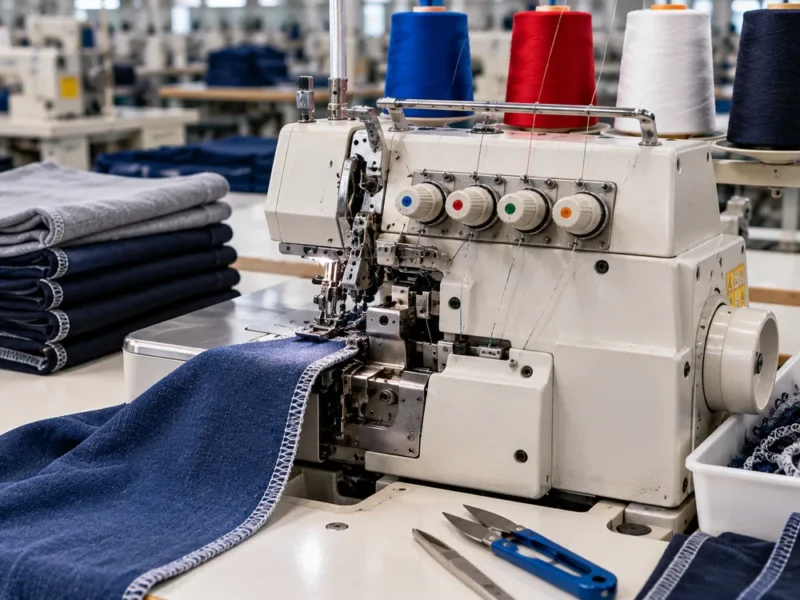
The types of feed in sewing machines decide how fabric moves under the needle, one stitch at a time. It sounds like a small detail, but feed is behind many of the sewing problems a line sees every day: puckered seams, stretched knits, plies that slip against each other, uneven stitch length and thick seams that refuse to move. Choosing the right feed for the fabric and the operation can solve a problem before it starts.
This guide explains what the feed system does, its main parts, and the main types: drop feed, differential feed, needle feed, compound feed, top and bottom feed, puller feed, reverse feed and jig feed. It then shows which feed suits which fabric or operation, how feed is adjusted and what goes wrong. It is written for mechanics, industrial engineers, line supervisors and anyone choosing machines.
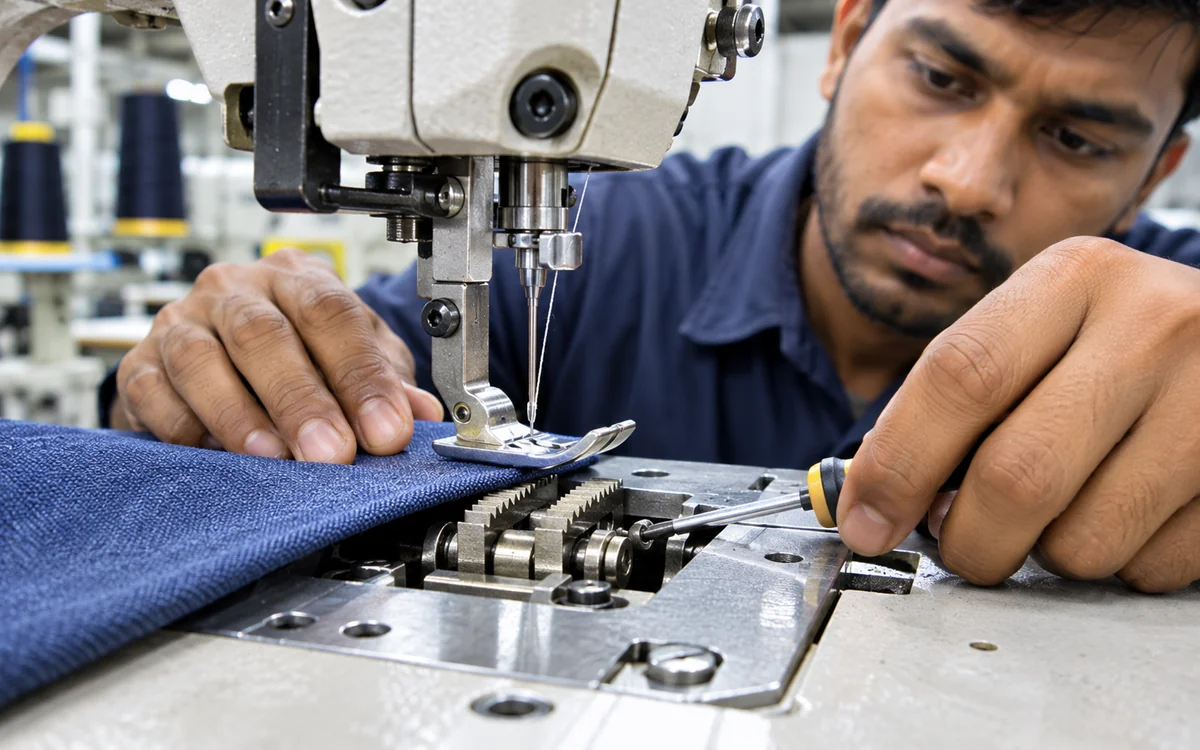
What the feed system does
A sewing machine makes a stitch, and then the fabric must move forward by one stitch length before the next stitch. The feed system does that moving. If it moves the fabric too little, the stitches bunch up. If it moves it too far, the stitches are long. If it moves the top layer and the bottom layer by different amounts, the seam puckers or the layers end up with different lengths.
So a good feed system has to do three things:
- move the fabric by the right distance for each stitch,
- move all layers by the same amount, or by a controlled difference,
- do it smoothly at the speed of the machine, without marking or damaging the fabric.
Parts of the feed system
- Feed dog. A metal plate with small teeth that rises through slots in the throat plate, grips the underside of the fabric and pulls it back, then drops below the plate.
- Throat plate (needle plate). The plate around the needle, with slots for the feed dog and a hole for the needle.
- Presser foot. Holds the fabric down against the feed dog so it can grip.
- Stitch length control. A dial or lever that sets how far the feed moves each stitch.
- Feed mechanism. The cams, rods and shafts that give the feed dog its movement.
- Needle feed or feeding foot parts. In machines with needle feed or top feed, extra parts move the needle bar or a second foot.
See parts of a sewing machine and their functions for the full list of parts.
Drop feed
The most common type. The feed dog rises through the throat plate, grips the underside of the fabric, moves it back by one stitch, then drops below the plate and returns to start again.
- Where it is used: general sewing on a wide range of fabrics, on basic lockstitch machines.
- Strengths: simple, cheap and reliable.
- Limits: it grips only the bottom layer. The top layer is held by the presser foot only, so it can drag or creep, and two plies may end up different lengths. This is the cause of many feed puckers. See seam puckering in garments.
Differential feed
A differential feed machine has two feed dogs, one in front of the needle and one behind it. Each is driven separately and can be set to a different stroke. By changing the setting, the operator can make the front feed move more or less than the rear one.
- If the front dog moves more fabric than the rear one, extra fabric is pushed into the seam, so the layers are gathered. This helps on knits that tend to stretch and go wavy.
- If the front dog moves less fabric than the rear one, the fabric is pulled tight and stretched slightly as it is sewn. This helps on light fabrics that tend to pucker.
- Where it is used: overlock machines for knit fabrics, stretchable seams, and any seam where the stretch or bunching of the fabric must be controlled.
- Strengths: a strong tool against wavy edges on knits and against puckers on light fabrics.
- Limits: needs correct setting for each fabric. Too much stretching gives a tight, rippled seam, and too much gathering gives a bunched seam.
Needle feed
In needle feed, the needle itself moves forward with the fabric while it is in the cloth. The needle bar swings, so the needle carries the fabric along as the feed dog moves it. This means the top and bottom layers both move at the point of stitching.
- Where it is used: often combined with drop feed. See compound feed below.
- Strengths: better control of the layers at the needle.
- Limits: a more complex mechanism, and it needs careful setting.
Compound feed
Compound feed combines drop feed and needle feed. The feed dog and the needle both move the fabric, so the cloth keeps moving even while the needle is still in it. Because the needle and the feed dog move together, the layers are held to each other, and there is less slipping between them.
- Where it is used: edge stitching, topstitching, seams on fabrics with checks and stripes, and any seam where the plies must stay matched.
- Strengths: reduces puckering and ply slippage, and helps keep patterns matched.
- Limits: more complex and needs good maintenance. It may not be needed for simple, plain seams.
Top and bottom feed (walking foot and unison feed)
In a top and bottom feed machine, the presser foot is replaced or helped by a feeding foot that has its own teeth. The feeding foot moves the top layer, and the feed dog moves the bottom layer, usually at the same speed. The two feeds can be adjusted separately.
- Walking foot: a foot that has two parts. One part lifts and moves forward while the other holds the fabric, so the top layer is moved together with the bottom one.
- Unison feed: needle feed, a feeding foot and the feed dog all work in unison, so the layers move together at the needle.
- Where it is used: heavy fabrics, many plies, leather, upholstery, quilting and seams with thick joins. Walking foot machines are often chosen for many plies and bulky seams in heavy fabrics.
- Strengths: layers stay together, so seams are even, and thick or slippery layers feed well.
- Limits: the feed foot can be larger, which makes it harder to sew near small details. Machines cost more.
Some top and bottom feed machines let the feeding foot work either before or after the needle. A feeding foot behind the needle can give an especially smooth seam.
Puller (roller) feed
A puller feed adds a wheel or a roller behind the needle, which pulls the sewn fabric away from the needle. It can run all the time or only at certain moments.
- Where it is used: long straight seams, such as side seams of trousers, sleeves and long seams on shirts, where puckering must be avoided.
- Strengths: helps the plies stay in step over a long seam, and keeps the sewn seam from being pushed back.
- Limits: works best on long, straight seams. It is not suited to short, curved or detailed work. The operator must not pull the fabric against the puller.
Reverse feed
Most lockstitch machines have a lever that reverses the feed, so the fabric moves backward. It is used mostly to backstitch the ends of a seam so the stitching does not unravel, or for bartacking on some machines. Chain stitch machines rarely have a reverse feed.
Check that the reverse stitches follow the forward ones, since a misaligned backstitch looks untidy and weakens the seam end. See buttonhole, bartack and attaching machines for machines that do this work automatically.
Clamp and jig feed (automatic machines)
On automatic machines, the fabric is held in a clamp or a jig, and a driven mechanism moves the jig under the needle along a set path. The path can be a bartack shape, a buttonhole, a pocket outline or any other programmed pattern.
- Where it is used: buttonhole machines, bartack machines, button sewing machines, pocket setters and pattern sewing machines.
- Strengths: exact, repeatable and fast for small, set operations.
- Limits: only suited to the operations they were made for, and a new pattern needs a new jig or program.
See list of sewing machines used in the apparel industry for the range of machines that use these feed types.
Which feed for which fabric or operation
| Fabric or operation | Feed often chosen |
|---|---|
| General woven seams | Drop feed |
| Knits, stretch seams, overlock | Differential feed |
| Edge stitching, topstitching, stripes and checks | Compound feed (drop and needle) |
| Very light or slippery fabric | Top and bottom feed, or differential feed set to stretch lightly |
| Heavy fabric, many layers, bulky seams | Walking foot or unison feed |
| Long straight seams | Puller feed |
| Backstitching at seam ends | Reverse feed |
| Buttonholes, bartacks, pocket outlines | Clamp or jig feed |
This table is a guide. The best feed also depends on the machine, the thread, the stitch and the buyer’s quality requirement.
Feed settings and adjustments
- Stitch length. Set by the stitch length control. Check it against the stitches per inch in the spec. See stitches per inch for different garments.
- Feed dog height. Teeth should rise above the throat plate by the right amount for the fabric. Too low and the fabric does not move. Too high and it can mark the cloth or bunch it.
- Teeth shape and rows. Finer teeth suit light fabrics, and coarser teeth suit heavy fabrics. More rows give a better grip.
- Presser foot pressure. Must be enough to hold the fabric against the feed dog, and not so much that the top layer drags or the cloth is marked. See sewing machine presser feet types.
- Differential ratio. On a differential feed machine, set the ratio so the seam is flat. Test on a spare piece.
- Timing. The feed motion must be timed with the needle and the hook. Timing is a job for a mechanic.
- Throat plate and foot hole size. Should match the needle size. A big hole lets thin fabric dip down.
Note these settings in the style file for each fabric, so the next order starts with a good setting. See folders in the apparel industry for tools that help guide fabric as it feeds.
Common feed problems and causes
| Problem | Likely causes |
|---|---|
| Fabric does not move or moves unevenly | Feed dog too low, worn teeth, presser foot pressure too light, lint in the feed dog slots |
| Top ply creeps or ends up longer than the bottom | Plain drop feed on slippery plies, pressure too light, no top feed |
| Seam puckers | Feed pucker from uneven plies, pressure wrong, operator pulling |
| Knit seam wavy or stretched | Differential feed set to stretch too much, pressure too heavy |
| Stitch length uneven | Worn feed parts, dirt, loose parts, speed too high |
| Fabric marked by the feed | Teeth too sharp or too high, pressure too heavy |
| Thick seams stop or stitches skip | Feed too weak for the thickness, needle deflected. See skipped stitches in sewing |
| Pattern does not match at seams | No compound or top feed, plies slipping |
| Needle breaks | Fabric pulled against the feed, wrong feed timing |
For more on checks and upkeep, see the sewing machine maintenance schedule.
Final thoughts
The types of feed in sewing machines include drop, differential, needle, compound, top and bottom, puller, reverse and clamp or jig feed. Each moves the fabric in a different way. Drop feed is the simple standard. Differential feed controls stretch and bunching. Compound and top and bottom feeds keep the layers together. A puller helps on long seams, and jig feed runs automatic machines.
Match the feed to the fabric and the operation, set the stitch length, feed dog height and presser foot pressure with care, and write the settings in the style file. When a seam puckers or the layers slip, check the feed before blaming the thread or the operator.
Frequently asked questions
Feed is the system that moves the fabric forward by one stitch length between stitches. It usually includes the feed dog, the presser foot and the mechanism that drives them.
Drop feed moves the fabric from below, with a toothed feed dog. In needle feed, the needle also moves with the fabric while it is in the cloth, which helps hold the layers together.
A feed that combines drop feed and needle feed, so the fabric keeps moving while the needle is in it. It reduces puckering and slipping between plies.
It has two feed dogs with separate strokes. It is used to gather or lightly stretch the fabric as it is sewn, which helps on knits and stretchy seams and prevents wavy, puckered or bunched seams.
A wheel or roller behind the needle that pulls the sewn fabric forward. It is used on long straight seams to avoid puckering.
A top and bottom feed, such as a walking foot or unison feed, often works well, because it moves both layers together. A differential feed set to stretch lightly also helps on some light fabrics that pucker.
Common reasons are a feed dog that is too low or worn, presser foot pressure that is too light or too heavy, lint in the feed slots, a throat plate that does not suit the fabric or an operator who pulls the cloth.