A sewing needle is the smallest part on a sewing machine and the cause of a surprising share of sewing problems. Skipped stitches, broken thread, puckered seams, holes in knit fabric and burned marks on synthetic fabric often come down to the wrong needle, or to a needle that is bent or worn. If you know the parts of a needle, you can choose the right one in seconds and explain a fault clearly.
This guide covers each part of an industrial sewing needle, how needle sizes work, the main point types and how to match a needle to a fabric. It is written for operators, mechanics and quality staff in garment factories, but it also helps home sewers. Needles are also a safety item, so factories control them closely. Our guide on the needle and sharp tools control procedure explains how this works on the floor.
What a needle does
A sewing needle has to do four jobs very quickly, often at several thousand stitches per minute.
- It must pierce the fabric cleanly.
- It must carry the upper thread through the fabric.
- It must form a small loop on the underside, so the hook or looper can catch the thread.
- It must pull back out without damaging the fabric or the thread.
Each part of the needle is designed for one of these jobs.
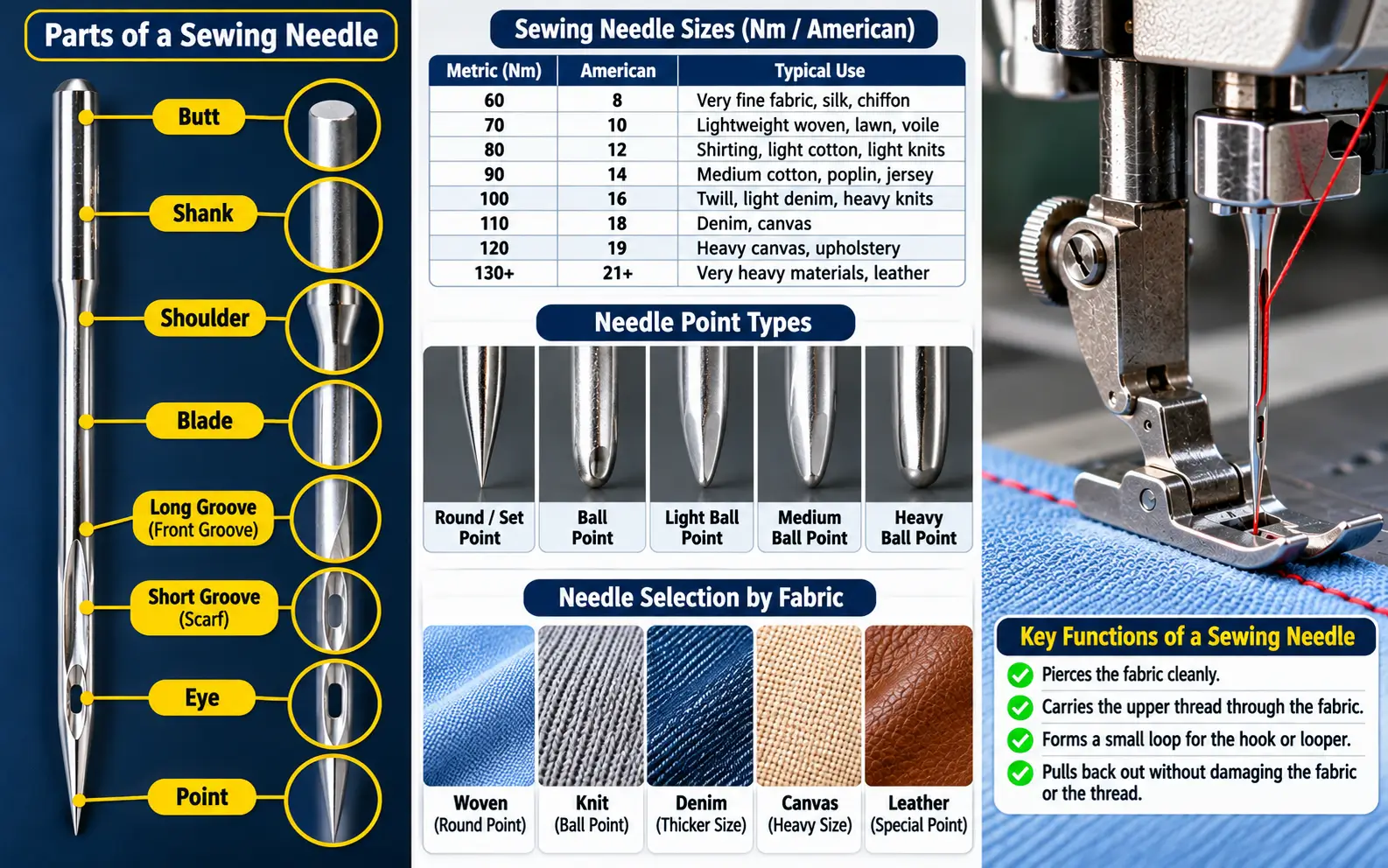
Parts of a needle at a glance
| Part | Location | Job |
|---|---|---|
| Butt | Top end | Helps insert the needle |
| Shank | Upper section | Fits into the needle bar |
| Shoulder | Where the shank narrows | Transition to the blade |
| Blade | Main body | Carries the thread and pierces the fabric |
| Long groove | Front of the blade | Guides the thread down |
| Short groove (scarf) | Back of the blade | Lets the hook reach the thread loop |
| Eye | Near the tip | Holds the thread |
| Point | The tip | Pierces the fabric |
Butt
The butt is the top end of the needle. It is slightly tapered or rounded so that the needle slides easily into the needle bar. It has no role in forming the stitch. But a damaged butt can make the needle hard to insert.
Shank
The shank is the thick upper part of the needle. It fits into the needle clamp. Industrial needles usually have a round shank. Home machine needles often have a flat side on the shank, which makes sure the needle goes in the right way. The shank diameter is standard for each needle system, so a needle of the right system will fit the machine.
Shoulder
The shoulder is the part where the thick shank tapers down to the thinner blade. It adds strength where the needle is under the most stress. Some needles have a reinforced or extra thick blade, which has a shoulder that tapers more slowly. These suit heavy fabrics, because they are less likely to bend.
Blade
The blade is the long, slim section that goes through the fabric. Its thickness decides the needle size. A thicker blade makes a larger hole and is stronger. A thinner blade makes a smaller hole but may bend or break in thick fabric.
The blade has two grooves, which are important to the stitch.
Long groove
The long groove runs down the front of the blade, on the side that faces the thread when you thread the machine. Its job is to protect the thread. As the needle pushes through fabric, the thread sits inside the groove and avoids heavy rubbing. The groove must be deep enough to hold the thread. Thick thread needs a deeper groove. If the thread is too thick for the groove, it frays and breaks.
Short groove or scarf
The short groove, called the scarf, is a cut-out on the back of the blade just above the eye. When the needle rises a little after reaching its lowest point, a loop forms on the thread. The scarf gives the hook or looper room to pass close to the needle and catch that loop. A well-shaped scarf lets the hook go safely into the loop. A poor scarf causes skipped stitches. Some needles have a larger scarf for stretch fabrics, which helps catch the loop when the fabric flexes.
Eye
The eye is the hole near the tip through which the thread passes. It is polished to prevent the thread from catching or wearing. Eye size grows with needle size. A thicker thread needs a larger eye. If the eye is too small, the thread frays and breaks. If it is too large, the stitch is loose and untidy.
A rough or damaged eye will cut the thread. This is why a needle that has hit a metal part should be replaced, even if it looks fine.
Point
The point is the tip of the needle and the most important part for fabric damage. Different points suit different fabrics. We cover the main kinds below.
How needle size works
Needle sizes are shown with two numbers, such as 80/12. The first number is the metric size (Nm). It shows the blade diameter in hundredths of a millimeter, measured above the eye. So an Nm 80 needle has a blade of about 0.80 mm. The second number is the older American size. The two scales run together.
| Metric (Nm) | American | Typical use |
|---|---|---|
| 60 | 8 | Very fine fabric, silk, chiffon |
| 70 | 10 | Lightweight woven, lawn, voile |
| 80 | 12 | Shirting, light cotton, light knits |
| 90 | 14 | Medium cotton, poplin, jersey |
| 100 | 16 | Twill, light denim, heavy knits |
| 110 | 18 | Denim, canvas |
| 120 | 19 | Heavy canvas, upholstery |
| 130 and above | 21 and above | Very heavy materials, leather |
In practice, a smaller needle for a given fabric makes a neater seam with less puckering. But the needle must be strong enough not to bend, and it must be big enough for the thread. A common rule is that the thread should fit freely into the long groove and eye.
The needle size, the thread size and the fabric weight should be a matched set. If you change one, check the others.
Point types
Round or set point
A round point is rounded at the tip, with a fine taper. It pierces the fabric by parting the yarns, not cutting them. It is the standard point for woven fabric. Sharp needles of this type give the neatest seams on tightly woven fabrics. The most common round point is often called a regular or set point.
Ball point
A ball point has a rounded tip. It pushes between the yarns of knit fabric instead of cutting them. This prevents holes and runs. There are several grades.
- Light ball point: For fine knits. It reduces damage to delicate fibers.
- Medium ball point: For general jersey and rib.
- Heavy ball point: For thick knits and fleece.
If a ball point is too round, it may skip stitches because it cannot pierce the fabric easily. If it is too sharp, it may cut yarns and cause holes. Operators match the ball grade to the fabric.
Cutting points
Cutting points have sharp edges that slice through the material. They are used for leather, vinyl and some coated fabrics, because those materials do not open when pierced. Cutting points include wedge and diamond shapes. They should never be used on regular woven or knit fabrics, because they would cut the fibers and weaken the seam.
Stretch needles
Stretch needles have a slightly larger scarf and a medium ball point. They are made for highly elastic fabrics such as spandex and Lycra blends. The deeper scarf lets the hook catch the thread loop more reliably when the fabric flexes.
Needle systems
A needle system is a code for the needle’s shank size, length and design. Machine makers specify the system that fits their machines. Common systems in garment factories include:
- DBx1: Common on lockstitch machines for woven garments.
- DPx5 (also written 135×5 or 134): Another widely used lockstitch system, often chosen for medium to heavy fabrics.
- UY 128 GAS and DCx27: Used on overlock machines.
- Flatlock and cover stitch systems: Special needles for these machines.
Using the wrong system is a quiet cause of defects. The needle may fit, but the distance between the needle and the hook, called the timing, will be off. Always use the system that the machine manual lists. If you are unsure, check the needle’s marking or the machine plate.
Needle coating and material
Needles are made from hardened steel and often plated with nickel or chrome. Plating reduces friction and wear. Some needles have a titanium nitride coating. This coating is gold in color and is much harder than steel. It resists heat, so it lasts longer on synthetic fabrics and on fused or glued areas where heat builds up.
At high sewing speeds, the needle can heat up and melt synthetic thread. A cooler-running needle, with a smooth finish, helps. Some factories also use cooling devices that blow air at the needle.
Matching needle to fabric
| Fabric | Needle point | Typical size |
|---|---|---|
| Silk, chiffon | Light round or fine | 60 to 70 |
| Lawn, poplin, shirting | Round | 70 to 80 |
| Cotton twill | Round | 90 to 100 |
| Denim | Round or jeans point | 100 to 110 |
| Single jersey | Light ball | 70 to 80 |
| Rib or interlock | Medium ball | 80 to 90 |
| Fleece | Medium to heavy ball | 90 to 100 |
| Lycra/spandex | Stretch ball | 75 to 90 |
| Leather | Cutting point | 90 to 110 |
| Canvas | Round, heavy | 110 to 120 |
Use this table as a starting point. Always sew a test seam on the actual fabric and look for skipped stitches, holes and puckering.
Needle problems and their causes
| Problem | Likely cause |
|---|---|
| Skipped stitches | Dull, bent or wrong needle, wrong ball point, timing off |
| Broken thread | Eye too small, burr on the eye, needle too hot |
| Thread fraying | Groove too shallow for the thread |
| Holes in knit | Sharp point on knit fabric |
| Puckered seam | Needle too large for fabric |
| Needle breakage | Fabric too thick, needle too fine, bent needle or hitting a part |
| Burned marks or melted threads | Needle heat on synthetic fabric |
| Fabric snags | Burred point |
| Noise | Bent needle |
| Loose stitches | Needle size and thread mismatch |
These problems also show up on our list of seam defects. See our guide on sewing defects and root causes for a broader view.
When to change a needle
A needle wears with every stitch. At 4,000 stitches per minute, it penetrates the fabric more than 200,000 times an hour. A tiny burr on the point is enough to cut yarns in a garment.
Good practice includes:
- Change needles on a fixed schedule, based on fabric and hours of use.
- Change immediately after a needle break, skipped stitch spells or any hit with metal.
- Change needles when starting a new style with a different fabric.
- Keep a needle change log by machine.
- Use a magnifier or touch test to check for burrs. A quick check is to draw the needle across a nylon stocking. If it snags, it should be replaced.
Factories often make the operator hand in the old needle before getting a new one. This way every broken needle piece is accounted for. A missing piece could be inside a garment. After sewing, garments pass through a metal detector, which is another safety layer. See our guide on the metal detection procedure in apparel.
Needle care tips
- Store needles in labeled containers by size and point.
- Do not mix used and new needles.
- Insert the needle all the way up into the clamp.
- Check the flat side faces the right way if your machine has one.
- Tighten the screw firmly but not too hard.
- Rethread the machine after changing a needle.
- Run a test stitch on scrap fabric before starting.
Final thoughts
A needle is a tiny tool with a complex shape. The shank fits it to the machine, the blade carries the thread, the long groove protects it, the scarf lets the hook catch the loop, the eye holds the thread and the point enters the fabric. When a fault appears, look at the needle first. Check its system, its size, its point type and its condition. Many problems end right there, and it costs only a few cents to fix.
Frequently asked questions
The main parts are the butt, shank, shoulder, blade, long groove, short groove (scarf), eye and point.
They show the size. In 80/12, 80 is the metric size, which is the blade diameter in hundredths of a millimeter. 12 is the older American size.
The scarf is the cut-out on the back of the blade above the eye. It gives the hook room to catch the thread loop and form a stitch.
A ball point needle is for knit fabric. Its rounded tip slips between the yarns without cutting them, so it prevents holes and runs.
Change it on a regular schedule, and any time it is bent, blunt or hits a hard object. In factories, schedules are set by fabric and machine hours.
It is better not to. A sharp round point can cut knit yarns, and a ball point may skip stitches on tight woven fabric.
Common causes include a needle eye that is too small, a burr on the eye, wrong thread size or wrong tension. Try a larger needle or a fresh one.