
A good pair of scissors feels like part of your hand. A bad pair chews the fabric, tires your wrist and leaves ragged edges. In a sewing room, scissors are used all day long, from cutting thread to trimming seam allowances. If you know the parts of scissors, you can choose a good pair, keep it sharp and fix small problems before they ruin your work.
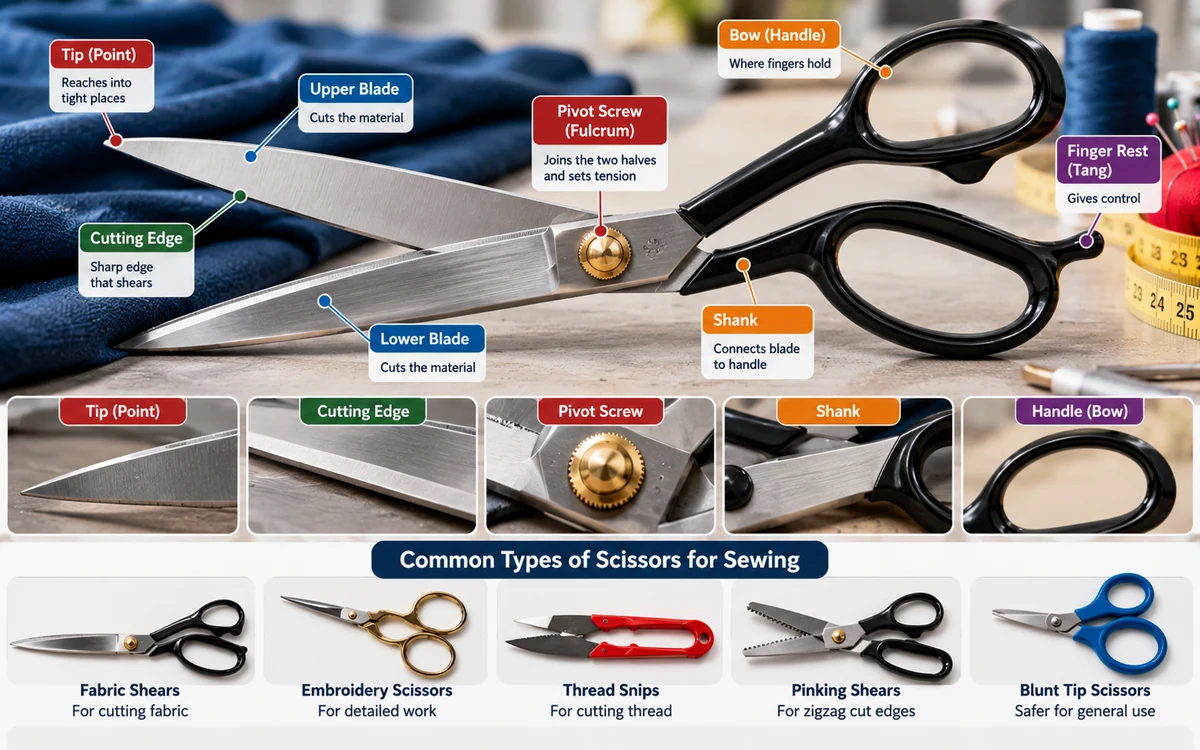
This guide names every part of a pair of scissors, explains what it does and describes the main types used for fabric and sewing. It also covers care, sharpening and common faults. If you work in a garment factory, you will see these tools at every table, from cutting to finishing. See our guide on needle and sharp tools control procedure for how factories track them.
How scissors work
Scissors are two levers joined at a pivot. Each lever has a blade on one side and a handle on the other. When you close the handles, the blades slide past each other and cut the material between them. The cutting happens at the point where the two blades cross. As the blades close, that point moves from the pivot toward the tip.
This sliding action is what makes scissors different from a knife. A knife pushes through. Scissors shear. Shearing leaves a cleaner edge, especially on fabric, because the material is held between two edges for a moment before it is cut.
Parts of scissors at a glance
| Part | Location | Job |
|---|---|---|
| Blades | Front | Cut the material |
| Cutting edge | Inside of each blade | The sharp edge that shears |
| Tip (point) | End of blade | Reaches into tight places |
| Pivot screw (fulcrum) | Middle | Joins the two halves and sets tension |
| Shank | Between pivot and handle | Connects blade to handle |
| Bow (handle) | Back | Where fingers hold |
| Finger rest (tang) | Beside the bow | Gives control |
| Spring (if present) | Between handles | Opens the blades |
| Lock or cover | Handle | Closes the blades for storage |
Blades
Each blade is a flat, tapered piece of steel. It has two sides.
- Cutting edge: The inner edge that does the cutting. It is ground at a slight angle, often around 70 to 80 degrees on the inner face.
- Outer face: The outside face of the blade. It is flat or slightly hollow.
The edges must meet exactly along their length. If they do not, the scissors will fold the fabric instead of cutting it. The blade length varies. Embroidery scissors have blades of 7 to 10 cm. Fabric shears have blades of 20 cm or more.
Blade material
Most good fabric shears use hardened steel. Common materials include:
- Carbon steel: Takes a very sharp edge but can rust.
- Stainless steel: Resists rust and stays clean, though it is slightly harder to sharpen.
- High-carbon stainless steel: A mix of both. Sharp and corrosion resistant.
- Titanium coated: A coating on top of steel, which reduces friction and wear.
Serrated blades
Some scissors have a fine serrated edge on one blade. The tiny teeth grip slippery fabric like silk or chiffon, so it does not slide away. Serrated blades suit light, slippery material. They are not used for fine tailoring cuts where a perfectly smooth edge is wanted.
Tip
The tip is the end of the blade. It can be sharp (pointed) or blunt (rounded).
- Sharp tips: Used for detailed work like clipping into corners or cutting thread. They can stab, so need care.
- Blunt tips: Safer for school and children’s use. They also help avoid snagging the fabric when cutting a long straight line.
Pivot screw
The pivot screw holds the two halves together at the center. It is also known as the fulcrum. Its tightness decides how the scissors feel.
- If the screw is too loose, the blades gap and fold the fabric.
- If it is too tight, the scissors feel stiff and wear quickly.
A good pair of fabric shears should open and close smoothly, with no wobble and no grinding. On better scissors, a spring-loaded or adjustable pivot lets you tune the tension. Some use a nut or a tension screw.
A drop of oil on the pivot keeps it smooth. Do not overtighten it, because it can damage the blades.
Shank
The shank is the neck of the scissors, between the pivot and the handle. It carries force from your hand to the blades. On heavy shears, the shank is thick and strong. On embroidery scissors, it is slim and light.
Bows and handles
The bows are the ring-shaped handles where you put your fingers. There are two bows on each pair of scissors. On most models, one is larger for the fingers and the other smaller for the thumb.
Handle shapes
- Symmetrical handles: Both bows are the same size. Common on household scissors.
- Offset handles (bent handles): The handle is angled away from the blade. This lets the lower blade lie flat on the table while cutting. Bent handle shears are the standard choice for cutting patterns, because they keep the fabric flat and give a more accurate cut.
- Ergonomic handles: Shaped to fit the hand and reduce strain. Useful for people who cut for long hours.
- Spring-action handles: Have a small spring that opens the blades automatically. Common on thread snips and light-duty scissors.
Handle material
Handles are often made of plastic, rubber-coated plastic or metal. Plastic is light and cheap. Rubber coating gives better grip. All-metal handles feel solid but may be heavy.
Finger rest
On some shears, there is a small projection on the handle called a finger rest, or tang. You rest your index finger on it for better control. It is useful in long cutting lines, because it keeps the blades steady.
Left-handed and right-handed scissors
Scissors are not always symmetrical. In a right-handed pair, the right blade is on top as you hold it. When you close it, the blades cross in a way that suits the pressure of your right thumb. If a left-handed person uses right-handed scissors, the pressure pushes the blades apart and the cutting becomes poor. Left-handed scissors are built with the opposite blade on top.
Types of scissors for sewing
Different tasks need different scissors.
Fabric shears
Fabric shears are the main cutting tool for fabric. They have long blades, bent handles and sharp cutting edges. They are used only for fabric. Cutting paper dulls the blades quickly.
Pinking shears
Pinking shears cut a zigzag edge. This stops woven fabric from fraying as fast. They are used to finish seam allowances.
Embroidery scissors
Small, sharp-pointed scissors for trimming thread and cutting small details. The blades are short, fine and often curved.
Thread snips
A tiny pair of spring-loaded scissors, used at sewing machines to trim thread ends. In many factories, snips are tied to the operator’s table with a string, so they cannot be lost in a garment.
Tailor’s shears
Heavy-duty scissors with long blades. They cut multiple layers and thick fabrics like wool and denim.
Rotary cutters
A rotary cutter has a round blade on a handle. It is not a scissor, but it is often used with a cutting mat. It cuts straight lines quickly and works well on layers.
Electric scissors
Electric shears have a motor and cut through several layers of fabric. They are used in cutting rooms. For more on cutting machines, see our guide on automatic and manual fabric cutting machines.
Buttonhole scissors
Specialized scissors with an adjustable screw, used to cut buttonholes to a precise length.
Sharpness and the cutting angle
The angle of the blade edge is important. A very thin edge cuts easily but dulls fast. A thicker edge lasts longer but needs more force. Fabric shears are usually ground at an angle that balances both.
A sharp pair of scissors cuts fabric with little effort. If you must press hard, or the fabric folds into the blades, the scissors are blunt or poorly adjusted.
Simple tests for sharpness:
- Cut through a single sheet of tissue paper. It should cut cleanly along the whole blade.
- Cut through a thin silk or cotton scrap. It should not fold.
- Try cutting near the tip. The tip should cut as well as the middle.
Scissors in a garment factory
In a factory, scissors are a controlled tool. Each pair is numbered and kept at a fixed workstation, and a broken blade must be accounted for before the shift ends. Thread snips are often tied to the table with a short cord so they cannot fall into a garment. At the end of each shift, a supervisor checks that every pair is present. This matters because a lost blade tip could end up in a garment, and buyers run a metal detection check on finished goods. In the cutting room, the cutters and the section follow written steps, which you can read in our cutting section SOP. For quality checks after cutting, see our guide on quality control of garments cutting section.
How to choose a good pair
- Match the task. Use long shears for pattern cutting, snips for thread and small scissors for detail work.
- Check the weight. Heavy shears give steady cuts but tire the hand. Light shears are quicker but can wander.
- Try the handle. Your fingers should fit the bows without pinching.
- Open and close them. The motion should be smooth, with no grinding.
- Look at the blade edges. They should meet cleanly, with no gap along the length.
- Think about the hand. If you cut for hours, bent and ergonomic handles are worth the extra cost.
Care and storage
- Use fabric scissors only for fabric.
- Wipe the blades clean after use.
- Oil the pivot occasionally.
- Store scissors closed, with a cover on the blades if possible.
- Keep them dry to avoid rust.
- Do not drop them. A fall can bend the blades or ruin the pivot.
- Sharpen them regularly. Many people use a professional sharpener. A poor sharpening can ruin the edge.
Common problems and fixes
| Problem | Likely cause | Fix |
|---|---|---|
| Fabric folds between blades | Loose pivot or dull edge | Tighten pivot, sharpen |
| Scissors stiff to open | Too tight or dirty pivot | Loosen slightly, oil |
| Ragged edge | Dull blades | Sharpen |
| Blades gap at the tip | Bent blade | Professional repair |
| Rust spots | Moisture | Clean, dry and oil |
| Hand pain | Poor handle shape | Use ergonomic handles |
| Cuts uneven | Wrong blade for task | Use proper fabric shears |
Final thoughts
Scissors look simple, but each part has a job. The blades cut, the pivot holds them together, the shank carries force and the bows give control. Choose a pair with blades that suit your material, handles that suit your hand and a pivot that moves smoothly. Keep them for fabric only, clean them after use and sharpen them when the cut starts to fold. A well-kept pair can serve for many years, and it makes every sewing job easier.
Frequently asked questions
The main parts are the two blades, the pivot screw, the shank and the two bows (handles). Some have a spring or a finger rest.
It is called the pivot screw or fulcrum. It joins the two halves and controls how the blades meet.
Bent handles let the lower blade lie flat on the table while the fabric rests on it. This gives a more accurate cut and less strain on the hand.
It is best not to. Paper contains fillers that wear down the blade edge, making the scissors dull for fabric.
Pinking shears cut a zigzag edge that stops woven fabric from fraying so quickly. They are used for seam allowances.
It depends on how much you cut. Many sewists sharpen their scissors once a year. Heavy factory use needs more frequent checks.
Shears are scissors with blades longer than about 15 cm, often with bent handles and different-sized bows. Scissors are shorter with equal-sized handles.

