
Two mills can buy dyeing machines from the same manufacturer, run similar fabric, and still end up with meaningfully different cost structures, simply because one chose a machine matched to its actual fabric mix and batch pattern, and the other bought based on capacity alone. Processing machinery decisions carry consequences that compound daily, in water and energy use, in cycle time, in how flexibly a mill can respond to a shade change or a rush order, which makes this category worth more deliberate planning than “buy the biggest machine the budget allows.”
How This Guide Is Organized
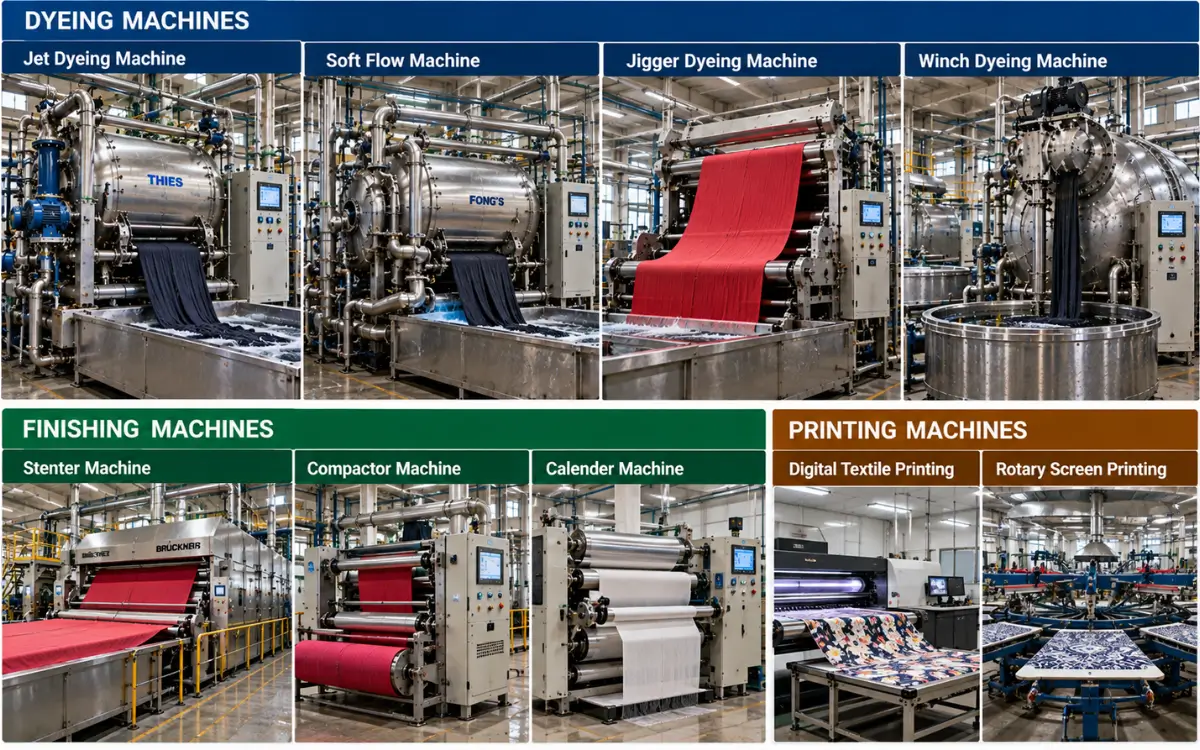
Wet processing machinery clusters into a few functional categories. Dyeing machines themselves vary considerably by fabric type and batch approach. Finishing machines shape, stabilize, and stretch fabric to final dimension and hand feel. Printing machinery rounds out the list for mills running that as part of their offering. This guide walks through the major categories and the criteria that should drive selection, with related articles going deeper on specific comparisons and calculations.
Dyeing Machine Types
For a full machinery list covering a knit composite dyeing and garments operation end to end, see this knit composite factory machinery list. Jet dyeing machines circulate fabric through a jet of dye liquor, commonly used for knit fabrics and offering good dye penetration and relatively fast cycle times, typically running at lower liquor ratios than older machine generations, which matters considerably for water and chemical consumption as covered in our Textile Chemicals guide. Soft flow machines, a gentler variant within the jet dyeing family, reduce mechanical stress on delicate knit fabrics while retaining much of jet dyeing’s efficiency advantage. Jigger machines run fabric back and forth through a stationary dye bath in open-width form, well suited to woven fabrics where the gentler, tension-controlled handling jiggers offer helps avoid the creasing that rope-form machines can cause on certain woven constructions. Winch dyeing machines handle fabric in rope form through a slower, more traditional process, still used for certain fabric types and smaller batch sizes where the capital cost of newer technology isn’t justified by the volume involved.
Each of these machine types suits different combinations of fabric type, batch size, and liquor ratio requirement, and the comparison article goes through the trade-offs in more depth, since the “right” dyeing machine genuinely depends on what a mill is actually running rather than which technology is newest.
Liquor Ratio: The Number That Drives Running Cost
Liquor ratio, the ratio of dye liquor volume to fabric weight in a given batch, is one of the single largest drivers of a dyeing machine’s running cost, since it directly determines water consumption and, proportionally, the salt and chemical needed to maintain effective concentration in the dyebath. Modern low liquor ratio machines have driven meaningful reductions in water, chemical, and energy consumption compared to older equipment running the same fabric type, and the dedicated article on liquor ratio works through exactly what moving to a lower ratio machine actually saves per batch, in concrete terms rather than a general efficiency claim.
Finishing Machinery
Stenter machines stretch and heat-set fabric to a controlled final width and dimensional stability, using a combination of chamber temperature, overfeed setting, and line speed that needs to be tuned to the specific fabric being processed. Getting stenter settings wrong is a common source of bowing (where the fabric’s grain distorts diagonally), shade variation across the fabric width, and dimensional faults that only become apparent once the fabric is cut into garment panels. The dedicated stenter article covers settings and common faults in depth.
Compactor machines, both tubular and open-width configurations, control shrinkage in knit fabric by mechanically compressing the fabric structure before it reaches the customer, reducing the residual shrinkage a garment will otherwise experience in its first several washes. Calender machines apply heat and pressure between rollers to affect surface finish, commonly used for a smoother, sometimes slightly glazed surface effect depending on the specific calendering approach used. Both machine types are covered in more depth in their own article, including where each sits in a typical knit finishing sequence.
Printing Machinery
For mills offering printed fabric, the choice between digital textile printing and rotary screen printing has shifted considerably over the past decade as digital printing technology has matured. Digital printing offers no screen setup cost, fast turnaround, and genuine cost advantage at low to moderate run lengths, while rotary screen printing retains a cost advantage at high run lengths once screen setup cost is amortized across a larger print quantity. The dedicated comparison article works through where the actual cost-per-meter breakeven tends to sit between the two approaches.
Capacity Planning: Matching Machine Mix to Actual Demand
A dyeing floor’s real output capacity depends on more than the sum of individual machines’ rated capacity. Batch size, cycle time per batch (which varies by process, shade, and machine type), and shade changeover time between batches all factor into what a dyeing floor can actually produce in a given period, and a machine mix that looks adequate on paper, based on rated capacity alone, can still create a real production bottleneck if cycle time and changeover patterns aren’t accounted for. The dedicated capacity planning article works through this calculation in more depth, including how to identify which specific machine in a mixed fleet is quietly capping the floor’s total output.
Matching Machinery Investment to Product Development Cycles
Processing machinery decisions don’t happen in a vacuum separate from a mill’s product development calendar, and mills that treat capacity planning as disconnected from seasonal buying cycles often find themselves either short of capacity right when order volume peaks, or carrying expensive idle capacity through the slower parts of the year. A mill serving buyers with pronounced seasonal ordering patterns, heavier volume ahead of specific retail seasons, benefits from mapping machinery capacity planning directly against that calendar, timing major capacity additions to come online with enough lead time to be fully commissioned, tested, and staffed before the peak ordering window arrives, rather than rushing a new machine into production mid-peak-season when there’s no slack in the schedule to properly trial its settings the way the stenter and compactor trial protocols covered elsewhere recommend.
This timing consideration also affects the used-versus-new decision covered in a related article. A mill facing a near-term capacity crunch ahead of a seasonal peak may have less time available for the extended diligence a used machinery purchase properly requires, which can tip the calculation toward new equipment with a defined, reliable lead time even where a used machine’s total cost of ownership might otherwise look more attractive on paper.
Utility Demand Behind Dyeing and Finishing Machinery
Dyeing and finishing machinery draws heavily on a mill’s utility systems, steam for heating dyebaths and drying, electricity for motors and heating elements, compressed air for certain pneumatic functions, and water, treated to whatever quality standard the process requires, in volumes that scale directly with liquor ratio and batch frequency. This connects directly to our Utilities and Energy guide, and machinery selection decisions made without accounting for the utility capacity and running cost they’ll actually demand are a common source of mismatched capital planning, where a mill invests in dyeing capacity that its utility infrastructure can’t actually support at full rated output.
Maintenance Across Processing Machinery
Processing machinery carries the same maintenance discipline requirements covered for sewing floor equipment in our Garment Machinery guide, adapted to the specific demands of dyeing and finishing equipment. Dyeing machines in particular need regular attention to seals, pumps, and heating elements given the combination of moisture, heat, and chemical exposure they operate under continuously, conditions considerably harsher than a sewing machine’s typical operating environment. Stenter chains and heating elements need scheduled inspection given how directly their condition affects the bowing and shade uniformity faults covered in the dedicated stenter article. A processing machinery maintenance program that treats these systems with the same daily, weekly, and monthly discipline outlined for sewing equipment elsewhere avoids the same category of expensive, avoidable downtime that under-maintained sewing machines create, just at a larger scale given processing machinery’s typically higher individual unit cost and centrality to a mill’s total output.
New Versus Used Machinery in This Category
Processing machinery represents a real capital commitment, and used equipment is a genuine option for mills managing that investment carefully, particularly for well-established machine types where the underlying technology hasn’t changed dramatically in recent years. The trade-offs, remaining working life, control system compatibility with current automation standards, and spare parts availability for older machine generations, deserve real diligence before a used equipment purchase, which is exactly what the dedicated inspection checklist article is built to support.
A Worked Illustration of Total Cost of Ownership
To make the running-cost argument concrete before the dedicated liquor ratio article goes deeper, consider two dyeing machines processing the same 500,000 kilograms of fabric a year. Machine A costs $180,000 installed and runs at a 1:10 liquor ratio. Machine B costs $260,000 installed, a $80,000 premium, but runs at 1:6.
Using the same water, energy, salt, and chemical cost logic worked through in the liquor ratio article, that liquor ratio difference alone might save on the order of $0.10 to $0.15 per kilogram of fabric processed, which across 500,000 kilograms a year works out to $50,000 to $75,000 in annual savings. Against an $80,000 capital premium, that’s a payback period of roughly 13 to 19 months, meaning Machine B’s higher purchase price is recovered well within its first two years of operation, with every year after that representing pure additional savings compared to what Machine A would have cost to run. This is exactly the kind of calculation that purchase price alone completely misses, and exactly why the total-cost-of-ownership framing matters more in processing machinery than in almost any other capital category covered across this guide.
Automation and Digital Control Trends
Processing machinery across every category covered in this guide has moved steadily toward more sophisticated digital control over the past decade, and this shift affects the buying decision in ways beyond the core mechanical function each machine type performs. Modern dyeing machines increasingly offer programmable process profiles that can store and recall recipe-specific temperature, time, and liquor ratio settings, reducing the process variation that comes from manual recipe execution and making it considerably easier to reproduce a successful batch’s exact conditions on a repeat order. Stenter machines with digital zone-by-zone temperature control and data logging make the fault diagnosis covered in the dedicated stenter article faster, since a logged temperature profile can be reviewed after the fact when a bowing or shade variation problem shows up, rather than relying purely on operator memory of what settings were actually running.
This digital control layer carries its own selection considerations beyond the mechanical comparison covered throughout this guide. Control system compatibility and software support, covered in more depth in the used machinery checklist, matters increasingly for new machinery purchases too, not just used equipment evaluation, since a mill standardizing on a specific control platform across its processing floor gains real operational benefit from staff familiarity and easier data integration across machines, a benefit that erodes if new purchases introduce yet another distinct control system the team has to learn separately.
Running Cost: The Comparison That Actually Matters
Purchase price differences between competing dyeing and finishing machine options are often smaller than the running cost differences that accumulate over years of operation. Liquor ratio’s effect on water, chemical, and energy consumption, covered above and in more depth elsewhere, typically outweighs a modest difference in machine purchase price within a relatively short operating period. Evaluating machinery purchases on total cost of ownership, purchase price plus a realistic projection of running cost over the machine’s expected working life, gives a far more accurate picture than purchase price comparison alone, and it’s the same total-cost framework our Garment Machinery guide applies to sewing floor equipment.
Environmental Performance as a Selection Factor
Beyond the direct cost arguments covered throughout this guide, processing machinery selection increasingly factors into a mill’s broader environmental performance profile, connecting directly to our ZDHC wastewater guideline and general environmental compliance considerations covered in the Textile Chemicals guide. Machine choices that reduce water and energy consumption per kilogram of fabric processed, low liquor ratio dyeing equipment being the clearest example covered, don’t just reduce direct operating cost, they also reduce the volume and treatment burden a mill’s effluent system needs to handle, connecting machinery selection directly to our effluent treatment approach and cost covered in the Utilities and Energy guide. Mills evaluating machinery purchases purely on production cost grounds, without factoring in this downstream effluent treatment connection, sometimes miss a meaningful part of the total cost and environmental performance picture that a more integrated evaluation would reveal.
Evaluating the Supplier, Not Just the Machine
The machine categories and comparisons covered throughout this guide assume a well-functioning relationship with whichever supplier or manufacturer a mill ultimately buys from, and that relationship deserves its own evaluation separate from the technical machine comparison. Installation and commissioning support, whether the supplier provides genuine on-site setup assistance and initial process trial support or simply delivers a crate and a manual, affects how quickly new equipment actually reaches its rated performance in practice. Training support for the mill’s own operators and maintenance staff, covered in the used machinery checklist as a factor in the buying decision, applies equally to new equipment purchases, since even the best-specified machine underperforms if the team running it hasn’t been properly trained on its specific controls and process capabilities. And a supplier’s willingness to support process troubleshooting after installation, not just during the initial commissioning period, is worth confirming explicitly before a purchase, since processing machinery problems sometimes only emerge once a mill has been running real production for weeks or months, well past a typical initial support window.
A Practical Selection Checklist
Pulling this guide’s guidance into a usable checklist for an actual purchasing decision: confirm the fabric types and typical batch sizes the machine needs to serve before comparing specific models, request liquor ratio figures at actual operating capacity rather than a manufacturer’s best-case figure, calculate total cost of ownership using the method illustrated above rather than comparing purchase price alone, confirm utility capacity, steam, power, and where relevant compressed air, can actually support the machine’s demand at full rated output, and factor in spare parts availability and service response time using our same diligence covered for sewing machinery in the Garment Machinery guide, since processing machinery carries the same real-world downtime risk from a thin parts network that sewing equipment does.
Bringing It Together
Every comparison and calculation method covered across these related articles traces back to the same underlying principle laid out in this guide: processing machinery decisions should be driven by the actual fabric, batch pattern, and cost structure a specific mill operates under, not by brand reputation, the newest available technology, or what a competitor down the road happens to be running. A jigger that’s the obviously right choice for one mill’s woven-heavy portfolio can be the wrong choice for a knit-focused operation next door, and neither mill is wrong for reaching a different conclusion, because they’re solving genuinely different problems. Reading this guide alongside the related articles below gives a mill the framework and the calculation methods to reach its own specific, correct answer, rather than importing someone else’s answer to a question that isn’t quite the same as the one this mill actually needs to solve.
Where to Go Next
The related articles below go deeper into specific decisions: comparing dyeing machine types directly, stenter settings and fault diagnosis, how knitting machine gauge affects fabric GSM, digital versus rotary printing economics, compactor and calender machine function in knit finishing, liquor ratio’s real cost impact, dyeing capacity planning method, and a used machinery inspection checklist. Together they build out the practical detail behind the framework laid out here.
Frequently Asked Questions
What’s the single biggest cost driver in dyeing machine selection?
Liquor ratio, since it directly affects water, energy, salt, and chemical consumption simultaneously, often outweighing a modest purchase price difference within a relatively short operating period.
Should a mill buy the newest dyeing technology available?
Not automatically. The right machine depends on the mill’s actual fabric mix, batch pattern, and cost structure, not which technology is newest. A jigger that’s right for a woven-heavy mill can be wrong for a knit-focused one.
Does finishing machinery need the same total-cost-of-ownership analysis as dyeing machinery?
Yes. Stenters, compactors, and calenders carry real running costs, energy for stenter heating especially, that should factor into purchase decisions the same way liquor ratio factors into dyeing machine selection.
How does utility capacity affect a dyeing machinery purchase decision?
A dyeing machine’s rated capacity means nothing if the boiler can’t supply steam fast enough or compressed air pressure drops during peak demand, which is why utility capacity needs to be confirmed before finalizing a machinery purchase, not assumed.
