Ask two mills what they pay per kilogram to dye a comparable fabric, and a meaningful chunk of any gap between their answers often traces back to a single number: liquor ratio. It’s one of those variables that sounds like a technical detail but actually functions as one of the biggest cost levers in the entire dyeing process, touching water, chemical, salt, and energy cost simultaneously.
Published research on this exact relationship backs up the scale of what’s at stake: reducing liquor ratio from 1:10 to 1:8 has been documented to deliver roughly a 20 percent reduction in water consumption and a corresponding 15 percent reduction in processing cost, a real, measured figure rather than a theoretical estimate. That’s from a modest two-point reduction in ratio. The gap between an older winch machine running 1:12 or higher and a modern low-liquor jet machine at 1:5 or 1:6 is considerably larger, which is exactly why the worked example below shows savings in the range it does.
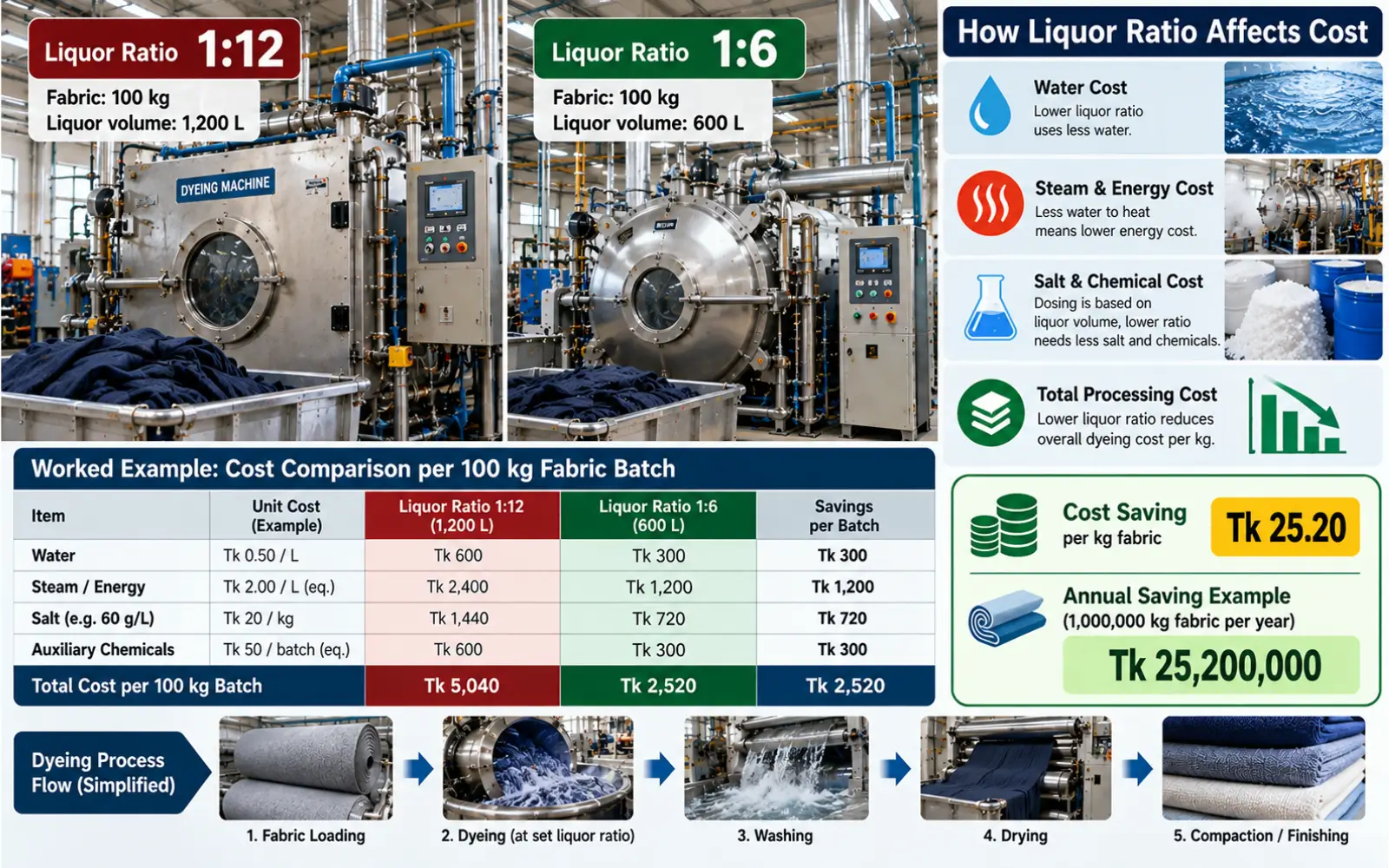
What Liquor Ratio Actually Measures
Material to liquor ratio expresses the relationship between fabric weight and the volume of dye liquor (water plus dissolved dye and chemicals) used to process it, commonly written as a ratio like 1:8 or 1:6, meaning 8 or 6 liters of liquor per kilogram of fabric. A lower ratio means less liquor volume relative to fabric weight, and a higher ratio means more.
This single number cascades into nearly every other cost in the batch. More liquor volume means more water to source and heat, more salt needed to maintain effective dyebath concentration at that larger volume, and more chemical auxiliaries needed for the same reason, since most chemical dosing is calculated as a percentage of liquor weight, not fabric weight directly.
How Liquor Ratio Drives Water Cost
Water cost scales directly and linearly with liquor volume, which itself scales directly with liquor ratio for a given fabric weight. Moving from a higher ratio machine to a lower ratio machine on the same fabric weight can meaningfully reduce total water consumption per batch, and that reduction applies to every batch run on the lower-ratio machine going forward, not as a one-time saving but as a permanent shift in the mill’s per-kilogram water cost structure.
How Liquor Ratio Drives Steam and Energy Cost
Water doesn’t just cost money to source, it costs money to heat to process temperature, and that heating cost scales with liquor volume the same way water sourcing cost does. A higher liquor ratio batch needs proportionally more steam or other heating energy to bring its larger water volume up to dyeing temperature, and this energy cost, often larger in absolute terms than the raw water cost itself depending on local energy and water pricing, is one of the less visible but larger costs liquor ratio actually drives.
How Liquor Ratio Drives Salt and Chemical Cost
Reactive dyeing, covered in more depth in Textile Chemicals guide, relies on salt to drive dye exhaustion onto the fiber, and salt dosage is typically calculated as a percentage of liquor weight. A higher liquor ratio batch, with more liquor weight to dose salt against, consumes proportionally more salt to achieve the same effective dyebath concentration as a lower liquor ratio batch dyeing the same fabric weight to the same shade. The same logic applies to most other liquor-weight-dosed auxiliary chemicals in the recipe.
Calculating the Real Savings From a Lower Ratio Machine
To put an actual figure on what moving to a lower liquor ratio machine saves, take the liquor volume difference per kilogram of fabric between the current and proposed machine, multiply by water cost per liter (including the energy cost to heat it, not just the raw water charge), then separately calculate the salt and key auxiliary chemical savings from the reduced liquor weight at typical dosing percentages for your actual recipes. Summing these gives a genuine per-kilogram cost saving that can be multiplied by expected annual fabric throughput to arrive at a real annual savings figure, which is the number that actually matters for evaluating whether a lower liquor ratio machine’s capital cost is justified.
This calculation follows the same total-cost-of-ownership logic covered elsewhere in this guide: purchase price alone doesn’t tell the full story, and a machine with a higher upfront cost but meaningfully lower liquor ratio can produce a shorter real payback period than comparing purchase price alone would suggest, once water, energy, salt, and chemical savings are all properly accounted for.
A Worked Savings Example
Here’s the calculation from the section above run with illustrative numbers, which you should replace with your mill’s actual water, energy, and chemical costs before making a real decision.
Say a mill is comparing its existing winch machine, running at a 1:12 liquor ratio, against a modern low-liquor jet machine at 1:6, for a 100-kilogram batch of fabric.
Liquor volume comparison: At 1:12, the batch uses 1,200 liters of liquor. At 1:6, it uses 600 liters, a difference of 600 liters per batch.
Water cost saved: 600 liters × $0.002 per liter (raw water charge) = $1.20 per batch.
Heating energy saved: Raising 600 fewer liters from ambient to process temperature, at an illustrative \$0.003 per liter in fuel cost for that temperature rise, saves a further $1.80 per batch.
Salt saved: Assuming salt is dosed at 60 g/L of liquor for this reactive dyeing recipe, the 600 liter reduction saves 600 × 60 = 36,000 grams (36 kg) of salt. At $0.15 per kilogram, that’s $5.40 per batch.
Auxiliary chemical saved: Assuming auxiliary chemicals dosed at roughly 2 g/L combined, the reduction saves 600 × 2 = 1,200 grams (1.2 kg), at an illustrative blended cost of $3.00 per kilogram, for $3.60 per batch.
Total saving per batch: $1.20 + $1.80 + $5.40 + $3.60 = $12.00 per 100-kilogram batch, or $0.12 per kilogram of fabric processed.
Across a mill running, say, 40 such batches a week, that’s $480 a week, or roughly $24,960 a year, purely from the liquor ratio difference on this one recipe. If the modern jet machine carries a $60,000 premium over an equivalent winch machine, and this represents a meaningful share of the mill’s total batch volume, the liquor-ratio-driven savings alone could pay back that premium in well under three years, before any throughput or labor efficiency gains the newer machine might also offer are even factored in. Rebuild this calculation with your own mill’s actual liquor ratios, batch volumes, and current utility and chemical pricing before making a real capital decision.
Ultra Low Liquor Ratio Machines
The newest generation of dyeing machinery has pushed liquor ratios considerably lower than what was standard even a decade ago, marketed as ultra low liquor ratio technology. These machines carry a further capital premium over standard modern low liquor ratio equipment, and whether that additional premium is justified depends on the same calculation approach above, run against the specific ratio improvement being offered and the mill’s actual fabric throughput and utility cost environment, rather than assumed to be worthwhile purely because the technology is newer.
Liquor Ratio Isn’t the Only Factor, But It’s a Major One
None of this means liquor ratio is the only variable worth optimizing in dyeing cost. Fabric type, dye class, and batch size all interact with the liquor ratio calculation above in ways that mean the exact savings figure varies mill to mill and recipe to recipe. But among the various machinery and process variables a mill can actually control, liquor ratio stands out for how directly and comprehensively it touches nearly every major cost category in a single batch, water, energy, salt, and chemical simultaneously, which is exactly why it deserves a proper calculated evaluation rather than being treated as a secondary spec sheet number behind more visible factors like batch capacity or brand reputation when a new dyeing machine purchase is on the table.
Communicating Liquor Ratio Savings Internally
Because liquor ratio’s cost impact spans four separate cost categories, water, energy, salt, and chemical, presenting a proposed machinery upgrade’s case using only one of those categories, energy savings alone, for instance, understates the real financial argument considerably. Building the full calculation covered in this article, and presenting it as a single combined annual savings figure rather than four separate, smaller-looking numbers scattered across different budget lines, gives whoever approves capital spending a clearer, more persuasive picture of what a liquor ratio improvement actually delivers, and it’s worth taking the time to build that combined case properly rather than relying on a partial calculation that makes a genuinely strong investment look only marginally attractive.
Frequently Asked Questions
How much water does lowering liquor ratio actually save?
Published research shows reducing liquor ratio from 1:10 to 1:8 delivers roughly a 20 percent water saving and a 15 percent processing cost reduction, and the gap grows considerably larger moving from an older winch machine to a modern low-liquor jet machine.
Does liquor ratio affect anything besides water cost?
Yes. Salt and most auxiliary chemicals are dosed as a percentage of liquor weight, so a higher liquor ratio also means proportionally more chemical cost, plus more energy needed to heat the larger water volume.
Is a lower liquor ratio machine always worth the higher purchase price?
Usually, once real savings are calculated properly. The worked example in this article shows a liquor ratio improvement can pay back a meaningful capital premium within a couple of years through combined water, energy, salt, and chemical savings.
What’s an “ultra low liquor ratio” machine?
The newest generation of dyeing equipment pushing ratios lower than what was standard a decade ago, carrying a further capital premium that should be evaluated with the same savings calculation as any other liquor ratio upgrade.