Walk onto the floor of a factory that’s six months old and one that’s been running for twenty years, and you’ll notice something that has nothing to do with output. The older factory’s machine layout looks deliberate. Every machine earns its floor space. The newer one, more often than not, has at least a few machines that never should have been bought, sitting half-used because someone overestimated a line’s needs or got sold on a feature nobody asked for.
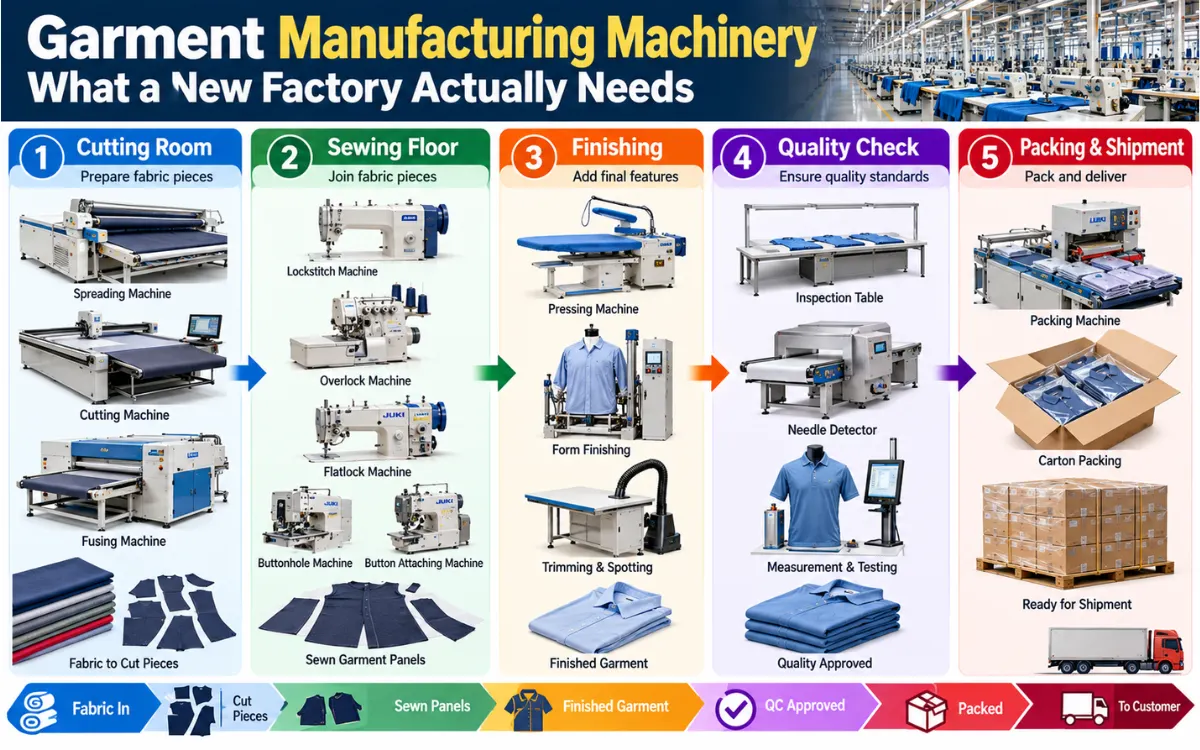
Buying garment machinery well is less about finding the best machine on paper and more about matching machine capability to what your product mix and order volume actually demand. This guide walks through what a factory needs at each stage of production, the criteria that should drive the buying decision, and where the real costs sit, both upfront and over a machine’s working life.
How This Guide Is Organized
Garment production moves through a handful of stages regardless of what’s being made: fabric arrives, gets cut, gets sewn, gets finished, and gets checked before it ships. Machinery decisions cluster around those same stages, so that’s how this guide is organized, with a dedicated article going deeper on each major category. Where a decision is genuinely a comparison between options (automatic versus manual cutting, or one sewing machine brand against another) that comparison gets its own article rather than a rushed paragraph here.
Cutting Room Equipment
The cutting room is where fabric utilization gets decided, and fabric is typically the single largest cost in a garment’s bill of materials. That makes cutting room machinery a higher-return investment than its price tag alone suggests.
Spreading machines lay multiple plies of fabric on the cutting table in a controlled, tension-free stack, which matters because uneven tension during spreading creates cutting inaccuracies that show up as fit problems much later in the process. Manual spreading still works for low-volume, high-mix operations. Automatic spreaders earn their cost once ply counts and daily meterage climb high enough that spreading speed starts limiting cutting room throughput.
Cutting machines range from straight-knife cutters, which are cheap, flexible, and still common in factories cutting a wide variety of styles, to computerized cutting systems that read a marker file and cut multiple plies with minimal fabric waste. The gap between these options in fabric utilization can run several percentage points, which sounds small until it’s multiplied across a season’s fabric spend. A full cost comparison between automatic and manual cutting, including the volume threshold where automation pays for itself, gets its own treatment.
Fusing machines bond interlining to fabric panels, most commonly on collars, cuffs, and plackets, using heat, pressure, and dwell time set specifically for the fabric and interlining combination in use. Getting fusing settings wrong is one of the more common causes of returns and rework in finished garments, since a poorly bonded interlining shows up as bubbling or delamination after the first wash, not on the cutting table. A dedicated article on fusing machine selection covers correct settings for knit versus woven fabric in more depth.
Sewing Floor Machinery
This is where most of a garment factory’s machine count and capital sits, and where machine selection has the most direct effect on daily output.
Lockstitch machines handle the majority of straight-seam construction across wovens and are the default single-needle machine on most sewing floors. Overlock machines trim and finish raw seam edges in a single pass, essential for knit garments where seam stretch and edge finishing both matter. Flatlock machines produce a flat, low-bulk seam commonly used on activewear and underwear, where a raised seam allowance would cause chafing against skin. Knowing which of these three handles which operation, and where factories commonly mismatch machine to operation, is detailed in a related guide.
Beyond these three core machine types, most factories also need a set of special purpose machines: buttonhole machines, bartack machines for reinforcing stress points like pocket corners and belt loops, button attaching machines, and sometimes eyelet machines depending on product category. These machines run at lower utilization than core sewing machines since not every garment needs them, which makes right-sizing this category particularly easy to get wrong in either direction.
Calculating How Many Machines You Actually Need
A common mistake in new factory setup is buying sewing machines based on a rough headcount estimate rather than working backward from the product’s SMV (standard minute value), target daily output, and a realistic line efficiency figure. Overbuying ties up capital in idle machines. Underbuying creates bottlenecks that no amount of overtime fixes cleanly. Machine requirement calculation, covered step by step in a related article, walks through the full method with a worked example, using SMV and efficiency assumptions to arrive at machines-per-operation rather than a guess.
Finishing Equipment
Finishing turns a sewn garment into a shippable one, covering thread trimming, spot cleaning, pressing, folding, and final inspection. Pressing equipment ranges from basic steam irons on adjustable tables to vacuum pressing systems and form finishers that shape a garment using internal air pressure, common on tailored jackets and formal wear where a flat press won’t achieve the right silhouette. The right finishing equipment depends heavily on product category. A t-shirt factory’s finishing line looks nothing like a tailored blazer factory’s, and buying finishing equipment sized for the wrong product category wastes both capital and floor space.
Utility Demand: The Hidden Line Item in Machinery Planning
Every machine on this list draws power, and several categories, fusing machines and steam pressing equipment among them, draw substantially more than a standard sewing machine. A factory that sizes its electrical service and compressed air capacity around the sewing floor alone often finds itself short once cutting room and finishing equipment come online. Compressed air in particular gets overlooked, since pneumatic cutting tables, some pressing equipment, and certain special purpose machines all draw from the same compressed air system, and undersized compressors show up as inconsistent machine performance that looks like a machine fault but is actually a utility capacity problem. Planning utility capacity alongside the machinery list, not after it’s finalized, avoids a class of problems that are expensive to fix retroactively once concrete floors and electrical runs are already in place.
Planning for Growth Without Overbuying
A new factory’s machinery list should account for realistic near-term growth, not just day-one requirements, but the right way to build in that buffer differs by machine category. For core, high-utilization machines like standard lockstitch and overlock, a modest capacity buffer above initial calculated requirement is reasonable, since these machines are relatively liquid in the used equipment market if growth doesn’t materialize as planned, and the cost of a small buffer is low relative to the disruption of being caught short on core capacity during a genuine ramp-up. For larger, more specialized capital investments, automatic cutting systems or high-capacity fusing equipment, buying ahead of confirmed demand carries more real risk, since these machines are harder to resell if growth projections don’t pan out, and the total-cost-of-ownership framework covered throughout this guide generally favors sizing these larger investments closer to confirmed near-term demand, expanding again once growth is actually realized rather than carrying speculative capacity on the most expensive line items in the machinery budget.
Machine Selection Criteria That Actually Matter
A handful of criteria should drive every machine purchase decision, in roughly this order of importance for most factories.
Product mix fit. A machine that’s perfect for knitwear may be the wrong choice for a factory that primarily runs structured wovens. Buying for the product mix you’ll actually run, not the product mix you might run someday, avoids paying for flexibility that never gets used.
Spare parts and service availability. A machine sitting idle for three days waiting on a part from overseas costs far more than the price difference between two competing machines might suggest. Local spare parts availability and service response time deserve real weight in the buying decision, not an afterthought after price is settled. This gets a full treatment, comparing how factories actually choose between major sewing machine brands on exactly this basis.
Total cost over the machine’s working life, not just purchase price. That includes maintenance, consumables, downtime risk, and resale value at the point the machine gets replaced. A cheaper machine with expensive, hard-to-source parts often costs more by year three than a pricier machine with a strong local parts network.
Operator learning curve. A machine that requires extensive retraining or a specialized operator skill set carries a hidden cost in ramp-up time and early-stage defect rates, particularly relevant for factories running high style variety with frequent changeovers.
A Worked Example: Pricing a 100-Machine Sewing Floor
To make the cost guidance below more concrete, here’s an illustrative example of how a factory might rough out a sewing floor budget before requesting real quotations. Say a new factory is building a line targeting a basic knit t-shirt product mix, needing an estimated 60 overlock machines, 25 lockstitch machines, 10 flatlock machines, and 5 special purpose machines (buttonhole, bartack, and button attaching combined) based on the SMV-driven calculation method covered in a related guide.
Using illustrative unit costs of $900 per overlock machine, $700 per lockstitch machine, $1,100 per flatlock machine, and an average $1,800 per special purpose machine (reflecting their generally higher unit cost and lower volume), the sewing floor machine cost alone comes to: (60 × $900) + (25 × $700) + (10 × $1,100) + (5 × $1,800) = $54,000 + $17,500 + $11,000 + $9,000 = $91,500.
Add cutting room equipment (a manual cutting setup at roughly $20,000 for this scale, per the automatic-versus-manual comparison covered in a related guide) and a mid-range continuous fusing machine at roughly $35,000, and total core machinery investment for this illustrative 100-machine floor comes to approximately $146,500, before installation, spare parts inventory, or the import cost considerations for factories sourcing machinery internationally.
This figure is illustrative only, built from placeholder unit costs, and exists to demonstrate how the pieces of a machinery budget actually add up, not to serve as a benchmark for what your own factory should expect to spend. Real unit costs vary by brand, specification, and current market pricing enough that actual supplier quotations remain the only reliable basis for a real capital budget.
Indicative Cost Ranges
Machinery costs vary widely by brand, specification, and country of purchase, so treat the figures below as a starting point for budgeting conversations rather than a quote. A single-needle lockstitch machine from a mainstream industrial brand typically lands in the low thousands of dollars per unit, fully installed. Overlock and flatlock machines run somewhat higher given their additional mechanisms. Automatic cutting systems represent a much larger jump, often ten to twenty times the cost of a straight-knife manual setup, which is exactly why that decision deserves its own dedicated cost comparison rather than a blanket recommendation. Fusing machines and specialized finishing equipment vary enormously based on line width, automation level, and throughput capacity.
For anyone building an actual capital budget, get current quotations from at least two or three suppliers rather than relying on published price lists, which tend to lag actual market pricing, especially for imported machinery where currency movement and shipping costs shift landed cost meaningfully from one order to the next.
Maintenance: The Cost Nobody Budgets For Properly
New factories consistently underbudget for machine maintenance, treating it as a minor recurring expense rather than a real driver of line uptime. A sewing machine running without a proper preventive maintenance schedule breaks down more often, produces more defects as components wear unevenly, and has a shorter working life before major overhaul or replacement becomes necessary. The maintenance schedule article covers what a proper daily, weekly, and monthly maintenance routine actually looks like, along with a method for putting a real number on what unplanned downtime costs a line per hour.
Importing Machinery: Costs Beyond the Sticker Price
For factories in Bangladesh and similar manufacturing hubs, the machine’s list price is only part of the landed cost. Duty, VAT, LC charges, freight, and clearing costs all add to what a machine actually costs by the time it’s running on the floor, and these costs vary depending on whether the machinery qualifies for capital machinery concessions under an export-oriented bond license. The dedicated article on garment machinery import cost walks through the full cost structure and where factories most often get surprised by charges they didn’t budget for.
Machinery Decisions and Buyer Compliance Audits
Beyond the direct production and cost considerations covered throughout this guide, machinery choices increasingly intersect with buyer compliance audits in ways worth planning for from the outset rather than discovering during an actual audit. Major apparel buyers conducting factory audits often assess machine maintenance records, safety guard presence and condition, and general housekeeping around machinery as part of a broader social and safety compliance review, separate from the pure production-capability questions this guide has focused on. A factory that’s made sound machinery purchasing decisions but neglected the maintenance documentation and safety guard upkeep an audit will actually check can still fail that audit despite having genuinely capable equipment on the floor.
This is worth building into machinery planning from day one: budgeting not just for the machine itself but for the safety guards, maintenance record-keeping systems, and general operational discipline that buyer audits increasingly expect to see documented, not just present. A factory treating this as a natural extension of the maintenance program covered elsewhere, rather than a separate compliance exercise bolted on before an audit, generally finds it far less disruptive to actually pass these reviews when they come.
Building the Machinery List for a New Factory
Pulling this together, a new garment factory’s machinery list typically needs, at minimum, and can be cross-checked against this machinery list for a knit composite factory: spreading and cutting equipment sized to fabric volume and style variety, a fusing machine if the product mix includes fused components, a sewing floor built around the correct ratio of lockstitch, overlock, and flatlock machines for the specific product being made, special purpose machines matched to the product’s actual construction requirements rather than bought as a blanket set, and finishing equipment sized to the product category rather than a generic pressing setup.
None of these decisions happen in isolation. A change in product mix six months after setup can leave a factory with the wrong machine ratio on the sewing floor, which is exactly why the calculation methods and comparison criteria covered in the related articles below matter more than any single machine recommendation could. The goal isn’t finding the “best” machine in each category. It’s finding the machine that fits the specific product, volume, and operating context this particular factory is actually running.
Common Mistakes When Building Out a New Line
A few patterns show up again and again in new factory setups, and most of them trace back to the same root cause: buying machinery based on assumptions rather than the actual product and volume in front of you.
Buying for peak season capacity year-round. It’s tempting to size the sewing floor for the busiest month of the year, but that leaves expensive machines sitting idle the rest of the time. A better approach sizes the core floor for typical volume and plans a subcontracting or overtime strategy for genuine peaks, rather than carrying that capacity as owned capital all year.
Copying a competitor’s machine list without adjusting for product differences. Two factories making what looks like similar product on paper can need very different machine ratios once construction details are accounted for. A factory making mostly basic tees needs a very different overlock-to-lockstitch ratio than one making structured shirts with more single-needle operations.
Underestimating special purpose machine needs. Buttonhole and bartack machines get treated as an afterthought in early budgeting, then become a bottleneck once the line is running, because these operations can’t easily be redistributed to other machines the way some straight-seam work can.
Skipping a maintenance budget in year one. New machines rarely break down in their first months, which creates a false sense that maintenance can wait. By the time the first real breakdowns start, the factory has already built production schedules that assume full uptime, and the resulting disruption costs far more than the maintenance program would have.
Treating machinery import cost as just the invoice total. As covered in a related guide, duty, VAT, LC charges, and clearing costs can add a meaningful percentage on top of a machine’s quoted price, and factories that don’t budget for this upfront often find their capital plan short by the time machines actually clear customs.
Sequencing Machinery Purchases for a New Factory
Machinery doesn’t all need to arrive at once, and sequencing purchases sensibly helps manage cash flow during setup. Cutting room equipment typically comes first, since fabric can’t move through the factory without it, followed by the core sewing floor sized to the first few styles actually going into production rather than the full eventual product range. Special purpose machines can often be added as specific styles require them rather than bought as a complete set on day one. Finishing equipment should be sized to match sewing floor output, since a finishing bottleneck defeats the purpose of sewing floor capacity that can’t actually ship. Utility and support equipment, our covered in a separate guide, needs to be planned in parallel rather than as an afterthought, since machinery sized without matching utility capacity for power, compressed air, or steam simply won’t run at rated output.
A Note on New Versus Used Machinery
Not every machine on a new factory’s list needs to be purchased new. Used machinery, particularly for standard lockstitch and overlock operations where technology has changed relatively little over the past decade, can meaningfully reduce initial capital outlay. The trade-off is remaining working life, less predictable maintenance history, and sometimes harder-to-source parts for older machine generations. This trade-off matters enough that it gets a dedicated inspection checklist of its own, covering what to actually check before buying second-hand rather than trusting a seller’s condition claims at face value.
Operator Training as Part of the Machinery Budget
A machine purchase decision that stops at capital cost and running cost, without budgeting real time and structure for operator training, tends to underdeliver against the productivity the machine’s specifications suggest it should achieve. This is particularly true for special purpose machines and any newer machine technology entering a factory for the first time, where operators trained primarily on more familiar equipment need a genuine ramp-up period before reaching standard efficiency, a period that shows up directly in the line efficiency assumption used throughout the machine requirement calculation covered in a related guide. Factories that build a structured training and certification process for new machine types into their setup timeline, rather than assuming operators will simply figure it out through informal on-the-job exposure, generally reach target efficiency on new equipment considerably faster than those that don’t, which is worth factoring into any timeline for a new line’s ramp-up to full target output.
Keeping This Guide Current
Machine specifications, pricing, and even which brands dominate a given market shift over time, and the specific figures and comparisons referenced throughout this guide and the related articles below should be treated as a framework for thinking through machinery decisions rather than a permanently fixed reference. Revisit the cost comparisons, particularly the automatic-versus-manual cutting payback and the brand total-cost-of-ownership calculations covered in a related guide, with current quotations whenever a real purchasing decision is on the table, rather than relying on figures that may have been accurate at the time this content was written but have since shifted with market conditions, currency movement, or new machine generations entering the market.
Bringing It Together
Every machine category covered across this guide, from the cutting table to the finishing line, exists to serve one goal: getting a specific product out the door at the volume, quality, and cost a factory has committed to. The specific machines change by product and by decade, but the underlying discipline this guide has argued for, calculating requirement from actual demand rather than guessing, weighing total cost of ownership rather than sticker price, and maintaining what’s already on the floor before buying more, stays constant regardless of what machine technology looks like next. Reading this guide alongside the related articles below gives a new or expanding factory the framework to make that discipline concrete, one machine category at a time.
Where to Go Next
Each of the related articles below goes deeper on one piece of this guide: stitch class selection, machine requirement calculation, cutting automation economics, fusing settings, maintenance scheduling, special purpose machines, import cost structure, and brand comparison. Read them in whichever order matches the decision currently in front of you. They’re written to stand alone, but they connect back to the framework laid out here.
Frequently Asked Questions
How much does it cost to set up a basic garment factory’s machinery?
It depends heavily on scale and product mix, but a 100-machine sewing floor with core cutting and fusing equipment typically runs in the range of a few hundred thousand dollars before installation and spares, as the worked example earlier in this article illustrates. Always confirm with current supplier quotations rather than published price lists.
What’s the difference between buying machinery for a new factory versus expanding an existing one?
A new factory needs to build out every category from cutting through finishing based on projected product mix, while an expansion usually only needs to add capacity to whichever specific category is actually constrained, which is why the machine requirement calculation covered in a related guide matters more for expansion decisions than a general machinery list does.
Do all garment factories need automatic cutting equipment?
No. Automatic cutting only pays back at higher daily fabric volumes with relatively stable, reused markers. Lower-volume or high style-variety factories are often better served by manual cutting, covered in the dedicated cost comparison.
How do I know if my sewing floor has the right machine ratio?
Run the SMV-based machine requirement calculation for every operation in your actual product mix rather than estimating from headcount. A mismatch usually shows up as a chronic bottleneck on one machine type while another category sits underused.