Switching a chemical supplier looks like a simple procurement decision from a purchasing spreadsheet. It rarely is once a recipe is already running in production, because even a chemically comparable substitute can behave just differently enough in a live dyebath to shift shade, fastness, or hand feel in a way that only shows up after a batch is already finished. Sourcing decisions in textile chemicals deserve more diligence than the same decision would in almost any other input category, precisely because “equivalent on paper” and “equivalent in the dyebath” aren’t always the same thing.
How Chemicals Reach Bangladeshi Mills
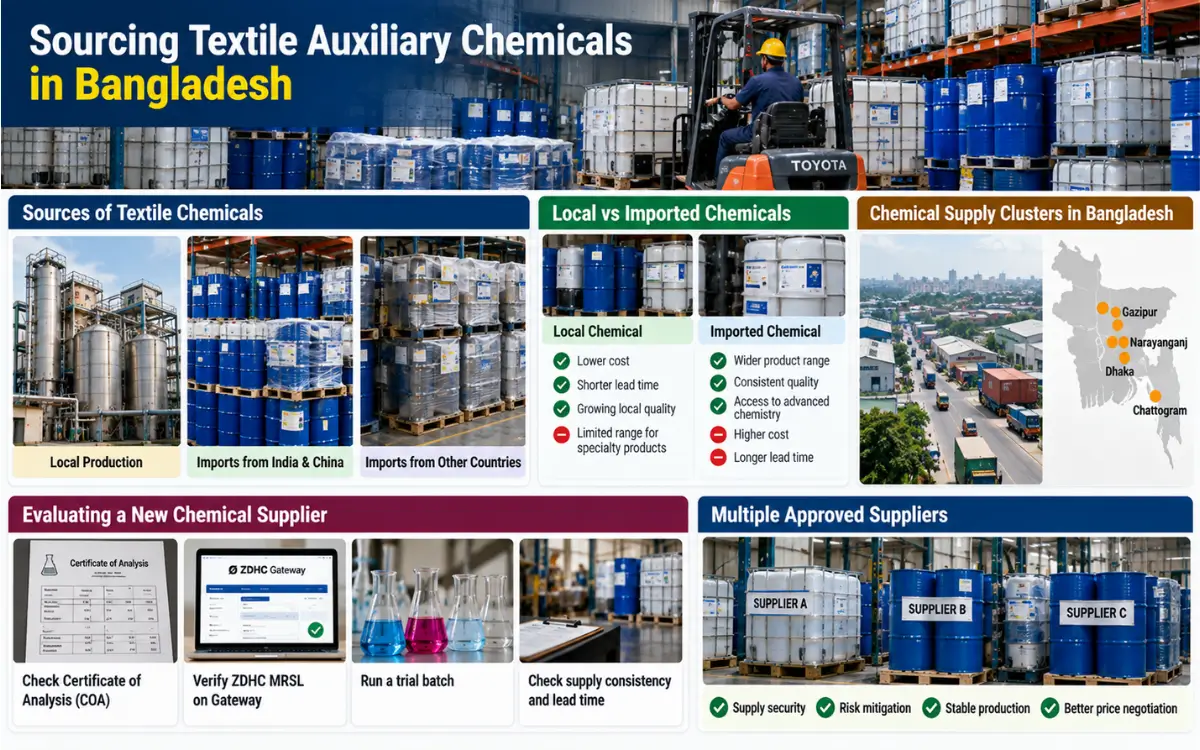
Bangladesh’s textile chemical supply runs through a mix of local production, regional imports (particularly from India and China, both major producers of textile auxiliary chemicals with established trade relationships into the Bangladeshi market), and imports from more distant origins for specialty chemistry not produced regionally at competitive quality or cost. Local production has grown considerably as the domestic textile industry’s scale has justified investment in local manufacturing for higher-volume, more commoditized chemical categories, while more specialized or performance-critical chemistry, certain dye classes, advanced finishing chemicals, and cutting-edge PFAS-free water repellent systems among them, more often comes through import from established international chemical manufacturers.
Local Versus Imported Chemical: The Real Trade-offs
Local chemical production generally offers price advantage and shorter lead time, both meaningful factors for a mill managing working capital and production scheduling tightly. The trade-off can be more limited product range for highly specialized applications and, in some cases, less consistent batch-to-batch quality control than an established international manufacturer with more mature quality systems, though this gap has narrowed considerably as local Bangladeshi chemical production has matured.
Imported chemical offers access to a broader range of specialized chemistry and, from established international manufacturers, generally strong batch-to-batch consistency, at the cost of longer lead time, higher landed cost once freight and duty are factored in, and exposure to currency and shipping cost volatility that a local supply chain avoids.
Most mills of any real scale end up running a blend, local sourcing for high-volume, well-established chemical categories where local quality has proven reliable, imported sourcing for specialty chemistry or where a specific international brand’s product has an established, trusted track record in a critical recipe.
Regional Chemical Sourcing Hubs Worth Knowing
Within the broader local-versus-imported framework covered above, it’s worth understanding that Bangladesh’s textile chemical supply chain has developed real regional concentration, with a meaningful share of both local production and import distribution activity clustered around the country’s major textile manufacturing zones. Mills located within or near these established chemical supply clusters generally benefit from shorter delivery lead times and more competitive local pricing than mills in more peripheral locations, simply from proximity to established distribution infrastructure. For a mill evaluating a new facility location or a major capacity expansion, factoring chemical supply chain proximity into that location decision, alongside the more commonly considered factors like labor availability and utility infrastructure, is worth genuine consideration given how directly chemical lead time and cost feed into the production planning and recipe costing covered elsewhere.
Evaluating a New Chemical Supplier
Before switching to a new supplier, whether local or imported, for any chemical currently used in an active production recipe, a few checks are worth running regardless of how attractive the new supplier’s pricing looks.
Request a current Certificate of Analysis (COA) for the specific batch or product lot being considered, not just a generic product data sheet, since a COA gives actual measured properties for the batch in question rather than typical or target values that may not reflect what’s actually being shipped.
Verify ZDHC MRSL conformance status directly on the Gateway, covered in more depth in the dedicated article on this topic, rather than relying on the supplier’s own compliance claim, since Gateway listing status is independently verifiable and a supplier’s marketing claim alone isn’t sufficient documentation for most serious buyers downstream.
Run a genuine trial batch before committing to a full production switch, comparing the new supplier’s product against the current one on the actual fabric, shade, and process conditions in use, not just against a generic lab standard. This is the single most important check on this list, since it’s the one that actually catches real-world performance differences a data sheet comparison alone won’t reveal.
Check supply consistency and lead time reliability, ideally by talking to other mills already using the supplier, since a chemical that performs well in a trial batch but arrives inconsistently or with unpredictable lead times creates its own production planning problems that a pure quality comparison wouldn’t surface.
Managing Multiple Approved Suppliers for the Same Chemical
Beyond the single-switch scenario covered above, many mills of real scale benefit from maintaining more than one approved supplier for their highest-volume chemical categories, rather than relying entirely on a single source. This isn’t about constantly switching for marginal price differences, it’s about supply security. A single-supplier dependency on a high-volume chemical leaves a mill exposed to that supplier’s own supply disruptions, whether from their own raw material shortages, logistics problems, or simply prioritizing other customers during a period of tight supply.
Building a genuine second approved source means running the same trial and verification process covered above for that second supplier well before an actual supply emergency forces a rushed, unverified switch. A mill that’s already trialed and approved a backup supplier for its core chemicals can respond to a primary supplier’s disruption by shifting volume to an already-qualified alternative within days, while a mill without that groundwork done in advance faces the choice between an unverified emergency switch or a production stoppage while a new supplier gets properly vetted under time pressure, neither of which is a position any mill wants to find itself in.
Negotiating Terms Beyond Unit Price
Evaluating a new chemical supplier isn’t purely a technical and compliance exercise, commercial terms matter too, and mills that focus exclusively on unit price during supplier negotiation often leave real value on the table elsewhere in the agreement. Payment terms affect working capital in ways that can matter as much as a modest unit price difference, particularly for mills managing tight cash flow across a production cycle. Minimum order quantities affect how much inventory risk a mill carries for a given chemical, especially relevant for lower-volume specialty chemistry where a supplier’s minimum order might represent months of actual consumption. And technical support availability, whether a supplier provides on-site troubleshooting assistance when a new recipe isn’t performing as expected, or leaves the mill to work through problems independently, is worth explicitly discussing and, where possible, formalizing before a switch, rather than discovering the actual level of support only once a problem arises and the mill needs it.
What Can Go Wrong When Switching Mid-Recipe
A softener switch that looked identical on a technical data sheet can produce a noticeably different hand feel once applied at scale, sometimes only becoming apparent when a buyer’s quality inspection flags it. A dye supplier switch, even between two suppliers claiming the same dye index number, can shift shade consistency enough to fail a buyer’s color approval, since dye manufacturing processes between suppliers aren’t always identical even when the underlying chemical classification matches. An auxiliary chemical switch, a new sequestering agent or wetting agent, can interact differently with a mill’s specific water quality or existing recipe chemistry in ways that only show up as an unexpected fastness or consistency issue after the fact.
None of these outcomes are inevitable, and plenty of supplier switches go smoothly. The point is that “chemically equivalent” claims from a new supplier deserve verification through an actual trial, not acceptance at face value, precisely because the cases where switching goes wrong are expensive enough, a failed buyer inspection, a rejected batch, a fastness complaint discovered after shipment, that the cost of a proper trial is small by comparison.
Building a Supplier Evaluation Process
Rather than evaluating each supplier switch ad hoc, a mill benefits from a standing evaluation process applied consistently: require a current COA and Gateway conformance verification for any new chemical entering consideration, run a defined trial protocol (same fabric, same shade, same process conditions as current production) before approving any switch on an active recipe, document trial results against the current supplier’s baseline performance rather than relying on subjective judgment alone, and maintain a formal approval record showing what was checked and by whom before a switch is finalized. This isn’t bureaucracy for its own sake. It’s the same discipline that prevents a well-intentioned cost-saving switch from becoming an expensive quality problem discovered only after a full production batch is already finished.
A Worked Example: Trial Cost Versus Switching Risk
Consider a mill evaluating a new sequestering agent supplier offering a 15 percent unit price saving on a chemical currently costing $3.00 per kilogram, used at roughly 0.5% owf across an illustrative 40,000 kilograms of fabric a month. At current pricing, monthly spend on this chemical runs 40,000 × 0.005 × $3.00 = $600. The proposed switch would save 15 percent of that, or $90 a month, roughly $1,080 a year.
A proper trial, running the new supplier’s product against the current one on a representative fabric and shade sample, checking shade consistency, fastness, and any interaction with existing recipe chemistry, might cost an illustrative $400 in lab time, sample fabric, and chemical for the trial itself, plus roughly two weeks of lead time before a production decision can be made.
Against a potential annual saving of $1,080, spending $400 and two weeks to verify the switch is a genuinely small cost relative to what’s being protected: a failed switch discovered only after a full production run, a rejected shipment, a fastness complaint, a shade-matching dispute with a buyer, would easily cost many multiples of the trial expense, in rework, expedited replacement fabric, or a damaged buyer relationship. This is the concrete version of the argument made earlier in this article: the trial cost is small, and skipping it to capture the saving a few weeks sooner is rarely a good trade once the actual numbers are laid out side by side like this.
A Note on Price-Driven Switching
Price is a legitimate and often primary reason to evaluate a new chemical supplier, and there’s nothing wrong with switching purely for cost savings once the performance and compliance checks above have genuinely been satisfied. The mistake isn’t switching for price. It’s skipping the verification process because a lower price makes switching feel urgent, or because a long-standing relationship with the current supplier makes a new one’s claims feel like they don’t need the same scrutiny. Every new supplier, regardless of how compelling the pricing looks, deserves the same evaluation discipline applied consistently, since the chemical categories where switching goes wrong aren’t predictable in advance, which is exactly why a consistent process matters more than case-by-case judgment calls about which switches seem “safe” enough to skip verification.
Building Long-Term Supplier Relationships
Beyond individual switching decisions, mills that invest in genuine long-term relationships with a core set of approved chemical suppliers, rather than treating every purchasing cycle as a fresh, purely transactional negotiation, often gain benefits that don’t show up directly in a unit price comparison. Established suppliers with a real track record at a specific mill tend to prioritize that mill during supply constraints, provide more candid technical guidance since the relationship isn’t purely adversarial, and are often more willing to work collaboratively on new formulation development or troubleshooting than a supplier with no history at that account. This isn’t an argument against ever switching or negotiating hard on price, it’s a reminder that supplier relationship value extends beyond the immediate transaction, and mills that only ever evaluate suppliers on unit price in isolation sometimes miss this broader value entirely.
Frequently Asked Questions
Is locally produced chemical or imported chemical better for Bangladeshi mills?
Neither is universally better. Local production generally offers price and lead time advantages, while imported chemical offers a broader specialty range and often stronger batch consistency, and most mills of real scale use a blend of both.
What should I check before switching to a new chemical supplier?
A current Certificate of Analysis for the specific batch, verified ZDHC MRSL conformance on the Gateway, and a genuine trial batch comparing the new product against the current one on the actual fabric and process in use, not just a data sheet comparison.
Why does a chemically “equivalent” supplier sometimes still cause problems?
Even suppliers claiming the same dye index or chemical classification can manufacture slightly differently, which is why a real trial batch, not a paper comparison, is the check that actually catches performance differences before a full production run is affected.
Should a mill maintain more than one approved supplier for the same chemical?
For high-volume categories, yes. A single-supplier dependency leaves a mill exposed to that supplier’s own disruptions, and having an already-qualified backup supplier means a mill can respond to a shortage within days rather than scrambling to vet a new source under time pressure.