Mention “dyeing machine” to someone outside the industry and they picture a single generic piece of equipment. In practice, a mill choosing between jet, jigger, and winch technology is choosing between fundamentally different ways of handling fabric through the dyeing process, and each approach suits a different combination of fabric type, batch size, and cost priority.
Jet Dyeing Machines
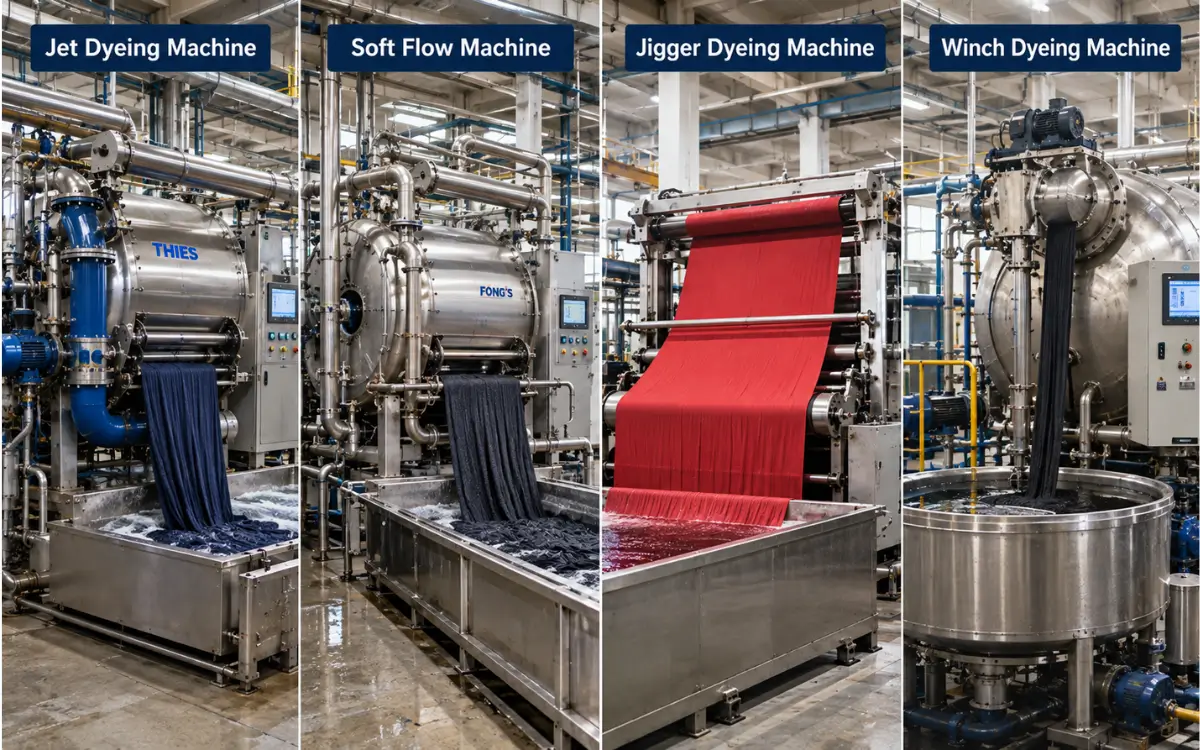
Jet dyeing machines circulate fabric in rope form through a nozzle that propels dye liquor and fabric together around a closed circuit, giving strong liquor penetration and relatively fast dye uptake. This makes jet machines a common choice for knit fabrics, where the technology’s throughput and dye penetration work well with knit construction’s characteristics. Modern jet machines have also driven meaningful reductions in liquor ratio compared to older generations of the same basic technology, which matters directly for water and chemical consumption, covered in depth in Textile Chemicals guide.
Soft Flow Machines
Soft flow machines are a gentler variant within the jet dyeing family, using a modified circulation mechanism that reduces mechanical stress on the fabric compared to conventional jet dyeing. This matters particularly for delicate or loosely constructed knit fabrics, where conventional jet dyeing’s more forceful circulation can cause pilling, distortion, or other mechanical damage. Soft flow machines generally trade a small amount of throughput speed for this gentler handling, a reasonable trade-off for fabric types where mechanical damage risk outweighs the value of maximum cycle speed.
Jigger Dyeing Machines
Jigger machines handle fabric in open-width form, running it back and forth between two rollers through a stationary dye bath, rather than circulating it in rope form the way jet and winch machines do. This open-width, low-tension handling makes jiggers well suited to woven fabrics, particularly those prone to creasing or permanent fold marks if handled in rope form through a jet or winch machine.
Jiggers generally run at considerably lower liquor ratio than jet or winch machines, which gives them a real advantage on water and chemical consumption per kilogram, though this needs to be weighed against jiggers’ typically slower cycle time and batch size limitations compared to jet dyeing on suitable fabric types.
Winch Dyeing Machines
Winch machines, among the older dyeing technologies still in active use, handle fabric in rope form through a slower, more gentle circulation than jet dyeing, using a rotating winch wheel to move fabric through the dye bath. Winch machines generally run at higher liquor ratio than modern jet or jigger technology, meaning higher water and chemical consumption per kilogram for a comparable batch. They remain in use, particularly in smaller mills or for smaller batch sizes, largely because of lower capital cost relative to modern jet dyeing technology, though the running cost gap from higher liquor ratio needs to be weighed honestly against that lower upfront cost.
Selecting for a Mixed Fiber Portfolio
Mills processing a genuinely mixed portfolio, cotton wovens, cotton knits, and polyester or blended fabrics all running through the same facility, face a more complex version of the selection question than a mill dedicated to a single fabric category. Rather than picking one dyeing technology as a universal standard, these mills typically need a deliberately mixed machine fleet, jet or soft flow capacity for the knit portion of the portfolio, jigger capacity for creasing-prone wovens, and enough flexibility in scheduling to route each order to the machine type genuinely suited to it rather than forcing everything through whatever capacity happens to be available at the moment an order needs to start. Planning this mixed fleet requires working through the capacity planning method covered in a related guide separately for each machine category, since a floor-wide blended utilization figure, as that article explains, can mask a shortfall in one specific machine type even while the floor’s overall utilization looks healthy.
Comparing the Four Technologies
| Machine Type | Fabric Handling | Best Suited For | Liquor Ratio | Relative Batch Speed |
|---|---|---|---|---|
| Jet | Rope form, forceful circulation | Knit fabrics, standard construction | Low (modern machines) | Fast |
| Soft Flow | Rope form, gentle circulation | Delicate or loosely constructed knits | Low to moderate | Moderate to fast |
| Jigger | Open width, low tension | Wovens prone to creasing | Low | Slower |
| Winch | Rope form, gentle circulation | Smaller batches, cost-sensitive operations | Higher | Slower |
Batch Size Considerations
Batch size capability varies across these machine types, and matching machine batch size to typical order size matters as much as matching machine type to fabric type. Running a large machine well below its rated batch size to process a small order wastes water, chemical, and energy proportionally, since these machines don’t scale their liquor consumption down cleanly for a partially filled batch the way total consumption might naively be assumed to. A mill with highly variable order sizes sometimes benefits from maintaining a mixed fleet across different batch size capacities, rather than sizing every machine for the largest orders and running smaller orders at poor utilization.
Utility Consumption Beyond Water
Liquor ratio’s effect on water consumption gets the most attention, but energy consumption for heating that water and maintaining process temperature scales right alongside it. A machine running at double the liquor ratio of a modern low-ratio alternative isn’t just using double the water, it’s also using considerably more energy to heat that additional water volume to process temperature, which connects this machine selection decision directly to the energy benchmarking covered in Utilities and Energy guide.
A Practical Decision Walkthrough
Consider a mill evaluating capacity expansion with two candidate fabric programs in mind: a high-volume basic knit t-shirt program running consistent, large batches in a narrow shade range, and a smaller, higher-mix woven shirting program with frequent shade and style changes. For the knit program, a modern jet or soft flow machine sized to the program’s typical batch volume is the clear fit, given knit fabric’s suitability for rope-form processing and the throughput advantage jet technology offers for consistent, high-volume batches. For the woven shirting program, a jigger’s open-width, low-tension handling avoids the creasing risk rope-form processing would introduce on these fabric constructions, and its lower liquor ratio helps offset the higher per-batch chemical cost that comes with more frequent shade changeovers on a high-mix program.
Buying a single machine type sized for the larger knit program and routing the woven shirting program through it as well, a common shortcut when capital budget is tight, risks exactly the creasing and shade consistency problems this comparison has flagged throughout, since forcing a woven program through equipment better suited to knits doesn’t just reduce efficiency, it can create genuine quality defects that cost more to remediate than the capital saved by not buying dedicated jigger capacity in the first place.
Making the Selection in Practice
For a mill building out or expanding dyeing capacity, the practical selection process starts with the actual fabric mix in production, knits generally pointing toward jet or soft flow, wovens prone to creasing pointing toward jiggers, then layers in typical batch size and the capital budget available, since modern low liquor ratio jet technology carries a real capital premium over winch dyeing that needs to be weighed against its running cost advantage using the same total-cost-of-ownership framework covered in the full guide. There’s rarely a single universally “best” choice among these four technologies. There’s a best choice for a specific mill’s actual fabric mix, batch pattern, and capital position.
Revisiting the Fleet as Fabric Mix Evolves
A dyeing machine fleet selected correctly for a mill’s fabric mix at one point in time doesn’t stay correctly matched forever, particularly for mills whose product range shifts over several years as buyer relationships and market demand evolve. A mill that gradually shifted from a woven-dominant to a knit-dominant product mix, without revisiting its machine fleet composition alongside that shift, can find itself running a disproportionate share of its now-dominant knit volume through jigger capacity better suited to the wovens the mill used to run more of, a mismatch that erodes efficiency gradually rather than announcing itself as a sudden problem. Treating fleet composition as something to revisit periodically against actual current product mix, not just at initial capacity planning, keeps the machine selection logic covered throughout this article genuinely matched to what the mill is producing today, not what it was producing when the fleet was originally built out.
Frequently Asked Questions
Why do jiggers suit woven fabric better than jet machines?
Jiggers handle fabric in open-width form under low tension, avoiding the creasing risk that rope-form processing on jet or winch machines can cause on certain woven constructions.
Is winch dyeing outdated technology?
It’s older, but it remains in use for smaller batch sizes and cost-sensitive operations given its lower capital cost, even though it runs at higher liquor ratio and correspondingly higher water and chemical consumption than modern jet technology.
What’s the difference between jet and soft flow dyeing machines?
Soft flow is a gentler variant within the jet family, reducing mechanical stress on delicate or loosely constructed knit fabrics, at a modest cost in throughput speed compared to conventional jet dyeing.
Does a mill running mixed fabric types need more than one dyeing machine type?
Usually, yes. Mills with a genuinely mixed knit and woven portfolio typically need a deliberately mixed fleet rather than forcing every fabric type through a single machine technology.