A decade ago, this comparison had a fairly settled answer: digital printing for samples and short runs, rotary screen for anything at real production volume. That line has moved considerably as digital printing technology and ink cost have improved, and mills that haven’t revisited the comparison recently are sometimes making print method decisions based on an economics picture that’s a few years out of date.
How the Two Technologies Differ
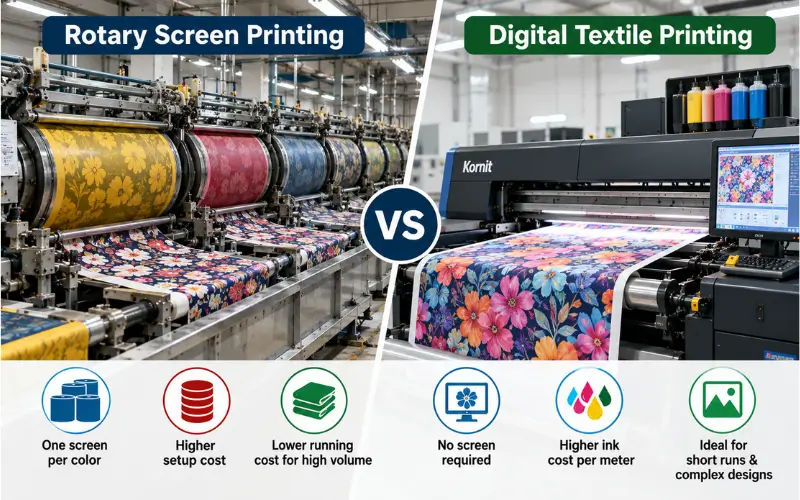
Rotary screen printing applies each color through a separate engraved cylindrical screen, with fabric passing under each screen in sequence to build up a complete multi-color design. Screen setup, engraving a screen for each color in the design, represents a real, largely fixed cost that gets incurred once regardless of how many meters ultimately get printed using that screen set. Once screens are made, the running cost per meter is relatively low, which is exactly why rotary screen printing has traditionally dominated high-volume production.
Digital textile printing applies ink directly to fabric through inkjet print heads, controlled entirely by a digital file, with no screens or physical setup required beyond loading the design file and preparing the fabric. This eliminates screen cost and setup time entirely, but ink cost per meter for digital printing is generally higher than the marginal ink cost in rotary screen printing, since digital printing doesn’t benefit from the same economies of scale that spreading a fixed screen cost across a large run provides.
Cost Per Meter: Where the Crossover Sits
The fundamental cost structure comparison is a fixed-cost-versus-variable-cost trade-off, similar in shape to the automatic-versus-manual cutting comparison covered in Garment Machinery guide, though the specific numbers and drivers differ. Rotary screen printing carries a real, order-specific fixed cost in screen engraving that needs to be spread across the run length to arrive at a true cost per meter. Digital printing carries close to zero fixed setup cost but a higher variable ink cost per meter that doesn’t improve with volume the way rotary screen’s blended cost per meter does.
At short run lengths, digital printing’s lack of setup cost makes it the clear cost winner, since rotary screen’s fixed screen cost, spread across a small number of meters, produces a high effective cost per meter that digital printing’s flat variable cost easily beats. As run length increases, rotary screen’s blended cost per meter drops as the fixed screen cost gets spread across more output, and at some point, the specific breakeven length depending on design complexity (number of colors, since each color needs its own screen), ink cost at the time, and the specific machines being compared, rotary screen’s lower marginal cost per meter overtakes digital printing’s flat rate.
Where exactly that breakeven sits has moved over the past several years as digital ink costs have declined and print head speeds have improved, meaning the run length threshold favoring rotary screen has generally lengthened over time, worth re-evaluating periodically with current pricing rather than relying on an industry rule of thumb that may reflect older technology economics.
Design Complexity and Color Range
Design complexity affects the two technologies asymmetrically. Rotary screen printing’s cost scales directly with the number of colors in a design, since each color needs its own engraved screen, making highly multi-colored or photographic-style designs disproportionately expensive under screen printing compared to a simple two or three color design. Digital printing’s cost is largely indifferent to color count, since adding more colors to a digital design file doesn’t add meaningful cost the way adding screens does. This makes digital printing particularly cost-competitive, even at moderate run lengths, for designs with high color complexity, photographic prints, complex florals, gradient effects, where screen printing would need an impractically large number of screens to reproduce faithfully.
Ink Systems: Pigment Versus Reactive
Both digital and rotary screen printing use multiple ink chemistry systems depending on fiber type and desired hand feel. Pigment ink printing sits on the fabric surface rather than bonding into the fiber, offering broad fiber compatibility and generally simpler processing (no steaming or extensive washing required after printing), at the cost of a somewhat stiffer hand feel compared to reactive printing, particularly at high ink coverage. Reactive ink printing, chemically similar in principle to reactive dyeing covered in Textile Chemicals guide, bonds into cellulosic fiber for a softer hand feel and generally stronger wash fastness, at the cost of requiring post-print steaming and washing steps that add process time and cost compared to pigment printing.
Ink system choice interacts with the digital-versus-rotary decision, since not every ink system is equally mature or cost-competitive across both print technologies, and a mill evaluating printing options should confirm ink system availability and cost specifically for the print technology being considered, rather than assuming ink economics transfer directly between digital and screen printing.
Turnaround Time
Beyond direct cost per meter, turnaround time is a real competitive factor that pure cost comparison misses. Digital printing’s lack of screen setup means a new design can move from file to printed fabric in a fraction of the time rotary screen printing requires once screen engraving and setup are factored in. For buyers working on compressed development timelines or wanting to test a design in limited quantity before committing to a full production run, digital printing’s speed advantage can justify its higher per-meter cost even where a pure breakeven calculation might favor rotary screen at the eventual full run length.
A Worked Breakeven Example
Say a design needs 6 colors under rotary screen printing, with each screen costing an illustrative $80 to engrave, for a total fixed screen cost of $480. Rotary screen printing’s marginal running cost, ink, labor, and machine time combined, runs an illustrative $0.35 per meter once screens are made. Digital printing for the same design, with no screen setup cost, runs an illustrative $0.95 per meter in ink and machine time, reflecting digital’s higher marginal ink cost.
Rotary screen total cost at a given run length (L meters): $480 + ($0.35 × L)
Digital total cost at the same run length: $0.95 × L
Setting these equal to find the breakeven run length:
$480 + $0.35L = $0.95L
$480 = $0.60L
L = 800 meters
Below 800 meters, digital printing is the cheaper option. Above 800 meters, rotary screen’s lower marginal cost overtakes digital’s lack of setup cost. At exactly 1,500 meters, for comparison, rotary screen costs $480 + ($0.35 × 1,500) = $1,005, while digital costs $0.95 × 1,500 = $1,425, a meaningful $420 difference favoring rotary screen at that run length. Run this same calculation with your actual screen cost, color count, and current ink pricing for both technologies, since the breakeven point shifts considerably with color count in particular, a 10-color design would push rotary screen’s fixed cost up to $800, moving the breakeven run length out to roughly 1,333 meters under the same marginal cost assumptions.
Hybrid Production Strategies
Some mills have moved beyond treating digital and rotary screen as a single either-or choice per order, instead running a genuinely hybrid production model where digital handles sampling and short-run production for every design regardless of its eventual run length, while rotary screen picks up the production run once a design proves out commercially and volume justifies screen investment. This approach captures digital’s speed advantage for the development and sampling phase, where getting a design in front of a buyer quickly matters more than absolute cost per meter, while still capturing rotary screen’s lower marginal cost once a design moves into confirmed, higher-volume production.
Setting this up requires genuine color and design fidelity matching between the two print technologies, since a design approved on a digital sample needs to reproduce acceptably close when the eventual rotary screen production run uses a different ink system and application method entirely. Mills running this hybrid model seriously invest in color management and approval protocols specifically calibrated to catch and correct for this cross-technology matching challenge, rather than assuming a digital-approved sample will translate directly to an acceptable rotary screen result without any verification step in between.
Why the Comparison Needs Periodic Revisiting
The cost figures underlying this comparison, digital ink pricing especially, have moved enough over recent years that a breakeven calculation done even two or three years ago may no longer reflect current economics. Digital print head technology has continued improving both speed and ink efficiency, while rotary screen’s core cost drivers, screen engraving and labor, have moved more slowly by comparison. This asymmetry means the run-length breakeven point discussed throughout this article has generally been shifting in digital printing’s favor over time, favoring digital at progressively longer run lengths than would have made sense under older cost assumptions. A mill that settled on a fixed print-method decision rule some years ago and hasn’t revisited it since may be routing orders to rotary screen that would now be more cost-effective on digital, simply because the underlying economics moved without the mill’s internal decision rule moving with them. Rebuilding the breakeven calculation with current quotations on a periodic basis, rather than treating a past comparison as a permanent rule, keeps this decision aligned with where the technology and cost landscape actually stands today.
Making the Decision in Practice
The practical decision framework works through run length first, since that’s the single biggest driver of the cost comparison, then adjusts for design complexity (favoring digital at any run length for highly complex, multi-color designs) and turnaround requirements (favoring digital where speed matters more than achieving the absolute lowest cost per meter). For mills running a genuine mix of order types, sample and short-run digital printing capacity alongside rotary screen capacity for established, high-volume, simpler designs, rather than treating the choice as an either-or capital decision for the whole operation, reflects how most of the order book actually breaks down across these two categories in real production planning.
Building Internal Capability for Both Technologies
Mills running both print technologies alongside each other, rather than treating the choice as a one-time capital decision favoring one over the other permanently, benefit from building genuine internal capability across both, color management, file preparation, and quality control practices specific to each technology’s actual requirements, rather than treating one as the primary process and the other as an occasional afterthought staffed less carefully. A design team fluent in preparing files correctly for both digital and rotary screen production, understanding each technology’s specific color gamut and file preparation requirements, produces more consistent results switching between the two as order economics dictate than a team primarily experienced with just one technology occasionally pressed into service on the other.
Frequently Asked Questions
At what run length does rotary screen printing become cheaper than digital?
It depends on screen cost and color count, but the worked example in this article shows a breakeven around 800 meters for a 6-color design, shifting to a longer run length as color count increases.
Why does design color count matter more for rotary screen than digital?
Rotary screen needs a separate engraved screen per color, so cost scales directly with color count, while digital printing’s cost is largely indifferent to how many colors a design uses.
Is digital printing always faster than rotary screen?
Yes, in terms of turnaround, since it has no screen setup time. This speed advantage can justify digital’s higher per-meter cost even at run lengths where a pure cost calculation might favor rotary screen.
Should a mill choose one printing technology exclusively?
Most mills benefit from running both, digital for sampling and short runs across every design, rotary screen for established, high-volume, simpler designs once a style is confirmed for production.