Before a loom can weave a single metre of cloth, thousands of yarns must be lined up side by side, with the same length and the same tension. Doing this by hand would be slow and uneven. That is the job of the warping machine. It takes yarn from many cones, arranges the threads in parallel and winds them onto a beam that goes to the loom or to the sizing machine.
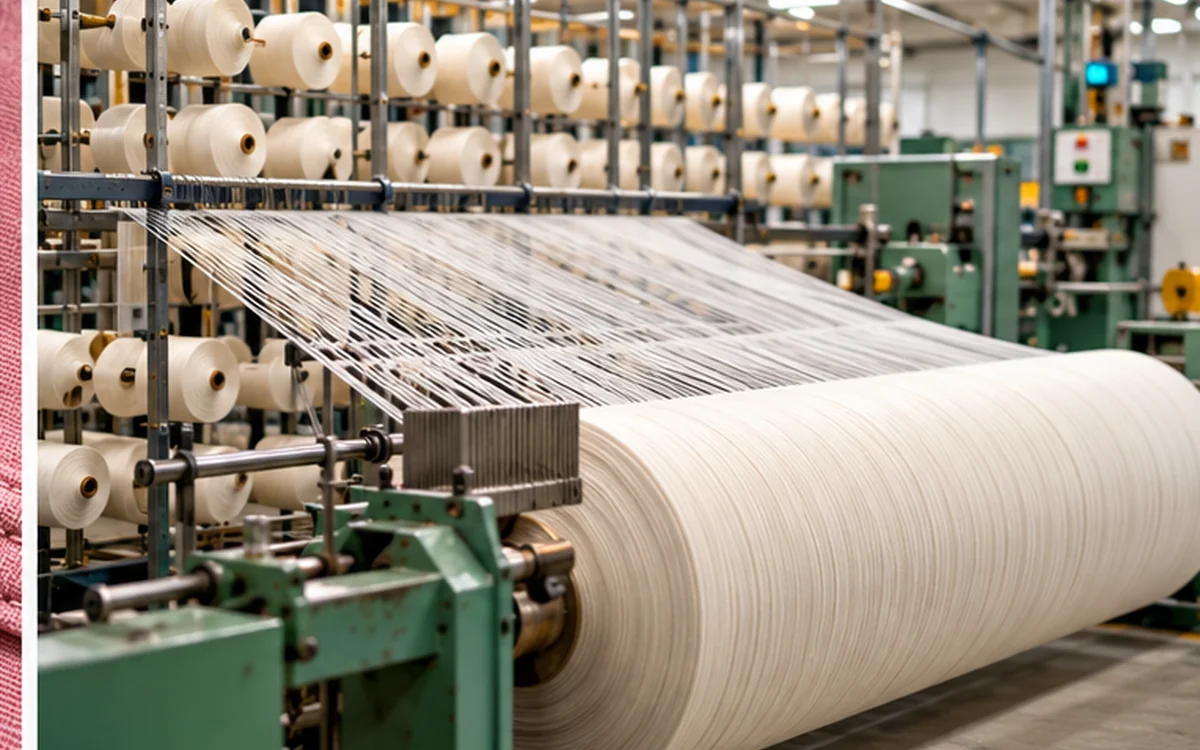
This guide explains what a warping machine is, why it is needed and how the two main types work. It covers the parts, a worked example with real numbers, common faults and tips for choosing a machine. The step comes right after winding and before sizing and weaving, as shown in our flow chart of weaving and our guide on the weaving process from yarn to fabric.
What is warping
Warping is the process of winding a large number of warp yarns, in parallel and under even tension, from a creel of cones onto a beam. The warp is the set of lengthwise yarns in a woven fabric. Warping decides how many threads the fabric will have and how long the warp is. Mistakes made here show up later as weaving stops, uneven cloth and wasted yarn.
Objectives of warping
- To collect the required number of ends in one sheet
- To wind them with equal length and uniform tension
- To build a beam of the right width and diameter for sizing or weaving
- To keep the yarns parallel, without twist or crossing
- To detect weak places and faults early and stop for repair
- To prepare the yarn from small cones into a large, convenient package
Where warping sits in the process
For a typical cotton woven fabric the order is: winding, warping, sizing, drawing-in or tying-in, then weaving. Cone winding cleans the yarn and puts it on large packages. The objectives of winding and the modern auto cone winding machine explain the step before. After warping, the sizing process coats the yarn to give it strength to survive the loom.
Main types of warping machines
1. Direct warping machine (beam warping)
In direct warping, yarn goes straight from the creel to a warper’s beam. The creel holds a large number of cones, often 400 to 1,000 or more. The machine winds all of them at once, so several beams are needed to make up the full number of warp ends. These beams are then placed together at the sizing machine, which combines them into one weaver’s beam.
- High speed, often 600 to 1,000 metres per minute on modern machines
- Best for long runs of the same warp, such as plain greige fabric or denim base yarn
- Needs a big creel and a lot of floor space
- Slow to change when the colour or count changes
2. Sectional warping machine (pattern warping)
In sectional warping, a smaller creel (often 200 to 800 cones) feeds a rotating drum. The warp is built in sections, one next to another, on a conical drum surface. When all sections are complete, the whole warp is transferred from the drum to the weaver’s beam in one step.
- Slower than direct warping, usually 100 to 500 metres per minute
- Excellent for short runs, striped patterns and frequent colour changes
- Used for yarn-dyed shirting, fancy fabrics and small orders
- The finished beam goes to the loom, or to a separate sizing step when the yarn needs it
3. High-speed and computer-controlled warpers
Modern machines have electronic length counters, tension sensors, automatic stop motions and hydraulic beam presses. They record the beam data for traceability. They suit large mills that run many styles and want fewer faults.
4. Ball warping (for denim rope dyeing)
For indigo denim, warp yarns are first made into ropes on a ball warping machine, dyed in the rope dyeing range and then re-beamed on a long chain beamer. This is a special route for denim. See our dyeing and finishing machinery guide for more on dye house machines.
Direct and sectional warping compared
| Point | Direct warping | Sectional warping |
|---|---|---|
| Creel | Large, fixed number of cones | Smaller, often moves along the drum |
| Speed | High | Lower |
| Beams made | Several warper’s beams, combined at sizing | One weaver’s beam directly |
| Best order size | Large | Small to medium |
| Colour changes | Slow | Easy |
| Sizing | Beams are combined and sized on a sizing machine | Done as a separate step when the yarn needs it |
| Pattern warps | Hard | Easy |
| Typical use | Plain fabric, denim, sheeting | Yarn-dyed shirting, fancy and short runs |
| Setup cost | Higher floor space and creel cost | Medium |
| Yarn waste | Lower on long runs | Higher on short runs |
Main parts of a warping machine
Creel. A frame that holds the cones. It can be fixed, a magazine type with spare cones ready or a travelling creel. Each yarn passes through a tension device and a stop motion. A good creel lets the operator replace empty cones quickly.
Tension device. Each end needs steady tension. Discs, rollers or balls apply a light brake. Even tension means even beam density.
Stop motion. If a thread breaks, a sensor drops or lights up and stops the machine. This avoids missing ends.
Expanding comb (reed). A comb that guides the sheet of yarn and sets the width. Direct warping uses it to spread the ends evenly. In sectional warping, it is adjusted to set the section width.
Measuring device. A counter that measures the yarn length. It stops the machine at the required length.
Headstock. The unit that carries the beam and drives it. It has a motor, a brake, a pressing roller and a beam lifting system.
Drum (in sectional warping). A cylinder, often with a conical front part, on which sections are wound.
Pressing roller. Presses the yarn on the beam so that the package is firm and even.
Control panel. Sets speed, length, ramp-up and stops.
Safety guards. Protect operators from moving parts and sparks.
How direct warping works, step by step
- Load cones onto the creel and thread each end through the tension device and stop motion.
- Pass the sheet through the expanding comb, which sets the sheet to the beam width.
- Tie the ends to an empty beam or to a starter band.
- Start at slow speed, then raise it to working speed.
- The machine winds the yarn onto the beam under steady tension.
- When the counter reaches the set length, the machine stops.
- Cut the sheet, doff the beam and place a new one.
- Repeat until the required number of beams is made.
How sectional warping works, step by step
- Load the creel with cones for one section.
- Thread the ends through the tension device and comb.
- Tie the sheet to the drum at the starting position.
- Wind the first section at a set angle, so the edges form a smooth slope.
- Move to the next position and wind the next section against the first.
- Continue until the whole width is covered.
- Transfer the warp from the drum to the weaver’s beam, rotating slowly under light pressure.
Worked example: planning a direct warp
A mill plans a warp for a poplin fabric. The numbers are as follows.
- Fabric width in the reed: 60 inches
- Ends per inch (EPI): 100
- Selvedge: 24 extra ends in total
- Warp yarn: 40s Ne cotton
- Warp length needed: 4,000 metres
- Creel capacity: 600 ends
Total ends
- Body ends = 60 × 100 = 6,000
- Total ends = 6,000 + 24 = 6,024
Number of warper’s beams
- 6,024 ÷ 600 = 10.04, so the plan is 11 beams
- Ends per beam: 6,024 ÷ 11 = 547.6, so make 10 beams with 548 ends and 1 beam with 544, or any split that adds up to 6,024
Check: 10 × 548 = 5,480, plus 544 = 6,024. Good.
Warping time per beam
- Speed = 600 metres per minute
- Time to wind = 4,000 ÷ 600 = 6.67 minutes
- Add 6 minutes for doffing, tying and stops. So each beam takes about 12.7 minutes.
- Total for 11 beams = 11 × 12.7 = about 140 minutes, or 2.3 hours
Weight of yarn
- Tex = 590.5 ÷ 40 = 14.76
- Total length of yarn = 6,024 × 4,000 = 24,096,000 metres, or 24,096 km
- Weight = 24,096 × 14.76 = 355,657 grams, or about 355.7 kg
- Add 2 percent for waste: 355.7 × 1.02 = 362.8 kg
The planner now knows how many cones to prepare and how many kilograms of yarn to issue. For help with the count maths, see our guide on yarn count calculation.
Worked example: sectional warping
Now take a similar warp on a sectional machine. To keep the numbers clean, assume 6,000 ends in total.
- Creel capacity: 600 ends
- Weaver’s beam width between flanges: 160 cm
Sections
- Number of sections = 6,000 ÷ 600 = 10
- Width of each section = 160 ÷ 10 = 16 cm
- Ends per cm in a section = 600 ÷ 16 = 37.5
This shows how the beam density works out. An operator would check whether 37.5 ends per cm is reasonable for the count. A finer yarn can be wound more tightly. A coarser one needs a wider section. If the total does not divide evenly by the creel size, the mill adds a smaller last section or changes the creel setup.
Efficiency and typical faults
Warping efficiency is the share of time the machine is actually winding.
Warping efficiency (%) = running time ÷ total time × 100
In the example above, 6.67 minutes of running out of 12.7 gives about 52 percent. Mills raise it with larger creels, quick cone changes and well-trained crews.
| Fault | Cause | Remedy |
|---|---|---|
| Missing ends | Broken yarn not noticed, faulty stop motion | Test stop motions, tie broken ends right away |
| Uneven tension | Dirty or worn tension devices | Clean and adjust, replace worn parts |
| Soft or hard beam edges | Wrong pressing roller or comb setting | Adjust the pressing and the comb width |
| Crossed ends | Threads passed wrongly | Check threading order, use a lease rod |
| Wrong length | Faulty counter | Calibrate the meter regularly |
| Yarn hairiness and fluff | Dirty creel, friction | Clean the machine, adjust the air system |
| Cone ends left (butt waste) | Cones changed too late | Use a rule for minimum cone weight |
| Mixed counts or lots | Wrong cones on the creel | Label cones and check before start |
| Beam doffing marks | Careless handling | Use a lift trolley |
Quality checks
- Check the count and lot of the cones at loading.
- Check the number of ends against the plan.
- Verify the beam length with the counter and a tape on a trial.
- Check beam density by looking at the surface for gaps and ridges.
- Watch tension readings if there is an electronic system.
- Record beam numbers, length and operator for traceability.
How to choose a warping machine
Think about your order pattern first.
- Long runs of few styles: direct warping is faster and cheaper per metre.
- Many short runs and colour changes: sectional warping is more flexible.
- Denim: a ball warping line with a rope dyeing range.
- Check the maximum beam width and flange diameter, so they fit your sizing machine and looms.
- Look at the creel type. A magazine creel reduces downtime.
- Check control features: electronic length counters, tension monitoring and data logging.
- Check the availability of spare parts and service.
- Calculate cost per beam, not just the machine price.
After warping, yarn goes to sizing and then to the loom. If you run modern machines, our guide on the air jet loom and the parts of a loom show how the beam is used next.
Maintenance tips
- Clean the creel and the machine at the end of each shift to remove fluff.
- Check and replace worn tension discs and stop motion contacts.
- Lubricate bearings as the maker advises.
- Calibrate the length counter regularly.
- Check the brake and the pressing roller for smooth action.
- Keep spare combs, sensors and belts in stock.
- Train operators in tying methods and safe beam handling.
Final thoughts
A warping machine looks simple, but it sets the quality of everything that follows. Even tension, correct length and the right number of ends save a lot of trouble at the loom. Match the machine to your order pattern, plan the beams with real numbers and keep the creel clean. That is how mills keep weaving efficiency high and waste low.
Frequently asked questions
It is a machine that winds many warp yarns in parallel from cones onto a beam, with equal length and tension, ready for sizing or weaving.
The main types are direct (beam) warping and sectional (pattern) warping. Ball warping is a special type used for denim.
Direct warping winds all ends onto several beams at high speed and combines them at sizing. Sectional warping builds the warp in sections on a drum and transfers it to one beam. It is slower but better for patterns and short runs.
Uneven tension makes some threads tight and others loose. This causes breaks in weaving and streaks in the fabric.
Direct warping machines may run at several hundred metres per minute, and fast models reach around 1,000. Sectional machines are slower, often in the range of 100 to 500.
For most spun yarns, sizing comes next, followed by drawing-in or tying-in and then weaving.
Multiply the fabric width in inches by the ends per inch and add the selvedge ends.