
Every woven shirt, bedsheet and pair of jeans starts as two sets of yarn that cross each other at right angles. One set runs along the length of the cloth. The other runs across it. The weaving process is how those two sets of yarn are prepared, held under tension and interlaced, one pick at a time, until a roll of fabric builds up.
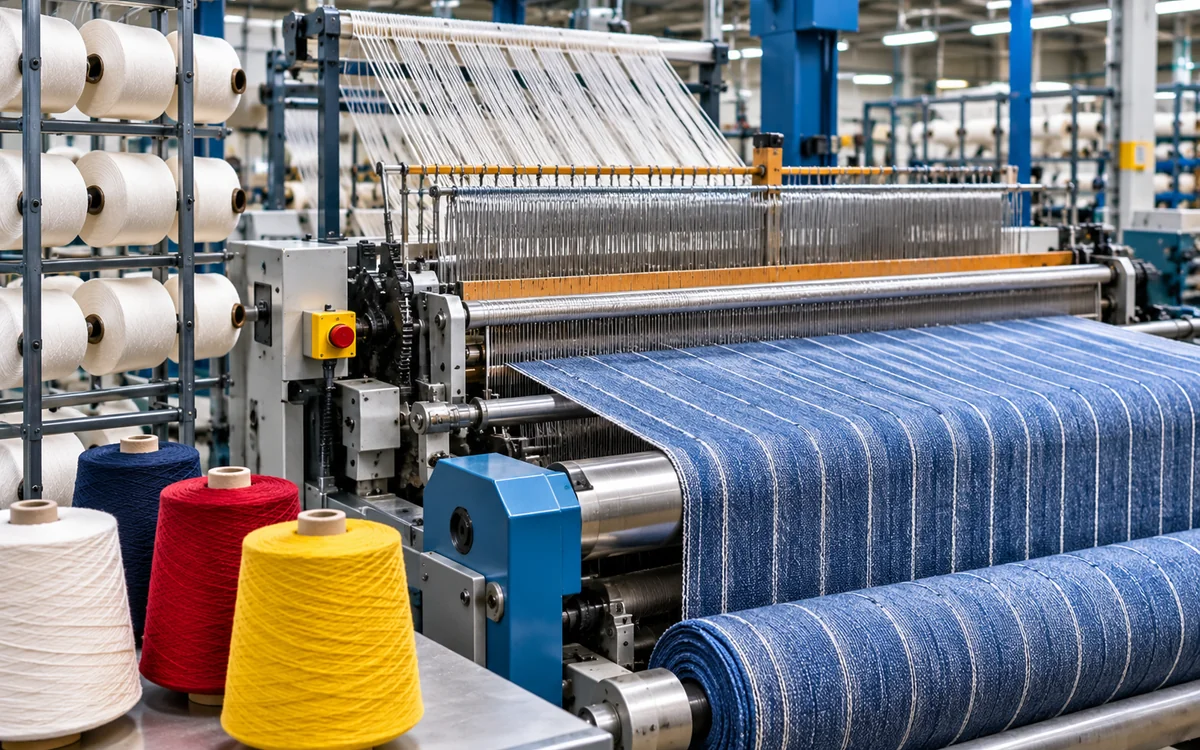
This guide explains the weaving process from yarn cone to finished roll. It covers preparation, the three main motions on a loom, the main loom types and the basic weaves. It also gives worked examples for fabric weight and loom output. For a quick visual summary, see the flow chart of weaving. For the machine itself, read our guide on the parts of a loom.
What is weaving
Weaving is the method of making fabric by interlacing two sets of yarn at right angles.
- Warp yarns run lengthwise. They are fixed on the loom under tension. Each single warp yarn is called an end.
- Weft yarns run crosswise. They are passed through the warp one at a time. Each single weft yarn is called a pick. The weft is also called the filling.
- Selvedge is the finished edge of the fabric, formed where the weft turns back at each side.
A woven fabric is stable. It does not stretch much along the warp or the weft, though it stretches a little on the diagonal, called the bias. That is the main difference from knitted fabric, which is made from loops and stretches more. If you want to compare the two, our guide on woven vs knit fabric explains it.
Stage 1: Preparation before weaving
Raw yarn from a spinner cannot go straight onto the loom. It must be wound, arranged and strengthened first.
Winding
Yarn arrives on cones, cheeses or hanks. Winding rewinds it onto larger, uniform packages, removes faults like slubs and joins broken ends. Good winding gives packages that run smoothly in the next step.
Warping
Warping takes yarn from hundreds of cones and winds it side by side onto a beam, as parallel threads of equal length and tension. There are two common routes.
- Direct warping: Yarn from many cones goes straight onto the warp beam. It suits short runs and simple designs.
- Sectional warping: Yarn is wound onto a drum in sections, then transferred to the beam. It suits long runs and patterned or coloured warps.
Sizing
Warp yarn is rubbed and pulled thousands of times on the loom. Sizing coats it with a film, usually starch, polyvinyl alcohol (PVA), CMC or acrylics, plus wax, to reduce hairiness and boost strength. The coated yarn is dried on hot cylinders and wound onto the weaver’s beam. Sizing is mainly for warp yarn in spun cotton and blends. Many filament yarns need only a light oil. After weaving, the size is removed in desizing, which is a chemical step in finishing.
Drawing-in or tying-in
Each warp end must be threaded through its own drop wire, heald (heddle) and a gap in the reed. Drawing-in is done by hand or machine for a new warp. For a repeat style, tying-in joins the new warp ends to the old ones, which is faster. The drawing-in plan decides the weave pattern.
Stage 2: The weaving itself
Once the weaver’s beam is mounted and the yarn is threaded, the loom runs through a repeating cycle. Three primary motions do the main work.
1. Shedding
The loom lifts some warp ends and lowers others, which makes a V-shaped opening called the shed. The pattern of up and down ends sets the weave. Shedding is done by cams (for simple weaves), a dobby (for small patterns) or a jacquard (for large patterns).
2. Picking
A weft yarn is sent through the shed. How it is sent depends on the loom type: a shuttle, a rapier, a projectile, a jet of air or a jet of water.
3. Beating-up
The reed moves forward and pushes the new pick against the edge of the fabric, called the fell. This packs the weft tightly. The strength of the beat-up sets how dense the fabric is.
Two secondary motions keep the process going.
- Let-off: The warp beam releases yarn at a steady rate so tension stays even.
- Take-up: The finished fabric is drawn forward and wound onto the cloth roll at a steady rate, which sets the picks per inch.
Auxiliary motions keep faults down. These include warp stop motions that stop the loom if an end breaks, weft stop motions that stop it if a pick is missing, and selvedge motions that form the edges.
Types of looms
| Loom | How the weft is inserted | Features |
|---|---|---|
| Handloom | Shuttle thrown by hand | Slow, flexible, used for craft and heritage cloth. See handloom |
| Shuttle loom | A shuttle carries the weft | Older design, slower and noisier. Makes true selvedges |
| Projectile loom | A small gripper carries the weft | Good for wide and heavy fabrics |
| Rapier loom | A rigid or flexible rapier carries the weft | Very flexible with colours and yarns. See rapier loom |
| Air-jet loom | A jet of compressed air carries the weft | Very fast. Good for plain, light and medium fabrics. See air jet loom |
| Water-jet loom | A jet of water carries the weft | Fast, for smooth filament yarns |
Shuttleless looms, meaning projectile, rapier, air-jet and water-jet looms, run far faster than shuttle looms and now produce most of the world’s woven cloth.
Basic weaves
- Plain weave: Each weft goes over one warp and under the next. It is the simplest, strongest and most common. Used in shirting, poplin and voile.
- Twill weave: The weft passes over two or more warps with a step, giving diagonal lines. It is strong and drapes well. Used in denim, gabardine and drill. See our guide on twill weave.
- Satin and sateen weave: Long floats on the surface give a smooth, lustrous face. Used in satin, bedding and evening wear.
- Dobby and jacquard: Patterned weaves made with dobby or jacquard heads. See jacquard weave.
Stage 3: After weaving
The cloth from the loom is called grey fabric, greige or loom state fabric. It is inspected on a table for faults, graded, and marked or repaired. Then it moves to wet processing, which covers desizing, scouring, bleaching, dyeing or printing, and finishing. Our guide on fabric inspection procedure shows how grey fabric is checked.
Worked example 1: fabric weight from construction
Fabric weight in grams per square metre (GSM) can be estimated from the yarn count, ends per inch (EPI) and picks per inch (PPI). For English cotton count (Ne), without allowing for crimp:
GSM ≈ 23.25 × (EPI ÷ warp Ne + PPI ÷ weft Ne)
Take a shirting fabric with 40s warp, 40s weft, 100 EPI and 80 PPI.
- EPI ÷ Ne = 100 ÷ 40 = 2.5
- PPI ÷ Ne = 80 ÷ 40 = 2.0
- Sum = 4.5
- GSM = 23.25 × 4.5 = 104.6
Real fabric is slightly heavier, because yarn takes a wavy path and uses more length than the fabric length. If the warp crimp is 7 percent and the weft crimp 5 percent, the estimate becomes (2.5 × 1.07 + 2.0 × 1.05) × 23.25 = (2.675 + 2.10) × 23.25 = 111 GSM. Finishing treatments and shrinkage change the final number, so the mill’s lab test is the final word.
Worked example 2: loom output
Loom output depends on speed, picks per inch and efficiency.
Production (m/hr) = (RPM × 60 × 0.0254) ÷ PPI × efficiency
An air-jet loom runs at 600 picks per minute. It weaves 80 PPI fabric at 85 percent efficiency.
- Picks per hour = 600 × 60 = 36,000
- Metres at 100 percent = 36,000 × 0.0254 ÷ 80 = 11.43 m per hour
- At 85 percent efficiency = 11.43 × 0.85 = 9.72 m per hour
- Per 24-hour day = 9.72 × 24 = 233 metres per loom
If the mill has 100 such looms, the output is about 23,300 metres a day. A change in efficiency from 85 to 90 percent adds around 1,300 metres a day. This shows why a few points of efficiency matter. Our guide on the calculation of weaving cost and profit uses these numbers to work out cost per metre.
How to read a weave diagram
Weave designers draw the pattern on squared paper. Each vertical column is one warp end. Each horizontal row is one weft pick. A filled square means the warp end is up over the weft at that crossing. An empty square means the weft is on top. The smallest block that repeats is called the repeat. For plain weave the repeat is two ends by two picks. For a 2/1 twill it is three by three, with the filled squares moving one step across on each pick to make the diagonal line. When a designer prepares a new cloth, the weave diagram, the drawing-in plan and the lifting plan are written together, so the loom is set up in one go.
Why looms stop: losses in efficiency
A loom never runs for the whole shift. Time is lost to warp breaks, weft breaks, beam changes, cleaning and waiting for the mechanic. Mills measure loom efficiency as the share of the theoretical output that is actually produced. A quick way to see the loss: if a loom could make 11.43 m an hour and the shift produces 9.72 m an hour, the efficiency is 9.72 ÷ 11.43 = 85 percent, so 15 percent of the potential is lost. If most of that loss is warp breaks, better sizing or better winding will help. If it is weft breaks, check the yarn and the insertion system. If it is waiting time, look at the number of looms per weaver and the spare parts system. Tracking the reason for each stop gives a clear list of what to fix first.
Roles in a weaving shed
- Weaver or operator: Watches several looms, ties broken ends and starts the loom after a stop.
- Fitter or mechanic: Sets and repairs looms.
- Beam gaiter or drawing-in worker: Prepares new warps.
- Quality inspector: Checks cloth on the inspection table and grades faults.
- Supervisor or shed in-charge: Plans loom loading, tracks efficiency and manages the team.
Common weaving faults
| Fault | Cause |
|---|---|
| Broken ends | Weak or poorly sized yarn, rough reed or healds |
| Missing picks | Weft feeding problems or stop motion failure |
| Float | A warp or weft yarn that skips the weave |
| Reed marks | Bent or worn reed dents, wrong tension |
| Slubs and neps | Yarn faults or poor winding |
| Stitching (bunched picks) | Loose weft or irregular beat-up |
| Uneven selvedge | Poor selvedge motion or tension |
| Weft bars | Variation in weft yarn or loom stops |
| Oil stains | Machine oil, dirty parts |
Weaving mills track faults per 100 metres and the number of stops per loom hour. Fewer stops means better yarn and better preparation.
Final thoughts
The weaving process turns loose yarn into a stable, flat cloth through steady, repeating steps. Good fabric begins with good preparation: clean winding, even warping, strong sizing and careful drawing-in. Then the loom does its three jobs again and again: open the shed, send the weft and beat it in. Learn the numbers behind the process, such as EPI, PPI, GSM and efficiency, and you can judge a weaving plan or a quote with confidence.
Frequently asked questions
It is the method of making fabric by interlacing warp yarns and weft yarns at right angles on a loom. It includes preparation and the main loom motions.
The steps are winding, warping, sizing, drawing-in, weaving (shedding, picking, beating-up), inspection and passing to wet processing.
Sizing coats warp yarn with a film to make it stronger and smoother, so that it can survive the rubbing of the loom without breaking.
They are shedding, picking and beating-up.
Warp yarns run lengthwise and stay fixed on the loom. Weft yarns run crosswise and are inserted one pick at a time.
Air-jet looms are among the fastest for common fabrics. Speed depends on fabric type and yarn.
No. Weaving interlaces two sets of yarn at right angles. Knitting forms interlocking loops from one yarn or a set of yarns.

