Every woven shirt, bedsheet and pair of jeans began on a loom. A loom looks like a tangle of threads and metal frames, but it follows a clear logic. Threads run in two directions and cross each other to form fabric. Each part of the loom has one small job in that process. Once you know the parts of a loom, the whole machine starts to make sense.
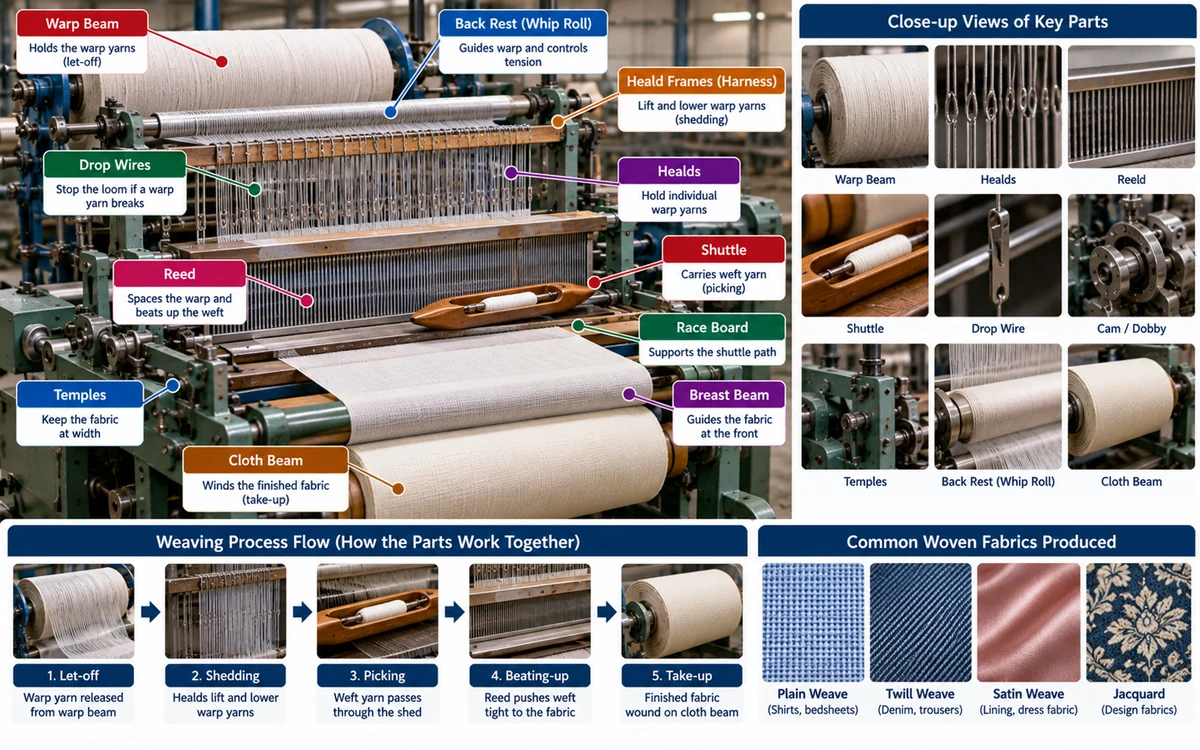
This guide covers the basic parts of a loom, from the hand loom to the power loom, and explains what each one does. We will follow the order of the weaving process, from the warp beam to the finished cloth. If you want a bigger picture of the process, our guide on the flow chart of weaving is a good companion. And for the three main motions, read about the primary motion of the loom.
The basic idea of weaving
Woven fabric is made from two sets of yarn.
- Warp: The yarns that run lengthwise, along the fabric.
- Weft: The yarns that run across, from side to side. Weft is also called filling or pick.
The loom holds the warp yarns tight and parallel. It then lifts some of them to make an opening, called the shed. A weft yarn is passed through the shed. Then the weft is pushed against the previously woven fabric, and the shed changes. This cycle repeats thousands of times to build up cloth.
For more on how woven structure differs from knit, see our guide on what is woven fabric.
The three primary motions
Every loom performs three main motions in order.
- Shedding: Lifting some warp yarns and lowering others to form the shed.
- Picking: Passing the weft yarn through the shed.
- Beating-up: Pushing the new weft yarn tight against the fabric.
Two more motions, called secondary motions, support these.
- Let-off: Releasing warp yarn from the warp beam at the right pace.
- Take-up: Winding the finished fabric onto the cloth beam.
Most loom parts support one of these five motions.
Parts of a loom at a glance
| Part | Motion | Job |
|---|---|---|
| Warp beam | Let-off | Holds the warp yarns |
| Back rest (whip roll) | Let-off | Guides the warp and controls tension |
| Drop wires | Warp protection | Stop the loom if a warp yarn breaks |
| Heald frames (harness) | Shedding | Lift and lower warp yarns |
| Healds | Shedding | Hold individual warp yarns |
| Reed | Beating-up | Spaces the warp and beats up the weft |
| Shuttle or other weft carrier | Picking | Carries weft through the shed |
| Race board | Picking | Supports the shuttle path |
| Cloth beam | Take-up | Winds the finished fabric |
| Breast beam | Take-up | Guides the fabric at the front |
| Temples | Fabric control | Keep the fabric at width |
| Cams, dobby or jacquard | Shedding | Control the lifting pattern |
Warp beam
The warp beam is a large roller at the back of the loom. It holds thousands of warp yarns wound side by side, like thread on a spool. The warp beam is prepared in a separate step called warping and sizing. In sizing, a starch or polymer coating is applied to the yarn. This stops the yarn from breaking when it rubs against loom parts during weaving.
As weaving goes on, the warp beam slowly turns and releases yarn. This is the let-off motion.
Back rest or whip roll
The back rest, also called the whip roll, is a roller that sits between the warp beam and the heald frames. The warp yarns pass over it. It guides them into the right position, and it can move slightly up and down to keep tension steady. In a tension control system, the back rest responds to changes in tension, and signals the let-off to adjust. This keeps the fabric even.
Drop wires
Drop wires are thin metal strips that hang on the warp yarns. Each yarn passes through one drop wire. If a yarn breaks, its drop wire falls onto an electrical contact bar. The contact stops the loom. This prevents faulty fabric from being woven with a missing yarn.
Drop wires are one of the most important protective parts. Without them, a broken warp yarn would create a long, visible line of fault.
Heald frames (harness) and healds
Heald frames, also called harnesses, are rectangular frames that carry healds. Healds are thin wires or cords, each with a small eye in the middle. A single warp yarn passes through each eye. When the heald frame goes up, it lifts the yarns attached to it. When it goes down, it lowers them.
A plain weave loom needs at least two heald frames. One lifts the odd yarns and the other lifts the even yarns. A twill weave needs three or four frames. A satin weave needs five or more. Complex patterns need many frames, or a dobby or jacquard system.
Wire healds are common on modern looms. They wear slowly but need to be kept clean and well-spaced.
Shedding mechanism: cam, dobby, jacquard
The heald frames need a mechanism to move them. There are three common types.
- Tappet or cam shedding: Cams are shaped wheels that push the frames up and down. It is simple and fast, but suits only simple weaves like plain and twill.
- Dobby shedding: A dobby is a mechanism that can control up to 16 or 32 frames, depending on the model. It uses a chain of pegs or an electronic controller. It is used for small geometric patterns, like those in shirt fabrics.
- Jacquard shedding: A jacquard head controls each warp yarn separately. It can weave large, complex patterns like brocade and damask. See our guide on brocade fabric for an example.
Reed
The reed is a comb-like frame made from thin metal strips, called dents, set closely together. The warp yarns pass through the gaps between them. The reed does two jobs.
- It keeps the warp yarns evenly spaced across the width.
- It beats the weft yarn into place after each pick.
Reed count describes how many dents there are per unit length. A fine reed has many dents per inch. It is used for fine, dense fabric. A coarse reed has fewer dents and is used for open fabric. Reed count affects fabric density and width, so it must be matched to the yarn and design.
Sley and lay
The reed is held in a swinging frame called the sley or lay. The lay swings back and forth, moving the reed toward the fabric to beat up the weft. On older shuttle looms, the lay also carries the shuttle’s race board.
Weft insertion devices
The weft must be carried across the shed. Different looms use different devices.
Shuttle
A shuttle is a small boat-shaped holder containing a bobbin, called a pirn, of weft yarn. It is thrown across the shed and slides along the race board. Shuttle looms are the oldest type. They are slow and noisy, but they make strong selvedges, the self-edges of the fabric.
Projectile
A projectile loom uses a small steel gripper to carry the weft across. It is faster than a shuttle loom and handles a wide range of yarns.
Rapier
A rapier loom uses flexible or rigid rods, called rapiers, that carry the weft from one side to the center and then pass it to another rapier. It is flexible and good for fancy fabrics and many colors.
Air jet
An air jet loom blows the weft across the shed with a jet of compressed air. It is very fast and works well with fine yarns. It uses a lot of compressed air, so energy efficiency matters. Compressed air is one of the main energy costs in a weaving mill. See our guide on compressed air energy loss for ideas on cutting that.
Water jet
A water jet loom uses a stream of water to carry the weft. It is very fast and suits smooth synthetic filament yarns, such as polyester. It cannot be used with yarns that absorb water, like cotton.
Race board
On a shuttle loom, the race board is a flat surface that supports the shuttle as it travels across the shed. It sits on the lay. Rough or dirty race boards slow the shuttle and cause yarn damage.
Selvedge motions and temples
The selvedge is the finished edge of the fabric. To hold the fabric edge firm, looms use selvedge motions such as leno or tucked selvedge devices. They stop the edges from fraying.
Temples are small spiked rollers or clamps that hold the fabric to the correct width as it is woven. Without them, the fabric would narrow, because the weft pulls the edges together. A worn temple leaves marks on the fabric edge.
Breast beam and cloth beam
The breast beam is a beam at the front of the loom, over which the finished fabric passes. The cloth beam, also called the fabric roll, sits below it and winds the fabric. The take-up motion rotates the cloth beam at a fixed pace. The pace sets the pick density: how many weft yarns per inch.
If the take-up is slow, picks bunch together and the fabric is dense. If it is fast, picks are spread out and the fabric is thin.
Supporting parts
- Loom frame: A heavy iron or steel frame that holds all parts.
- Crank shaft: Drives the lay and the shuttle or other weft carrier.
- Bottom shaft: Controls the cam or dobby.
- Weft feeder and stand: Hold the weft packages.
- Weft cutter: Cuts the weft yarn after each insertion.
- Weft stop motion: Stops the loom when a weft yarn is missing.
- Control panel: Sets the speed and pick count.
Hand loom parts
The hand loom has the same basic parts as the power loom, but they are operated by hand and foot. A weaver sits at the loom, presses pedals to move heald frames and throws the shuttle by hand. A hand loom is still used for specialty cloth and craft work. The core parts include the warp beam, heald frames, reed, shuttle and cloth beam. Hand looms play a role in cultural textile traditions and rural income in many countries, including Bangladesh and India.
Common faults linked to loom parts
| Fault | Cause |
|---|---|
| Warp break | Weak yarn, rough heald, worn reed |
| Weft break | Poor weft yarn, wrong tension |
| Broken pick | Weft not inserted |
| Float | Warp or weft missing the shed |
| Reed mark | Damaged or bent dent in the reed |
| Starting mark | Loom stopped and restarted |
| Selvedge fault | Poor temple or selvedge motion |
| Uneven density | Take-up or let-off problems |
| Oil stain | Excess lubrication |
| Crack | Dense fabric from slow take-up |
For related fabric issues after weaving, see our guide on fabric inspection procedure.
Final thoughts
A loom is a machine for crossing threads in a controlled order. The warp beam supplies the yarn, the heald frames make the shed, the weft carrier crosses it, the reed beats it in and the cloth beam winds it up. Learn these five parts first. After that, shedding choices, weft insertion types and temples are just refinements. When you walk through a weaving shed, try following a single warp yarn from beam to cloth. You will see every part in action.
Frequently asked questions
The main parts are the warp beam, back rest, drop wires, heald frames, reed, weft insertion device and cloth beam. Looms also have a shedding mechanism, such as a cam, dobby or jacquard.
The reed spaces the warp yarns evenly and beats up each weft yarn against the fabric.
The shed is the opening created when some warp yarns are lifted and others are lowered. The weft yarn passes through it.
Warp yarns run lengthwise along the fabric. Weft yarns run across, from side to side.
Healds hold warp yarns and lift or lower them to form the shed. Each warp yarn passes through the eye of a heald.
A dobby controls a set of heald frames and makes small patterns. A jacquard controls each warp yarn separately and can make large, complex designs.
Sizing coats the yarn with a thin film that makes it smoother and stronger, so it can survive rubbing against the loom without breaking.