Cloth is flat, but bodies are not. A shirt that fits the chest may balloon at the waist. A skirt that fits the hips may gape at the back. A dart is the small folded wedge that fixes this. It takes in extra fabric where the body curves in and lets the garment follow the shape without cutting extra seams.
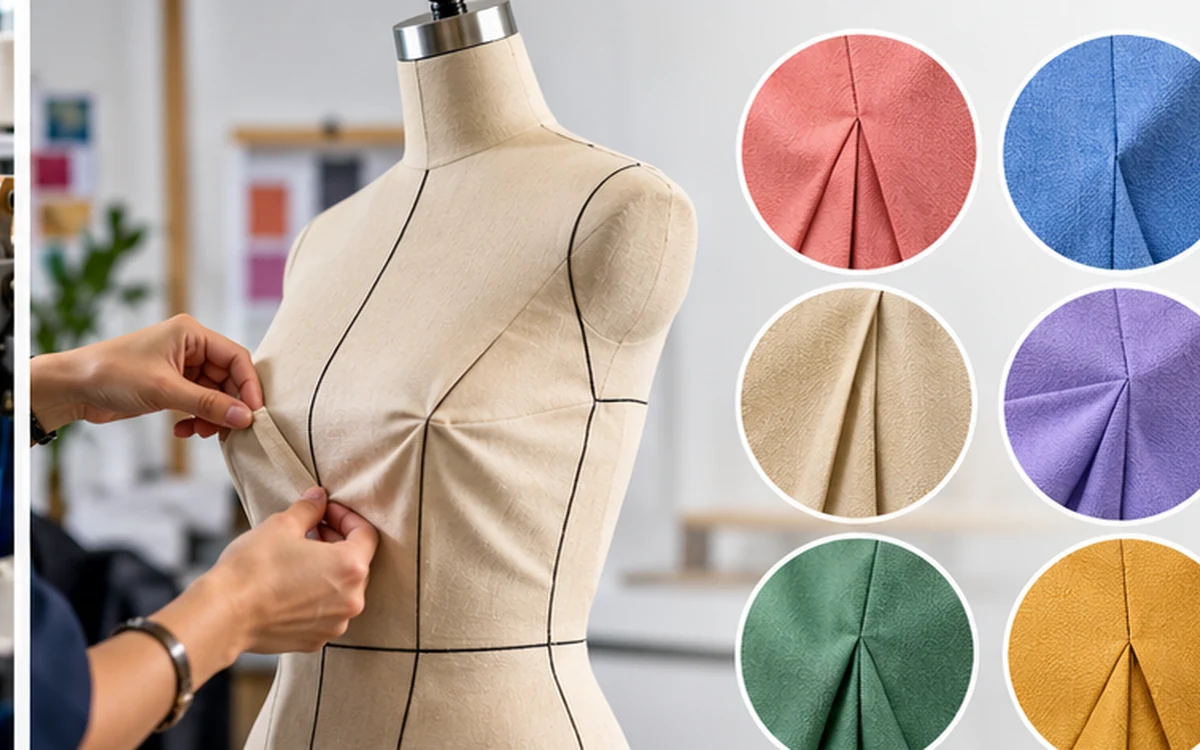
This guide explains the types of darts used in sewing and pattern making. You will learn the parts of a dart, where each type sits on a garment, how darts are sewn and how they can be moved. A worked example shows the numbers behind dart width and angle. The guide is simple enough for a beginner and useful for a pattern maker who wants a quick reference. For the wider topic, see our guide on pattern making in garments.
What is a dart
A dart is a triangular fold stitched into a piece of fabric to shape it. The fold is stitched from the wide end, at the edge of the fabric, to a point inside the piece. When it is pressed, the fabric forms a gentle curve over the body.
Darts are used mainly in woven fabrics, which do not stretch much. Knit fabrics stretch to fit, so they need fewer darts.
Parts of a dart
| Part | What it is |
|---|---|
| Legs | The two stitching lines that form the sides of the triangle |
| Intake (width) | The distance between the legs at the wide end, which is the amount of fabric taken in |
| Point (apex) | The tip of the dart, where the legs meet |
| Length | The distance from the wide end to the point |
| Fold line | The centre line of the dart, along which the fabric is folded |
| Wide end (base) | The end of the dart at the cut edge or the seam |
The point of a dart should end just short of the fullest part of the body. For a bust dart, this means about 2 to 3 cm before the bust point. If the dart ends exactly on the bust point, the fabric forms a pucker. If it ends too far away, the shape is too flat.
Main types of darts
1. Single-pointed darts
These have one wide end and one point. They are the most common.
Bust darts Bust darts shape the fabric over the chest. Depending on where the wide end starts, they have different names.
- Side bust dart (French dart). The base is on the side seam, below the armhole, and points toward the bust. A classic on blouses and dresses.
- Waist bust dart. The base is at the waist and points up toward the bust.
- Shoulder dart. The base is at the shoulder seam and points down toward the bust.
- Armhole dart. The base is on the armhole curve.
- Neckline dart. The base is on the neckline, often in the centre.
- Centre front dart. The base is at the centre front edge, below the neckline.
- Mid-armhole dart. A variation that sits between the armhole and shoulder.
Waist darts Waist darts take in fabric between the bust and the waist or between the hip and the waist.
- Front waist dart. Shapes the front of a skirt, trousers or bodice from the waist down toward the hip, or up toward the bust.
- Back waist dart. Shapes the back of a bodice or skirt over the hip and shoulder blades. Back darts are often longer than front darts.
- Hip dart. A short dart starting at the waistline and ending near the fullest part of the hip.
Shoulder blade dart Fits the back over the curve of the shoulder blades, where the fabric needs to be controlled.
Elbow dart Shapes fitted sleeves at the elbow. The dart goes from the back edge of the sleeve toward the elbow point.
Sleeve cap darts Small darts at the sleeve cap help to fit the sleeve head to the armhole.
2. Double-pointed darts (contour or fish darts)
A double-pointed dart has two points, one at the top and one at the bottom, with the widest part in the middle. It shapes a garment in two places at once. The classic use is a fitted dress, where the dart goes from the bust, down through the waist, and out toward the hip. It is also used on the back of a fitted jacket.
The widest part sits at the waist. The shape looks like a fish, which is why it has this nickname.
3. Dart equivalents
Not every shaping fold is a classic dart. Some are built into seams or gathers.
- Princess seams. A long seam that does the work of a bust dart and a waist dart, in one curved line.
- Gathers. Fabric gathered into a seam or waistband replaces a dart. It gives a softer fullness.
- Pleats and tucks. Folded fabric that releases at the bottom.
- Style lines and yokes. Seams placed on the pattern that absorb shaping.
- Ease and curved seams. Mild shaping built into a side seam.
Where each dart is used
| Garment | Common darts |
|---|---|
| Fitted blouse or shirt | Side bust dart, back waist dart |
| Dress | Bust dart, waist dart, fish dart |
| Skirt | Front and back waist darts |
| Trousers | Front and back waist darts, or none with pleats |
| Jacket or blazer | Front waist and back darts, shoulder dart, sleeve elbow dart |
| Kurti and salwar kameez | Side bust darts and waist darts |
| Bodice for gown or bridal wear | Multiple bust and waist darts, or princess seams |
| Tailored coat | Fish darts, shoulder darts |
| Bra and corset | Cups, boning, and shaping seams |
Measurements behind a dart
Dart size depends on the difference between two body measurements.
- For a skirt, it is the difference between the hip and the waist.
- For a bodice, it is the difference between the bust and the waist.
- For a bust dart, it is the cup volume, which depends on the difference between the full bust and the high bust, or the bust and the band measurement.
For more on taking measurements, see our guide on the measurement of top and bottom garments.
Worked example 1: dart size on a skirt
A skirt is made for these body measurements.
- Waist: 72 cm
- Hip: 96 cm
- Ease: 0 on the waist for this example, and the hip ease is taken out of the example to keep it simple
Step 1: find the total difference
- 96 − 72 = 24 cm for the full circumference
Step 2: work out the amount per pattern piece
A basic skirt has 4 quarter panels, a front pair and a back pair. Take one quarter.
- Hip quarter = 96 ÷ 4 = 24 cm
- Waist quarter = 72 ÷ 4 = 18 cm
- Difference per quarter = 24 − 18 = 6 cm
Step 3: share the shaping
Part of the shaping can go at the side seam, and the rest into darts.
- Side seam shaping: 2 cm per quarter
- Dart intake: 6 − 2 = 4 cm per quarter
If each quarter has one dart, the dart is 4 cm wide. That can be too deep for a smooth shape, so a pattern maker may use two darts of 2 cm each. This is why back panels often have two smaller darts, which sit better over the curve than a single big dart.
Typical dart lengths for a skirt are about 8 to 10 cm for the front and 12 to 14 cm for the back. Use your own fit tests to refine this.
Worked example 2: dart angle and moving darts
A dart is really a wedge, and its size depends on its length and the angle at the point. The relationship is:
intake = 2 × leg length × sin(angle ÷ 2)
Suppose a side bust dart has a leg length of 12 cm and an intake of 3 cm.
- sin(angle ÷ 2) = 3 ÷ (2 × 12) = 0.125
- angle ÷ 2 = about 7.18 degrees
- angle = about 14.4 degrees
Now the pattern maker wants to move the dart to the waist, where the leg length is 9 cm. When a dart is moved by pivoting around the bust point, the angle stays the same. The new intake is:
- 2 × 9 × sin(7.18 degrees) = 2 × 9 × 0.125 = 2.25 cm
So the same shaping needs a narrower dart, 2.25 cm, at a shorter leg length. The amount of fabric taken in around the bust point is unchanged. This is the idea behind dart manipulation, where a pattern maker moves, splits or turns a dart into a seam or gathers, without changing the fit.
How to move or change a dart
There are two common methods.
- Slash and spread (or slash and close). Cut from the new dart position to the bust point. Cut the old dart’s legs, close the old dart and the pattern opens at the new slash. Tape and redraw the outline.
- Pivot method. Put the pattern on paper with the bust point pinned. Trace the pattern, then rotate it around the point until the old dart legs close. Trace the rest. The new opening is the new dart.
After either method, true the seams. The pieces that join must have the same length. Our guide on pattern grading shows how patterns are sized up and down after shaping. If the fabric shrinks, read about pattern making based on fabric shrinkage.
How to sew a dart
- Mark the dart on the wrong side of the fabric using tailor’s chalk, a pen that washes out, or tracing paper. Mark the legs and the point.
- Fold the fabric right sides together, matching the legs. Pin across the dart.
- Start sewing at the wide end. Use a regular stitch length, a back-stitch at the start and sew toward the point.
- Taper into the point. At the last 1 to 2 cm, stitch very close to the fold. Do not backstitch at the point. Instead, sew off the fabric for a few stitches and tie the threads in a small knot, or use a short back-stitch.
- Press the dart flat as sewn. Then press it to one side. Bust darts are usually pressed down, waist darts toward the centre, and shoulder darts toward the neck.
- For thick fabric, cut the dart open and press the halves apart, or use a tailor’s ham to preserve the curve.
If the point puckers, the dart may be too long, too wide or not tapered smoothly. Re-sew a little shorter, or lower the point by 1 cm.
Common dart mistakes
| Problem | Likely cause | Fix |
|---|---|---|
| Pucker at the point | Dart ends on the fullest point, or stitching angle is abrupt | Shorten the dart and taper the last few stitches |
| Bubble at the point | Point is too short of the body curve | Lengthen the dart a little |
| Dart looks like a ditch | Intake too wide | Use two smaller darts |
| Wrinkles around the dart | Seam not pressed correctly | Press over a ham and use steam |
| Dart too high or low | Position not matched to the body | Fit a muslin and mark the correct point |
| Lumpy dart in thick fabric | Fabric bulk | Slash and press open |
| Uneven darts left and right | Marking error | Use a template and match pairs |
| Dart does not match at seams | Pattern not trued | Check lengths and notches |
Darts in knit and stretch garments
Knit fabrics stretch, so a close fit comes from the fabric and from pattern shaping like negative ease. Darts are used in structured knits, ponte, and in some fitted dresses. If you do use them, keep them slightly smaller than you would in woven fabric.
Tips for pattern makers
- Keep the dart legs equal in length, so the dart sews flat.
- Use the correct dart angle for the fabric. Stiff fabrics need smaller intake.
- Test the fit with a muslin (toile) before cutting the real fabric.
- Rotate the dart to a style line for a cleaner look.
- Mark darts clearly with notches, drill holes or pattern symbols. Many factories use a drill hole 2 cm short of the point.
- When grading, grade the dart intake and length with the size. A small size has a smaller dart than a large size.
- For factory use, write the dart size and the stitch type in the tech pack. See our page on the tech pack for clothing.
Final thoughts
The types of darts are many, but they follow one idea: take fabric in where the body curves in. Learn the parts, place the point carefully and press with care. When you understand the angle behind each dart, you can move it, split it or replace it with a seam, and your garments will fit well and look clean.
Frequently asked questions
The main types are bust darts (side, waist, shoulder, armhole, neckline, centre front), waist darts (front and back), hip darts, shoulder blade darts, elbow darts and double-pointed (fish) darts.
A French dart starts at the side seam and points to the bust. A waist dart starts at the waist and points up to the bust or down to the hip.
It shapes a garment at the bust, the waist and the hip in one dart. It is used in fitted dresses and jackets.
Yes. Princess seams, yokes and gathers can do the same job as a dart.
Bust darts and waist darts are usually pressed downward or toward the centre. Check the garment type and the fabric.
It depends on the garment. Skirt darts are often 8 to 14 cm, and bust darts stop 2 to 3 cm before the bust point.
Most knit T-shirts do not. The fabric stretches. Fitted women’s tops may have darts or shaped side seams.