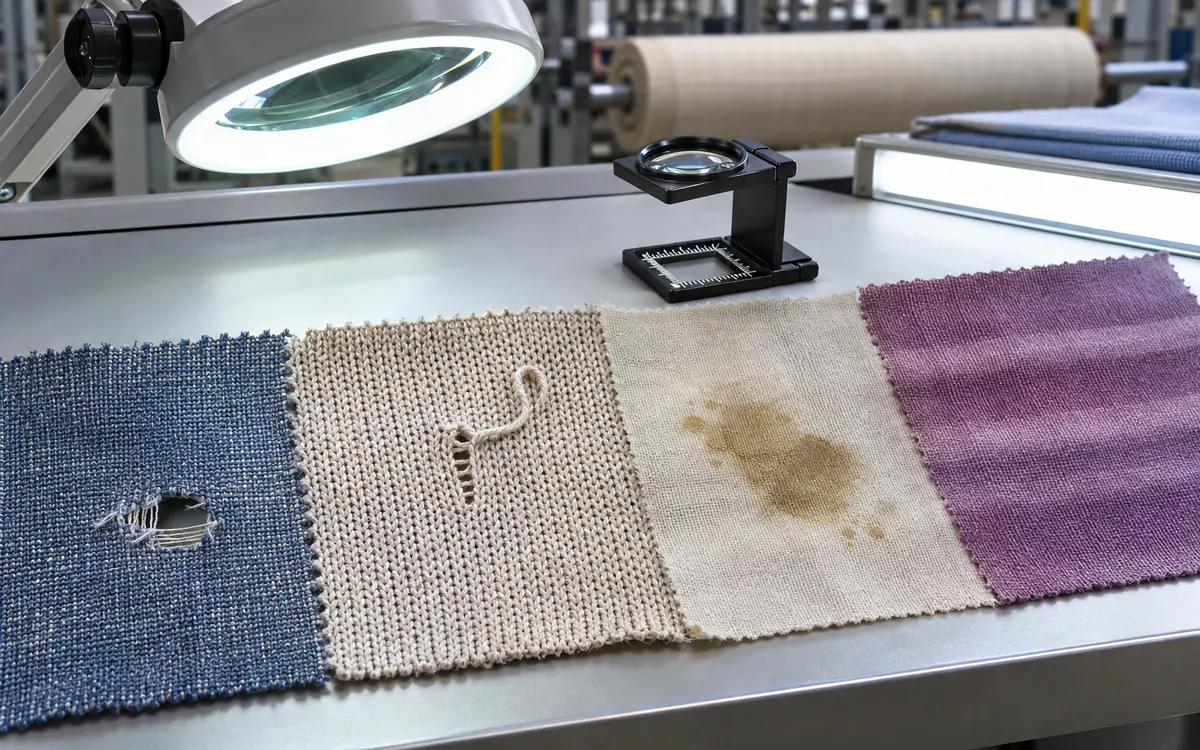
A buyer opens a roll of fabric and spreads it across the inspection table. Under the bright light, small faults appear: a thin line across the width, a spot of oil, a hole, a patch that is a little darker than the rest. Each one costs money. Some can be cut around. Others make the roll unusable. Fabric defects are among the biggest sources of waste in the textile and garment trade, and knowing them helps every person in the chain, from the weaver to the sewing line.
This guide lists the most common fabric defects in woven, knit and dyed fabrics. For each group it shows the likely causes and remedies. It then explains how defects are graded with the four-point system, with a worked scoring example. For the checking process itself, see our guide on the fabric inspection procedure and the 4-point system for fabric inspection.
What is a fabric defect
A fabric defect is any fault in a fabric that makes it different from what was ordered or lowers its look, strength or use. Defects may begin in the fibre, in the yarn, in weaving or knitting, in dyeing and printing, or in finishing and handling. Finding the stage where a defect began is the key to fixing it.
Classes of fabric defects
| Class | Meaning | Examples |
|---|---|---|
| Major | Visible, affects strength or look in a serious way, likely to be rejected | Holes, broken ends over a length, large stains, big shade bars |
| Minor | Small and not very visible, usually acceptable within limits | Small slubs, minor thread ends, light creases |
| Critical | Makes the fabric unsafe or unusable | Chemical damage that weakens the cloth, harmful residues |
The same defect can be minor on a dark upholstery cloth and major on a white shirting fabric. Buyers set the rules.
Woven fabric defects
| Defect | What it looks like | Common causes | Remedies |
|---|---|---|---|
| Broken end | A warp yarn is missing along a length, leaving a gap or line | Weak or poorly sized yarn, rough reed or heddle, high loom speed | Improve sizing and yarn strength, smooth the path, set loom speed correctly |
| Missing end | A line along the length with no yarn | Skipped end during drawing-in, unnoticed break | Check drawing-in, use warp stop motions |
| Double end | Two ends together act as one, giving a thick line | Wrong drawing-in, sticky yarn | Check drawing and reed denting |
| Broken pick | A weft yarn is absent across the width | Weft break, loom stop | Check weft feeding and the stop motion |
| Missing pick | A thin line across the fabric | Weft insertion failure | Adjust nozzles or rapiers, clean the path |
| Float | A warp or weft yarn skips over several yarns | Heald or cam error, broken end tangled | Check shedding and tie-up |
| Slub | A thick lump in the yarn | Spinning fault, fly in the yarn | Use better yarn, clear faults at winding |
| Neps | Small tangles of fibre | Poor carding, immature cotton | Better carding and fibre selection |
| Thick and thin place | Variation in yarn thickness shows up in fabric | Uneven yarn | Use even yarn and check yarn evenness |
| Reed mark | A thin, regular line along the warp | Bent or uneven reed dents | Replace the reed, check tension |
| Temple mark | Marks near the selvedge | Worn or wrong temples | Change temples, adjust pressure |
| Starting mark (stop mark) | A band across the width where the loom stopped and restarted | Let-off or take-up slip, uneven beat-up | Adjust restart settings |
| Weft bar | A band of different shade or density across the width | Different weft yarn lot, mixed yarn | Keep one lot per piece, avoid mixing |
| Uneven selvedge | Wavy, curled or loose edges | Selvedge motion fault | Adjust the selvedge unit |
| Oil stain | Dark spots or lines | Machine oil, dirty parts | Clean the loom, use proper lubrication |
| Hole | An opening in the fabric | Mechanical damage, sharp parts, chemical damage | Remove sharp edges, handle with care |
| Bowing and skewing | Weft lines are curved or slanted | Uneven stretch in finishing | Correct at the stenter or by weft straightening |
For notes on how looms create or avoid these, see our guides on the air jet loom and the weaving process.
Knit fabric defects
| Defect | What it looks like | Common causes | Remedies |
|---|---|---|---|
| Hole | An opening, often round | Yarn break, broken needle, too much tension | Check needles, lower tension, improve yarn |
| Drop stitch | A missing stitch giving a run or ladder along the length | Latch needle fault, loose or tight yarn feed | Change faulty needles, adjust yarn feed |
| Needle line | A vertical line along the fabric | Bent or damaged needle, dirt in the groove | Change the needle, clean the cylinder |
| Barre | Horizontal bands or stripes | Yarn variation, tension changes, mixed yarn lots | Use one yarn lot, even feed |
| Press-off | A big hole from a sudden machine stop | Yarn jam, power loss | Restart carefully, repair |
| Thick and thin place | Uneven yarn showing in the fabric | Yarn quality | Better yarn |
| Lycra drop or spandex missing | Part of the fabric loses stretch, or shows lines | Elastane feed broken, wrong tension | Check the elastic feed unit |
| Fly and lint | Fibre bits knitted into the cloth | Dusty room, poor housekeeping | Clean machines, use blowers |
| Oil spot | Dark stain | Lubricant on yarn or machine | Fix oil leaks, clean needles |
| Tuck | A yarn caught without a proper loop | Needle timing, yarn path | Adjust timing and feed |
| Curling edges | The edge rolls in | Natural property of single jersey | Heat set, use proper finishing |
| Spirality (torque) | Courses do not run straight, the fabric twists after washing | Yarn twist, circular knitting, no relaxation | Use balanced yarn, compact, heat set |
| Variation in GSM | Fabric weight is uneven | Loop length changes | Check machine settings and take-down |
| Shade bars | Patches of different colour | Different yarn lots, dyeing errors | Keep lots separate |
Dyeing, printing and finishing defects
| Defect | What it looks like | Common causes | Remedies |
|---|---|---|---|
| Patchy or uneven dyeing | Dark and light areas | Poor preparation, fast heating, wrong chemicals | Scour well, heat slowly, check recipe. See dyeing process |
| Listing or side-to-centre shade | Edge is darker or lighter than the centre | Uneven dye uptake across the width | Adjust padding pressure, drying |
| Tailing | Colour changes from start to end of the roll | Dye affinity changes over the run | Control speed and bath |
| Shade variation between batches | Different lots do not match | Changes in fabric, water or chemicals | Standardise inputs and keep records |
| Crease marks and rope marks | Lines from folds, often permanent | Fabric folded in the machine, high temperature | Adjust loading, use lubricants, cool slowly |
| Dye spots | Small dark specks | Undissolved dye, rust, scale | Dissolve dye well, filter, clean tanks |
| Scum | White or grey deposit | Hard water, lime soap, dye residues | Use soft water, sequestering agents. See sequestering agents |
| Poor rubbing fastness | Colour rubs off | Unfixed dye on the surface | Wash off properly, use fixing agents |
| Print misregistration | Colours do not line up | Screen setting, fabric slip | Reset screens, control fabric tension |
| Print blotches | Pooled colour | Paste too thin, screen clog | Adjust paste and cleaning |
| Chemical damage | Weak spots or holes | Too strong bleach or caustic, uneven rinse | Control chemical dose and rinse |
| Stiff hand | Fabric is harsh | Too much resin or binder | Reduce finishes, add softener |
| Uneven width and length shrinkage | Fabric changes size in the wash | Poor stabilising, over-stretching | Allow relaxation, measure shrinkage. See shrinkage control |
| Pilling | Little balls on the surface | Short fibres, weak twist | Use better yarn, bio-polish, singe |
| Hairiness | Fibres stand out from the surface | Yarn hairiness | Singe, compact spin |
Defects that come from handling and storage
- Stains from dirt, oil or water in storage.
- Mildew from damp rolls.
- Fold marks from poor rolling.
- Cuts and tears from careless handling or sharp edges.
- Fading from sunlight in warehouses.
- Selvedge damage from tight stacking.
Handle rolls with covers, keep stores dry and clean, and roll fabric on tubes with even tension.
How fabric defects are graded: the 4-point system
The four-point system gives each defect a penalty based on its size. Inspectors check the fabric on a table at a steady speed, record the defects and add the points.
| Defect size (length of the defect) | Points |
|---|---|
| Up to 3 inches (7.6 cm) | 1 |
| Over 3 and up to 6 inches (7.6 to 15 cm) | 2 |
| Over 6 and up to 9 inches (15 to 23 cm) | 3 |
| Over 9 inches (23 cm) | 4 |
| Hole of 1 inch or more | 4 |
Rules differ a little between buyers. A common rule says that no more than 4 points can be given for any one yard of fabric, however many defects it has. Fabric is often accepted if the points per 100 square yards are not above 40, though some buyers set a lower limit.
Formula:
Points per 100 square yards = (Total points × 36 × 100) ÷ (Length in yards × Width in inches)
The number 36 converts yards of length to inches, so that length and width are in the same unit.
Worked example: scoring a roll
A roll is 120 yards long and 58 inches wide. The inspector records:
| Defect size | Number found | Points each | Points |
|---|---|---|---|
| Up to 3 in | 5 | 1 | 5 |
| 3 to 6 in | 3 | 2 | 6 |
| 6 to 9 in | 2 | 3 | 6 |
| Over 9 in | 1 | 4 | 4 |
| Total | 11 | 21 |
Points per 100 square yards = (21 × 36 × 100) ÷ (120 × 58) = 75,600 ÷ 6,960 = 10.9
This is well below a limit of 40, so the roll passes on this test. The grade of the roll can then be set according to the buyer’s scale. A roll that scored, for example, 52 points per 100 square yards would fail and might be returned or sold at a discount.
Now see what happens if the same roll had 60 points instead of 21:
- (60 × 36 × 100) ÷ (120 × 58) = 216,000 ÷ 6,960 = 31.0
This is still below 40, but near it. The buyer may ask for a tighter limit for fine shirting. Always follow the contract.
Note that the four-point system counts defects, not defective rolls. That echoes the idea in our guide on defects vs defectives in garments.
Reducing fabric defects: a practical plan
- Start with the yarn. Test for evenness, strength and faults. Reject bad lots.
- Prepare well. Good winding, warping and sizing prevent most weaving defects.
- Maintain machines. Clean and service looms and knitting machines by schedule.
- Control the environment. Keep humidity and dust in the right range.
- Train staff. Show operators photos of defects and how to react.
- Inspect early. Check fabric at the loom or machine, not just at the end.
- Record defects by cause. Use a chart to find the top five and fix them first.
- Control wet processing. Use standard recipes, water quality checks and lot control.
- Handle with care. Cover rolls, avoid dragging and keep stores clean.
- Share findings with suppliers and teams so causes are fixed at the source.
How fabric defects affect garments
A fabric defect that is not caught at the fabric stage becomes a garment defect later. Cutters must either cut around the fault, losing fabric, or place the fault in a seam allowance. If it stays on the front of a shirt, the garment is a second. That is why many factories inspect fabric before cutting and mark the defects on the roll. See also our guide on cutting, sewing, washing and finishing defects in garments.
Final thoughts
Fabric defects are costly, but most of them are preventable. Each one has a cause in a certain step, and each step has simple checks that stop it. Learn the names and the look of the common faults, use a grading system like the four-point method and keep records by cause. The more you trace a defect back to its source, the fewer you will see on the table. Better fabric means fewer rejects and a smoother run in the sewing room.
Frequently asked questions
They are faults in fabric that lower its look, strength or usefulness, such as holes, stains, broken ends, uneven dyeing and slubs.
Common woven defects are broken ends, missing picks, floats, slubs, reed marks, weft bars, oil stains and uneven selvedges.
Holes, drop stitches, needle lines, barre, press-offs, oil spots, fly and spirality are typical.
Poor preparation, heating too fast, wrong chemicals, uneven fabric feed or mixed fabric lots.
It is a grading method that assigns 1 to 4 points to each defect based on its size, and adds them to give a score per 100 square yards.
Many buyers accept up to 40 points per 100 square yards, but the limit is set in the contract and may be lower.
By using good yarn, maintaining machines, controlling dyeing and handling, inspecting early and finding the cause of each fault.