An inspector checks 100 shirts at the end of a sewing line. She finds 12 faults, such as a skipped stitch, an open seam and a stain. The line supervisor says the line has 12 defective shirts. Is he right? Not necessarily. Those 12 faults may sit on only 8 shirts, because some shirts carry two faults each. So there are 12 defects but 8 defectives. This is the heart of the difference between defects and defectives, and mixing the two words is one of the most common mistakes in factory quality reports.
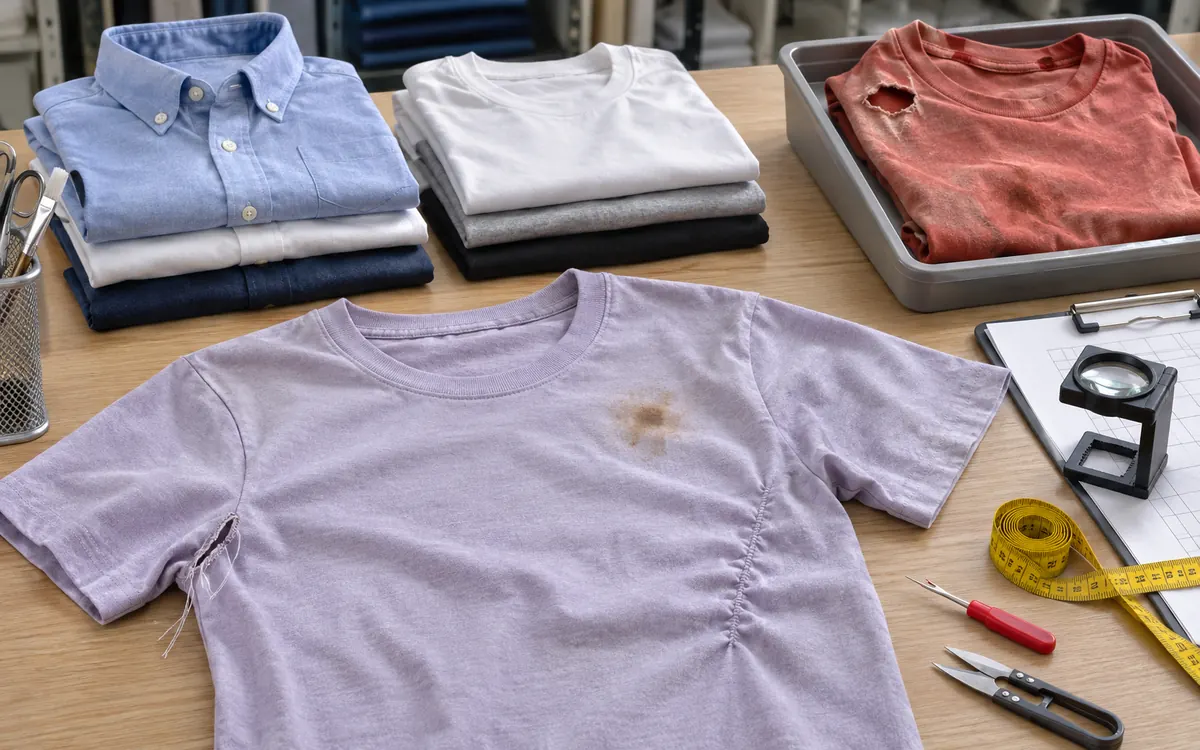
This guide explains the difference between defects and defectives in plain words, with the formulas for DHU and defective percentage, the classes of defects, the idea of AQL and worked examples you can copy. If you want to look at the defects themselves, see our guides on cutting, sewing, washing and finishing defects in garments and sewing defects and their root causes.
What is a defect
A defect is a single fault, flaw or failure to meet a requirement in a garment. It is something that is wrong with the product. Each separate fault counts as one defect.
Examples:
- A skipped stitch on a hem
- An open seam at the shoulder
- A broken needle hole in the fabric
- A stain on the front panel
- A missing button
- A wrong label
- A measurement outside the tolerance
One garment can carry many defects at the same time. If a shirt has a skipped stitch, a stain and an uneven collar, it has three defects.
What is a defective
A defective, also called a defective piece or a defective unit, is a garment that has one or more defects that make it not acceptable for sale as first quality. The count is by pieces, not by faults.
A shirt with one defect is one defective. A shirt with three defects is still one defective. A shirt with no defect, or with only a defect that the buyer’s standard allows, is not defective.
So defectives are always equal to or fewer than defects:
Number of defectives ≤ Number of defects
They are equal only when every defective piece carries exactly one defect.
The key difference in a table
| Point | Defect | Defective |
|---|---|---|
| Meaning | A single fault in a garment | A garment that has one or more defects and is not acceptable |
| What is counted | Faults | Pieces |
| Can one piece have more than one? | Yes, many defects on one piece | One piece counts only once |
| Example | Open seam, stain, skipped stitch | A shirt with an open seam and a stain |
| Common measure | DHU (defects per hundred units) | Defective percent, reject rate |
| Used to | Find where and why faults occur | Find how many pieces need repair or rejection |
| Typical value in a report | 12 defects | 8 defectives |
A simple way to remember: defects are what is wrong, defectives are what is wrong with whom.
Formulas
DHU (defects per hundred units)
DHU = (Total number of defects ÷ Number of pieces checked) × 100
DHU shows the average number of defects found in every 100 garments. It is the most popular quality number in apparel factories because it points to the process. A rise in DHU warns that a machine, operation or operator needs attention.
Defective percentage
Defective % = (Number of defective pieces ÷ Number of pieces checked) × 100
This shows the share of garments that are not acceptable. It tells you how much repair, rework or rejection to expect.
Defects per piece
Defects per defective piece = Total defects ÷ Number of defective pieces
This number shows how many faults an average faulty garment has. A high value means some pieces are in poor condition, which may mean a machine fault or a skill problem.
Worked example 1: DHU and defective percent
At the end of the line, a quality checker inspects 300 shirts. She records:
- Total defects found: 21
- Defective pieces: 15 (some shirts have two defects)
DHU = (21 ÷ 300) × 100 = 7.0
Defective % = (15 ÷ 300) × 100 = 5.0 percent
Defects per defective piece = 21 ÷ 15 = 1.4
This means that, on average, there are 7 defects for every 100 shirts, 5 of every 100 shirts need to be fixed or rejected, and a faulty shirt carries 1.4 faults. A line with a DHU of 7 and a defective rate of 5 percent needs a look at the top defect types. A common target for a good line is lower, but each buyer and product sets its own goal.
Worked example 2: why the two numbers move differently
Line A and Line B each have 400 shirts checked.
| Line A | Line B | |
|---|---|---|
| Total defects | 40 | 40 |
| Defective pieces | 40 | 20 |
| DHU | 40 ÷ 400 × 100 = 10 | 40 ÷ 400 × 100 = 10 |
| Defective % | 40 ÷ 400 × 100 = 10 percent | 20 ÷ 400 × 100 = 5 percent |
| Defects per defective | 1.0 | 2.0 |
Both lines have the same DHU. But in Line A the faults are spread across 40 pieces, and in Line B they are packed into 20 pieces. Line A has more garments to repair, but each repair is small. Line B has fewer garments to repair, but each one has more faults and may take longer. The right action differs. In Line A, look at the main sources of single faults. In Line B, look for a source that puts several faults on one garment, such as a poorly set machine, a new operator or a bad bundle of fabric.
Worked example 3: effect on repair cost
Say a repair takes on average 1.5 minutes for each defect and there is a fixed 0.5 minute handling time per defective piece (finding, picking up, putting back).
For Line A (40 defects, 40 defective pieces):
- Repair = 40 × 1.5 = 60 min
- Handling = 40 × 0.5 = 20 min
- Total = 80 min
For Line B (40 defects, 20 defective pieces):
- Repair = 40 × 1.5 = 60 min
- Handling = 20 × 0.5 = 10 min
- Total = 70 min
If a repair minute costs 2.5 currency units, Line A’s rework costs 200 units per 400 shirts, and Line B’s costs 175 units. A small difference, but across a month of 30,000 shirts per line, the gap adds up. This is also why many factories count both measures. Our article on productivity vs production shows how lost minutes link to output.
Classes of defects: critical, major and minor
Buyers do not treat all defects the same. They split them into three classes.
| Class | Meaning | Examples | Typical rule |
|---|---|---|---|
| Critical | A defect that makes the product unsafe or breaks a law | Broken needle left inside, sharp edge on a child’s garment, toxic dye, small parts that can detach | Zero tolerance. A single one fails the lot |
| Major | A defect that is likely to cause failure or make the product unsellable | Open seam, broken stitching, big stain, wrong size, missing button, hole | Limited by the AQL for major defects |
| Minor | A small defect that does not reduce use but is not perfect | Loose thread, slight uneven stitching, small crease, minor shade difference | Limited by the AQL for minor defects |
Different buyers and products shift where each defect sits. A small stain may be minor on a work shirt and major on white bridalwear. Always use the buyer’s defect classification list.
Defect classification by work stage
Many factories group defects by where they arise. This helps find the department responsible.
| Stage | Examples of defects |
|---|---|
| Fabric | Holes, slubs, shade variation, stains, barre, weaving faults. See fabric defects |
| Cutting | Wrong size cut, notches missing, ply shift, uneven cutting, bowing and skewing |
| Sewing | Skipped stitches, broken stitches, open seams, puckering, uneven stitching, raw edges, wrong stitch density, misaligned parts |
| Trims and accessories | Wrong buttons, snaps not working, zipper faults, label errors |
| Washing | Uneven wash, shade change, damaged fabric, bad smell. See garment washing defects |
| Printing and embroidery | Mis-registration, cracking, missing parts, thread tail |
| Pressing and finishing | Iron marks, shine, creases, loose threads, dirt |
| Packing | Wrong fold, wrong polybag, missing hang tag, wrong carton mark |
Classifying by stage turns a long list of faults into a clear picture of who needs to act. A Pareto chart, which ranks defect types by count, shows the top few that cause most of the loss.
AQL: how many defectives are acceptable
AQL stands for acceptable quality level. It is the maximum percentage of defective pieces that the buyer will accept as an average over many lots. It is part of sampling plans, such as the international standard ISO 2859-1, also published as ANSI/ASQ Z1.4. Under the plan, an inspector takes a random sample from the lot and counts defective pieces by class. If the number is at or below the acceptance number, the lot passes. If it reaches the rejection number, the lot fails.
Many garment buyers use these AQL values: 0 for critical, 2.5 for major and 4.0 for minor. Other buyers use different numbers.
Example plan. A lot of 2,000 pieces, inspected at general inspection level II, falls under code letter K, which gives a sample size of 125 pieces. The accept and reject numbers for that sample size are:
| AQL | Accept (Ac) | Reject (Re) |
|---|---|---|
| 1.0 | 3 | 4 |
| 2.5 | 7 | 8 |
| 4.0 | 10 | 11 |
Check the table in the standard or your buyer’s manual before using it, as plans can differ.
If the inspector finds 6 pieces with major defects, the lot passes the 2.5 major limit (6 is below the reject number of 8). If she finds 8, it fails.
Note that AQL counts defective pieces, not defects. A shirt with two major defects counts as one defective in this approach. That is why the two terms matter when reading an inspection report. Some buyers count defects instead, so read the buyer’s manual to see which they use. For more on how inspection is done, see our guides on garment inspection checklist and garments quality inspection.
Defects and defectives in fabric inspection
Fabric inspection uses a different system, the four-point system, which scores each defect by its length and adds the points to give a total per 100 square yards or metres. It counts defects, not defective pieces, because a roll of fabric is one continuous piece. See our guide on the 4-point system for fabric inspection.
Using the two measures together
| Question | Use |
|---|---|
| How good is the process? | DHU |
| What share of garments will need repair or rejection? | Defective percent |
| Where do faults come from? | Defect counts by type and stage |
| Will this lot pass the buyer’s inspection? | AQL plan with defective counts by class |
| How bad is the average faulty piece? | Defects per defective |
| What is the rework load? | Defectives and minutes per repair |
Track both numbers every hour on a line board, and by operation if possible. Spot trends early and act at the source.
Common mistakes
- Using the words defect and defective as if they were the same
- Counting a garment twice when it has two defects (in defective counts)
- Not recording the defect type, only the count
- Mixing critical, major and minor in one total
- Reporting only a percentage with no sample size
- Hiding defects by repairing them without a record
- Using a different inspection method on different shifts
- Forgetting that a repaired garment can still be counted as defective until it is re-checked
How to reduce defects and defectives
- Find the top defects with a Pareto chart.
- Find the root cause with simple tools such as the five whys, rather than blaming people.
- Fix the process: machine settings, needles, tension, attachments, work aids.
- Train operators on the top defects and show good and bad samples.
- Check early. Inline checks catch faults before a whole bundle is wasted.
- Control incoming materials. Reject bad fabric and trims before cutting.
- Use clear standards, with photos of acceptable and unacceptable work.
- Give feedback quickly to the operator and the supervisor.
- Track results and celebrate improvement.
Final thoughts
The difference between defects and defectives is simple, yet it changes how a quality report reads. Defects tell you what is going wrong. Defectives tell you how many garments are affected. Use DHU to watch the process, defective percent to plan repair and shipping, and AQL to match the buyer’s rules. Keep clear records by stage and by class, and use the facts to fix causes rather than symptoms. A line that counts well can improve quickly.
Frequently asked questions
A defect is a single fault in a garment. A defective is a garment that has one or more defects and is not acceptable. Defects are counted by faults and defectives by pieces.
Yes. It can have many defects, but it counts as only one defective piece.
DHU means defects per hundred units. It is total defects divided by pieces checked, multiplied by 100.
Divide the number of defective pieces by the number of pieces checked and multiply by 100.
Defects are equal to or greater than defectives. They are equal only when every defective piece has just one defect.
Critical defects make the product unsafe or illegal. Major defects make it unsellable or likely to fail. Minor defects are small flaws that do not affect use.
AQL is the acceptable quality level, a limit on defective pieces in a sample that decides if a lot passes or fails an inspection.