Look closely at the back of your jeans. You will see a pattern of fine diagonal lines running across the cloth. The same lines show up on chino trousers, work uniforms and many jackets. They are the signature of the twill weave, one of the three basic weaves in the textile world, along with plain weave and satin.
This guide explains what twill weave is, how it is built, the main types and the fabrics made from it. It also covers the properties, the uses and how to read a twill diagram, with worked examples on fabric weight and the amount of interlacing. For the wider process of making woven cloth, see our guide on the weaving process.
What is twill weave
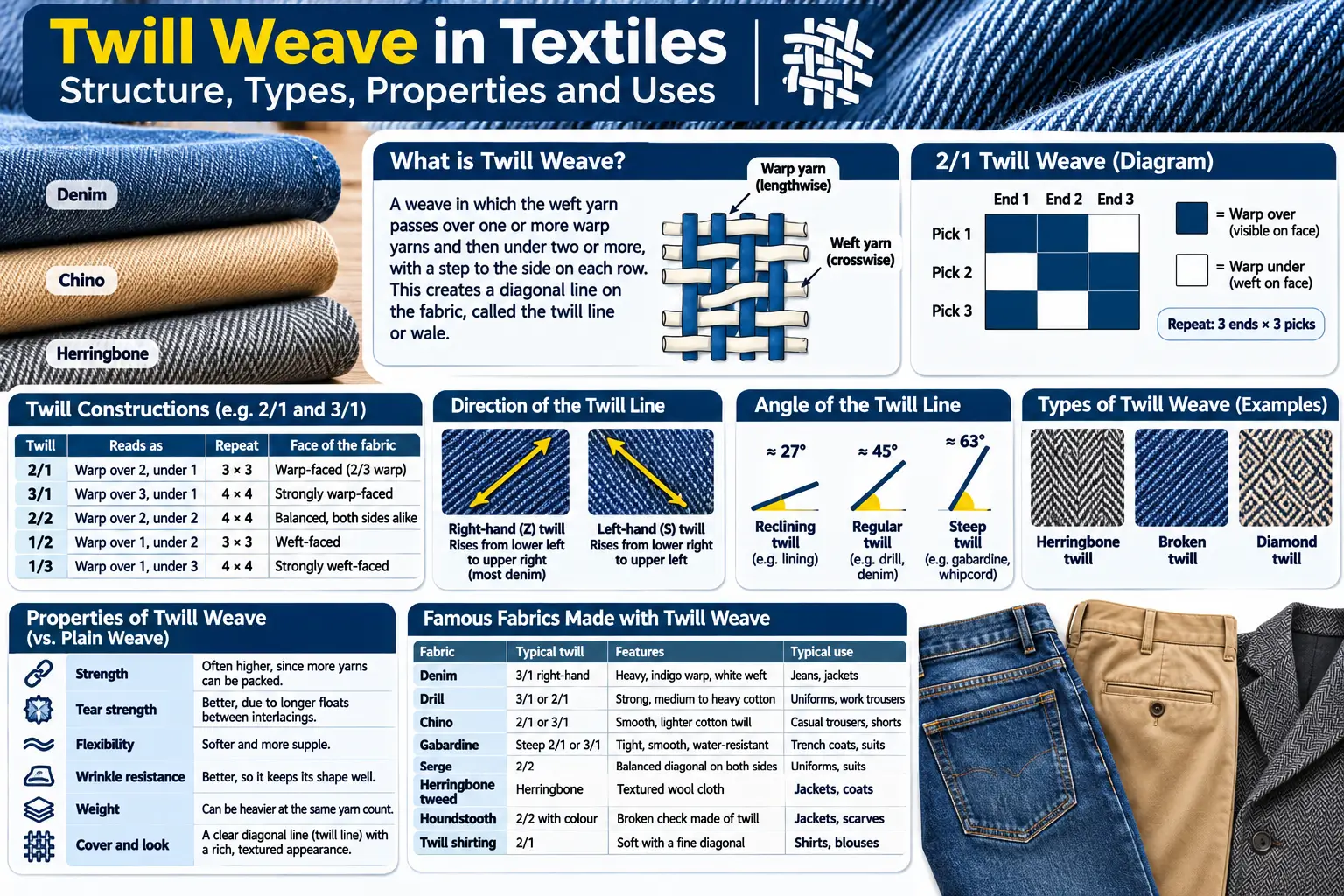
Twill weave is a weave in which the weft yarn passes over one or more warp yarns and then under two or more, with a step to the side on each row. This step creates a line of raised yarns that runs diagonally across the fabric. The line is called the twill line or the wale.
In the simplest case, the weft goes over two warp yarns and under one, and the next weft starts one yarn to the side. When you repeat this, the diagonal appears. Because the yarns float over each other for a longer distance than in plain weave, the cloth is softer, more flexible and more resistant to wrinkles. It can also hold more yarns in the same space, so it is heavier and stronger.
How twill is built: the basic structure
Weavers describe a twill with a fraction, such as 2/1 or 3/1. The top number is the number of warp yarns that go over a weft yarn. The bottom number is the number of warp yarns that go under. The sum of the two gives the repeat. For example:
| Twill | Reads as | Repeat | Face of the fabric |
|---|---|---|---|
| 2/1 | Warp over 2, under 1 | 3 ends × 3 picks | Warp-faced, 2/3 of the surface is warp |
| 3/1 | Warp over 3, under 1 | 4 ends × 4 picks | Strongly warp-faced, as in denim |
| 2/2 | Warp over 2, under 2 | 4 ends × 4 picks | Balanced, both sides alike |
| 1/2 | Warp over 1, under 2 | 3 ends × 3 picks | Weft-faced |
| 1/3 | Warp over 1, under 3 | 4 ends × 4 picks | Strongly weft-faced (reverse of 3/1) |
The smallest twill needs three ends and three picks, since a two-by-two repeat would just be a plain weave.
Drawing a 2/1 twill
On squared paper, each column is a warp end and each row is a weft pick. A filled square means the warp end is over the weft at that crossing.
| End 1 | End 2 | End 3 | |
|---|---|---|---|
| Pick 1 | ■ | ■ | □ |
| Pick 2 | □ | ■ | ■ |
| Pick 3 | ■ | □ | ■ |
The filled squares shift one place to the right with each pick, which makes the diagonal line. The repeat is 3 by 3. Every end is up for two picks and down for one.
Direction of the twill line
- Right-hand twill (Z twill): The line rises from lower left to upper right, like the middle stroke of the letter Z. Most denim is right-hand twill.
- Left-hand twill (S twill): The line rises from lower right to upper left, like the middle stroke of the letter S.
The direction affects the look and the feel against the skin. Fabrics for jeans often have a right-hand twill. Some brands use a left-hand twill for a different texture.
The angle of the twill line
When the number of ends and picks per inch is equal, the twill line runs at about 45 degrees. If there are more ends than picks per inch, the line becomes steeper. If there are fewer, the line is flatter.
| Type | Angle | Example |
|---|---|---|
| Regular twill | About 45 degrees | Drill, denim |
| Steep twill | About 63 degrees | Gabardine, whipcord |
| Reclining twill | About 27 degrees | Some lining fabrics |
Types of twill weave
Simple twills
These are the standard 2/1, 3/1, 2/2 and 1/2 patterns, with a straight line.
Herringbone twill
The twill line goes one way for a number of ends, then reverses. The pattern looks like the bones of a fish, or a row of V shapes. It is used in tweed jackets, suits and coats.
Broken twill
The twill line is broken at regular points, so there is no clear diagonal. It reduces the diagonal look and gives a more even surface. It is used for some suiting, to avoid a strong visible line.
Pointed twill
The twill line turns at a point and goes back, like a herringbone, but in a wider form that can be used to make zigzag effects.
Diamond and zigzag twills
The line changes direction in both warp and weft directions, which makes diamond shapes. Found in decorative cloths, bedding and some home fabrics.
Elongated and fancy twills
The twill goes over several ends at once, with long floats. Used for lining fabrics, sateen-like effects and special designs.
Warp-faced and weft-faced twill
If most of the surface is warp yarn, the cloth is warp-faced. Denim is warp-faced, which is why the outside looks blue (indigo warp) and the inside looks white (white weft). If the weft dominates, it is weft-faced.
Combination and corkscrew twills
Weavers combine twills of different step sizes to make a rounded cord look. Corkscrew twill is a steep twill with a rope-like diagonal, used in riding trousers and some suits.
Famous fabrics made with twill weave
| Fabric | Typical twill | Features | Typical use |
|---|---|---|---|
| Denim | 3/1 right-hand | Heavy, indigo warp, white weft | Jeans, jackets. See what denim is |
| Drill | 3/1 or 2/1 | Strong, medium to heavy cotton | Uniforms, work trousers |
| Chino | 2/1 or 3/1 | Smooth, lighter cotton twill | Casual trousers, shorts |
| Gabardine | Steep 2/1 or 3/1 | Tight, smooth, water-resistant | Trench coats, suits |
| Serge | 2/2 | Balanced diagonal on both sides | Uniforms, suits |
| Herringbone tweed | Herringbone | Textured wool cloth | Jackets, coats |
| Houndstooth | 2/2 with colour | Broken check made of twill with two colours | Jackets, scarves |
| Twill shirting | 2/1 | Soft with a fine diagonal | Shirts and blouses |
| Cavalry twill | Steep twill | Strong, hard-wearing wool | Riding wear |
| Silk twill | 2/1 | Smooth, with a soft sheen | Scarves, ties |
| Canvas variants | Some are twill | Heavy cotton | Bags, tents. See canvas fabric |
Properties of twill weave
| Property | Twill compared with plain weave |
|---|---|
| Strength | Often higher, since more yarns can be packed |
| Tear strength | Better, because floats allow yarns to group together |
| Drape | Softer and more flowing |
| Wrinkle resistance | Better |
| Stretch on the bias | A little more give |
| Soil hiding | Good. The diagonal texture hides dirt |
| Surface | Textured with a visible diagonal line |
| Abrasion | Float yarns can snag and wear sooner than in plain weave |
| Cost | Usually higher than plain, since it uses more yarn |
| Fraying | Can fray, so seams need finishing |
Why twill packs more yarn
In plain weave, every yarn crosses a yarn of the other set at every point, so yarns lock tightly and cannot be pushed together. In twill, yarns cross less often, so there is room to pack more ends and picks in one inch. More yarn means a heavier, stronger fabric.
Worked example 1: interlacing in plain vs twill
Count the crossings in one repeat, and count how many of them are binding points. Here a binding point is a place where a warp end goes from over the weft to under it.
- Plain weave repeat: 2 ends × 2 picks = 4 crossings. Each end goes down once in every two picks, so there are 2 binding points. That is 2 out of 4, or 50 percent.
- 3/1 twill repeat: 4 ends × 4 picks = 16 crossings. Each end is up for three picks and down for one, so it goes down once in four picks. That gives 4 binding points out of 16 crossings, or 25 percent.
A lower binding ratio means longer floats, a softer drape and room for more yarns. It also means the cloth can snag more easily, so the weaver must balance these effects.
Worked example 2: fabric weight of a denim twill
Denim weight is often quoted in ounces per square yard. To convert to grams per square metre (GSM), multiply by 33.9.
A 3/1 denim is labelled 12 oz.
- GSM = 12 × 33.9 = 406.8, about 407 GSM
Now estimate the weight from the weave construction. For a warp of 7s Ne with 72 ends per inch, and a weft of 8s Ne with 44 picks per inch, ignoring crimp:
GSM ≈ 23.25 × (EPI ÷ warp Ne + PPI ÷ weft Ne)
- 72 ÷ 7 = 10.29
- 44 ÷ 8 = 5.5
- Sum = 15.79
- GSM = 23.25 × 15.79 = 367
Adding the extra length of yarn that goes into the wavy path of the weave (crimp), say 8 percent in the warp and 4 percent in the weft:
- (10.29 × 1.08 + 5.5 × 1.04) × 23.25 = (11.11 + 5.72) × 23.25 = 16.83 × 23.25 = 391 GSM
That is close to the 407 GSM of a 12 oz label. The gap is due to the finishing (sanforizing and shrinkage change the weight), real yarn counts and rounding. The formula gives a good first estimate, and a lab weighs the real fabric. See our guide on how denim fabric is made for more on construction.
Worked example 3: cover factor
Cover factor shows how closely packed the yarns are. For cotton in English count, cover factor K = threads per inch ÷ √Ne.
For the same denim warp: K warp = 72 ÷ √7 = 72 ÷ 2.646 = 27.2. For the weft: K weft = 44 ÷ √8 = 44 ÷ 2.828 = 15.6.
The total cover factor is 27.2 + 15.6 = 42.8. A plain weave of the same yarns would struggle to hold 72 ends and 44 picks because the yarns would jam. Twill makes it easier. That is the reason denim can be so dense and still be flexible.
Uses of twill weave
- Clothing: Jeans, chinos, work trousers, uniforms, jackets, coats, shirting, ties and scarves.
- Home textiles: Upholstery, curtains, bed linen and tablecloths.
- Industrial and outdoor: Tents, tarpaulins, bags, aprons, work gloves.
- Military and safety wear: Drill and gabardine for field uniforms.
- Linings: Smooth twills for jackets and coats.
- Luxury goods: Silk twill for scarves and ties.
How twill is woven
Twill needs at least three heald frames, since the pattern repeats over three or more ends. A 3/1 twill needs four frames. On a modern loom, the shedding is done by a cam, a dobby or a jacquard. A cam can handle simple twills, a dobby can make herringbone and broken twills, and jacquard can create complex designs. See our guides on handloom, rapier loom and jacquard weave for the machines.
Twill vs plain weave vs satin
| Point | Plain | Twill | Satin or sateen |
|---|---|---|---|
| Smallest repeat | 2 × 2 | 3 × 3 | 5 × 5 |
| Surface | Flat, no pattern | Diagonal lines | Smooth with long floats |
| Strength | Good | Very good | Lower (floats snag) |
| Drape | Stiffer | Softer | Very soft |
| Shine | Low | Medium | High |
| Wrinkles | More | Fewer | Few |
| Cost | Lowest | Medium | Highest |
Care of twill fabrics
- Wash according to the label. Cotton twill takes machine washing well.
- Turn dark twills inside out to reduce fading.
- Avoid very hot dryers, which can cause shrinkage, especially in the first wash. See how to prevent clothes from shrinking.
- Iron while slightly damp, on the reverse side if the fabric is dark, to avoid shine.
- Steam silk and wool twill instead of pressing hard.
Final thoughts
Twill weave is a smart structure. A simple step to the side turns two sets of yarn into a cloth that is strong, soft and good at hiding wear. Learn the fractions, the directions and the common types, and you can read almost any woven fabric on sight. Whether you buy jeans, design uniforms or run a weaving shed, understanding twill helps you judge the quality and cost of what you make.
Frequently asked questions
Twill weave is a weave with a diagonal pattern, made by passing the weft over one or more warp yarns and under two or more, with a step to the side on each row.
Look for fine diagonal lines on the surface. Denim, chino and gabardine are common examples.
In a 2/1 twill the warp goes over two wefts and under one. In a 3/1 it goes over three and under one, so the face is more strongly warp-faced.
Often yes, because more yarns can be packed in the same space. But the long floats can snag more easily.
Yes. Most denim is a 3/1 right-hand twill with an indigo warp and a white weft.
It is a twill in which the line reverses direction at regular intervals, making a V-shaped pattern like fish bones.
Less than plain weave, since the structure is more flexible and recovers well.