Walk into a weaving village in Bangladesh, India or Vietnam and you will hear a steady, wooden rhythm. Clack, thump, clack, thump. A weaver sits at a pit, pushes a foot pedal, throws a shuttle from one hand to the other and pulls a wooden frame toward her chest. With each pull, a thin line of cloth grows. This is the hand loom, one of the oldest machines in the world, and it is still making some of the finest cloth anyone has ever worn.
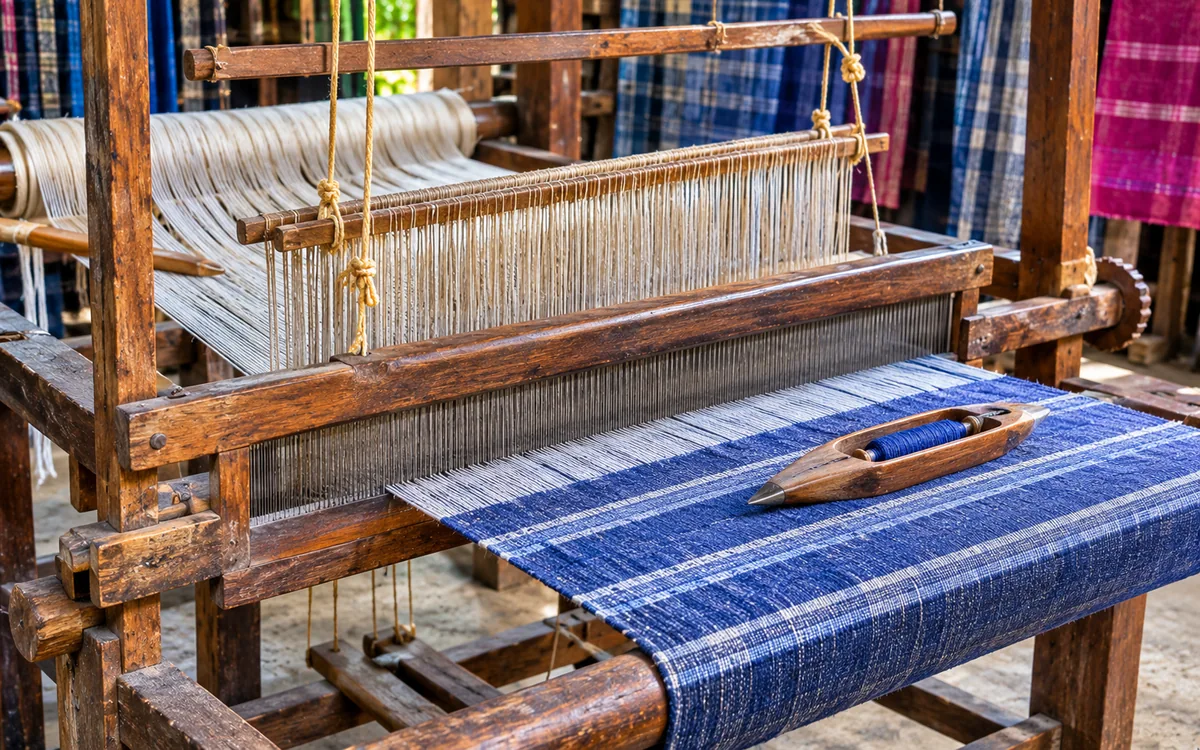
This guide explains what a hand loom is, how it works step by step, and what its parts do. It covers the main types, the fabrics that are made on it, how its output compares with a power loom and why it still matters. If you want the factory story, read our guide on the weaving process and our article on the parts of a loom.
What is a hand loom
A hand loom is a weaving machine that is operated by human power instead of an engine. The weaver controls the opening of the warp yarns, the passing of the weft and the beating of the cloth by hand and foot. There is no electric motor driving the motions.
All looms, hand or power, do the same three jobs in a cycle.
- Shedding: Lift some warp threads and lower others, making a gap called the shed.
- Picking: Pass the weft yarn through the shed.
- Beating-up: Push the new weft against the cloth with the reed, so the cloth stays tight.
On a hand loom, a person does each job. On a power loom, a machine does them at high speed. The fabric made is the same type, with warp and weft crossing at right angles. See our flow chart of weaving for the factory route: flow chart of weaving.
Main parts of a hand loom
| Part | What it does |
|---|---|
| Warp beam | A roller at the back that holds the long warp threads |
| Cloth beam (cloth roller) | A roller at the front that collects the finished cloth |
| Heald frames (heddles) | Frames with eyelets that lift chosen warp threads to make the shed |
| Treadles | Foot pedals that move the heald frames up and down |
| Reed | A comb-like frame that spaces the warp threads and beats the weft into place |
| Batten (sley) | The swinging frame that holds the reed |
| Shuttle | A boat-shaped tool that carries the weft thread across |
| Breast beam | The front beam over which cloth passes to the cloth beam |
| Back rest | The rod over which the warp passes from the warp beam |
| Temple (stretcher) | A small frame that keeps the cloth at full width |
| Lease sticks | Rods that keep the warp threads in order |
| Loom frame | The wood or metal structure that holds everything |
The reed is measured by its number of dents per unit length, and this decides ends per inch in the cloth. A reed with 60 dents per inch and two ends through each dent gives 120 ends per inch.
How a hand loom works: step by step
- Prepare the yarn. Yarn is wound, sized with starch or rice paste, dried and wound onto the warp beam. In many villages this is done in the open air, with the warp stretched in a long line.
- Draw in the warp. Each warp thread is passed through a heald eye and a gap in the reed. This sets the weave. A plain weave needs two heald frames. A twill needs three or four.
- Tie and set up. The warp is tied to the cloth beam and tensioned.
- Shedding. The weaver presses a treadle. One heald frame goes up and the other goes down. The shed opens.
- Picking. The weaver throws the shuttle through the shed from one side to the other. In the throw-shuttle type, it is passed from hand to hand. In the fly-shuttle type, a cord pulls the shuttle through a track.
- Beating-up. The weaver swings the batten forward. The reed pushes the weft against the fell of the cloth.
- Change the shed. The other treadle is pressed. The shed changes, the shuttle goes back, and the next beat follows.
- Take-up and let-off. As cloth grows, the weaver winds it onto the cloth beam and lets out more warp from the warp beam.
This is the same cycle that a factory loom runs. The difference is who powers it, how fast and how much variety of yarn it can handle.
Types of hand looms
| Type | Description | Typical use |
|---|---|---|
| Backstrap (loin) loom | Warp is tied to a tree or post at one end and to the weaver’s body at the other | Narrow cloth, found in many regions of Asia and Latin America |
| Frame loom | A simple wooden frame holding the warp | Wall hangings, craft, rugs, teaching |
| Pit loom | The loom sits over a pit and the weaver’s feet work the treadles inside | Sarees, lungis, dress fabrics |
| Throw-shuttle loom | Shuttle thrown by hand through the shed | Fine, delicate and patterned work |
| Fly-shuttle loom | Shuttle moves along a track when the weaver pulls a cord | Faster production, wider cloth |
| Jacquard hand loom | Fitted with a jacquard head or punched cards | Large figured designs. See our jacquard weave guide |
| Dobby loom | Fitted with a dobby for small patterns | Borders and checks |
| Jala (drawboy) loom | Extra threads lifted by hand with a harness | Floral patterns, brocade |
The fly-shuttle was invented in 1733 by John Kay in England. It nearly doubled the speed of a hand weaver and it was adopted widely, including on the Indian subcontinent in the nineteenth century.
Famous handloom fabrics
Jamdani
Jamdani is a fine cotton fabric with woven floral and geometric motifs, made in and around Dhaka and Narayanganj. The patterns are woven by hand, thread by thread, by adding extra weft yarns into the plain ground. The tradition comes from the old Dhaka muslin and was inscribed by UNESCO on its list of the Intangible Cultural Heritage of Humanity in 2013. A single saree can take weeks or even months.
Muslin
Dhaka muslin was a very fine, almost see-through cotton cloth. It was so light that, in old stories, it was compared to woven air. The original skill is largely lost, and groups are working to bring it back.
Khadi
Khadi is hand-spun and hand-woven cloth, usually cotton. It is thick, slightly rough and becomes softer with wear. It is known for its role in India’s freedom movement.
Banarasi and Kanjeevaram silk
These are rich silk sarees with gold or silver thread. They are woven on jacquard hand looms and can take from several days to months.
Ikat
Ikat is made by tying and dyeing the yarn in patterns before weaving. The blurred edge of the design is the sign of ikat. Pochampally in India, Cambodia, Indonesia and Uzbekistan all have famous ikat traditions.
Tangail and Tant
Tangail sarees from Bangladesh and tant sarees from Bengal are light, cotton sarees with bold borders. They are loved in warm weather.
Others
Chanderi, Muga silk of Assam, Kashmir shawls, Scottish tweeds such as Harris Tweed and Kente cloth of Ghana are all famous handwoven cloths. Our guide on silk fiber explains why silk is such a favourite for fine weaving.
Worked example: hand loom output
How much cloth can a weaver make in a day? Take these values for a plain cotton cloth.
- Weaver throws the shuttle at 40 picks per minute while weaving
- Efficiency is 60 percent, because of rest, tying broken threads and changing bobbins
- Fabric has 60 picks per inch (PPI)
- Working time is 6 hours
Effective picks per minute = 40 × 0.60 = 24
Picks per hour = 24 × 60 = 1,440
Inches woven per hour = 1,440 ÷ 60 = 24 inches = 0.61 metre
Metres per 6-hour day = 0.61 × 6 = 3.66 metres
A plain saree of 5.5 metres would take about 1.5 working days. A jamdani saree with hand-added motifs may need weeks, because each motif needs extra picks.
Now compare with a power loom. An air-jet loom running at 600 picks a minute on 80 PPI fabric at 85 percent efficiency makes about 9.7 metres an hour, as shown in our weaving process guide. In one hour the machine makes more than the hand weaver makes in a day. The hand loom competes on design and skill, not on speed.
Hand loom vs power loom
| Point | Hand loom | Power loom |
|---|---|---|
| Power | Human | Electric motor |
| Speed | Slow, a few metres a day | Very fast, many metres an hour |
| Cost of machine | Low | High |
| Cost per metre | High | Low |
| Design freedom | Very high for hand-added motifs | Limited by machine and program |
| Cloth feel | Slightly uneven, soft, characterful | Uniform and crisp |
| Skill | Years of training | Operator and mechanic training |
| Energy use | None except lighting | Electricity and compressed air |
| Jobs per metre of cloth | Many | Few |
| Best for | Heritage cloth, luxury, craft, small lots | Mass production |
For more on factory machines, see the guides on the rapier loom and the air jet loom.
Advantages of hand looms
- Low investment. A loom can be built and installed at a small cost.
- No electricity needed. It works in villages without stable power.
- Rich design. Skilled weavers can add motifs that machines struggle to copy.
- Many jobs. Handloom weaving supports many families, especially women, in rural areas.
- Low carbon footprint. No power is used in the weaving itself.
- Flexibility. Small lots, custom colours and short runs are easy.
Limitations of hand looms
- It is slow, so the cost per metre is high.
- Quality depends on the weaver’s skill and condition. Small differences from one piece to another are normal.
- Narrow widths. Many hand looms weave 36 to 48 inches. Wider cloth needs wider looms or joining.
- The work is physically hard. Sitting long hours at a pit loom strains the back, knees and eyes.
- Many weavers earn low pay, which is why younger people leave the trade.
- Competition from cheap power loom imitations hurts sales.
Why the hand loom still matters
Several reasons keep it alive. Buyers around the world want products with a story, such as who made them and where. Handloom cloth carries cultural meaning at weddings and festivals. It also supports local economies and keeps knowledge alive that would otherwise be lost. Many governments run schemes to support weavers, and some mark special days to honour them. India observes National Handloom Day on 7 August each year.
There is also a quality reason. Hand weaving can handle yarns that power looms find hard to run, such as very fine, very soft or very uneven yarns. Fine counts of cotton, silk and wool can be woven slowly with little tension. Our guide on the yarn making process shows how those yarns are made.
Telling handloom from power loom cloth
Buyers often ask how to spot the real thing. A few clues help, but none is perfect.
- Small irregularities such as slight changes in thickness or spacing can show hand weaving, although some power looms imitate these.
- Selvedge on a hand loom, especially a throw-shuttle one, is neat on both sides. Fly-shuttle and power looms also make good selvedges, so this alone is not proof.
- Extra-weft motifs that do not float across the whole width, as in jamdani, are hard to make on a power loom.
- Back of the cloth. On hand-woven motifs the back shows small loose ends of the extra weft. Printed or machine imitations may not.
- Labels and certification. In India, a Handloom Mark is used. Many countries have their own marks or geographical indications for crafts such as Jamdani. Look for official labels and ask the seller for proof.
Care of handloom fabrics
- Wash gently in cool water with a mild soap. Do not wring hard.
- Dry in shade to protect colours, especially natural dyes. See our guide on natural dyes.
- Iron on the reverse at the right heat for the fibre. Use a low heat for silk.
- Store folded with a clean cotton cloth between layers, and refold along new lines every few months.
- Keep away from direct moisture and moths.
Final thoughts
The hand loom is a simple machine, but it carries a deep skill. Its parts do the same jobs as the biggest factory loom, only slower and with more care. Where speed matters, power looms win. Where story, design and touch matter, the hand loom is hard to beat. If you buy or sell handloom cloth, learn the parts, ask about the process and pay a fair price for the hours that go into every metre.
Frequently asked questions
A hand loom is a weaving machine that is powered by a person instead of a motor. The weaver uses hands and feet to open the shed, pass the weft and beat it into place.
The weaver presses a treadle to lift some warp threads, throws a shuttle with the weft through the gap and pulls the reed to press it into the cloth. Then the other treadle changes the gap and the cycle repeats.
The main parts are the warp beam, cloth beam, heald frames, treadles, reed, batten, shuttle and the frame.
A hand loom is driven by a person and makes cloth slowly. A power loom is driven by a motor and is much faster, but has less freedom for hand-added design.
Famous examples include jamdani, muslin, khadi, tant, tangail, ikat, Banarasi silk and Kanjeevaram silk.
It is different. Handloom cloth has character and can carry detailed design. Machine cloth is more uniform and cheaper. The better choice depends on the use.
A plain saree can take a day or two. A fine jamdani or brocade saree can take weeks or even months.