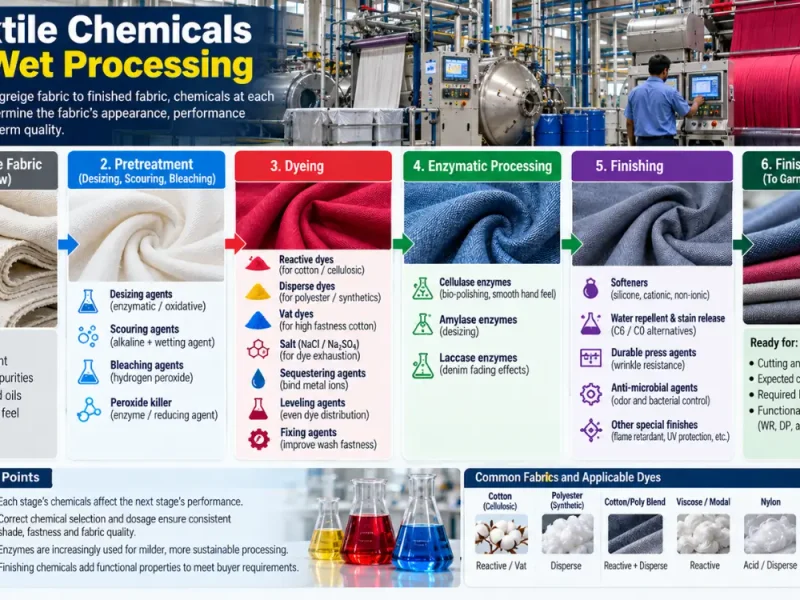
Open a paint tin and you find pigment. Look at a bright red T-shirt and you are probably looking at dye. Both give color, and people often use the two words as if they meant the same thing. They do not. Dyes and pigments look alike on the finished product, but they behave very differently while the color is being applied, and that difference shapes cost, feel, fastness and the way a mill is run.
This guide explains dyes and pigments in plain words. You will learn how each works, how they are grouped, where each is used in textiles, and what the trade-offs are. It also includes worked examples for dye bath and print paste recipes. For more on pigments alone, see our explainer on what is pigments. To learn how color holds up in use, read our guide on color fastness tests.
What is a dye
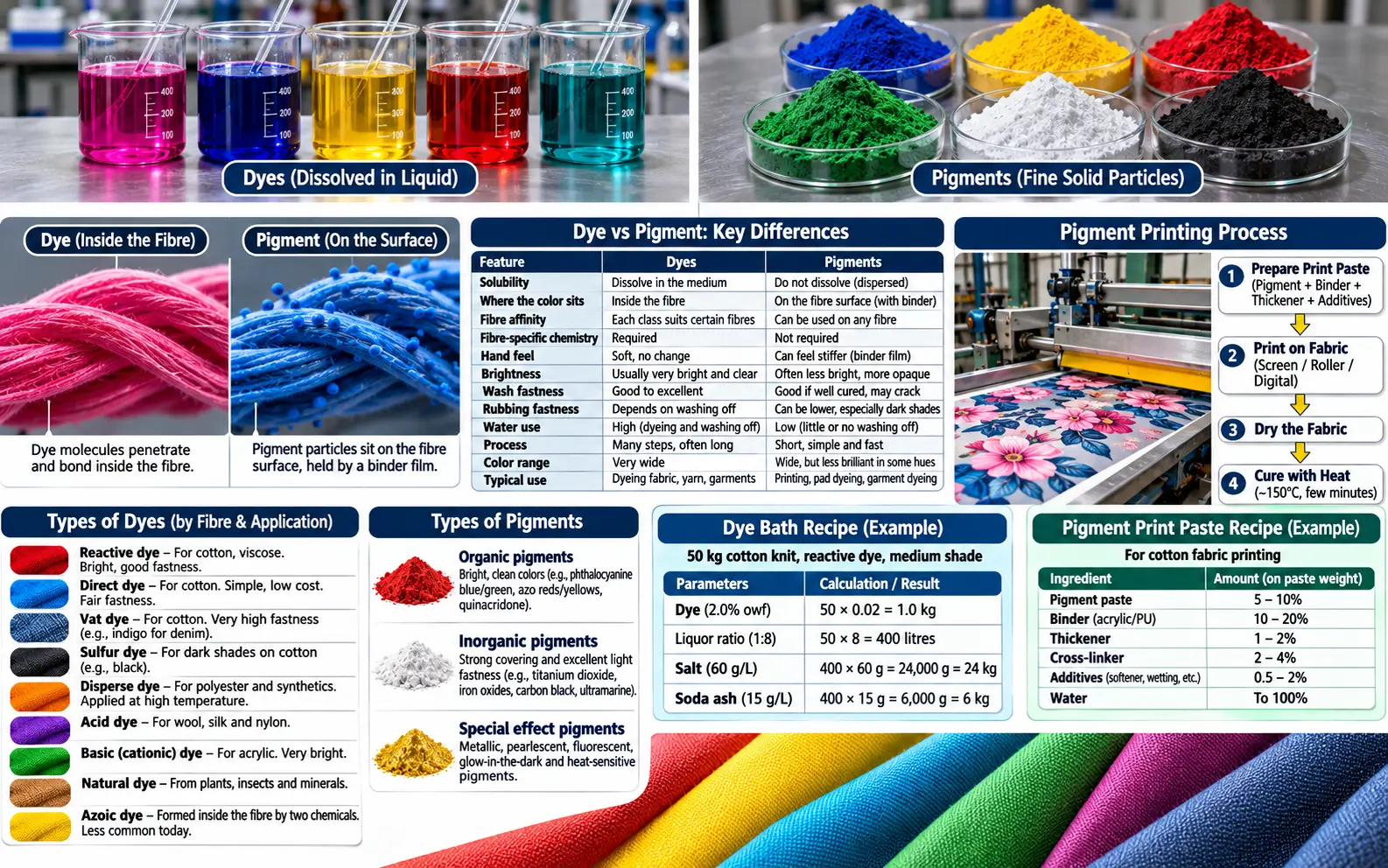
A dye is a colored substance that dissolves in water or another liquid and then attaches itself to a fibre. The dye molecule moves from the bath into the fibre. Once inside, it is held by chemical bonds, by physical forces or by being trapped in the fibre structure. The color becomes part of the fibre.
Because a dye must travel into the fibre, each dye class suits certain fibres. Reactive dyes suit cotton. Disperse dyes suit polyester. Acid dyes suit wool, silk and nylon. A dye also needs help from water, heat, salt, acid or alkali, depending on its type.
What is a pigment
A pigment is a colored powder that does not dissolve in water or in the fibre. It is made of tiny solid particles, usually finer than the width of a hair. To color a textile, the particles are mixed with a binder, which is a kind of clear glue. The binder sticks the particles to the surface of the fabric. When the binder is dried and cured with heat, it forms a thin film that holds the pigment in place.
So a pigment sits on the surface of the fibre. A dye goes into the fibre. This one difference explains most of what follows.
The main differences
| Feature | Dyes | Pigments |
|---|---|---|
| Solubility | Dissolve in the medium | Do not dissolve. They are dispersed |
| Where the color sits | Inside the fibre | On the fibre surface, held by a binder |
| Fibre affinity | Each class suits certain fibres | Can be used on any fibre |
| Fibre-specific chemistry | Required | Not required |
| Hand feel | Soft. No change | Can feel stiffer from the binder film |
| Brightness | Usually very bright and clear | Often less bright, more opaque |
| Wash fastness | Good to excellent, depending on class | Good if well cured, but may crack or rub off |
| Rubbing fastness | Depends on how well loose dye is washed off | Can be lower, especially in dark shades |
| Water use | High for dyeing and washing off | Low. Little or no washing off |
| Process | Many steps, often long | Short, simple and fast |
| Color range | Very wide | Wide, but less brilliant in some hues |
| Typical use | Dyeing fabric, yarn and garments | Printing, and also pad dyeing and garment dyeing |
Types of dyes
Dyes are grouped by how they are applied and which fibres they suit.
- Reactive dyes: Form a chemical bond with cellulose such as cotton and viscose. Bright, with good wash fastness. Used widely for T-shirts, towels and sheets.
- Direct dyes: Applied to cotton with salt. Cheap and simple, but wash fastness is only fair.
- Vat dyes: Insoluble dyes that are made soluble with a chemical, applied, then turned back into the insoluble form inside the fibre. Very high fastness. Indigo for denim is a vat dye.
- Sulfur dyes: Low-cost dyes for dark shades on cotton, especially black.
- Disperse dyes: Tiny particles that dissolve in polyester when it is heated. Used for polyester and some other synthetics.
- Acid dyes: Used on wool, silk and nylon from an acid bath. See our guide on acid dyes.
- Basic (cationic) dyes: Very bright dyes for acrylic. See our guide on basic dyes.
- Natural dyes: From plants, insects and minerals. See our guide on natural dyes.
- Azoic dyes: Formed inside the fibre by two chemicals reacting. Less common today.
For help picking between reactive, disperse and vat dyes, read our guide on reactive, disperse and vat dyes selection.
Types of pigments
Pigments for textiles are grouped by their chemistry.
- Organic pigments: Bright, clean colors such as phthalocyanine blue and green, azo reds and yellows, and quinacridone reds and violets. They are used for most bright textile prints.
- Inorganic pigments: Include titanium dioxide (white), iron oxides (browns and reds), carbon black and ultramarine blue. They are strong in covering and have excellent light fastness.
- Special effect pigments: Metallic, pearlescent, fluorescent, glow-in-the-dark and heat-sensitive pigments for prints.
Pigments are sold as pastes or dispersions in water, with additives to stop the particles from sticking together.
How a pigment is applied to textiles
A pigment print or pigment dye uses four main ingredients.
- Pigment: The colorant.
- Binder: An acrylic or polyurethane polymer that forms the film.
- Thickener: Gives the paste the right thickness for printing.
- Cross-linker and additives: Make the binder film strong and durable. Softeners, fixing agents and wetting agents are used as needed.
The paste is applied by screen, roller or digital print. The fabric is dried, then heated, usually at about 150 degrees Celsius for a few minutes, to cure the binder. No steaming or washing off is needed, which saves time, water and energy. For printing methods, see our guide on digital vs rotary screen textile printing.
Pigments are also used in pad dyeing, exhaust dyeing with a cationic binder, and garment dyeing, where a soft vintage look is wanted.
Worked example 1: a dye bath recipe
Dye recipes use percent on weight of fabric (owf). This means the dye weight is a percentage of the fabric weight.
Say a dyer has 50 kg of cotton knit fabric to dye in a medium shade with reactive dye. The recipe is 2.0 percent owf dye, a liquor ratio of 1:8, salt at 60 g per litre and soda ash at 15 g per litre. These figures are illustrative and vary with the dye and the shade.
- Dye = 50 × 0.02 = 1.0 kg
- Liquor = 50 × 8 = 400 litres
- Salt = 400 × 60 = 24,000 g = 24 kg
- Soda ash = 400 × 15 = 6,000 g = 6 kg
The salt and soda ash weigh far more than the dye. This explains why washing off and effluent treatment matter in reactive dyeing. A lower liquor ratio, for example 1:5, cuts the liquor to 250 litres and the salt to 15 kg, if the salt concentration stays the same.
Worked example 2: a pigment print paste
A print house wants 100 kg of a blue pigment paste for a T-shirt print. The recipe below is an example.
| Ingredient | Parts per 100 kg |
|---|---|
| Pigment dispersion | 4.0 kg |
| Acrylic binder | 12.0 kg |
| Synthetic thickener | 1.5 kg |
| Cross-linker | 1.0 kg |
| Softener | 1.0 kg |
| Water | 80.5 kg |
| Total | 100.0 kg |
If the print covers 30 percent of a shirt and the paste pick-up is 40 grams per square meter of the printed area, and a shirt panel is 0.35 square meters, the paste per shirt is 0.35 × 0.30 × 40 = 4.2 grams. A batch of 10,000 shirts then needs 42 kg of paste, so one 100 kg mix is enough with some left over. Always run a test print, because pick-up changes with the screen mesh and the fabric.
Fastness and performance
Dyes reach very high wash fastness when the unfixed dye is washed off properly. Poor washing-off leaves loose dye that bleeds in the first wash. Light fastness depends on the dye class and shade.
Pigments depend on the binder film. A well-cured, well-chosen binder gives good wash fastness, but heavy rubbing can wear the film. Dark shades and large solid prints can feel stiff. Dry rubbing and wet rubbing grades are the usual weak points. A good softener and a correct cure help.
Environmental points
Dyeing uses much water, energy and chemicals, and the effluent needs treatment. Pigment printing uses less water, but binders and cross-linkers add chemicals of their own, and some older systems released formaldehyde. Buyers now ask for lists of approved chemicals and test reports, so check your chemical suppliers. Avoid absolute claims, because both systems have good and bad practice. The better choice depends on the fibre, the design and the wash and rub demands.
Common problems and how to fix them
| Problem | Likely cause | Fix |
|---|---|---|
| Dyed fabric bleeds in the first wash | Unfixed dye left on the fibre | Better soaping and rinsing, fixing agent, check pH |
| Uneven dyeing, patchy color | Fast dye addition, poor circulation, uneven pretreatment | Slow the dosing, check pump and load, repeat scouring |
| Pigment print cracks | Binder too hard or too much binder | Use a softer binder, reduce film thickness |
| Pigment print washes off | Poor curing, low binder, wrong cross-linker | Check temperature and time, adjust recipe |
| Stiff hand in print | Heavy paste lay-down or high binder | Lower the lay-down, add softener |
| Screen clogging | Pigment particles too large or paste dries too fast | Filter paste, add retarder, clean screens often |
| Shade differs between lots | Different dye or pigment lots, process drift | Standardize recipes and check each lot |
Whenever a problem shows up, test a small sample first. A lab dip or a small print can show whether a fix works before a full batch is spoiled.
Dyes and pigments in denim and garment dyeing
Denim is a good example of both systems in action. Classic blue denim is dyed with indigo, a vat dye, on the warp yarn. The dye stays mostly on the surface of the yarn, which is why jeans fade over time and why mills design the fade on purpose. Black and colored denim often use sulfur dyes. Some colored jeans use pigment coating, which gives a bold, flat look but can wear off in patches. Garment dyeing, where finished clothes are dyed in a washing machine, can use reactive dyes for a clean look or pigments for a soft, washed-out, vintage feel. Pigment garment dyeing needs a cationic pre-treatment so the negatively charged pigment particles stick to the cotton. Our guide on the denim washing process shows how washes change the color afterward.
A short history
People have used natural dyes and pigments for thousands of years. Early cave artists used mineral pigments like ochre and charcoal. Early textile workers used plant dyes such as indigo, madder and weld. In 1856, the chemist William Henry Perkin made the first synthetic dye, mauve, by accident. After that, synthetic dyes grew fast and replaced most natural dyes in factories. Pigment printing grew later with the rise of synthetic binders, which made it simple and economical to print on blends.
Choosing between dyes and pigments
| If you need | Lean toward |
|---|---|
| Soft hand and top wash fastness on cotton knit | Reactive dye |
| Polyester sportswear in bright shades | Disperse dye |
| Quick, cheap prints on many fibre types | Pigment |
| Vintage garment-dyed look | Pigment or garment dye |
| Dark, bright block prints with little water use | Pigment |
| Wool or silk in rich shades | Acid dye |
| Deep indigo and long-lasting denim | Vat or indigo dye |
Final thoughts
Dyes and pigments both make fabric colorful, but they work in opposite ways. Dyes dissolve and enter the fibre, which gives soft, bright and well-bonded color after careful washing. Pigments stay outside and are glued on by a binder, which makes them fast and easy to apply to any fibre. Knowing which to use depends on fibre, shade, feel, fastness and water use. With the worked recipes above as a starting point, you can plan a dye bath or a print paste and test it before you run a full order.
Frequently asked questions
Dyes dissolve and go into the fibre. Pigments are insoluble particles that sit on the surface and are held by a binder.
Neither is better for all uses. Dyes give a softer hand and often better fastness. Pigments are faster, simpler and work on any fibre.
Yes. A binder holds the pigment on cotton, polyester, blends and many other fabrics.
The binder forms a thin film on the surface. A thick print with a lot of binder feels stiffer. A softer binder and a lighter print help.
The main types are reactive, direct, vat, sulfur, disperse, acid, basic and natural dyes.
Most natural dyes are true dyes, but some natural colorants act as pigments. Many need a mordant to attach to the fibre.
Dye is measured as a percentage of the fabric weight, called percent on weight of fabric (owf). Multiply the fabric weight by the percentage.