Run your finger over a rich brocade cushion or a damask tablecloth. The flowers, leaves and scrolls are not printed on. They are woven into the cloth itself, thread by thread. That kind of design is only possible because of the jacquard weave, a method that lets every single warp thread move on its own. Weavers have used it for over two hundred years, and its idea of storing patterns on punched cards helped inspire the early computer.
This guide explains what jacquard weave is, how a jacquard loom works, the main fabric types and where they are used. It includes worked examples to show how many hooks a design needs and how big the card or file is. For the basics of weaving, see our guide on the weaving process. For the simpler shedding systems, read about the parts of a loom.
What is jacquard weave
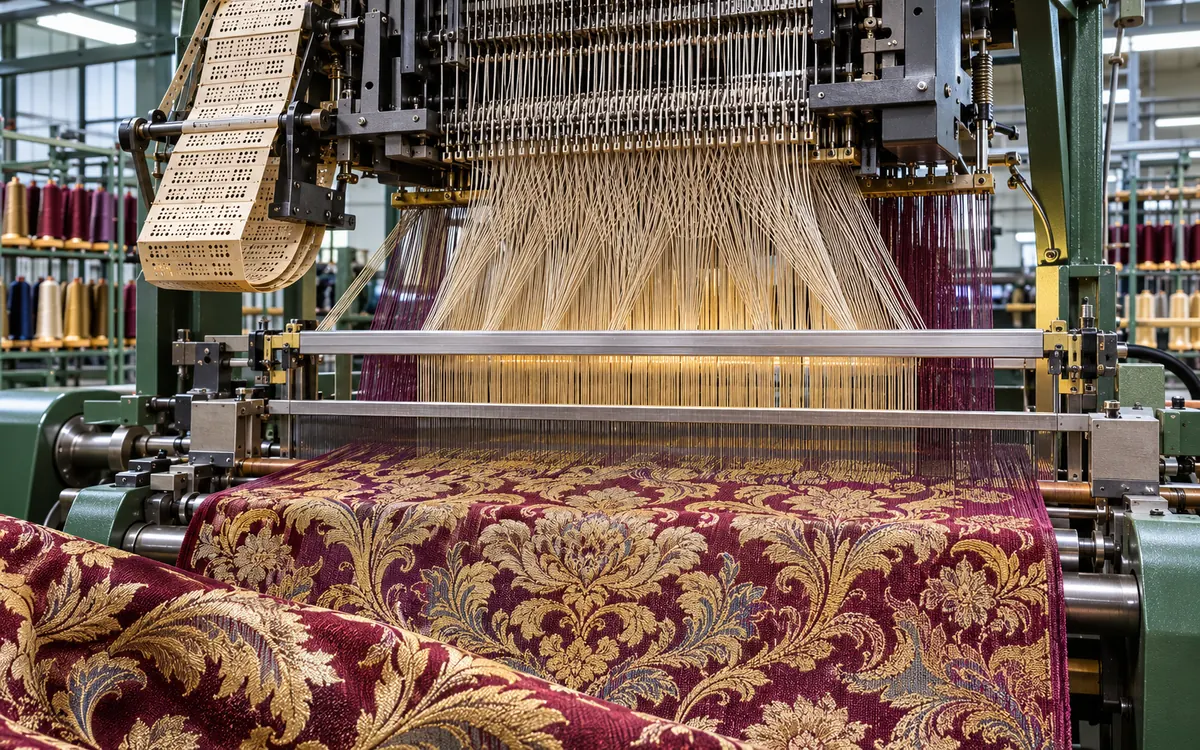
Jacquard weave is a method of weaving in which each warp thread, or each small group of warp threads, can be lifted independently. This lets the weaver make large, detailed patterns such as flowers, animals, scenes and logos. The pattern is stored on punched cards or, in modern machines, in a computer file.
It differs from the common ways to open the shed.
| Shedding method | How warp ends are controlled | Pattern size |
|---|---|---|
| Cam (tappet) | Warp ends are grouped on a few frames lifted by cams | Very small patterns, plain, twill and basic weaves |
| Dobby | Warp ends are grouped on up to about 16 or more frames, lifted by a dobby head | Small geometric designs, checks and stripes |
| Jacquard | Each end, or small group, is lifted on its own | Large, complex and non-repeating designs |
So a dobby is limited by the number of frames. A jacquard is limited by the number of hooks, which can run into the thousands.
A short history
In the late 1700s, weavers made patterned silk with a helper called a drawboy, who sat on top of the loom and pulled cords by hand to lift the right threads. It was slow. Several inventors in France tried to automate it. In 1804, Joseph Marie Jacquard patented a system that used a chain of punched cards to select the threads, so one weaver could produce the pattern alone. The idea spread across the silk-weaving centres of Lyon and then the world.
The punched card idea went further. Charles Babbage planned to use cards for his Analytical Engine in the 1830s, and punched cards were used for data in the late 1800s and for early computers in the 1900s. So an invention for weaving silk became part of the history of computing.
How a jacquard loom works
A traditional mechanical jacquard head sits above the loom and has these main parts.
| Part | Function |
|---|---|
| Hooks | Each hook is connected to one warp end, or a group of ends, through a cord |
| Harness cords (or tail cords) | The cords that hang from the hook down to the heddles |
| Heddles (or lingoes) | Small loops with an eye that hold a warp end, weighted to pull the end down |
| Griffe (knife frame) | A frame with horizontal blades that moves up and down and lifts the hooks that are engaged |
| Needles | Thin wires that push the hooks sideways, in or out of reach of the griffe |
| Cylinder | A rotating prism that carries the punched card |
| Punched card | A sheet with holes that tells which hooks should lift on each pick |
| Comber board | A board with holes that guides the harness cords into neat rows across the loom |
The cycle for one pick:
- The card reaches the needles. A hole lets a needle pass through, and a blank spot pushes the needle back.
- The needle pushes its hook away from, or leaves it above, the blade of the griffe.
- The griffe rises. The hooks it catches lift, taking their warp ends up. The others stay down.
- The open shed is made. The weft is inserted, and the reed beats it up.
- The griffe falls, the cylinder turns, and the next card arrives for the next pick.
Each card is one pick of the design. A design with 5,000 picks in its repeat needs 5,000 cards, laced into a chain.
Mechanical vs electronic jacquard
Today, most new jacquard looms use electronic heads.
| Feature | Mechanical jacquard | Electronic jacquard |
|---|---|---|
| Pattern storage | Punched cards or paper rolls | Computer file |
| Hook control | Needles, springs and card | Electromagnets or actuators controlled by a computer |
| Change of design | Slow, needs new cards | Fast, load a new file |
| Speed | Lower | Higher |
| Hook count | Hundreds to a few thousand | Up to many thousands |
| Precision | Good | Very high |
| Cost | Lower, older machines | Higher |
| Maintenance | Mechanical wear, cards wear out | Electronics, need clean power and dust control |
Electronic heads let a mill produce short runs of different designs and even weave personalised patterns. Many sizes are known by hook count, such as 1,344, 2,688 and 6,144 hooks, but the available sizes depend on the make.
Types of jacquard fabrics
Brocade
A rich fabric where the pattern is raised on the surface using extra weft threads, often in metallic or silk yarn. The back shows loose floats of those threads. Used in sarees, evening wear, ceremonial robes and upholstery. Banarasi and Kanchipuram sarees are famous examples woven on jacquard looms. See our guide on the handloom for how this is done by hand.
Damask
A reversible fabric where the pattern comes from contrasting satin and plain surfaces. The design is shiny on a matte ground on one side, and the reverse is shown the other way round. It is usually one colour. Used in table linen, napkins and curtains.
Brocatelle
A heavy, high-relief fabric with a pattern that stands out strongly, using a backing weft. Used in upholstery.
Matelassé
A double-woven fabric with a quilted, puffed look made without actual quilting. Used in bedspreads and jackets.
Gobelin and picture weaves
A heavy cloth with picture-like designs, with many colours woven in. Used in wall hangings and furniture.
Jacquard terry and towels
Pile fabrics with woven logos and patterns, used in hotel towels and bathrobes.
Jacquard labels and ribbons
Narrow fabrics with brand names and logos woven in, produced on narrow-width jacquard looms.
Jacquard knits
Not woven but knitted. Circular and flat knitting machines can control each needle separately to make patterned knits. This is the jacquard principle applied to loops. See our comparison of woven vs knit fabric.
Weave structures used in jacquard
A jacquard design is made of different weaves in different areas. The weaver picks plain weave, twill or satin for each part of the picture and fills the shapes in accordingly.
- Plain weave areas are firm and flat with little shine.
- Twill areas give a diagonal texture, with softer drape. See our guide on twill weave.
- Satin or sateen areas have long floats and give a bright shine.
- Extra weft or extra warp areas add colour and raised effects.
Shades come from different coloured yarns in the warp or weft. Weaving more than a few weft colours calls for a box or a rapier system on the loom. See the guide on the rapier loom.
Worked example 1: how many hooks does the design need
A designer plans a jacquard fabric. The fabric is 150 cm wide with 60 ends per inch (EPI) in the finished loom state.
Total warp ends across the width = 150 ÷ 2.54 × 60 = 59.06 × 60 = 3,543 ends
A jacquard head with 1,344 hooks cannot control every end separately. There are two common solutions.
Option 1: multiple tie-up (repeat the design across the width). Each hook controls several ends spread across the width. If each hook controls 3 ends:
- Ends covered = 1,344 × 3 = 4,032 (enough for 3,543)
- Hooks actually used = 3,543 ÷ 3 = 1,181 (rounded up)
- The design repeats three times across the fabric width, each repeat being 1,181 ends wide, which is 1,181 ÷ 60 × 2.54 = 50 cm
Option 2: a larger head. A 4,096-hook head could control every end separately and weave a single 150 cm wide design, at a higher machine cost.
The choice depends on the product. Table linen with a repeating pattern suits Option 1. A wide wall hanging with one scene needs Option 2.
Worked example 2: how many picks and cards
The design repeat is 30 cm long. The fabric has 50 picks per inch (PPI).
- Picks in the repeat = 30 ÷ 2.54 × 50 = 11.81 × 50 = 591 picks
On a mechanical loom, that needs 591 cards in the chain. On an electronic loom, the file holds 591 rows.
File size. Each row has 1,181 on-off bits (one per hook used). The raw size of the pattern is 591 × 1,181 = 697,971 bits, or about 87 kilobytes. Real design files hold additional information about colours and weave, but the point is that a whole pattern is small, as it is only a black-and-white map of on and off.
Worked example 3: weaving speed and fabric length
A jacquard loom runs at 450 picks per minute with 50 PPI, at 85 percent efficiency.
Production (m/h) = (picks per minute × 60 × 0.0254) ÷ PPI × efficiency
- Picks per hour = 450 × 60 = 27,000
- Metres at 100 percent = 27,000 × 0.0254 ÷ 50 = 13.7 m per hour
- At 85 percent = 13.7 × 0.85 = 11.7 m per hour
At this speed, one repeat of 30 cm takes 0.30 ÷ 11.7 = 0.026 hours, about 1.5 minutes. A 100 metre order takes 100 ÷ 11.7 = 8.5 hours of running time. Note that jacquard looms usually run slower than plain looms, such as the 600 to 1,000 pick per minute air jet looms in our guide to the air jet loom, because the head has more moving parts and the fabric is heavier or more complex.
How a jacquard design is prepared
- Artwork. A designer draws or scans the picture and sets the size and colours.
- Colour reduction. The design is reduced to the number of colours the loom can use.
- Weave assignment. Each colour region gets a weave: plain, twill, satin or extra weft.
- Point paper or bitmap. The design is converted to a grid in which each square is a warp end and a weft pick.
- Card cutting or file creation. For mechanical looms, cards are punched. For electronic looms, the file is loaded to the loom.
- Sampling. A short sample is woven to check colour, size and clarity.
- Production. The final settings are set and recorded.
Specialist software now does most of these steps.
Uses of jacquard fabrics
- Fashion: Sarees, evening dresses, jackets, scarves, ties and waistcoats.
- Home furnishings: Curtains, upholstery, cushions, bedspreads, tablecloths, napkins.
- Hotel and hospital textiles: Damask table linen, towels, bathrobes, bed linen.
- Labels and trims: Woven brand labels, ribbons and badges.
- Carpets and rugs: Woven carpets with large patterns, such as Wilton carpets.
- Technical uses: Seat covers in cars and trains, airline seat fabrics.
- Art and décor: Woven wall pictures, wall hangings, portrait weaves.
Advantages of jacquard weave
- Large, detailed and non-repeating designs are possible.
- The pattern is part of the structure and does not wear off like a print.
- Fabrics are rich in texture and appear luxurious.
- The same loom can make different designs by changing the cards or file.
- Fabrics are often durable, with good body.
- Woven logos and labels look sharp and last.
Limitations of jacquard weave
- Looms and heads are costly.
- Design preparation takes time and skill.
- Production speed is lower than for plain weaves.
- Long floats on the back or surface may snag.
- Fabrics can be heavy and stiff.
- Changes of design require setup time.
- Small orders can be costly unless the loom is electronic.
Care of jacquard fabrics
- Follow the care label. Silk and metallic brocades often need dry cleaning.
- Wash cotton and polyester jacquard in cool water on a gentle cycle.
- Avoid pulling or snagging the floats on the surface.
- Iron on the reverse side, at a heat that suits the fibre.
- Store folded with tissue paper between layers for delicate brocade.
Final thoughts
Jacquard weave turns a loom into a canvas. Each thread can be lifted on command, so pictures and patterns become part of the cloth. Whether you are looking at a silk brocade, a hotel towel with a woven logo or a car seat cover, the same idea is at work. If you plan to design or buy jacquard fabric, learn the basic terms, ask about hooks and repeats, and sample before you place a large order. The result is a fabric that carries its design for life.
Frequently asked questions
It is a weaving method in which each warp end can be lifted independently, which allows large and complex patterns to be woven into the cloth.
Joseph Marie Jacquard patented his system in 1804 in France. It built on earlier ideas by other inventors.
A dobby controls groups of warp ends on a limited number of frames and makes small patterns. A jacquard controls ends individually or in small groups and makes large patterns.
Woven. The design is part of the fabric structure and does not wash off.
Brocade has raised designs made by extra weft, often in colour or metal. Damask is reversible and is made by contrasting satin and plain areas, usually in a single colour.
Yes. Jacquard knitting machines choose needles one by one to make patterned knits.
The looms are costly, the design takes time to prepare, the weaving is slower and the fabrics use more yarn.