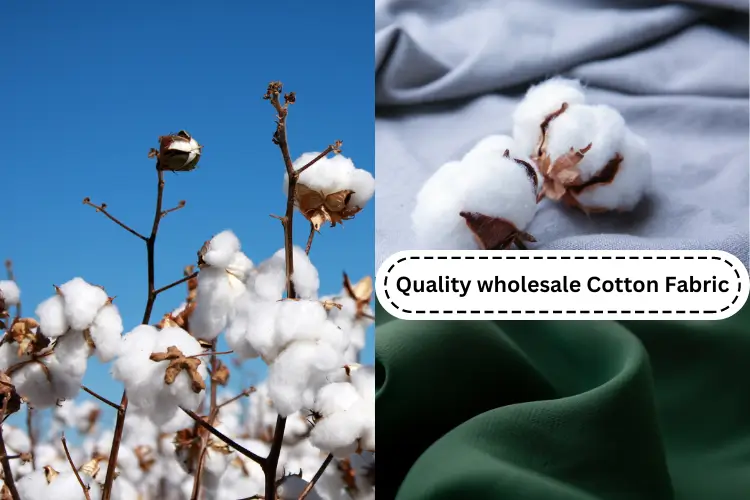
Pick up a crisp shirt and a soft T-shirt. Both are made of yarn, and both can be cotton. Yet they feel and behave very differently. One holds its shape and wrinkles. The other stretches and springs back. The reason is how the yarn is put together. That one choice decides how the fabric looks, how it is cut and sewn, how it is priced and where it is used.
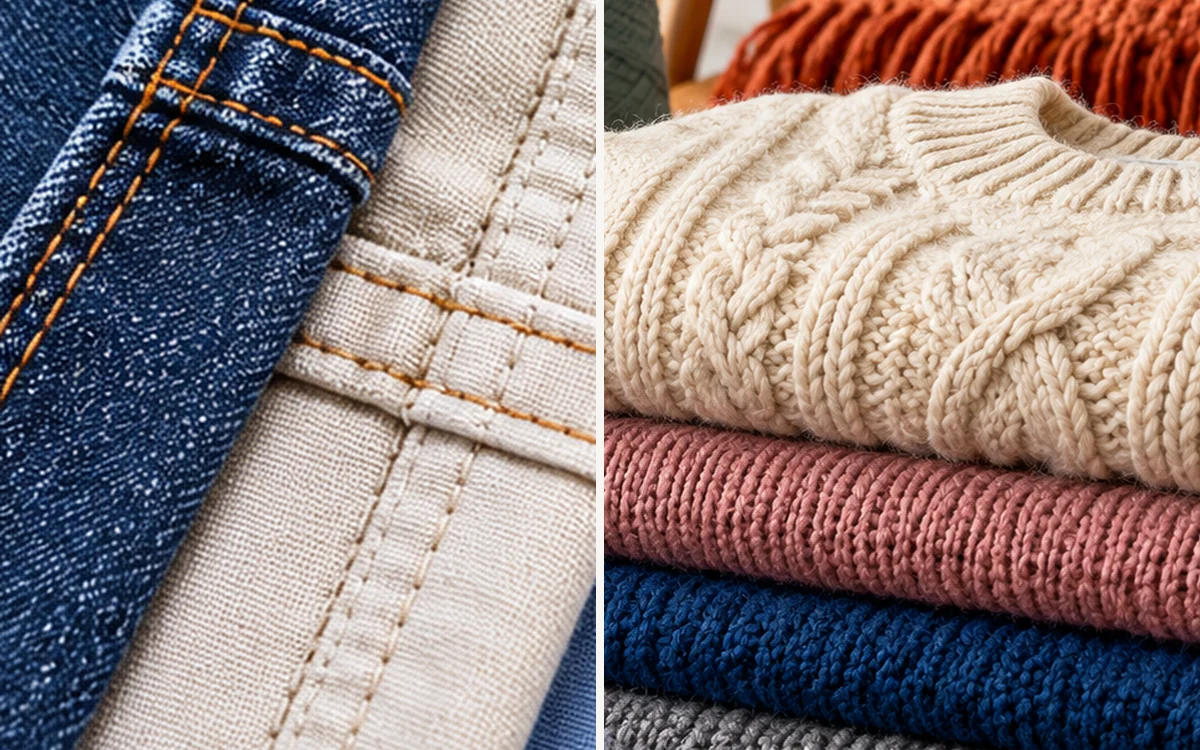
This guide explains the difference between woven and knit fabric in plain words. You will see the structure of each, a side-by-side table, two worked GSM calculations, simple ways to tell them apart and tips on which to choose. For another view of the topic, see our earlier page on the difference between woven and knitted fabric. This article goes further into the maths, the factory side and the buying decision.
What is woven fabric
Woven fabric is made on a loom by crossing two sets of yarn at right angles. The lengthwise yarns are called the warp. The crosswise yarns are called the weft, or filling. The weft passes over and under the warp in a set pattern. The simplest pattern is plain weave, where each weft goes over one warp and under the next. Twill and satin are other common patterns. Our guide to twill weave types shows one of them in detail.
Because the yarns cross at 90 degrees and lock each other, woven fabric is stable. It does not stretch much along the warp or weft. It stretches more on the diagonal, which is called the bias. To follow the full process from yarn to cloth, read our guide on the weaving process.
What is knit fabric
Knit fabric is made by pulling loops of yarn through other loops. A single yarn can make a whole row of loops. Loops in a row are called a course. Loops in a column are called a wale. Because loops can open and close, knit fabric stretches in both directions and recovers well. To see how loops are formed, read about knitted fabric and the flow chart of knitting.
There are two main families. Weft knitting makes loops across the width, one course at a time, and is used for T-shirts, polo shirts and socks. Warp knitting makes loops along the length with many yarns at once, and is used for lace, mesh and sportswear fabric.
Side-by-side comparison
| Point | Woven fabric | Knit fabric |
|---|---|---|
| Structure | Two yarn sets cross at right angles | Interlocking loops of yarn |
| Machine | Loom (air jet, rapier, projectile and others) | Knitting machine (circular, flat, warp) |
| Stretch | Low, mostly on the bias | High in width, good in length |
| Recovery | Low, unless elastane is added | Good |
| Wrinkling | Wrinkles more easily, especially cotton | Wrinkles less |
| Strength and tear | Usually stronger and more stable | Weaker in tear, can run or ladder in some types |
| Edges | Fray when cut | Curl when cut, but usually do not fray |
| Drape | Stiffer, more structured | Softer, clings to the body |
| Breathability | Depends on the weave and the thread count | Often more open and airy |
| Shrinkage | Lower in most cases | Higher, can distort |
| Production speed | Slower on most looms | Faster, especially circular knitting |
| Cost of fabric | Often higher per metre for the same weight | Often lower, with fewer preparation steps |
| Sewing | Needs a lockstitch for most seams and finishing | Needs stretch stitches like overlock and flatlock |
| Typical GSM | 80 to 400 or more | 100 to 350 for common types |
| Typical products | Shirts, trousers, jeans, jackets, suits, curtains | T-shirts, polos, leggings, socks, underwear, hoodies |
Worked example 1: GSM of a woven fabric
GSM means grams per square metre. For a rough estimate of a plain woven fabric, a common shortcut is:
GSM ≈ 23.25 × (EPI ÷ warp Ne + PPI ÷ weft Ne)
Here EPI is ends per inch (warp threads), PPI is picks per inch (weft threads) and Ne is the English cotton count. The shortcut ignores crimp, so the real figure is a little higher.
Take a shirting fabric with 100 EPI, 60 PPI, 40s warp and 40s weft.
- EPI ÷ Ne = 100 ÷ 40 = 2.50
- PPI ÷ Ne = 60 ÷ 40 = 1.50
- Sum = 4.00
- GSM ≈ 23.25 × 4.00 = 93 GSM
That is a light shirting. If the mill adds sizing and finishing, the final weight may come closer to 100 GSM.
Worked example 2: GSM of a knit fabric
For a single jersey, a useful formula uses the stitch length, the yarn tex and the loop density.
GSM = stitch length (mm) × yarn tex × wales per cm × courses per cm ÷ 100
Tex is the weight in grams of 1,000 metres of yarn. For cotton, tex = 590.5 ÷ Ne.
Take 30s Ne yarn, stitch length 2.8 mm, 15 wales per cm and 19 courses per cm.
- Tex = 590.5 ÷ 30 = 19.68
- Loops per cm² = 15 × 19 = 285
- GSM = 2.8 × 19.68 × 285 ÷ 100 = 55.1 × 285 ÷ 100 = 157 GSM
So a typical T-shirt fabric of about 157 GSM comes out of this construction. A longer stitch length gives a lighter and looser fabric. A shorter stitch length gives a heavier, tighter fabric. See our guide on knitting machine gauge and fabric GSM for how the setting changes the weight.
Why woven fabric stays stable
In a woven fabric, each yarn is held by the yarns that cross it. There is no easy path for the fabric to open up in length or width. That is why a woven shirt keeps its shape and takes a crease well. It is also why woven fabrics suit tailored clothes, uniforms, bags and home furnishing. To add stretch, mills blend a small percentage of elastane (spandex) into the weft. A stretch denim, for example, may include about 1 to 3 percent elastane.
Why knit fabric stretches
A loop is not a tight lock. It can be pulled out sideways and then return to its shape. That is what gives knit fabric its comfort. A cotton single jersey can stretch noticeably in width even with no elastane at all. Add a little elastane and the recovery improves. The loop structure also traps air, which can make a knit feel warm or breathable depending on the yarn and the gauge.
How the two are made in a factory
| Step | Woven | Knit |
|---|---|---|
| Yarn preparation | Warping, sizing, drawing-in, tying-in | Usually winding only |
| Fabric formation | Weaving on a loom | Knitting on a circular or flat machine |
| Grey fabric width | Flat, fixed by loom | Tubular for circular, flat for others |
| Preparation | Singeing, desizing, scouring, bleaching | Scouring, bleaching (no desizing) |
| Finishing | Stenter, calender, sanforising | Compacting, calendering, sometimes stenter |
| Defects | Missing ends, broken picks, slubs, stains | Needle lines, holes, drop stitches, barre |
Woven fabric needs more steps before it is ready, which partly explains the higher price. The warp must be set up carefully on a beam before weaving begins. A knitting machine can turn yarn into fabric directly. For the finishing side, see our guides on the stenter machine and the compactor and calender in knit finishing.
How it changes garment making
The fabric type changes almost every step in the garment factory.
- Cutting. Woven fabric is cut on grain, and the grain line matters because the bias hangs differently. Knit fabric needs a relaxed lay and care with the direction of the wales, or the garment may twist after washing.
- Sewing. Woven seams are usually straight lockstitch with seam allowance. Knit seams need to stretch with the body, so overlock and flatlock are common. A stitch that cannot stretch will snap in a knit garment.
- Seam allowance. Knits often use a smaller allowance, around 1 cm, since they do not fray. Wovens often need 1.5 cm or more and a finished edge.
- Needles. Ball-point needles are used for knits so they push loops aside without cutting them.
- Shrinkage. Allow more for knits. Our page on shrinkage control shows how factories plan for it.
- Fit. Woven garments rely on darts, seams and ease for shape. Knit garments get shape from stretch, so patterns can be smaller than the body.
How to tell woven from knit
You do not need a lab. Try these quick checks.
- Look closely. A woven fabric shows a tiny grid of crossing yarns. A knit shows rows of small V-shaped loops on the face and bumps on the back.
- Stretch it. Pull gently along the width and length. A knit gives easily and returns. A woven barely moves.
- Cut a small edge. A woven edge frays into loose threads. A knit edge curls and does not fray much.
- Pull a thread. In a woven, one thread comes out and leaves a gap. In a knit, a pulled yarn can run along a wale and unravel the row.
- Look at the clothing label. Shirts and trousers are usually woven. T-shirts and leggings are usually knit.
- Check for a tube. A circular knit fabric may arrive as a tube with no side seam.
Mixed cases exist. Some fabrics, such as pique or fleece, are knits that look dense and stable. Some stretch wovens behave like knits in one direction. When in doubt, check the stretch and the structure under a magnifier.
Which one should you choose
| Need | Better choice | Reason |
|---|---|---|
| Crisp shirt or formal wear | Woven | Holds shape, takes a press |
| Everyday T-shirt | Knit | Soft and comfortable |
| Jeans and workwear | Woven (denim, twill) | Strength and abrasion resistance |
| Sportswear and activewear | Knit (often with elastane) | Stretch and moisture management |
| Underwear and socks | Knit | Fit and comfort |
| Tailored jackets and suits | Woven | Structure |
| Baby clothes | Knit | Soft and easy to wear |
| Bedsheets and curtains | Woven | Flat, stable, wide widths |
| Fast, low-cost fashion tees | Knit | Quick production |
| Dress shirts with low shrink | Woven | Better stability |
If you are developing a product, begin with the use. Think about how it will be worn, how often it will be washed and what the buyer expects at that price. Then check the fabric on those points rather than the look alone.
Cost thinking for buyers
Do not compare only the price per metre or per kilo. A knit fabric is sold by weight (kg), so a lighter GSM gives more area per kilo. A woven fabric is sold by length (metres or yards) at a stated width. To compare, convert both to cost per square metre. Fabric width matters too, because a wider roll gives better marker efficiency. For the garment side of the maths, see our guide on how to calculate product cost.
Common mistakes
- Choosing a knit for a product that needs a stable shape, such as a structured jacket.
- Using a straight lockstitch on a stretchy knit seam, which breaks when pulled.
- Ignoring shrinkage in knits when sizing.
- Comparing a woven price per metre with a knit price per kg without converting.
- Assuming that all knits are casual. Fine gauge knits can be very smart.
- Assuming that all wovens are stiff. Voile, lawn and chiffon are light and flowing.
Final thoughts
The difference between woven and knit fabric comes down to structure. Crossing yarns give stability and a crisp look. Looped yarns give stretch and comfort. Choose by the use, check the cost per square metre and match the sewing method to the fabric. When you know how each one is built, you can predict how it will behave in the factory and on the body.
Frequently asked questions
Woven fabric is made by crossing two sets of yarn at right angles on a loom. Knit fabric is made by looping yarn through loops. Woven is stable and knit is stretchy.
Woven fabric is usually stronger and more stable at the same weight. Some technical knits are very strong, but most everyday knits are weaker in tear.
Knit fabrics wrinkle less than woven ones, especially woven cotton and linen.
Jersey is a knit fabric.
Denim is a woven fabric, usually a cotton twill. Knit denim looks like denim but is made on a knitting machine.
Knit fabric is often cheaper to produce because the process has fewer steps and runs faster. The final price depends on yarn, weight and finish.
Yes, if elastane is added to the yarn, or if the cloth is cut on the bias. Stretch wovens are common in jeans and trousers.