Pick up a cotton T-shirt and pull at a loose thread. That thread started as a puff of short, tangled fibres, each one only a few centimeters long. Somewhere between the field and your shirt, millions of those fibres were cleaned, lined up, thinned out and twisted together into one strong, even strand. That path from bale to cone is the process of making yarn from fibre, and it is the heart of every spinning mill.
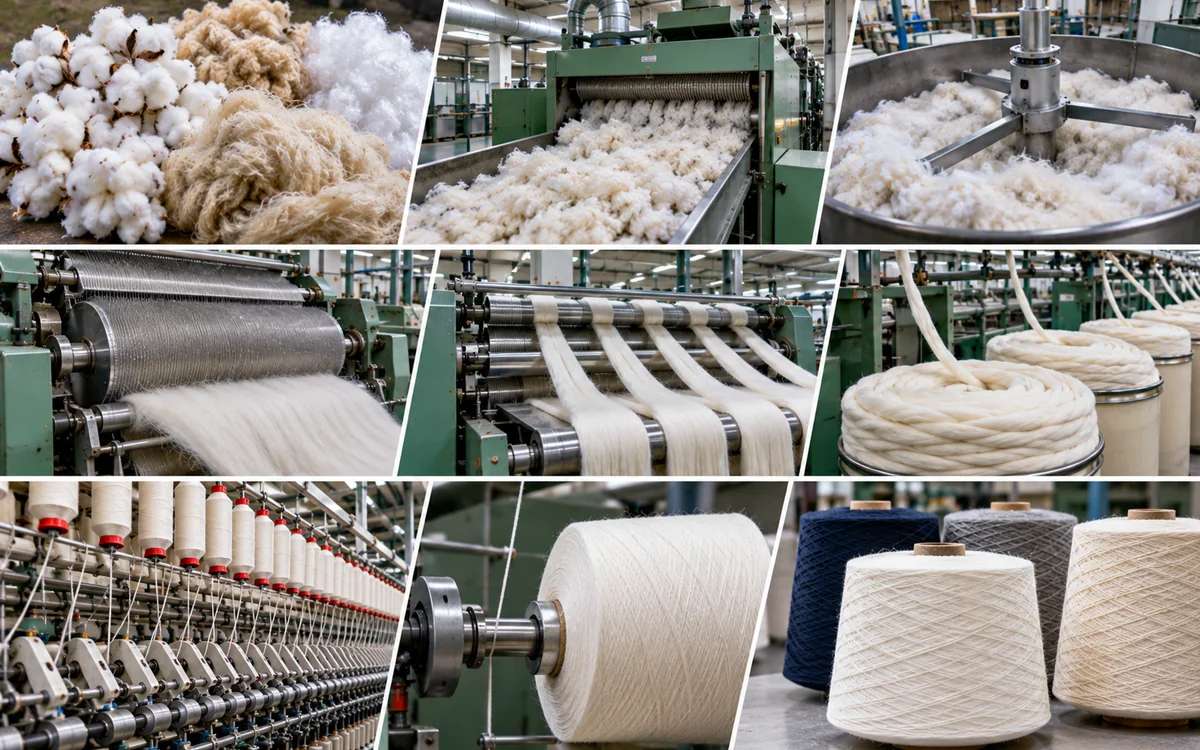
This guide walks through that process step by step, using cotton as the main example because it is the most common fibre. It also covers other spinning systems, shows worked examples for draft and twist, and lists the main faults to watch. For the machine at the end of the line, see our guide on the parts of a ring frame. For a quick flow diagram, see the flow chart of spinning.
What is yarn
Yarn is a continuous strand of fibres that are held together by twist, so that it can be woven, knitted, braided or sewn. The fibres can be short (called staple, as in cotton and wool) or very long (called filament, as in silk and synthetic fibres). The process of making yarn from fibre is called spinning.
Staple fibres do not hold together on their own. Twist presses them against each other, and friction between the fibres holds the strand together. Filament fibres are already long, so they need little twist, or none, to make yarn.
The main steps for cotton yarn
Here is the usual path for ring-spun cotton yarn.
Step 1: Ginning and baling
Cotton is picked from the plant with seeds and trash still in it. At the gin, machines pull the seed from the fibre and clean it a little. The fibre is pressed into dense bales. Our guide on the ginning process of cotton explains this step in more detail.
Step 2: Bale laying and mixing
At the spinning mill, bales from different lots are laid out in a group, called a lay-down. The mill takes small tufts from many bales at once. This blends the natural variation in length, strength and colour and keeps the yarn even over time. See our notes on mixing and blending in the spinning mill.
Step 3: Blow room
The blow room opens the pressed cotton into small tufts and removes dirt, seed coat bits and short bits of leaf. Machines beat and pull the fibre while air carries it forward. The goal is to open and clean the cotton with as little damage to the fibre as possible. Our guide to basic operation in the blow room shows the machines and their order.
Step 4: Carding
Carding is the heart of the process. The tufts pass between a large cylinder and flat bars covered with fine wire teeth. The teeth pull the tufts apart into single fibres, remove more trash and short fibres and begin to line the fibres up. The output is a thick, soft rope called a sliver. It is collected in a can.
Step 5: Breaker and finisher drawing
Several card slivers are fed together into a draw frame. Rollers running at increasing speeds stretch the slivers, which makes them thinner and straighter. Doubling several slivers together levels out the thick and thin places. Most mills use two passes, called breaker and finisher drawing. The result is a more even sliver with fibres lying parallel.
Step 6: Combing (for fine yarn)
For fine, smooth, strong yarn, the cotton goes through a lap former and a comber. The comber removes short fibres, called noil, and any remaining small trash. Combed yarn is cleaner, more even and stronger than carded yarn, and it is more costly because the noil is waste of about 12 to 20 percent. See our notes on combed yarn manufacturing and carded yarn manufacturing.
Step 7: Roving (simplex)
The sliver is still too thick to spin directly. The roving frame, also called the simplex, thins it further and gives it a small amount of twist so that it holds together. The output is called roving. It is wound onto large bobbins.
Step 8: Ring spinning
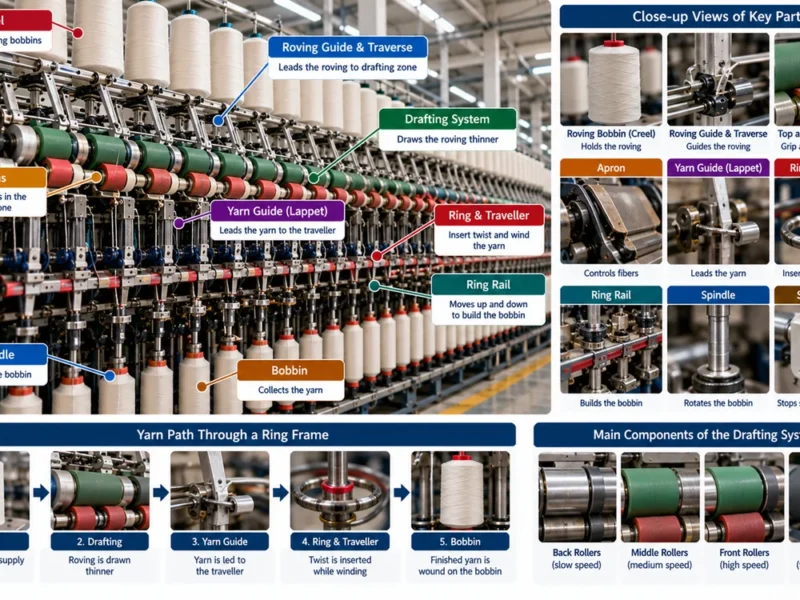
The ring frame is where the final yarn is made. Roving is drawn out a last time by a set of rollers to the required thickness. Then it passes through a small traveller that spins around a ring. The traveller twists the strand and winds it onto a bobbin. The result is ring-spun yarn. It is strong and even, and it is the most widely used type for quality knit and woven fabrics.
Step 9: Winding
The small ring bobbins are rewound onto large cones. The winder, often an auto-coner, checks the yarn, cuts out thick places, thin places and foreign matter and joins the ends with a splice. The cone is now ready for weaving, knitting or dyeing. See our overview of the modern auto cone winding machine.
Step 10: Packing
Cones are weighed, labelled and packed for shipping.
Other ways to spin yarn
| System | How it works | Typical features |
|---|---|---|
| Ring spinning | Twists and winds with a traveller on a ring | Strong, fine, soft. Slower and costlier |
| Compact spinning | Ring spinning with a device that tightens the fibres before twist | Less hairiness, higher strength. See the flow chart of compact yarn |
| Rotor (open-end) spinning | Fibres collect in a spinning rotor and twist as they leave | Faster, cheaper, bulkier. Skips roving. See the flow chart of rotor yarn |
| Air-jet spinning | Air jets twist the outer fibres around a core | Very high speed. Used for many shirts and bedsheets |
| Wool and worsted spinning | Carding or combing, then spinning | Warm, bulky or smooth, depending on route |
| Filament spinning | Melt or solution spun through a spinneret | Long continuous strands |
How synthetic filament yarn is made
Synthetic yarn follows a shorter path. Polymer chips are melted and pushed through a plate with fine holes. The streams cool into filaments. The filaments are drawn to line up the molecules, then wound. They can be used as filament yarn or cut into staple and spun like cotton.
Worked example 1: draft
Draft shows how much a strand is thinned in a machine. It is the output length divided by the input length, or the input weight per length divided by the output weight per length.
Suppose a draw frame feeds six slivers, each with a hank of 0.12 Ne, and delivers one sliver of 0.12 Ne.
- Total input weight per length = 6 × (1 ÷ 0.12) = 6 × 8.33 = 50 units
- Output weight per length = 1 ÷ 0.12 = 8.33 units
- Draft = 50 ÷ 8.33 = 6
So the draft is 6, which equals the number of doublings. The drawing step keeps the sliver weight steady while straightening the fibres.
Now suppose the roving frame feeds a sliver of 0.12 Ne and delivers roving of 1.0 Ne.
- Draft = delivery hank ÷ feed hank = 1.0 ÷ 0.12 = 8.33
And the ring frame feeds roving of 1.0 Ne and delivers yarn of 30 Ne.
- Draft = 30 ÷ 1.0 = 30
The total draft from sliver to yarn is 8.33 × 30 = 250. The product is the same as 30 ÷ 0.12 = 250. This gives a quick way to check mill settings. Our guide on yarn count explains what Ne means.
Worked example 2: twist
The amount of twist is measured in twists per inch (TPI). It depends on the yarn count and a number called the twist multiplier (TM).
TPI = TM × √Ne
For a 30 Ne ring-spun cotton yarn with a TM of 3.6:
- √30 = 5.477
- TPI = 3.6 × 5.477 = 19.7 twists per inch
If the TM is raised to 4.2, the TPI becomes 4.2 × 5.477 = 23.0. More twist makes the yarn stronger up to a point, but it also makes it harder, less soft and slower to produce. Knit yarn usually uses a lower TM than weaving warp yarn. The exact value depends on the fibre and the end use, so mills set it by testing.
Worked example 3: how much yarn in a pound
For cotton, the English count (Ne) tells how many hanks of 840 yards fit in one pound. A 30 Ne yarn has 30 hanks per pound.
- Length per pound = 30 × 840 = 25,200 yards
- In metres = 25,200 × 0.9144 = 23,043 m
So one pound of 30 Ne yarn is about 23 kilometers long. That is why a few kilograms of yarn can knit a lot of fabric.
Worked example 4: waste and yield in the mill
Every step takes out some waste. The numbers below are typical illustrative ranges, and each mill measures its own.
Start with 1,000 kg of cotton for a combed yarn.
- Blow room waste at 4 percent: 1,000 × 0.96 = 960 kg
- Card waste at 5 percent: 960 × 0.95 = 912 kg
- Comber noil at 14 percent: 912 × 0.86 = 784 kg
- Drawing, roving, ring frame and winding waste at 2 percent: 784 × 0.98 = 768 kg
So about 768 kg of yarn comes out of 1,000 kg of cotton, a yield of roughly 77 percent. For carded yarn, skip the comber step: 912 × 0.98 = 894 kg, a yield of about 89 percent. This gap explains why combed yarn costs more. The mill must buy more cotton and sell the noil at a lower price. It also shows why good cotton with less trash saves money, even when it costs more per kilogram.
Fibre quality that shapes the yarn
The fibre decides much of what the yarn can be.
- Length: Longer fibres give stronger, finer, smoother yarn. Short fibres make hairy, weak yarn.
- Fineness: Finer fibres give more fibres in the yarn cross-section, which gives better strength and a softer feel.
- Strength: Strong fibres make strong yarn and fewer breaks.
- Maturity: Immature cotton makes neps and dyes unevenly.
- Trash and short fibre content: More of either means more waste and more faults.
- Colour: Even colour avoids shade problems later.
Instruments in the lab measure these traits, and mills use the results to plan the lay-down.
Types of yarn by structure
- Single yarn: One strand of twisted fibres. Common in knit fabric and light woven cloth.
- Plied yarn: Two or more singles twisted together. Stronger and smoother. Used for sewing thread and fine shirting warp.
- Cabled yarn: Plied yarns twisted together again. Used for ropes and cords.
- Fancy yarn: Yarn with slubs, loops or knots on purpose for special looks.
- Core-spun yarn: A core of elastane or filament wrapped with staple fibre, used in stretch fabric.
Common faults in yarn
| Fault | Cause |
|---|---|
| Thick and thin places | Uneven drafting, worn rollers |
| Neps | Fibre knots from rough opening or immature cotton |
| Hairiness | Loose fibre ends, low twist, rough travellers |
| Weak places | Too little twist, short fibres, damaged fibre |
| Count variation | Wrong draft settings or uneven sliver |
| Contamination | Foreign fibres or plastic in the cotton |
| Slubs | Fibre lumps from dirty or worn parts |
Quality tests for yarn
- Count: Weigh a known length.
- Strength: Measure breaking force and elongation.
- Evenness: Measure the variation in mass along the yarn (CV%).
- Imperfections: Count thin places, thick places and neps per kilometer.
- Twist: Count the twists per inch.
- Hairiness: Measure the length and number of protruding fibres.
Final thoughts
The process of making yarn from fibre looks long, but each step has a simple job. Open the fibre, clean it, line it up, thin it out and twist it. Mills that control each step, from bale mixing to winding, produce even yarn that makes good fabric. If you buy yarn, ask about the count, the twist, the evenness and the spinning system. If you make it, keep your settings steady and check the numbers often.
Frequently asked questions
It is called spinning. Fibres are opened, cleaned, lined up, thinned and twisted together into a continuous strand.
The main steps are bale mixing, blow room, carding, drawing, combing (optional), roving, ring spinning and winding.
Combed yarn goes through an extra combing step that removes short fibres. It is smoother, stronger and more costly than carded yarn.
Twist is the spiral turns given to the fibres. It holds the fibres together and adds strength.
Ring spinning twists the yarn with a traveller on a ring and gives strong, soft yarn. Rotor spinning is faster and cheaper but gives bulkier, weaker yarn.
Polymer is melted or dissolved and pushed through a spinneret to form filaments. These are drawn, wound and used directly or cut into staple.
Yarn count shows how thick or thin the yarn is. In the English system, a higher number means finer yarn.