In a spinning mill, the ring frame is where soft rope-like roving becomes real yarn. It is the last big step before winding, and most of a mill’s production passes through it. A ring frame can run hundreds of spindles at once, each turning thousands of times a minute. If one small part is worn, the whole yarn quality can fall. That is why spinning engineers need to know the parts of a ring frame well.
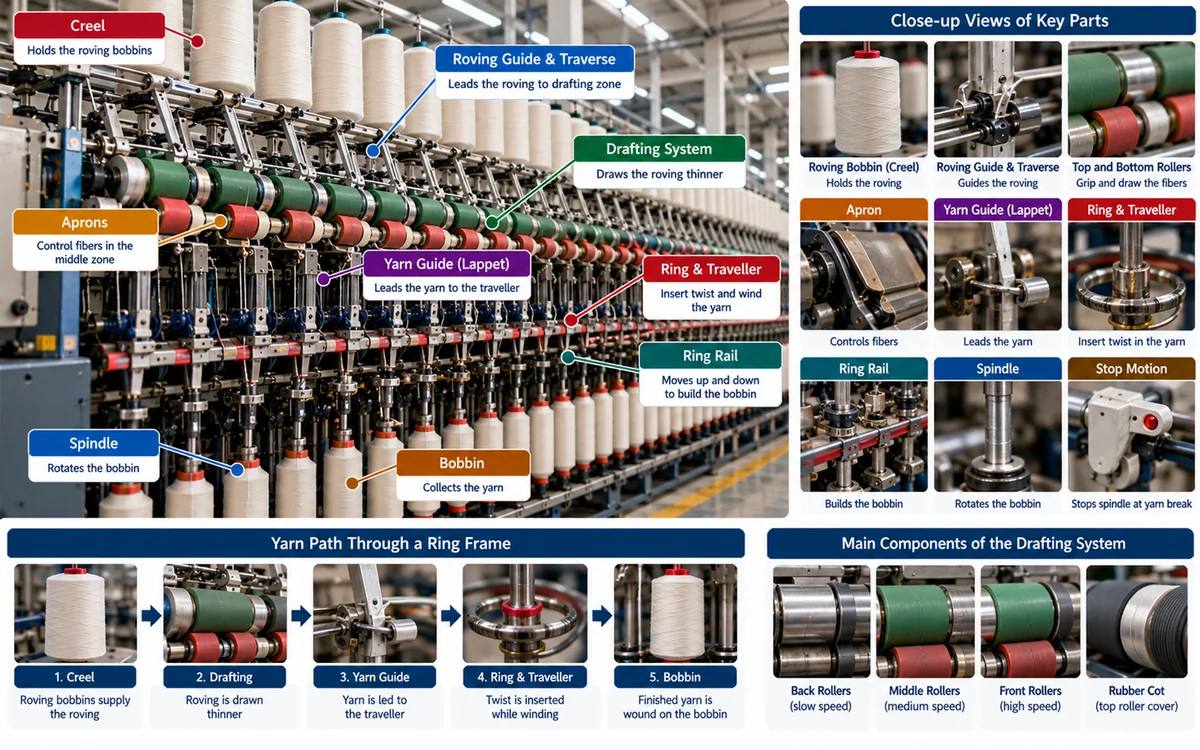
This guide goes through each main part in the order the material travels. We start with the roving creel and finish with the bobbin. If you want to see where the ring frame fits in the mill, see our guides on the carded yarn manufacturing process and the combed yarn manufacturing process. For a list of the other machines in a spinning mill, see our list of spinning machines for yarn making.
What a ring frame does
A ring frame does three things.
- Drafting: It pulls the roving thinner, to the count needed.
- Twisting: It adds twist to give the yarn strength.
- Winding: It winds the finished yarn onto a bobbin.
Drafting thins the roving. Twisting turns the thin strand into yarn. Winding collects the yarn. All three happen at the same time, in a continuous motion, on each spindle.
Parts of a ring frame at a glance
| Part | Job |
|---|---|
| Creel | Holds roving bobbins |
| Roving guide and traverse | Lead the roving into the drafting zone |
| Drafting system | Draws the roving thinner |
| Top and bottom rollers | Grip and draw the fibers |
| Aprons | Control fibers in the middle zone |
| Condenser or compact device | Narrows the fiber strand |
| Yarn guide (lappet) | Leads the yarn to the traveller |
| Balloon control ring | Controls the yarn loop |
| Separator | Separates yarn balloons |
| Ring and traveller | Insert twist and wind the yarn |
| Ring rail | Moves up and down to build the bobbin |
| Spindle | Rotates the bobbin |
| Bobbin | Collects the yarn |
| Spindle drive | Turns the spindles |
| Stop motion | Stops a spindle when yarn breaks |
Creel
The creel holds the roving bobbins, which are the feed material. They hang from supports at the top of the machine. Each spindle has its own roving bobbin. The roving unwinds as it is pulled into the drafting system.
The creel must hold the bobbins so they unwind freely, without dragging. Poor unwinding causes uneven tension and bad yarn evenness. Operators also check the roving for damage before loading.
Roving guide and trumpet
The roving passes through a guide as it leaves the bobbin. Many frames use a traversing guide that moves the roving slowly from side to side. This spreads wear across the drafting rollers so they last longer. A small trumpet, or condenser, narrows the roving to the right width at the entry to the drafting zone.
Drafting system
The drafting system is the heart of the ring frame. It thins the roving by pulling it through sets of rollers that run at different speeds. A typical system has three lines of rollers.
- Back rollers: Slow, holding the roving as it enters.
- Middle rollers: Medium speed, with aprons for fiber control.
- Front rollers: Fast, pulling the thinned strand away.
Because the front rollers run faster than the back ones, the roving is stretched. The ratio of front roller speed to back roller speed is called the draft. If the front surface speed is 20 times the back, the draft is 20.
Top rollers and bottom rollers
Each roller line has a bottom roller and a top roller.
- Bottom rollers: Steel rollers with flutes, which are grooves cut along their length. The flutes grip the fibers. They are driven by gears.
- Top rollers: Rollers covered with rubber, which press down on the bottom rollers. The rubber cover gives a soft grip. The top rollers turn by friction.
The pressure on the top rollers is set by a weighting arm, using springs or air. This holds the fibers firmly as they are drawn. Too little pressure lets fibers slip. Too much wears the rubber and the flutes.
Rubber cots
The rubber cover on a top roller is called a cot. It has to be the right hardness and condition. A worn or glazed cot gives uneven drafting, leading to thick and thin places in the yarn. Cots are ground or replaced on a set schedule. Grinding restores the surface. Aged cots become hard and shiny and slip.
Aprons
In the middle zone, short leather or synthetic aprons run around a top and bottom bar. They guide the fibers and control their movement as they are drawn. Aprons stop floating fibers from moving too freely. A torn apron causes sudden thick places.
Roller settings
The distance between the roller lines is called the roller setting. It depends on the fiber length. Longer fibers need wider settings. Setting too narrow will break fibers. Setting too wide will cause uncontrolled fibers and poor evenness.
Compact device
Compact spinning adds a device after the front rollers, usually a perforated drum or a suction tube. It draws the fiber strand together before twisting. This reduces the spinning triangle, which is the fan-shaped area between the front rollers and the twist point. A smaller triangle includes more edge fibers in the yarn, giving a smoother, stronger and less hairy yarn.
Compact yarn is used for high-quality fabrics. See our guide on the flow chart of compact yarn for more.
Yarn guide or lappet
After the drafting zone, the yarn passes through a yarn guide, often called a lappet. This is a small hook or eyelet positioned above the spindle. It guides the yarn toward the traveller. The lappet is set exactly on the spindle’s axis. If it is not, the yarn balloon will be uneven and the end will break more often.
Balloon control ring and separators
Between the lappet and the traveller, the spinning yarn forms a loop in the air, called a balloon. The spinning twist and rotation make it swing outward. If the balloon is too big, it touches neighboring balloons, causing breaks.
Two parts control the balloon.
- Balloon control ring: A small ring placed on the yarn path that restricts the size of the balloon.
- Separator: A thin plate between neighboring spindles that stops balloons from touching.
These parts allow higher speeds and larger package sizes.
Ring and traveller
The ring and the traveller are the parts that actually twist and wind the yarn.
Ring
The ring is a polished steel ring fixed around each spindle on a plate called the ring rail. Its inner surface is smooth and flanged. The traveller rides on it.
Traveller
The traveller is a small C-shaped piece of steel or nylon that clips onto the ring. The yarn passes through it. As the spindle spins and the bobbin rotates, the traveller is dragged around the ring by the yarn. The drag of the traveller delays the winding of the yarn onto the bobbin by a slight amount compared to the spindle speed. This delay inserts twist.
In simple terms, the spindle winds the yarn on the bobbin. The traveller slows the winding a bit. The difference in speed creates twist.
Travellers come in different weights, shapes and materials. Heavy travellers suit coarse yarn and give good control. Light travellers suit fine yarn. A traveller wears out in a matter of days under high speed, and is changed on a fixed schedule. A worn traveller causes yarn breaks, hairiness and uneven twist. Correct traveller selection is one of the biggest daily decisions in a ring spinning department.
Ring rail
The ring rail is a horizontal bar that holds all the rings. It moves up and down along the spindle, in a cycle. This movement makes the yarn wind in layers up the length of the bobbin. The layers form a cone shape at the top and bottom. The ring rail motion is set to build a bobbin of the right size and shape.
Spindle
The spindle is a vertical rotating shaft that carries the bobbin. It turns at very high speed. Modern ring frames run spindles at around 15,000 to 25,000 rpm, depending on yarn count and mill. The spindle speed together with the front roller speed decides the twist in the yarn. The twist, measured in turns per inch or per meter, comes from the relation of spindle speed to front roller delivery.
Spindles run in bearings and need regular cleaning and oiling. A worn spindle bearing vibrates and causes uneven yarn and noise. Spindle alignment must be checked, because a misaligned spindle causes balloon trouble and breaks.
Bobbin
The bobbin is a plastic or paper tube slipped over the spindle. The yarn winds onto it. A full bobbin is called a cop. Cops are doffed, which means removed, when full, and sent to the winding department.
Doffing can be manual or automatic. Many mills now use automatic doffing, which replaces full bobbins with empty ones in a few minutes, reducing downtime.
Spindle drive
The spindles are turned by a drive system, either a tape drive, a belt drive or individual motor drive. A single long tape may drive four spindles in a tape drive system, running from a central cylinder. Individual drive gives each spindle its own motor. It saves energy and allows each spindle to be stopped independently.
Stop motion and yarn monitoring
Ring frames are fitted with sensors on each spindle. If a yarn breaks, the traveller stops and the sensor detects it. Some frames then stop the roving feed, so the broken end does not waste material or wrap around the roller. Without this, a broken end can foul the drafting zone and cause many neighboring ends to break.
Suction system
A suction pipe is placed near the front rollers of each spindle. It sucks up the broken end and prevents it from wrapping around the rollers or the neighboring yarn. This improves efficiency and cuts waste.
Why the parts matter for yarn quality
| Yarn problem | Likely part |
|---|---|
| Thick and thin places | Worn cots, aprons, wrong roller setting |
| Hairiness | Worn traveller, bad ring, wide spinning triangle |
| Low strength | Low twist, worn rollers, poor fiber |
| End breaks | Worn traveller, rough lappet, wrong tension |
| Uneven twist | Spindle speed variation, belt slip |
| Kinky yarn | Excess twist, wrong steaming |
| Slubs | Fly waste, dirty drafting zone |
| Fluffy bobbin | Poor ring rail setting |
| Neps | Poor cotton or carding, not just the ring frame |
| Count variation | Wrong draft, roller slippage |
For more on count calculations, read our guide on calculation of yarn English count.
Daily and weekly care
- Clean lint from the drafting zone and rollers each shift.
- Check cots for damage or glazing.
- Change travellers on schedule.
- Check lappet alignment with the spindle.
- Oil spindles as the maker advises.
- Check weighting arms for correct pressure.
- Monitor end breaks per hundred spindle hours.
- Doff on time to avoid bobbin overfilling.
Mills track end breaks per 1,000 spindle hours as a key indicator. A rise in end breaks usually points to worn travellers, bad cots, unstable humidity or poor roving.
Final thoughts
A ring frame looks like a long row of identical units. Each unit has the same sequence: roving in, drafting, twist, winding. When you understand that sequence, it becomes easier to trace a problem back to its source. Thick and thin places point to drafting. Breaks point to the traveller and lappet. Twist problems point to the spindle. Hairiness points to the ring, traveller and spinning triangle. Use this map the next time you walk the spinning floor.
Frequently asked questions
The main parts are the creel, drafting system, ring and traveller, ring rail, spindle and bobbin. Other parts include the lappet, balloon control ring, separator and compact device.
The traveller guides the yarn around the ring and lags slightly behind the spindle. That lag inserts twist into the yarn.
Draft is the ratio of the speed of the front rollers to the speed of the back rollers. It tells how much the roving is thinned.
A cot is the rubber cover on a top drafting roller. It grips the fibers against the bottom roller.
Ring spinning uses a spindle, ring and traveller to twist and wind the yarn. Rotor spinning uses a spinning rotor in which fibers collect and twist. Ring yarn is usually stronger and finer, and rotor spinning is faster.
Common reasons include worn travellers, poor roving, rough guides, wrong humidity and incorrect settings in the drafting zone.
The spinning triangle is the small fan-shaped area where fibers leave the front rollers and come together into yarn. A large triangle lets edge fibers escape and causes hairiness.