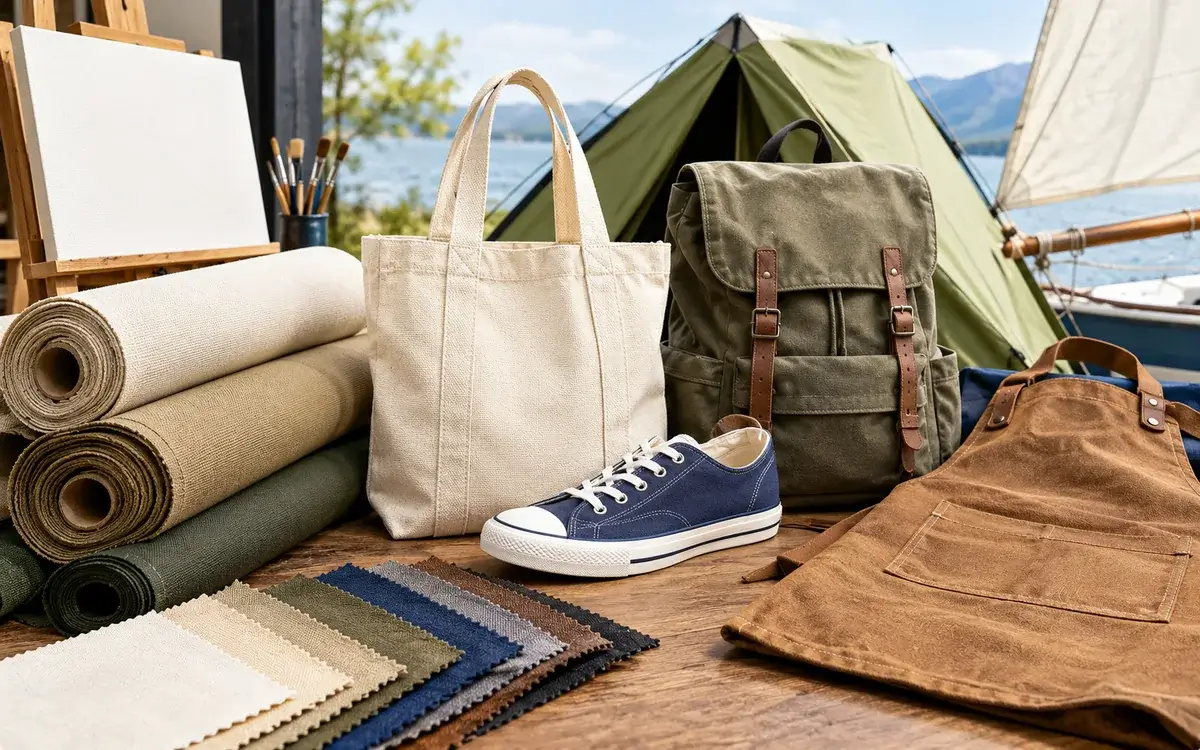
Think of a painter’s blank board, a camping tent, a sneaker, a heavy tote bag and a ship’s old sail. All of them can be made from the same family of cloth. It is called canvas, and it has been around for a very long time. Canvas fabric is tough, plain and useful. It is not soft or fancy, but it lasts.
This guide explains what canvas fabric is, what it is made of, how it is woven and how its weight is measured. It also covers the main types, the best uses, care tips and what to check when you buy it in bulk. If you want to place canvas among other cloths, our guide to common fabric types is a good starting point.
What is canvas fabric
Canvas is a heavy, plain-woven fabric. Plain weave means each weft yarn goes over one warp yarn and under the next, in a simple checkerboard pattern. This is the strongest and simplest way to weave cloth. Canvas uses thick yarns packed closely, so the fabric is dense, stiff and hard to tear.
The word is thought to come from the Latin word for hemp, because early canvas was made from hemp. Today the most common canvas is cotton. Linen, jute, polyester and acrylic canvas are also made.
Canvas does not stretch much. It is not very breathable when it is thick. It can be waterproofed with wax or coatings. These traits explain why it is used for things that need strength more than softness.
What is canvas fabric made of
Cotton canvas
This is the standard. Cotton canvas is strong, takes dye well and softens with use. It is breathable and fairly cheap. Untreated cotton canvas can absorb water and may rot or grow mildew if kept damp, so outdoor use usually needs a treatment.
Linen canvas
Linen is made from flax. It is stronger than cotton, with a natural slub texture. Artists often prefer linen canvas for painting because it stays stable. It costs more than cotton.
Hemp and jute canvas
These are rougher and more natural. They are used for sacks, rugs and eco-friendly bags. Jute canvas is coarse and not meant for skin contact.
Polyester and blended canvas
Polyester canvas, or a cotton and polyester blend, resists mildew and shrinks less. It dries faster and keeps color well. It is common in cheap bags, tarps and awnings.
Acrylic canvas
Acrylic canvas, often made with solution-dyed yarn, is made for outdoor use. The color goes through the fiber, so it resists sun fading. It is used for awnings, boat covers and outdoor cushions.
Canvas vs duck
Duck is a close cousin of canvas. In many places the two names are used as if they were the same. A common way to separate them is that duck is more tightly woven and has a finer, smoother surface, while canvas can be looser and rougher. Another point is the yarn plies. Duck may use plied yarns in the warp and weft, which makes it stiffer. The names vary between mills and countries, so always ask for the weight, the fiber and the weave rather than relying on the name.
How canvas weight is measured
Canvas is sold by weight. Two units are in use.
- Ounces per square yard (oz): The traditional unit, used in the United States.
- Grams per square meter (GSM): The metric unit used in most other countries.
To convert, multiply ounces by 33.9 to get GSM. For example, 10 oz canvas is about 10 × 33.9 = 339 GSM. A 15 oz canvas is about 509 GSM. To convert the other way, divide GSM by 33.9.
There is also an older numbered system for canvas, where a lower number means a heavier cloth. The exact weight for each number differs between makers, so do not trust the number alone.
Typical weight classes
The ranges below are common but not fixed, and mills draw the lines in different places.
| Class | Approx. weight (oz) | Approx. GSM | Typical use |
|---|---|---|---|
| Light | 6 to 9 | 200 to 305 | Shoes, aprons, light bags, art canvas |
| Medium | 10 to 14 | 340 to 475 | Totes, backpacks, clothing |
| Heavy | 15 to 20 | 510 to 680 | Tents, workwear, tool bags |
| Extra heavy | Over 20 | Over 680 | Tarps, sails, industrial covers |
A heavier canvas is stronger but harder to sew, and it needs a bigger needle and stronger thread.
Types of canvas
Plain (untreated) canvas
This is the base cloth with no treatment. It is breathable and soft after washing. It can shrink, so pre-wash it for sewing projects.
Washed or garment-dyed canvas
The fabric is washed to soften it. It gives a worn feel from the start. Common in clothing and soft bags.
Waxed canvas
Wax is worked into the fabric, which makes it water resistant. It becomes darker and develops creases that look good with age. It needs occasional re-waxing. It is not machine washable and it should be kept away from heat.
Oil-treated and coated canvas
Oils or coatings such as PVC and polyurethane are applied for waterproofing. Used for tarps, truck covers and tents. Coated canvas is not very breathable.
Fire-retardant canvas
Treated with chemicals for use in tents and industrial covers. Check the safety rating that applies in your market.
Printed canvas
Used for fashion and home decor. The prints sit on a firm surface, so they look sharp.
Artist’s canvas
Cotton or linen, primed with gesso so paint sits on top and does not soak in. It is stretched on a wooden frame. Primed canvas should be bought as such, because ordinary canvas absorbs paint unevenly.
For more on finishes like wax, coating and softening, see our guide on textile finishes.
Uses of canvas fabric
- Bags: Tote bags, backpacks, duffels and messenger bags. See our guide on the parts of a bag.
- Footwear: Sneakers and casual shoes use light to medium canvas.
- Workwear: Aprons, work jackets, trousers and tool belts. See the parts of an apron.
- Tents and shelters: Heavy canvas gives a durable, quiet tent.
- Awnings and covers: Boat covers, patio covers and market stalls.
- Art: Painting canvas, framed and stretched.
- Home furnishing: Slipcovers, cushions, curtains and floor cloths.
- Sails: Historic ships used canvas sails. Modern sails use synthetic cloth.
- Industrial: Conveyor belts, hoses and military gear.
- Fashion: Hats, jackets, belts and shorts.
Canvas in the supply chain
For a factory or buyer, canvas is a simple fabric to source but a hard one to sew at speed. Mills often sell it in rolls of 50 to 100 meters, and heavy rolls can be hard to lift and spread. Plan the cutting room for the weight. Heavy canvas dulls knife blades quickly, so keep spare blades ready. In sewing, needle breakage is a common loss at thick seam joins, so train operators to slow down at crossings. Always test a sample of the final order fabric before bulk cutting, because the same name can hide a different weight or finish from another mill.
Strengths and weaknesses
| Strengths | Weaknesses |
|---|---|
| Strong and tear resistant | Heavy |
| Long life | Stiff at first |
| Takes dye and print well | Can shrink |
| Can be waterproofed | Untreated cotton can mildew |
| Looks better with age | Hard to sew when thick |
| Fairly low cost | Not stretchy |
| Easy to repair | Low breathability when coated |
Sewing canvas
Canvas is simple to sew but needs the right tools.
- Needle: Use a heavy needle, such as size 90/14 to 110/18 for medium and heavy canvas. Light canvas can use 80/12 or 90/14.
- Thread: Use strong thread, such as polyester or heavy cotton.
- Stitch length: Longer than normal, about 3 to 4 mm. Short stitches can weaken the fabric.
- Seams: Flat-felled and double-stitched seams add strength.
- Pressing: Use a hot iron with steam. Canvas takes heat well, but not coated or waxed canvas.
- Layers: Thick seam crossings may break needles. Hammer the seam flat with a mallet before stitching.
- Edges: Canvas frays, so bind or fold the edges.
Our guide on sewing defects and root causes helps if you see skipped stitches or puckering.
Care of canvas
- Wash cotton canvas in cool or warm water. Use mild soap.
- Pre-wash fabric for projects, because it can shrink. Our guide on checking fabric shrinkage shows a basic test.
- Air dry. Heat from a dryer may shrink the cloth and set creases.
- For waxed canvas, wipe with a damp cloth. Avoid detergents and heat.
- Store dry. Damp canvas can grow mildew.
- Brush off dirt when dry, then spot clean.
A worked example: tote bag order
Suppose a brand orders 2,000 tote bags from 12 oz cotton canvas. Each bag body needs two panels of 40 cm × 38 cm, plus two handles of 60 cm × 5 cm cut from the same fabric. The fabric is 150 cm wide.
- Body panels per bag: 2 × (40 × 38) = 3,040 square cm
- Handle area per bag: 2 × (60 × 5) = 600 square cm
- Total area per bag: 3,640 square cm
- With 10 percent cutting waste: 3,640 × 1.10 = 4,004 square cm, or about 0.40 square meters
For 2,000 bags, the need is about 2,000 × 0.40 = 800 square meters. Divide by the width of 1.5 meters to get the length: 800 ÷ 1.5 = 533 meters. Add a 3 percent shrinkage and sampling buffer, so order about 550 meters. At 12 oz, which is about 407 GSM, the fabric weighs about 0.407 × 800 = 326 kg for the cut area. These numbers help when you plan freight and cost.
In real life, the marker layout may fit better or worse, so the waste figure should come from your cutting plan.
What to check when buying canvas
- Fiber content: Cotton, linen, polyester or a blend.
- Weight: In oz or GSM, with the tolerance, for example plus or minus 5 percent.
- Width: Measured between selvedges.
- Yarn count and thread density: Threads per inch in warp and weft.
- Strength: Tensile and tear strength, if the end use needs it.
- Shrinkage: Check length and width after washing.
- Color fastness: Rubbing and washing, especially for dark colors.
- Treatment: Waxed, coated, fire-retardant or untreated.
- Defects: Slubs, holes, stains and uneven dye. Our guide on fabric inspection procedure shows how to grade a roll.
Canvas and denim
Canvas and denim look related, but they are different. Denim is a twill weave, with a diagonal line, and is usually dyed with indigo in the warp. Canvas is a plain weave and can be any color. Denim is softer and more flexible. Canvas is stiffer. Read more in our explainer on what is denim.
Final thoughts
Canvas is a plain, honest fabric. It is made to be strong, to take hard use and to look better with age. The right choice depends on weight, fiber and finish. Cotton suits most bags and clothing, linen suits art, polyester and acrylic suit outdoor use, and wax or coating adds water resistance. Check the weight in GSM, test the shrinkage, pick a heavy needle and a sturdy thread, and canvas will repay you with years of use.
Frequently asked questions
Canvas is a heavy, tightly woven plain-weave fabric, usually made from cotton, linen or polyester. It is strong and used for bags, tents, shoes, art and workwear.
Most canvas is cotton. Linen, hemp, jute, polyester and acrylic canvas are also made.
Plain canvas is not waterproof, but it can be treated with wax, oil or a coating to resist water.
Duck is usually more tightly woven and smoother than canvas, but mills use the names differently. Ask for weight and weave details.
It ranges from about 6 oz (around 200 GSM) for light canvas to over 20 oz (over 680 GSM) for very heavy canvas.
Cotton canvas can shrink, especially the first time it is washed. Pre-wash it, or choose pre-shrunk fabric.
Light and medium canvas can be sewn on many home machines with a heavy needle and strong thread. Very heavy canvas needs an industrial machine.