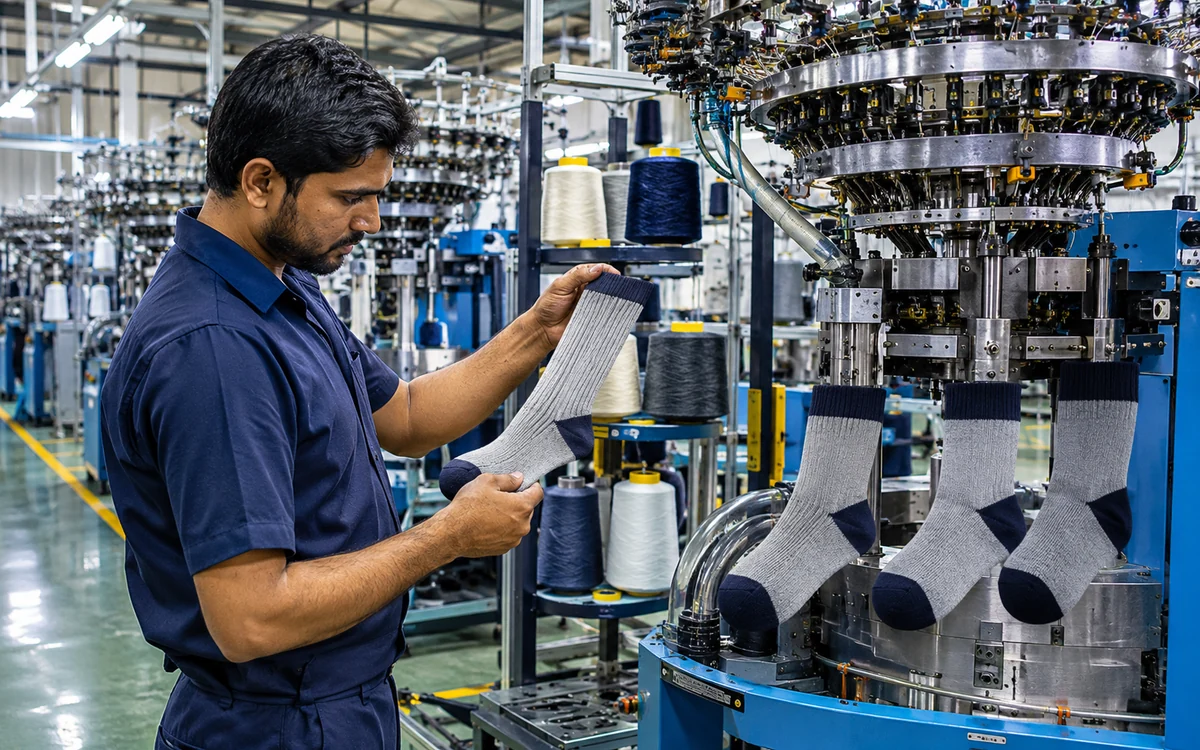
The socks manufacturing process is one of the most automated routes in the apparel industry. A modern sock knitting machine can turn cones of yarn into a finished tube with a ribbed cuff, a leg, a heel pouch, a foot and a toe in a few minutes, with almost no sewing. The work that remains, such as closing the toe, washing, setting the shape on a form, pairing and packing, decides whether those socks sell as a good product or come back as claims.
This guide walks through the whole flow in order, from yarn choice and machine setup to packing. It explains the types of sock machines, how the heel and toe are knitted, how toe closing works, what happens in dyeing, boarding and pairing, which quality checks matter and which defects are most common. It is written for merchandisers, knitwear managers, designers and students. Machine models, sizing systems and practices differ between factories and markets, so treat this as a general map and follow each buyer’s specification.
Overview of the process
| Stage | Main activities |
|---|---|
| 1. Design and sampling | Style, size range, yarns, pattern, sample approval |
| 2. Yarn | Selection, dyeing if needed, winding, preparation |
| 3. Knitting | Knitting the sock tube with cuff, leg, heel, foot and toe |
| 4. Raw inspection | Check greige socks for holes and faults |
| 5. Toe closing | Linking or seaming the toe |
| 6. Wet processing | Dyeing, washing, softening, extraction, drying |
| 7. Boarding | Shaping on forms with steam or heat |
| 8. Finishing and packing | Pairing, labelling, tagging, folding, packing |
| 9. Inspection and shipping | Final checks, cartons, documents |
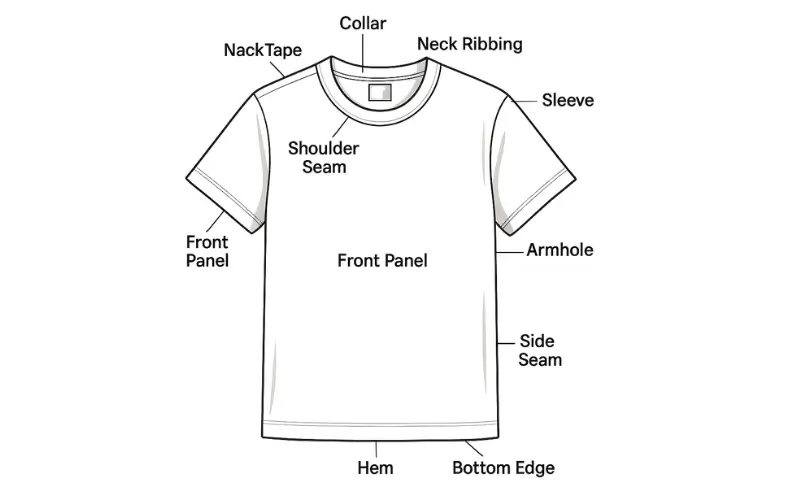
The named parts of a sock are shown in parts of a sock, and the range of styles in types of socks.
Stage 1: Design and sampling
The design starts with the type of sock, such as casual, dress, sports, compression, school, thermal or no show, and the market. The technical details include:
- Size range. Sock sizes are usually based on foot length or shoe size ranges, and markets use different systems, so confirm the chart with the buyer.
- Yarns and fibre content. Cotton, wool, nylon, polyester, elastane and blends.
- Construction. Plain, rib, terry cushion, mesh, jacquard, plated.
- Cuff and elastic details.
- Heel and toe reinforcement.
- Labels and packaging.
Samples are knitted on small sample machines or on production machines, then washed and boarded, since knit sizes change in processing. Approval steps are similar to those in the guide to the fit approval process in garments, and the details should be recorded in a spec sheet, as explained in what a garment spec sheet contains.
Stage 2: Yarn
Yarn types
Sock yarns are chosen for comfort, durability and stretch.
- Cotton. Combed or mercerised cotton for softness and absorbency.
- Nylon or polyamide. Added for strength, especially at heel and toe. See nylon fibre, nylon 6 versus 66.
- Elastane. Provides stretch and recovery, often as a covered yarn in the cuff and the body. See spandex fibre, elastane and lycra.
- Wool and merino. For warm, soft socks. See how to source merino wool socks and protein fibres, wool and silk properties.
- Polyester and acrylic. For sports, thermal and low cost socks. See polyester fibre properties and uses and acrylic fibre properties and uses.
- Viscose, bamboo viscose and modal. For soft, fluid socks. See bamboo fabric and viscose.
- Functional yarns. Moisture wicking, antimicrobial or thermal yarns, as described in moisture wicking fabric and antimicrobial finish for textiles.
A typical sock combines a face yarn with a back yarn and an elastic yarn. The combination can differ between the cuff, leg, heel, foot and toe. For counts, see yarn count.
Yarn dyeing and winding
Many socks are made from dyed yarn, which is dyed in package or cone form before knitting. Others are knitted in greige or white and dyed after knitting. Shade control is vital, since socks in a pair, or in a pack, must match. See the guides on shade variation in fabric and light box for colour matching. Yarn is wound onto cones and waxed or lubricated where needed. See auto cone winding machines.
Stage 3: Knitting
Sock machines
Socks are knitted on small diameter circular hosiery machines. Common machine types include:
| Machine type | Features | Typical products |
|---|---|---|
| Single cylinder | One needle cylinder, plain, plated and jacquard knits, simpler and faster | Casual, sports, no show socks |
| Double cylinder or cylinder and dial | A dial adds a second set of needles for rib and special structures | Dress socks, rib cuffs, terry socks, thermal socks |
| Electronic needle selection machines | Computer controlled patterns | Jacquard and fashion socks |
| Closed toe machines | Close the toe during knitting, with less linking | No seam toe socks |
The cylinder diameter is usually small, and the needle count differs by fineness of the sock, for example in the range of a hundred to a few hundred needles. These details vary by machine maker and use, so check the machine supplier’s data. For the general idea of gauge and fineness in knitting, see knitting machine gauge and fabric GSM and parts of a knitting machine.
Knitting sequence
A typical sock is knitted from the top down in this order.
- Welt or top. A plain or ribbed band that forms the cuff, sometimes with an inlaid elastic yarn for grip, and often with a turned welt.
- Leg. Knitted in a continuous tube, in plain, rib or patterned structure.
- Heel. The machine switches to reciprocating knitting, which means the needles knit back and forth over part of the cylinder, shaping a pouch that fits the heel. Reinforced yarn, such as extra nylon, is often added here.
- Foot. Returns to continuous round knitting, and may include cushioned terry loops on the sole.
- Toe. Reciprocating knitting again forms the toe pouch, with reinforcement.
- Separation course. A few courses of waste yarn or a special course to separate the sock from the next one, so the machine can knit continuously.
The machine then repeats the sequence for the next sock. Machine programming controls stitch length, speed, yarn changes, patterns and tension at each step.
Controls at the machine
Check at the machine:
- Stitch length and tension
- Sock length and width after knitting, since they change in processing
- Yarn lot, colour and feeding
- Pattern alignment and jacquard clarity
- Heel and toe shape
- Holes, needle lines, dropped stitches and floats
Many factories measure and weigh sample socks at set intervals, to catch drift early. Machine maintenance and needle changes matter greatly, since a single damaged needle causes lines and holes in every sock. See the guide to needle damage in garments for the general idea, and the page on knitting defects, causes and remedies for knitting faults.
Stage 4: Raw inspection
After knitting, socks are inspected in the greige state. Inspectors look for holes, dropped stitches, needle lines, uneven patterns, wrong colours, tight or loose welts and size faults. Defective socks are removed before closing and dyeing, since fixing later is expensive. Many factories also check weight and length against targets.
Stage 5: Toe closing
Most socks leave the machine with an open toe, which must be closed. The usual methods are:
- Linking. A linking machine joins the toe edge loop by loop, so the seam is flat and elastic. An operator places the loops on the machine points. This gives a fine, flat toe seam.
- Seaming with an overlock or flat seam machine. Faster, but the seam can be bulkier.
- Machine knitted closed toe. Some machines close the toe automatically, so no seam is needed. These are marketed as no seam toe socks.
Toe seam quality is a key comfort point. A bulky or rough toe seam can cause blisters, and a loose one can burst. The guide to knitting garments with few or no seams covers related knitting ideas, and lockstitch versus overlock versus flatlock explains stitch families for seaming.
Stage 6: Wet processing
Socks go through wet processing to clean, colour and soften them.
- Dyeing. Socks that were knitted in greige or white yarn are dyed in garment dyeing machines, such as paddle or rotary machines. Yarn dyed socks may only need washing.
- Washing. Removes oils, wax and impurities.
- Softening. Adds soft hand. See textile softener types comparison.
- Special finishes. Antimicrobial, moisture management or anti odour finishes, if required. Claims depend on tested finishes and local rules. See antimicrobial finish for textiles.
- Extraction and drying. Spin out water and dry at controlled temperature.
Colour fastness is important for socks, because they contact sweat and are washed often. See colour fastness tests. Restricted substance limits apply, particularly for children’s socks. See restricted substances in garments.
Stage 7: Boarding
Boarding sets the final shape and size of the sock. The sock is pulled onto a flat, foot shaped form, usually made of metal or heat resistant material, and heated with steam or hot air. The heat and moisture relax the knit and set it to the shape of the form, which fixes length, width and the foot outline. Temperature and time depend on the yarn, since elastane and synthetic fibres can be damaged by too much heat, while nylon, polyester and wool take set differently.
Form size controls the finished size of the sock. If the form is too large, the sock can lose recovery. If it is too small, the sock can feel tight. Measure socks after boarding and cooling, and compare them to the size chart.
Stage 8: Finishing and packing
- Pairing. Match two socks as a pair, by size, colour and pattern, and check left and right if the style has them.
- Labelling and tagging. Add sleeves, bands, hang tags, barcodes and size stickers. See hang tags in garments and types of garment labels.
- Metal detection. Check for needle fragments. See metal detection procedure in apparel.
- Packing. Fold pairs, put them in polybags, header cards or boxes, then pack them into cartons. See polybag in garment packing, garment packing methods, flat pack and hanger pack and ratio pack versus solid pack.
- Carton planning. Socks are small and light, so many pairs fit in a carton, and carton volume matters for freight. See CBM calculation for garments and export garment carton packing specs.
Quality control through the process
| Stage | Key checks |
|---|---|
| Yarn | Count, shade, strength, elastane content, lot |
| Knitting | Stitch length, size, holes, needle lines, pattern, heel and toe shape |
| Raw inspection | Defects, weight, length |
| Toe closing | Seam strength, flatness, closing completeness |
| Wet processing | Shade, fastness, shrinkage, softness, stains |
| Boarding | Final size, shape, recovery |
| Pairing | Matching size, colour and pattern |
| Labelling | Correct label, content and position |
| Final | Cleanliness, metal detection, packing, count |
Typical tests include size and dimensional stability after wash, colour fastness, pilling, elastic recovery, seam strength at the toe and fibre content. The buyer’s methods and limits decide. Inspection levels often follow an AQL plan. See AQL sampling plans for garment inspection. Pilling test methods are explained in the guide to the ISO 12945-1 pilling box method.
Common sock defects and causes
| Defect | Common causes | Prevention |
|---|---|---|
| Holes and dropped stitches | Damaged needles, yarn breaks, wrong tension | Replace needles, maintain machine, check yarn |
| Needle lines | Bent or worn needles | Change needles and check settings |
| Heel or toe misshape | Wrong machine setting or yarn tension | Check programme and settings, monitor first socks |
| Bulky toe seam | Wrong linking or seaming method | Train linkers, use proper machine, check seam |
| Open toe or seam failure | Weak closing, poor loop matching | Check seam strength, correct linking |
| Size variation | Stitch length drift, wrong boarding | Control stitch length, check form size, measure regularly |
| Tight or loose welt | Elastic yarn tension variation | Control elastane feed and welt settings |
| Shade difference in a pair | Mixed yarn lots or dye lots | Use one lot per pair, shade sort |
| Colour bleeding | Poor dye fixation | Test colour fastness, wash and rinse well |
| Twisted legs | Yarn twist or machine tension | Balance yarn twist, correct settings |
| Pilling | Short fibres, friction | Select better yarn, finish properly |
| Snags and floats | Long floats, rough handling | Pattern design controls, careful handling |
| Mismatched pairs | Poor pairing | Pairing checks, colour and size control |
| Oil stains | Machine oil or wax | Clean machines, control lubricants |
For a wider list of faults, see sewing defects and root causes, which helps with seaming faults at the toe.
Cost and planning
Sock cost depends on yarn type and weight, machine speed and efficiency, toe closing labour, dyeing and finishing, packaging and freight. A small saving per pair becomes large over millions of pairs, so yield, waste and efficiency matter. Machine downtime and needle breakage are key losses, so planned maintenance pays. The guide to costing of knit garments shows a similar cost structure.
Factories also plan around order sizes and colours. Short runs with many colours need quick changeovers, while long runs of basic socks suit fewer, well tuned machines. See line balancing in the garment industry for ideas on balancing steps from knitting to packing.
Final thoughts
The socks manufacturing process is a knitting led flow in which most of the shaping happens in the machine, and the finish is set by toe closing, wet processing and boarding. Quality depends on good yarn, well maintained machines, controlled stitch length, careful toe seams and correct boarding.
To control it, approve yarn and shade early, check the first socks after every setup, remove faults at raw inspection, train toe closing operators, test wash and size stability on samples, and measure after boarding. Follow the buyer’s size chart, fibre content and restricted substance rules, and keep clear records so reorders match the approved sample.
Frequently asked questions
Socks are knitted on small circular machines that knit the cuff, leg, heel, foot and toe in sequence. The toe is then closed, the socks are dyed or washed, shaped on forms, paired and packed.
Single cylinder and double cylinder sock knitting machines, often with electronic needle selection, plus linking or toe closing machines, dyeing machines, boarding machines and packing equipment.
The machine switches to knitting back and forth over part of the needles, which forms a pouch that fits the heel. Reinforcing yarn is often added.
It is the step of joining the open toe of a knitted sock, usually by linking loop by loop or by seaming, so the toe is flat and strong. Some machines close the toe automatically.
Boarding is shaping the sock on a foot shaped form with steam or heat, which sets its final size and shape.
Nylon adds strength and wear life, especially at the heel and toe. Elastane gives stretch and recovery so the sock holds its shape and stays up.
Holes, needle lines, dropped stitches, bulky or open toe seams, size variation, shade difference in a pair, tight or loose welts and mismatched pairs.