Look at the labels in your wardrobe. Chances are that more than half of them mention polyester. It is in shirts, sportswear, sofas, curtains, bags, seat belts and even the stuffing of pillows. Polyester fibre has become the most used fibre in the world, and most people wear it every day without thinking about it.
This guide explains what polyester fibre is, how it is made, what it is good at and where it falls short. You will find its properties in a table, its uses, a plain answer on whether it suits summer, tips on dyeing and care, and worked examples with real numbers. For a wider view, read our guide on the types of synthetic fibres and our article on why blended fibers are so popular.
What is polyester fibre
Polyester fibre is a man-made fibre made from a polymer called polyethylene terephthalate, usually shortened to PET. It is the same plastic used to make many drink bottles, though the grade and the shape are different. The word polyester means the polymer chain is joined by ester links.
The base chemistry was found in 1941 by two British chemists, John Rex Whinfield and James Dickson, who were working at the Calico Printers’ Association. It was first sold as Terylene in the United Kingdom and later as Dacron in the United States. Polyester grew quickly from the 1950s because it was cheap, strong and did not wrinkle.
How polyester fibre is made
- Raw materials. Purified terephthalic acid (PTA) and monoethylene glycol (MEG) are made from petroleum or natural gas. They are the two building blocks.
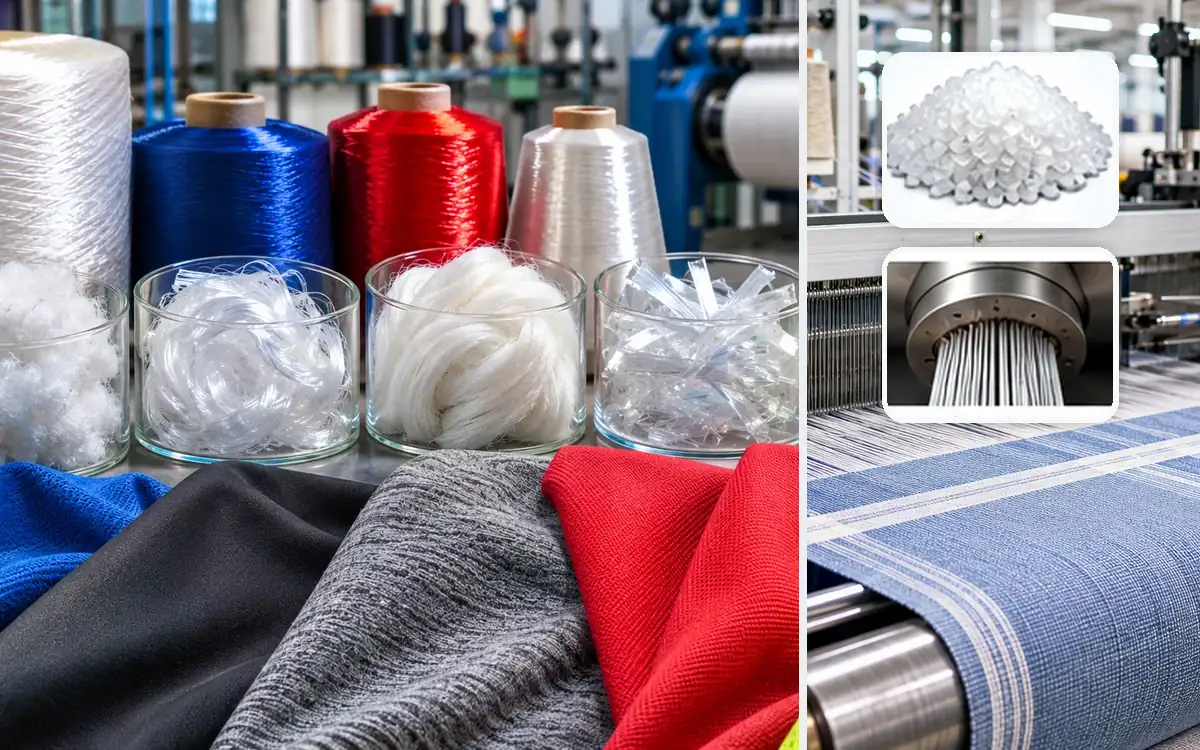
- Polymerisation. PTA and MEG react in a reactor at high temperature. Water is removed, and the long PET chains form. The molten polymer is cooled and cut into chips, or fed straight to spinning.
- Melt spinning. The polymer is melted and pushed through a spinneret, a plate with tiny holes. Each hole makes one filament. Cool air solidifies it.
- Drawing. The filament is stretched to several times its length. This lines up the polymer chains, and gives strength and low stretch.
- Finishing the form. The fibre is wound as filament yarn, textured to give bulk, or cut into staple fibre.
Forms of polyester
| Form | What it is | Typical use |
|---|---|---|
| Filament (smooth) | Long continuous strands | Satin, linings, silk-like blouses |
| POY | Partially oriented yarn, an intermediate | Feed for texturing |
| FDY | Fully drawn yarn | Smooth fabrics, sarees, linings |
| DTY | Draw textured yarn with crimp | Knit fabric, sportswear, stretchy wovens |
| Staple fibre | Cut into short lengths | Spun yarn, blends with cotton, fiberfill |
| Microfibre | Filaments finer than 1 denier | Soft, peach-skin and sports fabrics |
| Recycled (rPET) | Made from bottles or fabric waste | Eco lines of the same products |
Properties of polyester fibre
| Property | Typical behaviour |
|---|---|
| Strength | High. Tenacity about 4 to 7 g/denier for textile grades |
| Elasticity | Good recovery from small stretches |
| Wrinkle resistance | Very good |
| Moisture regain | Very low, about 0.4 percent |
| Drying | Very fast |
| Density | About 1.38 g/cm³, heavier than nylon and lighter than glass |
| Melting point | About 255 to 260 degrees Celsius |
| Heat setting | Holds pleats and shape when heat set |
| Sunlight | Good resistance, better than nylon |
| Chemicals | Good resistance to most acids, damaged by strong alkali at high heat |
| Abrasion | Good |
| Static | Builds static in dry air |
| Pilling | Staple types can pill |
| Oil absorption | Attracts oily stains |
The low moisture regain explains most of the story. Polyester does not soak up water, so it dries fast, but it also does not soak up sweat, so it can feel clammy. For a way to compare fibres, see our guide on the properties of textile fibres.
Uses of polyester fibre
Clothing
- T-shirts, polo shirts and sportswear, often in wicking knits
- Suits and trousers in blends with wool or viscose
- Sarees and dress fabrics in filament yarn
- Jackets and outerwear, including fleece
- Linings and tricot
- Socks and activewear, blended with elastane
Home textiles
- Curtains, bedsheets and quilt covers
- Carpets and rugs
- Pillow and cushion filling (hollow fibre)
- Upholstery fabrics
Industrial and technical
- Tyre cord and conveyor belts
- Seat belts and car interiors
- Ropes and sailcloth
- Filter fabrics and geotextiles
- Nonwovens such as wipes and insulation
Blends
Polyester is often mixed with cotton, wool, viscose or elastane. A common cotton blend is 65 percent polyester and 35 percent cotton, which keeps cotton’s comfort and adds strength, shape and easy care. Wool blends keep a sharp crease for suits.
Is polyester good for summer
The honest answer is that it depends on the fabric and the place.
- In hot, humid weather, 100 percent regular polyester can feel sticky, since it does not absorb sweat well. Cotton, linen and viscose usually feel cooler on the skin.
- In a knit with an open structure, or a microfibre built to wick, polyester moves moisture along the surface and dries quickly. That helps when you exercise.
- Light, loose, breathable weaves in polyester are fine for warm days.
- Cotton and polyester blends are a middle path.
If comfort in heat is the main goal, pick natural fibres or blends, or polyester made for sport. If drying speed and easy care are the goal, polyester is hard to beat.
Dyeing polyester
Polyester is dyed with disperse dyes, which are small, water-insoluble molecules that dissolve in the fibre. The fibre is too tight for dyes at normal boiling, so one of these methods is used:
- High-temperature, high-pressure dyeing at 130 degrees Celsius. The most common method for fabric.
- Carrier dyeing at the boil. Chemical carriers swell the fibre. Used less often because of effluent concerns.
- Thermosol dyeing at about 200 degrees Celsius. Continuous method for woven fabric.
The bath is kept at a pH of 4.5 to 5.5 with acetic acid. Dark shades need a reduction clearing step to remove loose dye. See our guide on the dyeing process for the stages, and our guide on reactive, disperse and vat dye selection for the dye choice. Mills can also colour polyester in the melt, called dope dyeing, which uses far less water.
Worked example 1: bottles to a T-shirt
Recycled polyester is often made from used PET bottles. A typical half-litre bottle weighs somewhere in the range of 12 to 25 grams, depending on the design. Take 20 grams as a working figure.
A T-shirt in 100 percent polyester weighs 150 grams. Not all the bottle material becomes fibre. After cleaning, sorting and melting, assume about 85 percent of the weight is usable.
- Bottle weight needed = 150 ÷ 0.85 = 176 g
- Number of bottles = 176 ÷ 20 = 8.8, so about 9 bottles
So a single recycled T-shirt uses around nine half-litre bottles. This is a rough figure. Actual numbers depend on the bottle, the process and the shirt, so ask for the supplier’s own data before printing a claim on a label.
Worked example 2: moisture and commercial weight
Polyester has a standard commercial regain of 0.4 percent.
A buyer receives 2,000 kg of dry polyester staple fibre.
- Commercial weight = 2,000 × 1.004 = 2,008 kg
For cotton, the regain is 8.5 percent. The same 2,000 kg of dry cotton is 2,170 kg commercial. This shows how little water polyester holds compared with a natural fibre.
Worked example 3: blend ratio by cost
A mill wants a 65/35 polyester-cotton yarn. Suppose polyester staple costs 1.30 currency units per kg and cotton costs 2.10 per kg. Ignore waste for simplicity.
- Cost of 1 kg blend = 0.65 × 1.30 + 0.35 × 2.10 = 0.845 + 0.735 = 1.58 units
A 100 percent cotton yarn would cost 2.10 per kg of fibre, so the blend saves 0.52 units per kg, or about 25 percent on fibre cost. In real life, cotton carries more waste in spinning, so the saving is a little higher. Prices move every week, so use current quotes.
Polyester vs cotton
| Point | Polyester | Cotton |
|---|---|---|
| Source | Petroleum-based chemicals | Plant (cotton boll) |
| Moisture regain | About 0.4 percent | About 8.5 percent |
| Comfort in heat | Can feel clammy | Breathes and absorbs |
| Drying time | Very fast | Slow |
| Wrinkles | Resists | Wrinkles easily |
| Strength when wet | Same as dry | Stronger wet than dry |
| Shrinkage | Very low | Can shrink on first washes |
| Price | Usually lower | Varies with the market |
| Dye | Disperse dyes, high heat | Reactive dyes, lower heat |
| Biodegradable | No | Yes |
Neither one is better in every case. Cotton wins on touch and comfort. Polyester wins on strength, easy care and speed of drying. That is why blends are so common.
Common fabric names made from polyester
- Georgette and chiffon: Light, sheer fabrics from fine filament yarn.
- Crepe and satin: Smooth, draping fabrics for dresses.
- Fleece: Brushed knit in staple or textured yarn. Warm and light.
- Interlock and pique: Knits for sports and polo shirts.
- Taffeta and ripstop: Crisp fabrics for jackets and bags.
- Microfibre peach skin: Very fine filaments with a soft, suede-like surface.
- Mesh: Open-weave knit for sports and linings.
The fibre in all of these is the same chemically. The look and feel come from the yarn size, the construction and the finish. A fine filament woven in satin looks shiny and smooth. A staple yarn in a pique knit looks matte and feels more like cotton.
Quality points when buying polyester fabric
- Yarn type and denier. Ask whether the yarn is FDY, DTY or spun, and check the denier.
- Weight in GSM. A tee fabric may sit near 140 to 180 GSM, while a fleece may be 250 or more.
- Shrinkage. Request a test result, since poor heat setting can leave residual shrinkage.
- Colour fastness. Disperse dye can migrate to the surface in heat, which can mark light-coloured items sewn beside dark ones. See the colour fastness tests guide.
- Pilling grade. Rub test results should be available for staple fabrics.
- Finish. Check for wicking, anti-static or soft finishes and ask how durable they are.
Care of polyester
- Wash in warm or cool water. Polyester is strong and handles machine washing well.
- Avoid very hot water and hot dryers, which can set creases.
- Use a low-heat iron if needed. High heat can melt it.
- Wash sports garments inside out, and avoid fabric softener, which can coat the fibre and block wicking.
- Use a laundry bag or a microfibre filter to catch shed fibres.
- Treat oily stains early, since polyester holds on to oil.
Environmental points
Polyester is made from fossil fuels, and making it takes a lot of energy. It does not rot, so discarded garments stay in landfill for a very long time. Washing sheds microfibres that reach rivers and seas. On the positive side, recycled polyester cuts the use of new oil and diverts bottles from waste. Garment-to-garment recycling is growing, but it is still a small share of supply. Look for clear certificates. Also remember the best saving is to wear a garment for longer.
Advantages of polyester fibre
- Strong, durable and long lasting
- Resists wrinkles, shrinking and stretching
- Dries very fast
- Cheap compared with natural fibres
- Holds pleats and prints well
- Resists moths, mould and most chemicals
- Blends well with other fibres
Limitations of polyester fibre
- Low moisture absorption, so it can feel hot and clammy
- Builds static and attracts oil
- Staple types can pill
- Needs high-temperature dyeing
- Made from fossil fuels, and sheds microfibres
- Does not biodegrade in normal conditions
Final thoughts
Polyester fibre is popular for good reasons. It is strong, cheap, easy to care for and flexible in many forms. Its weak points are comfort in the heat, static and the environment. Pick it where durability and fast drying matter, blend it where you want comfort, and choose recycled yarn when you can. Knowing the properties lets you buy and design with fewer surprises.
Frequently asked questions
Polyester fibre is a strong, man-made fibre made from PET, a polymer made from petroleum-based chemicals. It is the most widely used fibre in the world.
It is strong, wrinkle resistant, fast drying, low in moisture absorption and holds its shape. It can feel warm in humid heat.
Regular polyester can feel sticky in hot and humid weather. Breathable weaves, wicking sportswear knits and blends with cotton work better.
With disperse dyes at about 130 degrees Celsius under pressure, or by other methods such as carriers and thermosol dyeing.
It is the same polymer family, PET. Fibre grade and bottle grade are different in detail, but bottles can be recycled into fibre.
Very little. Heat setting makes it stable, though very high heat can still distort it.
It has a high carbon footprint and sheds microfibres, and it does not break down easily. Recycled polyester and longer wear help reduce the impact.