Merino wool socks sit at the intersection of premium fiber, technical knitting, seasonal demand, and repeat-purchase basics. That combination can create attractive value, but it also invites expensive specification mistakes. A buyer who focuses only on wool percentage may overlook fit, abrasion, shrinkage, pilling, elastic recovery, claim substantiation, and the footwear in which the product will actually be worn.
The strongest sourcing brief converts a broad promise—warm, breathable, durable—into measurable construction and quality requirements.
1. Define the End Use Before the Composition
Start with the customer and shoe, not a target fiber percentage. A classic boot sock, a slim business sock, and a sport crew have different bulk, cushioning, support, and durability needs. The specification should state:
- target climate and season;
- intended footwear and available internal volume;
- sock height and size range;
- desired cushioning level;
- expected frequency of wear and laundering;
- retail price and margin target;
- required claims and sales markets.
This prevents a familiar problem: approving a soft, thick sample that feels excellent in the hand but performs poorly in the customer’s everyday shoe.
2. Read the Blend as a Functional Map
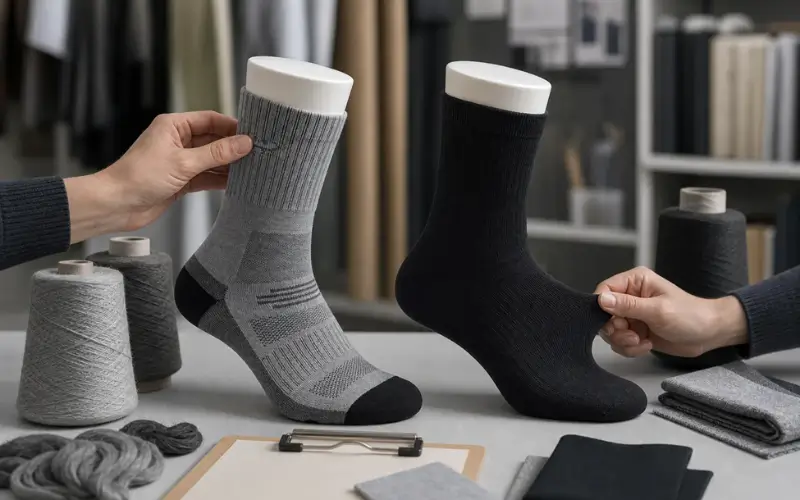
Merino provides thermal and moisture-buffering benefits, but supporting fibers often carry critical mechanical roles. Nylon can improve abrasion resistance and yarn strength. Elastane supports stretch and recovery. Functional yarns may be introduced for odor management or other properties.
Ask the supplier where each yarn is used. Overall composition should be supported by a plating or zone map. A sock with nylon concentrated at the heel and toe may behave differently from one in which nylon is evenly blended through the body, even when the label percentages match.
Commercial products illustrate how the balance shifts by use case. MP Magic’s merino wool sock collection currently spans classic, lightweight, and sport-oriented crew styles. Its published specifications range from an 82% merino classic basic crew to a 74% merino lightweight crew and a 53% merino sport crew with a higher Lycra share. A buyer should not treat the highest number as automatically superior; the relevant question is whether the blend supports the intended performance and price position.
3. Specify Construction in Detail
A complete tech pack should define more than length and color. Include yarn count and ply, machine gauge, stitch structures by zone, terry coverage, reinforcement, toe-seam method, heel shape, cuff depth, elastic placement, and acceptable finished dimensions.
Critical questions include:
- Does cushioning create too much bulk for the target shoe?
- Does the cuff stay up without excessive pressure?
- Is the heel pocket deep enough to prevent slip?
- Are mesh structures positioned where they can contribute to ventilation?
- Are reinforcement yarns present at actual wear points?
- Is the toe closure smooth and consistent across sizes?
4. Control Fit Across the Size Range
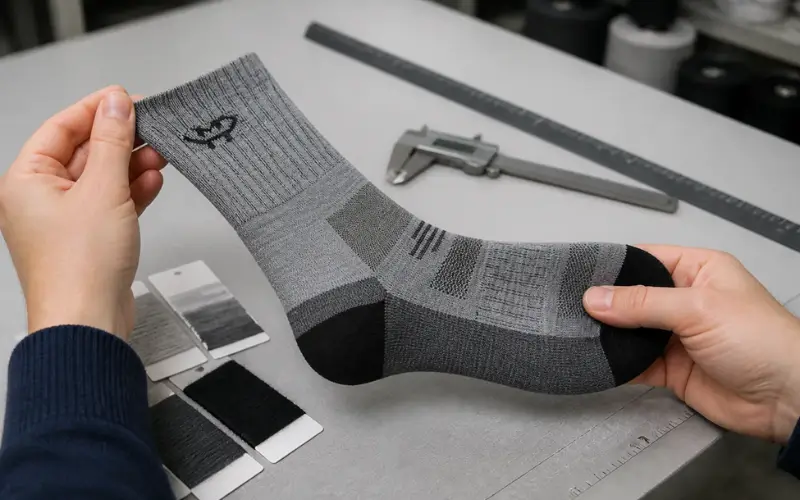
Stretch can hide measurement inconsistency during a casual sample review. Measure socks relaxed and under a defined extension, and confirm foot length, leg length, widths, cuff dimensions, and heel/toe placement. Grade each size deliberately; do not assume one construction can simply be stretched across a broad range.
Wear trials should use representative feet and intended footwear. Record slippage, bunching, cuff pressure, toe restriction, temperature perception, and abrasion points after realistic durations. A sample that fits one employee is not a fit validation.
5. Verify Easy Care on the Finished Sock
Wool may felt or shrink when moisture, heat, and agitation interact. If the commercial promise includes machine washing, identify the treatment route and test the finished sock through the claimed cycle. Assess dimensional change, appearance, pilling, color, elastic recovery, and hand after multiple washes.
The care label must match the evidence. If tumble drying is permitted only at low heat, state it. If a gentle cycle or specific maximum temperature is required, the customer needs that information. Return rates often begin where marketing convenience and actual care instructions diverge.
6. Build a Claim-to-Evidence File
Premium hosiery frequently uses language such as odor-resistant, antibacterial, compression, sustainable, non-mulesed, biodegradable, or certified. Each term needs a defined basis.
- For fiber content, retain composition test reports.
- For colorfastness and dimensional stability, specify the relevant methods and pass criteria.
- For antimicrobial or odor claims, define the organism, protocol, number of washes, and exact wording supported.
- For compression, verify pressure and classification requirements in each destination market.
- For responsible sourcing, keep chain-of-custody and animal-welfare documentation applicable to the purchased wool.
Do not extend a yarn-level certificate to claims about the whole sock unless the certification scope permits it.
7. Cost the Lifecycle, Not Only the Pair
FOB price is only one part of product economics. Include testing, inspection, packaging, freight, duty, markdown risk, returns, and defect allowances. A cheaper construction that pills quickly or loses shape can damage reviews and repeat purchase. Conversely, adding every possible feature can over-engineer a basic product beyond its price ceiling.
A useful cost review connects each component to customer value. Reinforcement at the heel may justify its cost; decorative complexity hidden inside a boot may not. Multi-pair packs can improve perceived value and order economics, but only if size and color assortments match demand.
8. Establish Production Controls
Before bulk approval, lock an approved sample, measurement chart, bill of materials, color standard, workmanship criteria, packaging specification, and testing plan. During production, track yarn lots, machine settings, size/color output, and finishing batches. Final random inspection should check pairing, dimensions, shade, defects, labeling, packaging, and carton assortment.
Conclusion
Sourcing a strong merino sock is an exercise in alignment: fiber with function, construction with footwear, care claims with test evidence, and product cost with customer value. Buyers who translate these relationships into a precise tech pack and control plan are better positioned to