Few garments are as small and as well shaped as a sock. A good sock fits your foot like a second skin. It has a snug cuff that stays up, a heel that cups your heel and a toe that does not rub. All of that shape comes from the knitting, not from cutting and sewing. Learning the parts of a sock explains why socks fit so well, and why some feel better than others.
This guide names each part from the top to the toe, explains what it does and describes how socks are made on a knitting machine. It also covers the usual faults and how to check a pair. If you are interested in the many kinds of socks, you can also read our guide on the types of socks.
How a sock is made
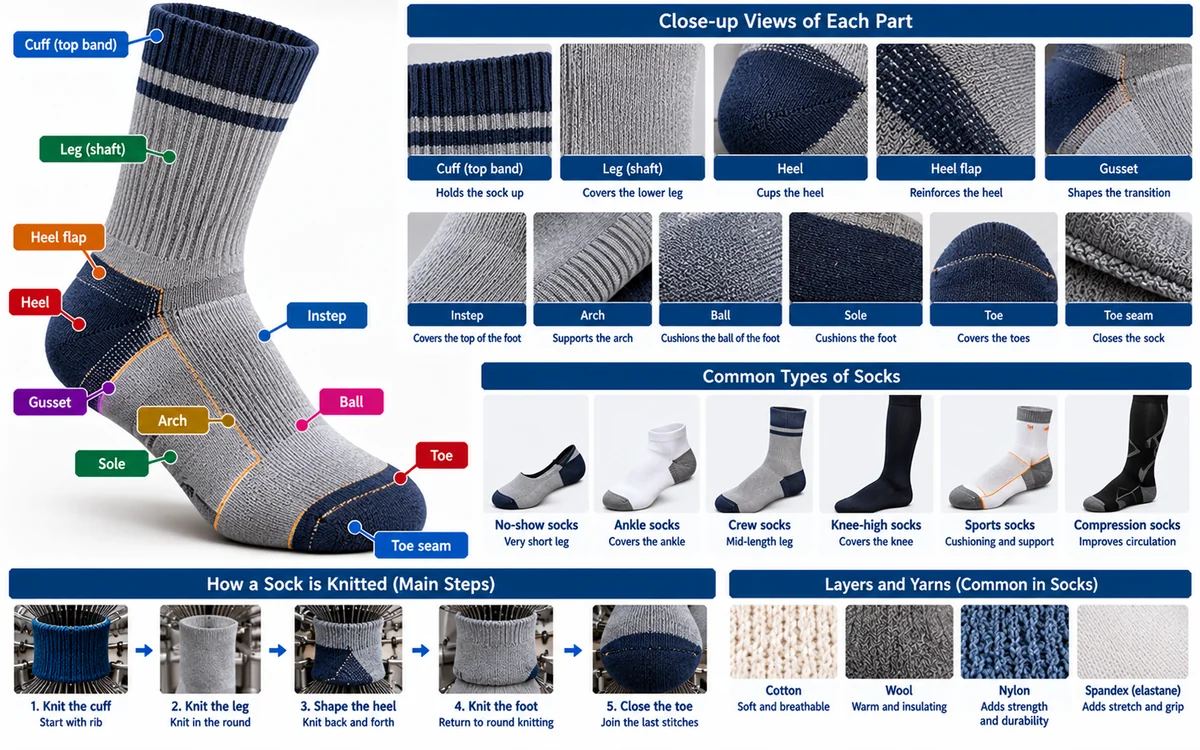
Most socks are knitted as a tube on a small circular knitting machine. The machine starts at the cuff and knits down the leg. When it reaches the heel, it switches from knitting around in circles to knitting back and forth, using only some of the needles. This forms a pocket for the heel. It then returns to the round motion for the foot and finally closes the toe. For the basics of how a machine knits, see our guide on the parts of a knitting machine.
Because the shape is knitted in, there are very few seams. The only seam in many socks is at the toe, where the last stitches are joined.
Parts of a sock at a glance
| Part | Location | Job |
|---|---|---|
| Cuff (top band) | Top edge | Holds the sock up |
| Leg (shaft) | Between cuff and heel | Covers the lower leg |
| Heel | Back of foot | Cups the heel |
| Heel flap | Back of heel | Reinforces the heel |
| Gusset | Sides of the heel | Shapes the transition |
| Instep | Top of foot | Covers the top of the foot |
| Arch | Middle of sole | Supports the arch |
| Ball | Front sole | Cushions the ball of the foot |
| Sole | Bottom of the foot | Cushions the foot |
| Toe | Front | Covers the toes |
| Toe seam | Tip of toe | Closes the sock |
Cuff
The cuff, also called the top band or welt, is the top edge of the sock. It is usually knitted in rib, a stretchy structure of alternating columns of stitches. Rib springs back and grips the leg without cutting in. A good cuff stays up all day and leaves no deep mark on the skin.
Many socks have a small amount of spandex or elastane in the cuff. Spandex keeps the grip as the sock is worn and washed. Without it, the cuff relaxes and the sock slips down. Some socks have a lighter, looser cuff for comfort, such as those made for people with swollen ankles. Others use a silicone grip inside the cuff, common in sports socks and ankle socks.
A cuff can also be folded over, like a turn-down cuff, for style. Some socks have a plain hem, called a welt, that is turned and sewn.
Leg or shaft
The leg is the part between the cuff and the heel. It covers the calf or shin. Its length varies a lot. Ankle socks have almost no leg. Crew socks have a mid-length leg. Knee-highs have a long one.
The leg is usually knitted in plain jersey, a rib or a patterned stitch. Rib legs hug the leg and stay up better. Plain legs are softer and cheaper. Some sports socks include mesh panels in the leg for ventilation.
Heel
The heel is the most technical part of a sock. It has to curve around the back of the foot. The knitting machine forms this curve by knitting a pocket, using about half of the needles and working back and forth. The pocket is shaped with decreases and increases.
Heel flap
The heel flap is a reinforced panel at the back of the heel. It is knitted with a thicker or double yarn, because the heel wears out fastest. Many socks add nylon yarn here to make it more durable.
Heel turn
The heel turn is the shaped part that makes the curved bottom of the heel pocket. It is where the knitting machine changes direction to create the cup.
Gusset
The gusset is the triangular area on each side of the heel, where the heel pocket joins the foot. In a hand-knitted sock, the gusset is easy to see because stitches are picked up along the sides of the heel flap. In machine-made socks, the gusset is part of the shaped heel and is less obvious. It lets the sock sit smoothly over the ankle and instep.
Foot
The foot is the main section that covers the foot from heel to toe. It has several named zones.
Instep
The instep is the top of the foot. It is often knitted in a stretchy rib or a patterned stitch. A tight instep holds the sock in place. A loose one wrinkles under the shoe.
Arch
The arch is the middle of the sole. Some socks have an arch support band, a tight elastic strip that wraps around the arch and holds the sock in place. This is common in sports socks and compression socks.
Ball
The ball is the front of the sole, just behind the toes. In cushioned socks, the ball may have extra thick padding to absorb impact. Running and hiking socks often add terry loops here.
Sole
The sole is the bottom of the foot. Terry or plush knitting on the sole adds cushioning and warmth. Terry has small loops on the inside of the sock, like a towel. A full terry sole is warmer and softer.
Toe
The toe covers the front of the foot. Its shape is made by the machine decreasing stitches until only a few remain. There are two main ways to finish the toe.
- Hand-linked toe: The last stitches are joined one by one on a linking machine or by hand. The seam is flat and almost invisible. This is the best finish for comfort.
- Machine-closed toe (looped or sewn): The toe is closed with a quick seam made by a sewing machine. It leaves a visible ridge that some people find irritating.
No-seam toe socks claim to remove this ridge. Look inside the toe to see which finish a sock has.
Toe seam position matters. A seam that sits across the toes can rub. Some brands move the seam to the top of the toes, away from the pressure point.
Reinforced toe
The toe is also a high wear area. Like the heel, it is often knitted with an extra yarn for strength.
Right and left
Most socks are not shaped for left and right feet. They can be worn on either foot. Some premium socks, especially sports and compression socks, are made specifically for each foot. These have a shaped heel and an asymmetric toe box. They fit better but cost more.
Yarns and fibers
The yarn determines how the sock feels and wears. Common choices:
- Cotton: Soft and breathable. It absorbs moisture and dries slowly.
- Merino wool: Warm, odor resistant and good at moisture control.
- Bamboo viscose: Soft and smooth.
- Polyester: Strong and dries quickly.
- Nylon: Adds strength, usually in heels and toes.
- Spandex or elastane: Adds stretch.
- Acrylic: A budget wool substitute.
A typical everyday sock may contain cotton, nylon and a small portion of spandex. A typical sports sock may contain polyester, nylon and spandex. Our types of socks article gives details of fiber blends.
Sock sizing
Sock sizes are given in ranges, such as 6 to 8 or 9 to 11, that match shoe sizes. A sock stretches to fit several shoe sizes, because the knitted fabric is elastic. Measuring across the foot and length is still important, because a sock that is too small will wear out fast, and one that is too large will wrinkle and cause blisters.
Machine needle count and cylinder diameter decide the sock’s size. A sock machine for adult socks has a cylinder that is just a few inches wide, with around 100 to 200 needles. Finer socks use more needles.
Finishing
After knitting, socks go through finishing.
- Linking or toe closing. The toes are closed.
- Inspection. Each sock is checked for holes and faults.
- Dyeing. If the socks are knitted from undyed yarn, they are dyed after knitting.
- Boarding. Socks are placed on metal forms called sock boards and steamed to set the shape.
- Pairing. Socks are paired and matched.
- Labeling and packing. Labels, hangers and packages are added.
Boarding is important. It gives socks their final size and shape. Poor boarding makes socks come out the wrong size.
Sock lengths and where the parts change
The parts above stay the same across sock lengths, but their size changes. A no-show sock has a very short cuff and no leg, so the heel and the cuff sit close together and often carry a silicone grip. An ankle sock adds a short leg. A crew sock has a leg of about mid-calf height. A knee-high sock extends the leg and needs a stretchier cuff to stay up. Compression socks add graduated pressure along the leg, tightest at the ankle, which is built by changing the tension and the spandex content as the sock is knitted.
Care tips
Wash socks inside out in cool or warm water. Hot water and hot dryers wear out the elastic in the cuff and can shrink cotton and wool. Pair socks before washing, or use a small mesh bag, so you do not lose one in the machine. Air dry or tumble on low. If a sock has a hole at the heel or toe, mend it early with a small darning stitch before the hole grows. A little care adds months to the life of a pair.
Common faults
- Holes: Broken needle or yarn, or weak yarn.
- Thin spots: Low tension or low quality yarn.
- Heel too tight: Wrong heel shaping.
- Cuff too tight: Rib too narrow.
- Cuff too loose: Spandex missing or weak.
- Toe ridge: A bulky seam.
- Shade difference: Yarn lots do not match.
- Pilling: Short fibers rubbing together.
- Shrinkage: Cotton or wool shrinks.
- Mismatched pair: Differences in size or color.
Our guide on types of garments defects lists general faults and how inspectors classify them.
How to check a sock
- Turn it inside out. Look at the toe seam and the stitching.
- Stretch the cuff. It should spring back.
- Look at the heel. It should have a curved pocket.
- Feel the sole. It should be even and soft.
- Hold it up to the light. Thin spots and holes show.
- Wash and measure. The sock should hold its size.
Final thoughts
A sock is a small shaped tube, and every part of it has a job. The cuff grips, the leg covers, the heel cups, the sole cushions and the toe closes. Check the cuff, the heel and the toe seam when you buy a pair. They show the quality of the knitting more clearly than the price or the brand label.
Frequently asked questions
The main parts are the cuff, leg, heel, instep, arch, ball, sole and toe. The heel includes a flap and a gusset.
It is called the cuff, or top band. It is usually a rib knit that holds the sock up.
The seam closes the last stitches at the end of the knitting process. A hand-linked toe is flat and smooth, while a machine-sewn toe has a small ridge.
The gusset is the triangular area at the sides of the heel, where the heel pocket joins the foot of the sock. It helps the sock fit smoothly around the ankle.
These areas wear out first, so they are reinforced with extra or stronger yarn, often nylon.
Most are not. Some sports and compression socks are shaped for each foot.
Most socks are knitted on a small circular machine that makes the cuff, leg, heel, foot and toe in order. The toe is then closed, and the sock is dyed or steamed and packed.