Walk through a weaving shed that makes shirting, curtains, home textiles and suiting, and many of the machines you see will be rapier looms. They are known for flexibility. A rapier loom can handle fine yarn and coarse yarn, plain colours and many-coloured wefts, cotton, wool, silk, linen and synthetics. It does this at a steady speed, with gentle treatment of the yarn.
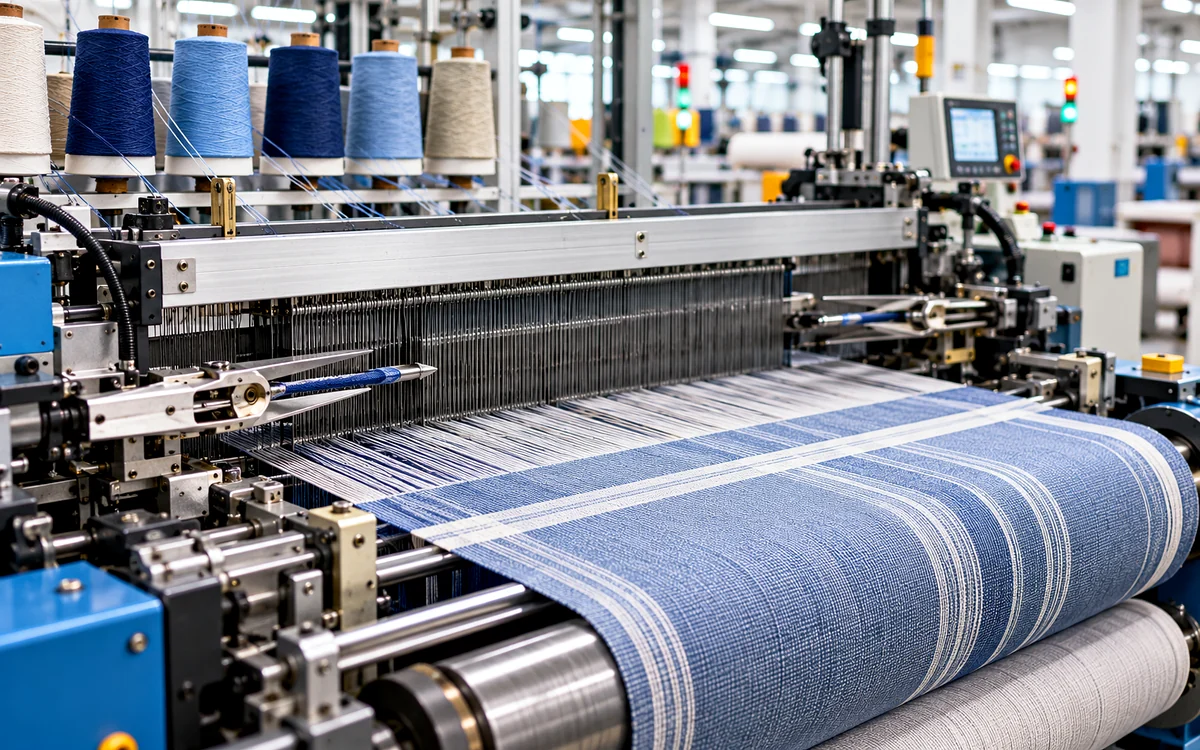
This guide explains the rapier loom in simple steps. You will learn how it inserts the weft, the main types, the parts, how to calculate its speed and production and how it compares with other shuttleless looms. For the first loom guide in this series, see our page on the air jet loom.
What is a rapier loom
A rapier loom is a shuttleless weaving machine. The weft yarn is carried across the width of the warp shed by a rod or a flexible tape, called the rapier, rather than by a shuttle. The rapier picks up the weft yarn from a package placed outside the loom, takes it into the shed and leaves it there. Then it returns empty for the next pick.
Old shuttle looms threw a heavy wooden shuttle that carried its own weft. This was noisy and slow, and it wore the yarn. Shuttleless looms such as rapier, air jet, water jet and projectile looms replaced them in most modern mills. To follow the broader steps of weaving, read our guide on the weaving process from yarn to fabric and the flow chart of weaving.
The basic working principle
All looms follow the same four main motions, whatever the weft insertion system.
- Shedding. Heald frames or a jacquard lift some warp threads and lower others, creating an opening (the shed).
- Picking. The weft is inserted through the shed. On a rapier loom, this is done by the rapier.
- Beating up. The reed pushes the new weft against the fell of the cloth.
- Let-off and take-up. The warp is released from the beam and the finished cloth is wound on, in step with the picks.
Our guide on the primary motions of a loom explains these in more detail.
How the rapier inserts the weft
On a typical double rapier loom:
- A weft yarn is chosen by a selector at the side of the loom and held at the feeding side.
- The feeding-side rapier, driven by a gear or a lever system, enters the open shed. Its head grips the end of the weft.
- The rapier moves to the centre of the shed. At the same time, the receiving-side rapier enters from the other side.
- The two heads meet in the middle. The weft is passed from the giving head to the taking head.
- Both rapiers withdraw, and the taking rapier pulls the weft to the far side.
- The yarn is cut at the feeding side. The reed beats the pick into place.
- The shed closes and the cycle repeats, hundreds of times per minute.
This method is called the transfer system or Dewas system. Another system uses a single rapier that carries the weft across the full width and back.
Types of rapier looms
By the rapier type
| Type | Description | Notes |
|---|---|---|
| Rigid rapier | A solid rod or bar enters the shed | Needs space on the side for the rod. Good for heavy fabric. Used mainly on older or special looms |
| Flexible rapier | A flexible tape, coiled around a wheel or stored in a guide | Needs less space, runs faster and is the usual choice on modern looms |
By the number of rapiers
| Type | How it works | Notes |
|---|---|---|
| Single rapier | One rapier carries the weft across the full width and returns | Older, simple, used for narrow or special fabrics |
| Double rapier | Two rapiers meet in the middle and transfer the weft | The most common. Faster, as each rapier travels only half the width |
By the transfer system
| System | Idea | Notes |
|---|---|---|
| Gabler system | The giving rapier carries the yarn tip, and the taking rapier receives it by clamping | Gentle on yarn, suitable for fine and delicate yarns |
| Dewas system | The giving head holds the weft in a loop and the taking head clamps it | Used with many yarn types, positive transfer |
| Tip transfer vs loop transfer | The weft is passed as a tip or as a loop | Affects the yarn it suits and the selvedge |
Machine makers use different names and designs. When you buy a loom, ask for the transfer system used and the yarn range it can handle.
Main parts of a rapier loom
| Part | Function |
|---|---|
| Warp beam | Holds the warp yarns |
| Let-off motion | Releases warp at the right tension |
| Back rest roller (whip roll) | Guides the warp and senses tension |
| Drop wires | Stop the loom when a warp yarn breaks |
| Heald frames or jacquard | Form the shed |
| Reed | Spaces the warp and beats in the weft |
| Rapier heads and tapes (or rods) | Carry the weft across the shed |
| Rapier drive | Gear, cam or servo drive that moves the rapiers |
| Weft selector | Chooses which weft is inserted |
| Weft feeder (accumulator) | Controls the weft supply and tension |
| Weft cutter | Cuts the weft at the feeding side |
| Tuck-in or leno selvedge device | Forms a neat edge |
| Take-up roller | Draws the fabric forward |
| Cloth roll | Collects the fabric |
| Electronic control | Handles speed, stops, pattern and data |
For a general list, see our guide on the parts of a loom.
Speed and production
Rapier looms run at lower speed than air jet looms but give a high weft insertion rate. Speeds vary by make, width and fabric. A loom speed in the range of about 400 to 700 picks per minute is common for rapier looms. Check the maker’s data for your model.
Weft insertion rate (metres per minute) = picks per minute × reed space in metres
Loom production (metres per hour) = picks per minute × 60 × 0.0254 ÷ PPI × efficiency
Here PPI is picks per inch and 0.0254 converts inches to metres.
Worked example: production of one loom
A rapier loom runs under these conditions.
- Speed: 500 picks per minute
- Reed space: 190 cm = 1.9 m
- Fabric: 60 picks per inch
- Efficiency: 85 percent
Weft insertion rate
- 500 × 1.9 = 950 metres per minute
Production per hour
- Picks per hour = 500 × 60 = 30,000
- Length at 100 percent = 30,000 ÷ 60 = 500 inches = 500 × 0.0254 = 12.7 metres
- At 85 percent efficiency = 12.7 × 0.85 = 10.8 metres per hour
Production per day
If the loom runs 22 hours of the day in a mill that has changeovers and maintenance:
- 10.8 × 22 = 237.6 metres per loom per day
For 100 looms
- 237.6 × 100 = 23,760 metres per day
Worked example: weft yarn needed
- Reed space: 190 cm. Each pick travels about the reed space, plus a small waste for tails.
- Picks per metre of cloth = 60 × 39.37 = 2,362
- Weft length per metre = 2,362 × 1.9 = 4,488 metres (before crimp and waste)
- Weft yarn: 40s Ne cotton, tex = 590.5 ÷ 40 = 14.76
- Weight per metre of cloth = 4,488 × 14.76 ÷ 1,000 = 66.2 g
The weft yarn alone weighs about 66 grams per metre of cloth. Add warp weight and about 3 to 5 percent for waste to plan the yarn purchase. For weaving cost calculations, see our guide on the calculation of weaving cost and profit.
Advantages of a rapier loom
- Very flexible. Handles a wide range of yarns, from fine filament to coarse and fancy yarns.
- Easy to weave with many weft colours, often 8 or 12 or more, which suits stripes, checks and fancy shirting.
- Gentle on the weft yarn, which is useful for delicate and hairy yarns.
- Lower noise and vibration than shuttle looms.
- Lower power use than air jet looms, since there is no compressed air for weft insertion.
- Wide fabric widths possible, including very wide home textile fabric.
- Neat selvedges, with leno or tuck-in devices.
- Good for short runs and quick style changes.
- Works well with jacquard and dobby shedding for patterned fabrics.
Limitations of a rapier loom
- Slower than air jet looms for simple fabrics, so the output per loom is lower.
- More moving parts, so more wear on the rapier heads, tapes and drive.
- Needs careful setting of the transfer point in the centre of the shed.
- Costs more to maintain than some simple designs.
- Waste yarn at the selvedge, from the tail cut at the feeding side.
- Less suited to very high-volume plain fabrics where speed counts most.
Rapier loom compared with other looms
| Point | Rapier | Air jet | Water jet | Projectile |
|---|---|---|---|---|
| Weft carrier | Rapier head and tape or rod | Compressed air | Water jet | Small gripper projectile |
| Typical speed | Medium | High | High | Medium |
| Yarn range | Very wide | Medium, best on spun and filament of fair strength | Hydrophobic filament (polyester, nylon) | Wide, good for heavy yarns |
| Weft colours | Many | Fewer (often up to 6 or 8) | Few | Few |
| Fabric width | Narrow to very wide | Narrow to wide | Narrow to medium | Very wide |
| Energy use | Lower | Higher (air) | Medium (water and pump) | Medium |
| Noise | Moderate | High | Moderate | Moderate |
| Fabric examples | Shirting, suiting, curtains, towels, denim, technical | Poplin, sheeting, denim, bulk fabric | Taffeta, linings, synthetic cloth | Canvas, heavy fabric, filter cloth |
These are general trends. The best machine depends on your product and your volume. Compare cost per metre, not just machine speed.
Uses of rapier looms
- Shirting and blouse fabric with stripes and checks
- Suiting and wool fabrics
- Home textiles such as curtains, upholstery and bedding
- Terry towels (with special terry motion)
- Denim, in mills that want flexible weft options
- Silk and fine filament fabrics
- Carpet and technical fabrics
- Fancy fabrics woven with dobby or jacquard heads. See our guide to jacquard weave
Common faults and remedies
| Fault | Likely cause | Remedy |
|---|---|---|
| Weft breaks at transfer | Wrong transfer timing, worn heads | Reset timing and replace heads |
| Missing pick | Weft not gripped, weak yarn | Check clamps, tension and yarn quality |
| Weft float or loop | Poor weft tension control | Adjust feeder and brake |
| Tape wear or breakage | Friction, dirt, wrong tension | Clean guides, replace tape, align |
| Selvedge defects | Wrong tuck-in or leno settings | Reset and check cutter |
| Warp breaks | Poor sizing, high tension | Check size, reduce shed height, clean reed |
| Reed marks | Bent or dirty reed | Replace or clean reed |
| Starting marks | Stop and start with loose beat-up | Use proper restart procedure |
| Shade bars | Mixed weft lots | Control lots at the creel |
| Rapier collision | Timing error | Check synchronisation and safety sensors |
Maintenance tips
- Clean the loom daily to remove fluff and dust, especially around the rapier path and sensors.
- Lubricate as the maker advises, with the right oil and quantity.
- Check rapier heads and tapes for wear every week, and replace on schedule.
- Check the transfer timing after any repair.
- Keep reeds, healds and drop wires in good order.
- Record stops and causes, and review them weekly to find the biggest loss.
- Train weavers and fitters on setting and troubleshooting. Training lowers stops and wasted time.
How to choose between loom types
Think about the fabric first.
- Many weft colours and fancy yarns: rapier.
- Large volumes of simple fabric at high speed: air jet.
- Filament synthetics: water jet.
- Very wide or heavy fabric: projectile or wide rapier.
- Small orders with frequent changes: rapier, because the changeover is quick.
Also consider power costs, air supply, yarn waste, spare parts and skilled staff. If you are new to weaving, a visit to a working mill gives a better feel than any brochure. For a simple look at hand weaving before machines, see our page on the handloom.
Final thoughts
The rapier loom is the all-round machine of modern weaving. It may not be the fastest, but it is flexible, gentle and good for variety. Understand how the rapier passes the weft, plan production with real numbers and keep the transfer point and tapes in good order. Then the loom will repay you with steady, high-quality fabric across a wide range of styles.
Frequently asked questions
It is a shuttleless loom that inserts the weft with a rapier, a rod or flexible tape that carries the yarn across the shed.
A rigid rapier is a solid rod that needs space beside the loom. A flexible rapier is a tape that coils up, so the loom is more compact and can run faster.
It is a weft transfer method where a giving head and a taking head meet at the centre of the shed and pass the weft between them.
Typical speeds are in the range of 400 to 700 picks per minute, depending on the model and fabric. Check your machine data.
It is flexible with yarn types and colours, gentle on yarn, quiet and uses less energy than air jet looms.
Neither is better for all uses. Air jet is faster for simple fabrics. Rapier is better for variety, many colours and delicate yarns.
Yes. Many mills use rapier looms for denim, especially when they need flexibility in weft yarns and fancy effects.