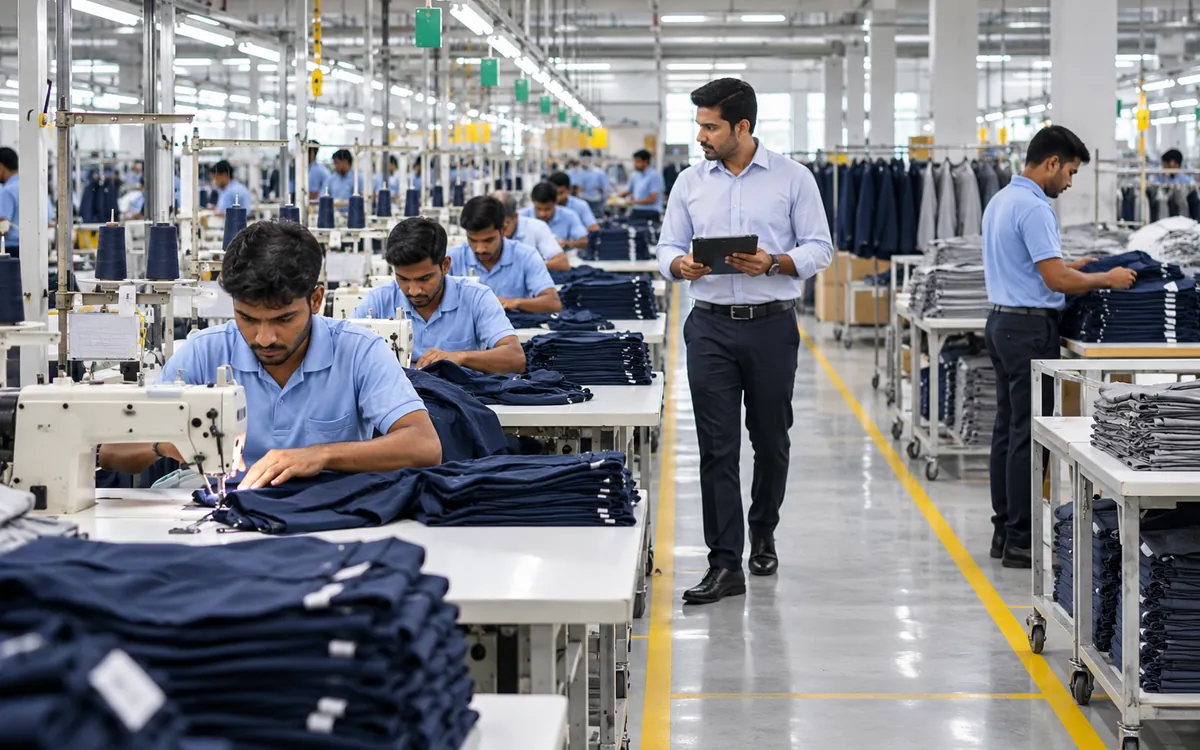
Walk down any sewing line and watch for ten minutes. You will see bundles waiting for an operator, a helper carrying cut parts across the floor, a worker bending to reach a box of thread and a stack of garments waiting for repair. None of this adds value for the customer. All of it costs money. Lean thinking has a name for this: waste. The 7 wastes of lean give you a simple checklist for finding it.
This guide explains each of the seven wastes with examples from a garment factory, shows a small calculation for each so you can see what the waste costs, and suggests practical fixes. If you want the wider picture of lean in apparel, our guides on implementing lean manufacturing in a garments factory and lean manufacturing initiatives in the apparel industry are good places to continue.
What waste means in lean
In lean, waste is any activity that uses time, money or effort but does not add value that the customer would pay for. A buyer pays for a finished, well-made shirt. A buyer does not pay for the shirt to sit in a bin for two days.
Lean separates work into three kinds.
- Value-adding: Work that changes the garment in a way the customer wants, like sewing a collar.
- Non-value-adding but necessary: Work that supports value, such as checking quality or cleaning machines.
- Waste: Everything else.
The aim is to cut waste step by step. In many sewing lines, only a small share of the time a garment spends in the factory is real sewing time. The rest is waiting and moving.
The seven wastes come from the Toyota Production System. A memory aid is TIMWOOD: Transport, Inventory, Motion, Waiting, Overproduction, Over-processing and Defects.
The seven wastes at a glance
| Waste | In a sewing factory | Common fix |
|---|---|---|
| Transport | Carrying bundles long distances | Better layout, flow lines |
| Inventory | Piles of WIP and fabric | Kanban, smaller bundles |
| Motion | Reaching, bending, searching | Workstation design, 5S |
| Waiting | Operators wait for work or machines | Line balancing, maintenance |
| Overproduction | Making more than the order or the next step needs | Pull systems, clear targets |
| Over-processing | Extra stitches, extra checks | Clear specs, standard methods |
| Defects | Rework and rejects | Quality at source, root cause fixes |
1. Transport
What it is
Transport is the movement of material from one place to another when it is not needed for the process. Every move adds time and risks damage.
Examples in a sewing factory
- Cut bundles carried from the cutting room to a store, then to the line.
- Garments traveling to a separate floor for finishing.
- Trims brought from a central store in small batches many times a day.
- Trolleys taking parts around a poorly arranged line.
What it costs
Suppose a helper carries bundles 40 meters to the line, 25 trips a day, and each round trip takes 4 minutes. That is 25 × 4 = 100 minutes a day, or more than one and a half hours of helper time. Over 26 working days, that is 2,600 minutes, about 43 hours, for moving work.
How to reduce it
- Place cutting, sewing and finishing close together.
- Arrange machines in the order of operations, so work flows one way.
- Use overhead rails or conveyors in larger lines.
- Deliver trims to the line in the quantity needed for the shift.
2. Inventory
What it is
Inventory is more material than is needed right now. In garments it shows up as work in process (WIP), raw fabric and finished goods waiting to ship. Inventory hides problems. If a machine breaks, a pile of WIP lets the line keep going, so nobody feels the pain, and nobody fixes the cause.
Examples
- Piles of bundles beside each machine.
- Excess fabric rolls in the store.
- Finished garments waiting for a shipment date.
- Spare trims and cartons, ordered “just in case.”
What it costs
If a line has 2,400 pieces of WIP and makes 800 pieces a day, the WIP is three days of work. That means a garment cut today may not leave the line for three days. The money tied up in that WIP is cash that cannot be used for anything else. If each piece has 8 USD of material and labor in it, 2,400 pieces hold 19,200 USD. If the factory pays 12 percent a year on its borrowing, holding that WIP for a year would cost 2,304 USD in interest, before counting damage, lost pieces and floor space.
Our guide on what is WIP and how to calculate it explains how to measure it.
How to reduce it
- Use smaller bundle sizes.
- Set a WIP limit for each operation.
- Use a kanban board or card system to signal when to make more.
- Buy trims and cartons closer to the need date.
3. Motion
What it is
Motion waste is unnecessary movement of people or machines within the process. It is different from transport, which is about material. Motion is about the operator.
Examples
- Bending down to pick bundles from the floor.
- Walking to find scissors, thread or a tool.
- Turning the body to reach a part far away.
- Re-gripping a garment more than needed during sewing.
- Searching for the right bundle among many.
What it costs
Say a layout puts the bundle box 40 cm farther than needed. The operator reaches an extra 80 cm per piece, to and from the box. If each reach takes 2 seconds and the operator sews 1,000 pieces a day, the loss is 2 × 1,000 = 2,000 seconds, about 33 minutes. Across 50 operators, that is over 27 hours of lost time a day. These are example numbers. Measure your own with a stopwatch or video.
How to reduce it
- Put tools and parts in fixed, labeled spots within easy reach.
- Use the 5S method to remove clutter. See our guide on 5S implementation in the apparel industry.
- Raise bundles to table height with stands or boxes.
- Improve the workstation using method study. Our guides on work measurement techniques and the roles of industrial engineering show how.
4. Waiting
What it is
Waiting is idle time when people, machines or garments wait for something. It includes waiting for fabric, trims, instructions, repairs or the previous operation.
Examples
- An operator has nothing to sew because the previous operation is slow.
- A machine is down and the mechanic has not arrived.
- A line waits for approval of a first piece.
- Workers wait for trims that are missing.
- Garments wait in a queue for a single, slow machine, such as a buttonhole machine.
What it costs
Suppose 5 operators on a line wait an average of 20 minutes each per day. That is 100 minutes of paid time with no output. If each operator’s pay and overhead cost is 0.06 USD a minute, the loss is 6 USD a day, 156 USD over 26 days, per line. A factory with 30 lines loses around 4,680 USD a month on waiting alone, even at this small level.
How to reduce it
- Balance the line, so each operation takes about the same time.
- Keep a preventive maintenance schedule. Our guide on preventive machine maintenance checklists gives a starting point.
- Check trims and fabric before the line starts. A pre-production meeting helps.
- Use visual signals so supervisors see waiting at once. See our guide on visual management systems.
5. Overproduction
What it is
Overproduction means making more than is needed, or making it before it is needed. Lean calls this the worst waste, because it creates all the others. Extra pieces need transport, storage, handling and sometimes rework.
Examples
- Cutting 3 percent more than the order allows, then never using the extra.
- Sewing styles ahead of the shipping plan.
- An early operation produces faster than the next one can handle, and bundles pile up.
- Making all sizes ahead, then waiting for a trim.
What it costs
If a factory cuts 2 percent over on 100,000 pieces, that is 2,000 extra garments. At a cost of 5 USD each for fabric and cutting, the extra cutting cost is 10,000 USD. If the extras cannot be sold as stock lots, the money is lost. Some extra cutting is needed to cover damage. But it should be planned, not random.
How to reduce it
- Set clear cutting allowances by order and fabric.
- Match output of each operation to the next one.
- Use pull systems, like kanban, to signal demand.
- Plan production close to the ship date, within what is practical.
6. Over-processing
What it is
Over-processing means doing more work than the customer needs. It happens when specs are unclear, or when habits keep extra steps alive.
Examples
- More stitches per inch than the buyer requires.
- Pressing a garment twice.
- A 100 percent inspection at every stage when sampling is enough.
- Extra bar tacks, extra trims, extra tape or thread.
- Reporting the same data in three different forms.
- Making a sample that is better than the order requires.
What it costs
If an operator adds an extra row of topstitching that is not in the spec, and it takes 6 seconds on each of 1,000 pieces, that is 6,000 seconds, or 100 minutes a day. The cost is also in thread and machine wear.
How to reduce it
- Make clear, written specifications for each style.
- Use standard operating procedures. See our guide on the apparel industry SOP.
- Check each step: does the buyer ask for it? Does it help the customer?
- Ask operators for ideas. They often know steps that can go.
7. Defects
What it is
Defects are products that do not meet the standard, so they need repair, downgrade or scrap. A defect costs more than the repair. It costs the original work, the repair work, the inspection and sometimes the shipment delay.
Examples
- Skipped stitches, open seams, wrong size labels.
- Shade variation in fabric.
- Holes from a bad needle.
- Misaligned prints.
- Wrong trims.
What it costs
Let us look at a line making 1,000 pieces a day. If the defect rate is 6 percent, 60 pieces need repair each day. If each repair takes 3 minutes, that is 180 minutes, or 3 hours, of repair labor per day. Add inspection time, and the lost pieces that cannot be fixed. If the defect rate falls to 3 percent, the repair work falls to 90 minutes. The saving is 90 minutes a day on one line.
How to reduce it
- Build quality at the source. Inline inspectors check early and catch faults at the operation where they begin.
- Find root causes. Use simple tools like the 5 whys. Our guide on sewing defects and root causes shows how.
- Track the right measure. See the explanation of RFT (right first time).
- Use first piece approval and pilot runs. See the pilot run process.
- Train operators and keep machines in good condition.
The eighth waste
Many modern lean teams add an eighth waste: unused talent. It means not using the knowledge and ideas of employees. In a sewing factory, an operator who sees a better way to hold the fabric is a source of savings. If nobody asks, that value is lost.
How to find waste on your floor
You do not need special tools to start.
- Walk the floor. Go with a notebook and look for each of the seven wastes.
- Take a video. Film an operation for ten minutes and watch it later.
- Map the flow. Draw the path of a garment from fabric to carton, and mark waiting and moving.
- Measure. Count bundles, time moves and note defects.
- Ask the team. Operators, supervisors and mechanics can name wastes at once.
- Prioritize. Pick the waste that costs the most or is easiest to fix.
- Try a small change. Test it on one line.
- Measure again. Keep the change if it works.
Common mistakes
- Chasing every waste at once. Pick one or two.
- Blaming people. Waste is usually caused by the system.
- Cutting inventory too fast. Without fixing flow first, the line can starve.
- Ignoring defects. Rework often hides large losses.
- Not sustaining. Without standards and follow up, old habits return.
Final thoughts
The seven wastes of lean are a simple way to see what you may have stopped noticing. Transport and inventory are easy to spot. Motion and waiting hide in small seconds. Overproduction and over-processing hide in habits. Defects hide in repair tables. Take one line, walk it with the list in your hand and count what you see. You will probably find enough to keep a team busy for months, and every minute you save goes straight to your cost per piece.
Frequently asked questions
They are transport, inventory, motion, waiting, overproduction, over-processing and defects. The short name is TIMWOOD.
Lean teaches that overproduction is the worst, because it causes inventory, transport and many other wastes.
Motion is the movement of people. Transport is the movement of materials.
Balance the line, keep machines in good condition, check materials before starting and use visual signals to show problems early.
Unused talent. It is the loss from not using the skills and ideas of workers.
No. Lean aims to remove waste from the process, not to cut people. The freed time is used for more output, better quality or training.
Start by walking the floor, find the biggest waste and test one small change. Use 5S as a base, because it improves motion, waiting and defects at once.