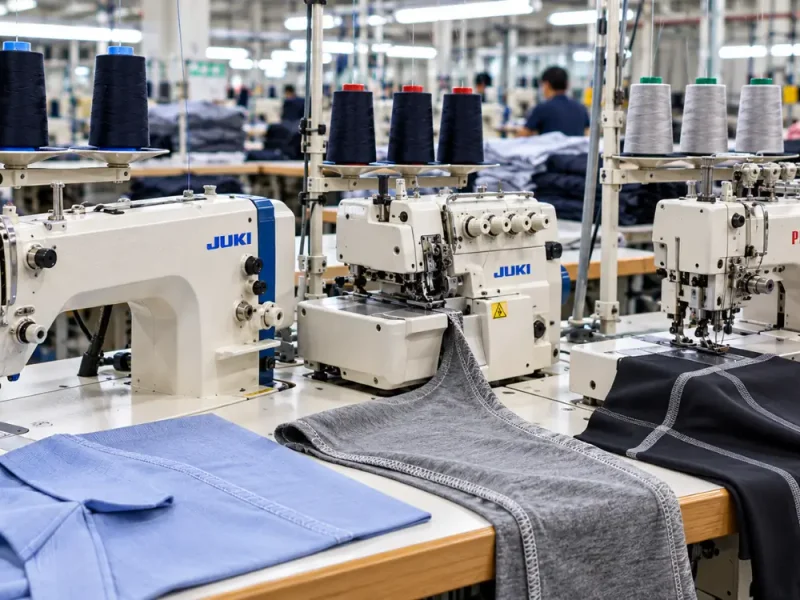
The overlock machine is the sound of a knit factory. It runs fast, trims the fabric edge with a small knife and wraps the edge in thread all in one pass. If you work with knit garments, you will use it for side seams, shoulder seams and edge finishing every day. Knowing the parts of an overlock machine is the first step to setting it up, fixing it and teaching new operators.
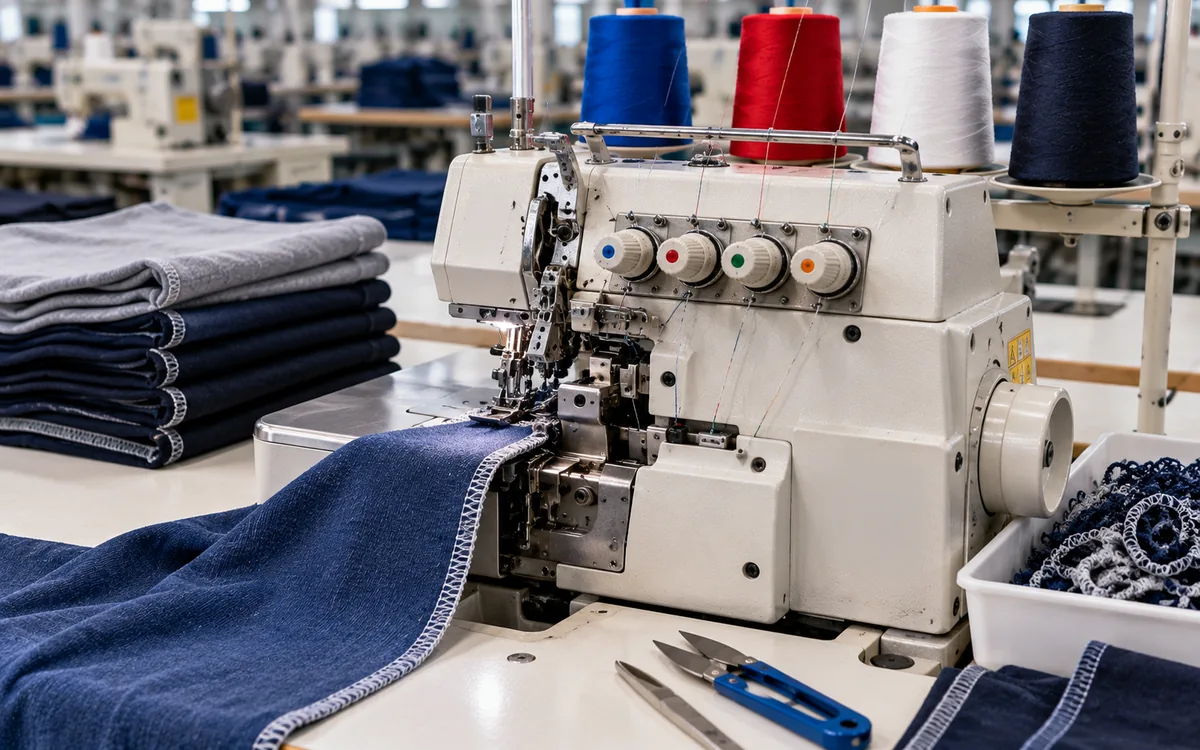
This guide covers each main part, what it does and what goes wrong when it is worn or set badly. It also covers the common thread setups. For a broader view of the machine’s types and settings, see our guide on overlock sewing machine types, specifications and technical adjustment. And if you want to compare it with other machines, read about lockstitch, overlock and flatlock.
What an overlock machine does
An overlock machine, also called a serger, does three jobs at once.
- It cuts the edge of the fabric with a knife, so the seam allowance is neat.
- It joins the pieces with a seam.
- It wraps the cut edge with thread, so the fabric does not fray.
Because the stitch is formed by loops of thread instead of a single locked thread, it stretches with the fabric. This is why overlock is the usual choice for t-shirts, polo shirts, leggings and underwear.
Parts of an overlock machine at a glance
| Part | Job |
|---|---|
| Needle(s) | Carry the needle thread through the fabric |
| Upper looper | Lays thread across the top of the seam |
| Lower looper | Lays thread under the seam and edge |
| Knife (upper and lower) | Trims the edge of the fabric |
| Needle plate (throat plate) | Supports the fabric and guides the knife |
| Presser foot | Holds the fabric against the feed dogs |
| Feed dogs | Move the fabric under the needle |
| Differential feed | Controls stretch or pucker |
| Thread stand | Holds the cones of thread |
| Thread guides | Lead the thread to the needles and loopers |
| Tension dials | Control the thread tightness |
| Stitch length dial | Sets the length of each stitch |
| Handwheel | Turns the machine by hand |
| Stitch finger | Sets the width of the stitch edge |
| Waste collector | Collects the trimmed fabric |
Needles
An overlock machine uses one or two needles. They pass through the fabric and carry the needle thread down to meet the loopers. Needles on an overlock are often a special system, different from the needles on a lockstitch machine. Always use the type the machine maker names.
Needle size depends on fabric weight. Fine fabric needs a thin needle. Heavy fabric needs a thicker one. The needle point also matters. A ball point needle parts the fibers of a knit without cutting them, which helps avoid skipped stitches and holes. A sharp point suits tightly woven fabric. Our guide on the sewing needle parts and how to choose size and point explains this in detail.
A bent or blunt needle is a top cause of skipped stitches, thread breaks and damaged fabric. Change needles on a set schedule, not only when they fail.
Loopers
The loopers are the heart of an overlock stitch. They swing back and forth under the needle plate. There are two of them.
- Upper looper: Passes over the top of the fabric edge, carrying thread across the top of the seam.
- Lower looper: Passes underneath, carrying thread under the fabric and around the edge.
The two loopers interlock their thread with each other at the edge of the fabric. Needle thread locks into this loop structure, and the result is a strong, stretchy seam.
A looper that is bent, worn or out of timing causes loops to be missed. The timing between the needle and looper is delicate. The looper must pass the needle at the right moment, close behind it. If it is too far away, it misses the thread. If it is too close, it can hit the needle.
Knives
An overlock machine has two knives. The upper knife moves up and down. The lower knife is fixed. They work like scissors, trimming the edge of the fabric just before the stitch is formed.
Sharp knives give a clean edge. Dull knives chew the fabric, leaving a ragged edge, loose threads and skipped stitches. In a busy knit factory, knives are changed or sharpened on a schedule. The upper knife is often a hardened steel blade. Wear shows as shiny spots at the edge.
Most machines let the operator disable the knife. This is done for rolled hems and some decorative stitches.
Needle plate, also called throat plate
The needle plate is a flat plate beneath the needles and presser foot. It has a slot for the needles and a surface the fabric slides over. The plate also holds the lower knife and the stitch finger. Its job is to support the fabric as it is stitched and cut.
A scratched or rough plate can snag the fabric. The fabric feed area should be smooth.
Stitch finger
The stitch finger is a small metal prong on the needle plate. The thread wraps around it as the stitch forms. Its width controls the width of the stitch. On some machines, the stitch finger can be changed or adjusted for different stitch widths, such as a standard overlock or a rolled hem.
Presser foot
The presser foot presses the fabric down against the feed dogs. It controls the pressure on the fabric so that the feed moves smoothly. If the pressure is too light, the fabric slips and feeds unevenly. If it is too heavy, thin fabric puckers or thick fabric will not feed.
A presser foot lifter, usually a lever at the back, raises the foot to insert or remove fabric. Many machines also have a knee lifter so the operator can lift the foot with a knee while holding the fabric with both hands.
Feed dogs and differential feed
The feed dogs are small toothed bars under the presser foot. They rise through slots in the needle plate and move forward in a repeating motion, pulling the fabric through.
An overlock machine has two sets of feed dogs.
- Main feed dog: Behind the needle.
- Differential feed dog: In front of the needle.
Each moves at its own speed. The differential feed ratio controls how much each section pulls. If the front feed moves faster than the back, the fabric gathers. If it moves slower, the fabric stretches. The operator sets this with a lever or dial on the machine.
Differential feed is very useful for knit fabric. Fine, stretchy knits tend to wave, so the front dog is set to feed slightly slower to prevent stretching. For lettuce edging and gathering, the operator sets the opposite ratio.
Tension dials
Each thread passes through its own tension unit. These are round dials, one for each needle and looper. They control how tight the thread is as it enters the stitch.
Correct tension gives balanced loops. If the upper looper thread is too tight, the loops pull the fabric edge and can cause puckering. If the lower looper thread is too tight, the fabric edge rolls under. If the needle tension is too loose, the seam feels weak.
When setting tension, change one dial at a time. Make a test sample and check both sides. Many operators lose time adjusting everything at once.
Stitch length dial
The stitch length dial controls how far the fabric moves with each stitch. Overlock stitches are measured in millimeters. A short stitch is stronger but uses more thread. A long stitch uses less thread but can look rough. Typical stitch length in knit garments is often 2.5 to 3.5 mm, but buyers set their own requirements, so check the specification.
Thread stand and thread guides
The thread stand holds the cones of thread. It has a vertical pole for each thread. Above it, a thread guide leads the thread down and into the machine. The guides keep the thread path smooth and free of snags.
The thread path inside the machine passes through several guides, tension units, take-up levers and eyelets. If a thread skips one guide, tension will be wrong and the stitch will not form. Each machine has a diagram on the cover showing the correct threading. Operators should follow it every time.
Take-up lever
The take-up lever moves up and down, pulling thread from the cone and releasing it as the needle goes down. It sets the rhythm of thread supply.
Handwheel
The handwheel is the large wheel on the right of the machine. It turns the machine by hand. Operators use it to thread the needle, check timing and clear small jams. On many modern machines, a safety switch stops the motor when the cover is open.
Waste collector
Some machines have a bag or a pipe to catch the trimmed fabric. It keeps the work area clean and prevents lint buildup inside the machine. In large factories, a vacuum system pulls the trimmed edge away.
Thread setups: 3, 4 and 5 thread
An overlock machine is named by how many threads it uses.
| Type | Needles | Loopers | Typical use |
|---|---|---|---|
| 3 thread | 1 | 2 | Edge finishing, light seams |
| 4 thread | 2 | 2 | Seams on knit and woven, stronger |
| 5 thread (safety stitch) | 2 | 3 (two overlock loopers plus one chain-stitch looper) | Strong seams on trousers and heavy fabrics |
A 3 thread machine is the simplest. A 4 thread machine adds a second needle for strength. A 5 thread machine combines a 3 thread overlock with a separate chain stitch, so it makes two seams at once.
Common faults and their parts
| Fault | Possible cause |
|---|---|
| Skipped stitches | Bent or blunt needle, wrong needle type, looper out of timing |
| Thread breaks | Wrong tension, rough thread path, burr on a guide |
| Wavy seams | Differential feed wrong, presser foot too heavy |
| Puckering | High tension or too much feed |
| Rolling edge | Lower looper tension too tight |
| Ragged edge | Blunt knives |
| Weak seam | Loose needle thread or short stitch length |
| Noise | Dry parts, missing oil, loose screws |
| Fabric not feeding | Presser foot pressure too low, worn feed dogs |
| Loops missing at edge | Looper timing off |
For a wider list of sewing faults and their remedies, see our guide on sewing defects and root causes.
Basic care and maintenance
An overlock machine makes a lot of lint. Cleaning is a daily task.
- Daily: Remove lint from the feed dogs, loopers and knives. Use a brush, not a blade.
- Daily: Check the needle. Replace if bent or blunt.
- Weekly: Oil the moving parts as the maker advises.
- Monthly: Check knives, belts and screws.
- As needed: Change the knife.
Follow the maker’s instructions, because oil points differ by model. Our guide on sewing machine maintenance schedule gives a plan you can adapt.
How to thread an overlock machine
Each model has its own threading order, but most share a logic.
- Turn off the machine and raise the presser foot.
- Place the thread cones on the stand.
- Thread the lower looper first.
- Thread the upper looper second.
- Thread the right needle, then the left needle.
- Pull the threads under the presser foot and to the back.
- Turn the handwheel by hand to make a few stitches before sewing.
Threading in the wrong order often causes tangles. Most manuals say lower looper, upper looper, right needle, left needle.
Final thoughts
An overlock machine looks complicated, but it is built from a handful of parts that work together. The needles carry thread down, the loopers wrap the edge, the knives trim, the feed dogs move the fabric and the tension dials balance the thread. If something goes wrong, work through these parts in order. Start with the needle, then the threading, then tension and finally the loopers and knives. This simple order solves most problems.
Frequently asked questions
The main parts are the needles, upper and lower loopers, knives, needle plate, presser foot, feed dogs, tension dials, stitch length dial and thread stand.
The loopers carry thread around the edge of the fabric to create loops. They interlock with each other and the needle thread to form the stitch.
Differential feed lets the machine move the fabric at two different speeds using two sets of feed dogs. It stops knit fabrics from stretching or puckering, and it can also gather fabric.
The most common causes are a bent or blunt needle, the wrong needle type or loopers that are out of timing.
It depends on the fabric and the workload. In busy factories, knives are checked on a regular schedule. Replace them when the edge looks ragged.
They are the same machine. Serger is the term more common in home sewing. Overlock is the term used in the garment industry.
A safety stitch is a 5 thread seam that combines an overlock stitch and a chain stitch. It is stronger than a plain overlock and is used on trousers and workwear.