Run your hand over the seam of a good pair of sports leggings or a soft base layer. If it lies flat against the skin and does not dig in, it was probably sewn on a flatlock machine. This machine makes a wide, flat, stretchy seam with no ridge, which is why it is loved for activewear, underwear and baby clothes.
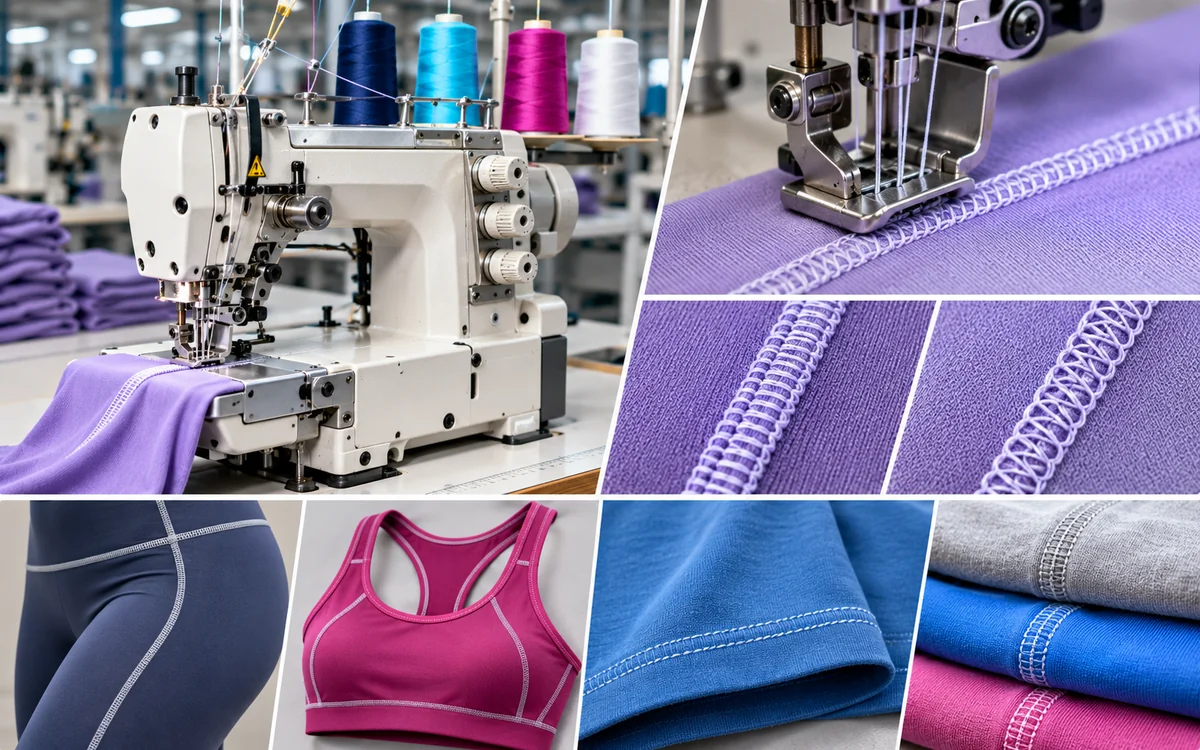
This guide explains what a flatlock machine is, how it forms a stitch, where it is used and how to set it up. It covers the main parts, the stitch types, needle and thread choice, a worked example for thread use and sewing time, and the faults you will meet on the floor. For a short comparison with other machines, see our guide on lockstitch vs overlock vs flatlock.
What is a flatlock machine
A flatlock machine is an industrial sewing machine in the cover stitch family. It uses several needles and loopers to make a seam where the stitches lie flat on both sides of the fabric. Unlike an overlock, it does not cut the edge to trim it in many uses. It is mostly used to join, to hem or to attach tape, and it works especially well on stretchy knit fabric.
The machine is sometimes called a flat seamer, a cover stitch machine or an interlock machine. Names vary by region and by factory, and the same machine may be used for several jobs.
Why the seam is flat
In a normal seam, two fabric pieces are placed face to face and sewn at the edge. The seam allowance stands up on the inside as a ridge. In a flatlock seam, the two edges are placed side by side or slightly overlapped, and the stitch crosses over them. The seam opens flat when pulled. The ridge is gone, so there is nothing to rub the skin. The stitching pattern on one side looks like a ladder, and on the other side like a series of loops.
How a flatlock machine works
A flatlock machine uses these working parts.
| Part | Job |
|---|---|
| Needles (usually 2 to 4) | Carry the needle threads through the fabric |
| Lower looper | Makes loops of thread under the fabric and links with the needle threads |
| Upper (top cover) looper | Lays a decorative thread on top of the seam in some stitches |
| Feed dogs | Move the fabric forward. Differential feed lets the fabric be stretched or gathered |
| Presser foot | Holds the fabric against the feed dogs. See presser feet types |
| Throat plate | Guides the stitch and supports the fabric |
| Tension discs | Control the thread tension of each thread |
| Thread stand | Holds the cones above the machine |
| Folder or binder (attachments) | Fold tape or hem in place before the stitch |
In one cycle, the needles go down and pick up loops from the lower looper. The looper then moves across and carries thread beneath the needle threads. The feed dogs move the fabric by one stitch length. The cycle repeats thousands of times per minute. Because several threads interlock, the seam has a lot of stretch.
Stitch types made on a flatlock machine
Standard stitch numbers come from the ISO 4915 stitch type list. Flatlock and cover stitch families sit in the 400 and 600 classes.
| ISO stitch | Description | Typical use |
|---|---|---|
| 406 | Two-needle bottom cover stitch | Hems on t-shirts, sleeve and bottom hems |
| 407 | Three-needle bottom cover stitch | Wide hems and waistbands |
| 602 | Two-needle top and bottom cover stitch | Joining and hemming sportswear |
| 605 | Three-needle top and bottom cover stitch | Flat seams, tape attach, sports bras |
| 607 | Four-needle flatlock stitch | Flat joining seams on underwear and activewear |
The exact list of stitches a machine can make depends on its model and its gauge. Always check the machine’s manual.
Gauge is the distance between the needles, shown in millimetres or fractions of an inch. A narrow gauge such as 5.6 mm suits fine knits and underwear. A wider gauge such as 6.4 mm or more suits sportswear and thicker fabrics.
Where flatlock machines are used
- Activewear and sportswear: Leggings, sports bras, cycling shorts, base layers.
- Underwear and shapewear: Briefs, bralettes, camisoles, thermals.
- T-shirts and knit tops: Hems, neck binding, sleeve hems.
- Baby and children’s clothes: Seams that do not irritate the skin.
- Swimwear: Stretchy, flat, secure seams.
- Decorative seams: Contrast thread on the outside as a design feature.
- Tape attach: Elastic, binding tape, shoulder tape.
For other common machines and their jobs, see our list of the sewing machines used in the apparel industry.
Advantages of a flatlock seam
- Flat on the skin, so more comfortable
- Very stretchy and recovers well, so it will not snap when the garment stretches
- Strong, because several threads interlock
- Neat on both sides if set up well
- Can double as a design feature
- Works at high speed on knit fabric
Limitations
- Uses a lot of thread compared with a basic stitch
- Needs more skill to set up and fix
- Can run if a thread breaks in a knit fabric
- Not suitable for most heavy or stiff woven fabrics
- Cannot be taken apart as easily as a lockstitch
- Machine cost and spare parts cost are higher
Needles, thread and fabric
Needles
Knit fabrics are made of loops that a sharp needle can cut. Use a ball point needle, which slips between the loops. Sizes in the 65 to 80 range (metric) are common for light knits, and 80 to 90 for heavier knits. Choose the needle system that your machine maker states. Our guide on the parts and selection of sewing needles explains sizes and points.
Thread
- Needle threads: Spun or core-spun polyester, tex 24 to 40 depending on the fabric.
- Lower looper thread: Textured polyester or nylon (often called wooly nylon) that spreads to cover the seam and feels soft.
- Top cover thread: Textured or spun polyester, often in a matching or contrast colour.
Use good quality thread with even thickness. Cheap thread with slubs makes breaks and skipped stitches.
Fabric
Flatlock works best on knits: single jersey, rib, interlock, spandex blends and fleece. For very thin or very stretchy fabrics, use a lighter needle, a smaller stitch and tape or elastic to avoid wavy seams.
Setting up and adjusting the machine
- Thread the machine in the order shown in the manual. A wrong path is the number one cause of problems.
- Fit the right needles. Insert them with the flat side to the back, and push them fully up.
- Set the stitch length. For knits, 2.5 to 3.5 mm is common, which gives about 7 to 10 stitches per inch. Shorter stitches give stronger seams on stretch, longer stitches are faster.
- Set the tension. Start with medium tension on all threads. Adjust one thread at a time.
- Set the differential feed. A ratio above 1 gathers the fabric. A ratio below 1 stretches it. For stable knits start near 1.0 and adjust to avoid puckering or waves.
- Set the presser foot pressure. Light fabric needs light pressure. Too much pressure leaves marks.
- Test on scrap. Sew a sample from the real fabric along both the grain and across. Pull the seam to check stretch and recovery.
- Check the look on both sides. The top and bottom stitches should look even with no loops hanging out.
Worked example 1: thread consumption
Thread consumption is the length of thread used per unit of seam. The ratio depends on the machine, the stitch type and the stitch length. As an example, assume a four-needle flatlock seam uses 22 metres of thread for each metre of seam, counting all threads together. You can find the true figure for your machine by sewing a 100 cm seam, unpicking all the threads and measuring them.
A garment has 90 cm of flatlock seam.
- Thread per garment = 0.90 × 22 = 19.8 m
- For 1,000 garments = 19.8 × 1,000 = 19,800 m
- A cone holds 5,000 m, so 19,800 ÷ 5,000 = 3.96, so about 4 cones are needed
Add 5 percent for waste at the cone end, thread breaks and set-up. That makes 19,800 × 1.05 = 20,790 m, or about 4.2 cones. If thread costs 0.80 currency units per 1,000 m, the thread cost for 1,000 pieces is 20.79 × 0.80 = 16.6 units, or 0.017 per garment. Small per piece, but large over a million pieces.
Worked example 2: sewing time
A machine runs at 4,000 stitches per minute. The stitch density is 10 stitches per inch, which is 10 ÷ 2.54 = 3.94 stitches per cm.
- Sewing speed = 4,000 ÷ 3.94 = 1,015 cm per minute = about 10.2 m per minute
- Time to sew 90 cm = 90 ÷ 1,015 = 0.089 minute = 5.3 seconds
In practice, an operator does not sew at full speed all the time. Handling, turning corners and trimming add time. If the operation has a standard minute value (SAM) of 0.35 for the whole 90 cm seam, the pure sewing time of 0.089 minute is only about a quarter of it. The rest is handling. That is why a well-designed work aid, such as a folder, can speed up the job more than a faster motor. Our article on productivity vs production shows how SAM links to output.
Common faults and fixes
| Fault | Likely cause | Fix |
|---|---|---|
| Skipped stitches | Wrong or blunt needle, bad timing, wrong needle height | Use ball point needle, change it, check timing |
| Broken needle thread | Tension too high, rough path, burr on guide | Lower tension, polish the guide, rethread |
| Loops showing on the top | Looper tension too low | Raise looper tension |
| Seam puckers | Tension too high, wrong differential feed | Lower tension, adjust feed |
| Wavy seam on stretchy fabric | Too much feed stretch | Reduce differential feed ratio |
| Seam too tight, no stretch | High tension, short stitch, wrong thread | Loosen tension, use textured thread |
| Fabric tunnelling | Too much tension on the cover thread | Loosen the top cover tension |
| Needle holes or cut yarns | Sharp needle in a knit | Switch to a ball point needle |
| Thread jams in the looper | Lint, wrong threading | Clean and rethread |
Care and maintenance
- Clean lint and thread bits from the loopers, feed dogs and throat plate after every shift.
- Oil the machine at the points shown in the manual. Use the right oil.
- Change needles on a schedule, such as every shift for heavy runs, or when a skipped stitch appears.
- Check belts, bobbins and guides weekly.
- Record faults and repairs. Our checklist for preventive machine maintenance is a good starting point.
Seam types and where flatlock fits
In seam standards, a flatlock seam is classed as a flat seam, where two edges are butted or slightly overlapped and sewn with a cover stitch. This differs from a superimposed seam, where two pieces are stacked and sewn at the edge. See our guide on the types of seams in garments for the whole family.
Buying notes
When you compare machines, look at the maximum speed, the needle gauges on offer, the number of threads, the feed type and the attachments you need. Major makers include Juki, Pegasus, Yamato, Kansai Special and Brother, among others. Ask for a trial on your own fabric. Check the availability of spare parts and service in your area, since downtime costs more than the price gap between models.
Final thoughts
A flatlock machine earns its place wherever comfort and stretch count. It makes a flat, strong seam that keeps its shape on the body. Success depends on the details: a ball point needle, good textured thread, steady tension and the right differential feed. Keep a log of settings for each fabric, measure thread use, and keep the machine clean. A little care at the start saves a lot of rework at the end.
Frequently asked questions
It is an industrial sewing machine that makes flat, stretchy seams using several needles and loopers. It is used mostly on knit fabric in activewear and underwear.
An overlock trims and wraps the fabric edge with thread. A flatlock makes a flat seam with the stitch laid across butted or overlapped edges, so it has no ridge.
Common stitches include ISO 406, 407, 602, 605 and 607. The exact list depends on the model.
A ball point needle is used for knit fabrics. The size is usually in the 65 to 90 range.
It can sew light stretch wovens, but it is designed for knits. For most woven fabrics, other machines work better.
Usual causes are tension that is too high or a wrong differential feed setting. Lower the tension and adjust the feed.
A lot more than a basic lockstitch. A four-needle flatlock may use 20 times the seam length or more. Measure on your own machine for an exact figure.