In a garment factory, cutting is where money is won or lost. Fabric is the biggest cost in most garments. A cut that is 3 mm off can mean a shirt that does not fit, a sleeve that does not match the armhole or a whole bundle that gets rejected. The tool at the center of this work is the knife cutting machine.
This guide explains how a knife cutting machine works, the three main types, where each one fits, how to set the lay height, how to keep the machine safe and sharp and what faults to watch for. If you want the full flow of the cutting room, our article on the process sequence of fabric cutting is a good companion.
What is a knife cutting machine
A knife cutting machine is a tool that cuts many layers of fabric at once, using a sharp blade. The fabric is spread in layers on a long table. This stack is called a lay. A paper marker with the pattern pieces is placed on top. The operator then cuts along the marker lines.
Knife machines are cheaper and simpler than computer controlled cutters. Many small and medium factories use them every day. They need skill, because the operator guides the cut by hand or by feeding the fabric to the blade. For a comparison with automatic cutters, read our guide on automatic vs manual fabric cutting machines.
The three main types
| Type | Blade | How it works | Best for |
|---|---|---|---|
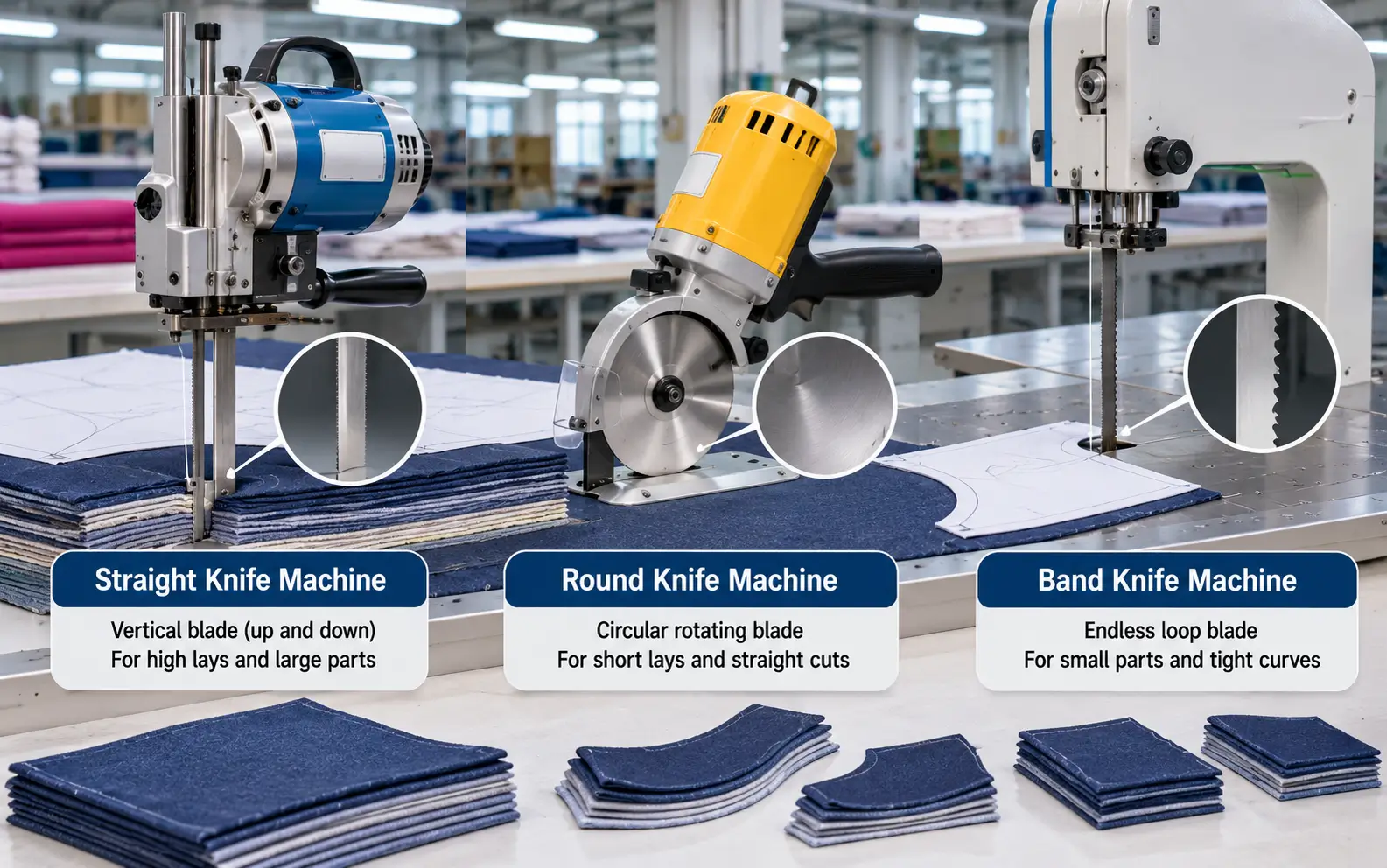
| Straight knife | Vertical blade going up and down | Moved by hand along the marker | Cutting large parts from tall lays |
| Round knife | Circular rotating blade | Moved by hand along the marker | Short lays and straight or gently curved cuts |
| Band knife | Endless blade loop | Fabric is moved against a fixed blade | Small, exact parts and sharp curves |
1. Straight knife machine
The straight knife machine has a long, thin vertical blade. A motor drives the blade up and down very fast. The machine sits on a base plate with a small sole that slides under the lay. The operator holds the handle and pushes it along the marker line.
Strengths
- Cuts high lays, so one pass can cut many pieces.
- Portable, so it works on long tables.
- Handles straight lines and gentle curves.
- Fairly low cost.
Limits
- Hard to cut tight curves with accuracy.
- The blade can lean, so top and bottom plies differ in size.
- Heat from friction can melt synthetic fabric.
- Needs skilled operators.
Used for
- Cutting a lay into rough blocks
- Cutting large pieces such as shirt fronts, backs and trouser legs
- Knit and woven fabric in most factories
Blades come in different lengths and the cutting height depends on the blade. Machine makers list the maximum cutting height. Always stay below that figure, and follow the maker’s guidance for the fabric you cut.
2. Round knife machine
A round knife machine has a circular blade that spins like a small saw. The blade is about a few inches across. A motor spins it and the operator pushes the machine along the cut line. The blade sits low, so it cuts shorter lays than a straight knife.
Strengths
- Cuts fast along straight lines.
- Lighter and easy to move.
- Good for short lays and single or few layers.
- Useful for cutting a lay into smaller blocks.
Limits
- Cannot cut tight curves.
- Limited lay height because the blade is round.
- The spinning blade is a safety risk.
Used for
- Block cutting, which means dividing the lay into rough sections
- Cutting straight edges and bias strips
- Light fabrics and small lots
3. Band knife machine
A band knife machine has a blade shaped like a loop. It runs around two or more wheels, like a band saw. The blade stays fixed. The operator moves the fabric block to the blade and guides it along the pattern line.
Strengths
- Very accurate, with clean edges.
- Cuts tight curves and small parts well.
- The blade does not lean, so top and bottom plies match.
- Works well for stacked blocks, because the fabric is held flat on a table.
Limits
- The fabric must be moved, so big lays must be cut into blocks first.
- Needs a trained operator.
- Costs more than a straight knife machine.
- Takes more floor space.
Used for
- Collars, cuffs, pockets and small panels
- Curved parts such as necklines and armholes
- Fine pattern work where fit matters
In most factories, the lay is first cut into blocks with a straight or round knife machine. Then the blocks go to the band knife for exact cutting of small parts. Our guide on the cutting section SOP shows how these steps fit in the daily routine.
Other tools that work with knife machines
- Notchers: Mark small cuts on the edge to guide sewing.
- Drills: Make small holes to mark pocket or dart positions.
- Die cutters: Cut one shape again and again, such as labels and small trims.
- Spreading machines: Lay the fabric smoothly before cutting.
- Vacuum tables: Hold the lay flat, which improves accuracy in some cutting systems.
Choosing the right machine
| If you need | Choose |
|---|---|
| High lays, large parts | Straight knife |
| Quick block cuts on short lays | Round knife |
| Small parts and curves with high accuracy | Band knife |
| Low volume, low budget | Straight knife plus a round knife |
| High volume with small parts | Straight knife for blocks, band knife for parts |
Lay height and blade selection
Lay height is the number of plies stacked, or the total height of the stack. Too high, and the blade leans and the cut gets wrong. Too low, and the factory wastes machine time.
A simple way to check height is to multiply the plies by the thickness of one ply.
Lay height = number of plies × thickness per ply
Worked example
You plan to cut a cotton jersey with 300 plies. One ply is about 0.5 mm when pressed. This is an illustrative figure. Measure your own fabric.
- Lay height = 300 × 0.5 = 150 mm, or 15 cm
If your straight knife has a maximum cutting height of about 20 cm, the lay fits, but it is close to the upper end. A lay that high can lean the blade. Many cutting rooms choose to cut a lay of 200 plies instead, which is 100 mm, for better accuracy. The tradeoff is more lays to spread and cut. Check the fabric with test cuts, and measure the top and bottom pieces.
How many lays
Suppose the order needs 1,800 fronts of a shirt. If each lay holds 200 plies and one marker has 3 fronts per lay, one lay gives 600 fronts. You need 1,800 ÷ 600 = 3 lays. The plies are counted together with the fabric need. Our article on fabric warehouse and cutting best practices helps with planning.
Blade care and sharpening
A dull blade is the top cause of cutting faults. It pulls the fabric, melts edges and makes a rough cut.
- Straight and round knife machines have a built in sharpening stone or belt. Use it by the schedule.
- Sharpen often when cutting synthetic or heavy fabric.
- Replace a bent, chipped or short blade.
- Keep the blade clean and oiled as the maker tells you.
- A band knife blade is sharpened with an attached grinder. Change it when it wears down.
- Clean the sole plate and the knife guide to prevent snags.
Blade temperature matters. A blade that is too hot can melt synthetic ply edges so they stick together. Slow the speed, use a lubricant or a cooling method, or cut smaller lays.
Safety rules
Knife cutting machines can cause serious cuts. Good rules protect workers.
- Wear a cut resistant glove on the hand that holds the fabric. Metal mesh gloves are common.
- Wear protective footwear and tie back loose clothing and hair.
- Never reach over a moving blade.
- Keep the blade guard in place.
- Switch off and unplug the machine before changing a blade or cleaning.
- Store the machine on its stand when not in use, with the blade covered.
- Train new operators before they cut a real lay.
- Keep the floor clear of cut pieces and scraps.
Also check the machine’s cable and plug. A damaged cable on a cutting table is a hazard.
Cutting faults and fixes
| Fault | Likely cause | Fix |
|---|---|---|
| Top and bottom plies differ in size | Blade leans, lay too high | Lower the lay, use a sharp blade, guide straight |
| Rough or frayed edges | Dull blade | Sharpen or replace |
| Melted edges on synthetic fabric | Blade too hot | Slow the speed, lower the lay, lubricate |
| Notches in the wrong place | Marker slipped | Fix the marker with tape or clips |
| Pieces not matching the pattern | Operator drifted off the line | Train and use a clear marker |
| Fabric pulling during cut | Lay not held flat | Use a clamp or a vacuum table |
| Uneven curves | Straight knife used for tight curves | Use a band knife |
| Fabric damage near the blade | Lint or debris in the machine | Clean and oil |
Our article on quality control of garments cutting section shows how to inspect cut parts before sewing.
Preparing the lay before you cut
Good cutting starts before the machine is switched on. Spread the fabric with even tension, so no ply is stretched or twisted. Match the grain of every ply to the marker. Let knit fabric rest after spreading, because relaxed fabric moves less after the cut. Fix the marker firmly on the top ply, with weights or clips at the corners. If the table is not clean, a bit of lint or a thread under the lay can lift the stack and change the cut line. Check that the table is flat and the sole plate slides freely. A few minutes of preparation saves far more time than it costs, and it makes the machine operator’s job easier.
Cutting accuracy and cost
A cutting error costs more than the cut itself. If one panel is 3 mm short in a bundle of 20 pieces, the sewing line may find the fault later. The pieces must be re-cut from extra fabric, or the whole bundle is sewn with a mismatch.
Take a simple example. A factory cuts 2,000 pieces a day. If the cutting reject rate is 1 percent, that is 20 pieces a day. If the fabric for one piece costs 2.50 dollars, the daily loss is 20 × 2.50 = 50 dollars, which is 1,250 dollars over 25 working days. Add the re-cut labor and the delay, and the cost is higher. A better blade routine and a band knife for small parts often cut this loss.
Final thoughts
The knife cutting machine is simple, but it needs care. Pick a straight knife for tall lays and large parts, a round knife for quick block cuts and a band knife for small exact pieces. Set the lay height from real fabric measurements, keep the blade sharp and train operators in safe habits. Check the first cut parts against the pattern every time. A steady, accurate cutting room saves fabric, saves sewing time and keeps the line running.
Frequently asked questions
A knife cutting machine is a machine that cuts many layers of fabric at once with a sharp blade. The main types are straight, round and band knife.
A straight knife moves up and down and is pushed by the operator along the lay. A band knife has a fixed, looped blade, and the operator moves the fabric block to it. A band knife is better for small, exact and curved parts.
A straight knife machine is usually used for high lays. Check the maker’s maximum cutting height.
Use a sharp blade, lower the lay, slow the speed and use a lubricant or cooling method.
It depends on the fabric and the volume. Heavy and synthetic fabric dulls blades faster. Check the cut quality and follow the maker’s schedule.
It can cut very gentle curves but not tight ones. Use a band knife for tight curves.
A cut resistant glove, protective footwear, tied back clothing and hair and a blade guard in place.