
Fabric arrives at a wet processing mill as raw greige cloth (see also this overview of wet processing for the same stage sequence from a broader introductory angle), stiff with sizing agent and natural impurities, and leaves as something a garment factory can actually cut and sew. Everything that happens in between, desizing, scouring, bleaching, dyeing, and finishing, runs on chemistry, and the specific chemicals chosen at each stage determine not just how the fabric looks and feels but how it performs for the rest of its working life as a garment.
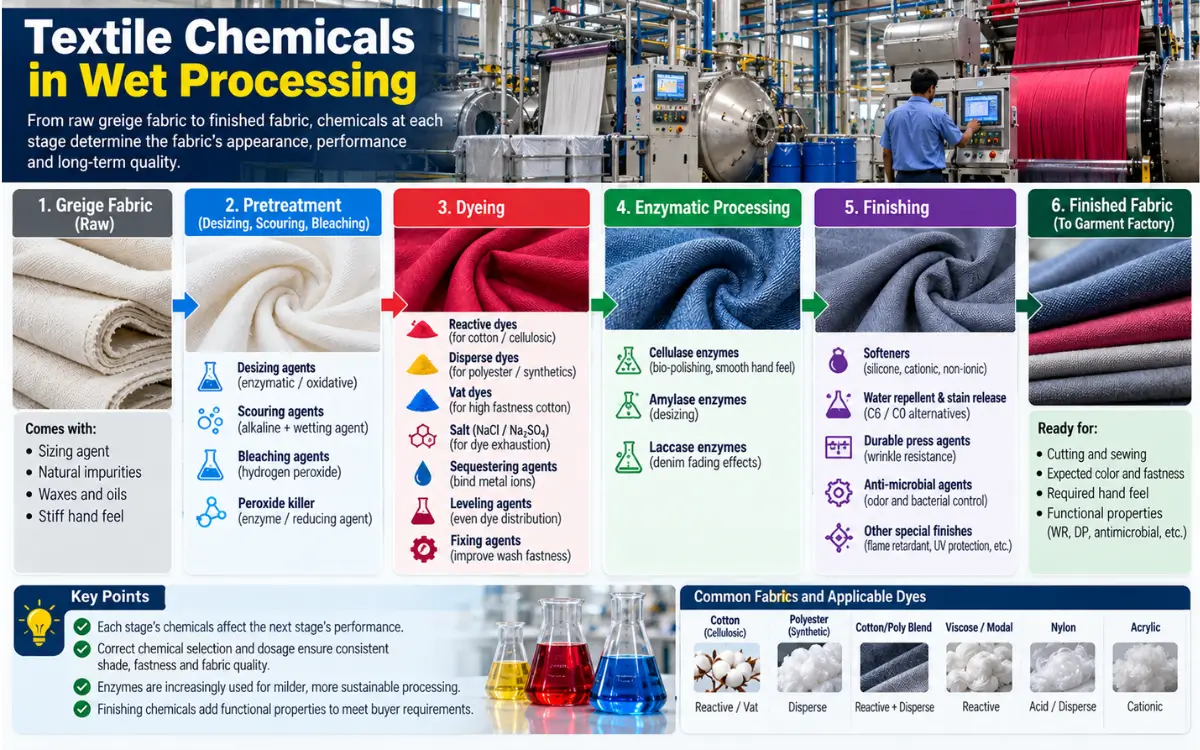
This guide organizes that chemistry by processing stage, giving a working reference for what each chemical class does and why it’s used where it is. Each stage gets its own deeper article elsewhere, since the practical detail, dosage ranges, selection criteria, common faults, deserves more room than a single reference page can give it.
Why Organizing by Stage Matters
Textile chemicals don’t function in isolation. A scouring agent’s job is partly defined by what desizing left behind, and a dyeing recipe’s success depends heavily on how completely pretreatment removed impurities that would otherwise interfere with dye uptake. Understanding wet processing chemistry stage by stage, rather than chemical by chemical, reflects how these processes actually connect on a real production floor.
Pretreatment: Desizing, Scouring and Bleaching
Pretreatment prepares raw fabric to accept dye and finishing chemistry evenly, and it’s arguably the stage where problems are hardest to fix later if it’s done poorly. Desizing agents, commonly enzymatic (amylase-based for starch sizes) or oxidative, remove the sizing compound applied to yarn before weaving to help it withstand loom tension. Scouring agents, typically alkaline formulations paired with a wetting agent, remove natural waxes, oils, and residual impurities from the fiber. Bleaching, most commonly using hydrogen peroxide in current practice, removes natural coloring matter and any remaining impurities, preparing the fabric for even dye uptake. A peroxide killer (typically an enzyme or reducing agent) is applied after bleaching to neutralize residual peroxide that would otherwise interfere with subsequent dyeing. The deeper article on pretreatment chemicals covers dosage ranges and the specific faults that trace back to incomplete pretreatment.
Dyeing: Reactive, Disperse and Vat Classes
Dye selection depends primarily on fiber type, with reactive dyes dominating cotton and other cellulosic fibers, disperse dyes used almost exclusively on polyester and other synthetics, and vat dyes offering the strongest fastness properties for cotton where wash and light fastness requirements are particularly demanding. Each class has its own application chemistry, its own fixation mechanism, and its own trade-offs on fastness, shade range, and cost. The dedicated article on dye selection goes through how to choose between these classes based on fiber, shade depth, and fastness requirement, since getting this choice wrong at the recipe stage is expensive to correct once a batch is already dyed.
Auxiliary Chemicals That Support the Dyeing Process
Beyond the dye itself, a dyeing recipe typically includes several supporting chemicals. Salt (commonly sodium chloride or sodium sulphate) drives dye exhaustion in reactive dyeing by reducing the dye’s solubility in the dyebath, pushing it onto the fiber. Sequestering agents bind metal ions in the water supply that would otherwise interfere with dye uptake or cause shade inconsistency. Leveling agents help dye distribute evenly across the fabric, reducing the risk of patchy or uneven shade. Fixing agents, applied after dyeing in some processes, improve wash fastness by helping the dye molecule bond more permanently to the fiber. Getting the ratio and sequencing of these auxiliaries right is as much a factor in final shade consistency as the dye itself.
Enzymes in Wet Processing
Enzymes have taken over several processes previously handled by harsher chemical treatments, largely because they work under milder conditions with less fiber damage and a smaller environmental footprint. Cellulase enzymes handle bio-polishing, removing surface fuzz from cotton fabric for a smoother hand feel, and are also central to denim’s stone-wash-alternative enzyme washing process. Amylase enzymes handle desizing, as noted above. Laccase enzymes are used in denim processing for controlled, localized fading effects that replace some traditional chemical or mechanical abrasion methods. The dedicated article on enzymes covers dosage, pH, and temperature windows for each enzyme class, since enzymes are considerably more sensitive to process conditions than the conventional chemicals they’ve replaced.
Finishing Chemicals
Finishing is where fabric gets its final hand feel and functional properties before it becomes a garment. Softeners, covered in depth in a dedicated article, come in silicone, cationic, and non-ionic formulations, each with different trade-offs on hand feel, yellowing tendency, and cost. Water repellent and stain release finishes have changed considerably in recent years as the industry has moved away from long-chain PFAS chemistry toward C6 and C0 alternatives, a shift with real performance and compliance implications covered in its own article. Durable press and anti-wrinkle finishes, flame retardant finishes for specific end uses, and anti-microbial finishes round out the main functional finishing categories a mill needs to have working knowledge of, even if not every mill runs every one of them regularly.
Effluent-Stage Chemistry
What doesn’t stay on the fabric ends up in the effluent stream, and effluent treatment has its own chemistry, coagulants and flocculants to settle suspended solids, pH adjustment chemicals, and biological treatment considerations where the effluent treatment plant relies on microbial digestion of organic load. A mill’s chemical choices upstream directly affect the effluent treatment burden downstream, which is part of why chemical selection increasingly factors in not just dyeing and finishing performance but downstream treatability and regulatory compliance as well.
Chemical Management and Compliance
Textile chemical selection today happens inside a compliance framework that didn’t exist with the same rigor a couple of decades ago. ZDHC MRSL compliance, covered in its own dedicated article, has become close to a baseline expectation from major brands sourcing from mills globally, requiring chemical suppliers to demonstrate their formulations don’t contain substances on ZDHC’s restricted list, verified through a tiered conformance system. Mills increasingly need functioning chemical inventory management systems, tracking what’s in use, what’s been discontinued, and what documentation, safety data sheets, MRSL conformance certificates, is on file for each product in active use.
A Simple Illustration of How Chemistry Stacks Into Total Cost
To make the stage-by-stage structure above more concrete, consider a single kilogram of cotton fabric moving through a standard reactive dyeing process from pretreatment through finishing. Pretreatment consumes desizing enzyme, scouring agent, wetting agent, and peroxide for bleaching, each a modest per-kilogram cost individually but adding up across four distinct chemical inputs before the fabric has even reached the dyebath. Dyeing itself adds dye cost, salt, and several auxiliary chemicals, sequestering agent, leveling agent, sometimes a fixing agent, layered on top of pretreatment’s cost. Finishing adds a softener, and possibly a functional finish like water repellency depending on the product. By the time a kilogram of fabric has moved through all three stages, it’s accumulated cost from perhaps ten or more distinct chemical inputs, which is exactly why the recipe costing approach covered in the chemical consumption benchmarking article works stage by stage and input by input rather than trying to estimate total chemical cost as a single blended percentage of fabric cost.
Documentation and Traceability Across the Chemistry Chain
Beyond the chemical inventory management covered above, a mature wet processing operation maintains recipe-level documentation connecting every batch back to the specific chemical lots, dosages, and process conditions actually used, not just the intended recipe on paper. This traceability matters for two distinct reasons that go beyond simple record-keeping discipline. First, it’s what makes fault diagnosis genuinely efficient, since a shade or fastness problem discovered in a finished batch can be traced back to the exact chemical lots and conditions involved, rather than requiring guesswork about what “probably” happened during processing. Second, it’s increasingly what buyers and compliance auditors expect to see as evidence that a mill’s chemical management claims reflect actual practice on the floor, not just a policy document, connecting directly to the ZDHC audit preparation covered in the dedicated MRSL compliance article.
Benchmarking Chemical Consumption
Chemical cost is a real, trackable line item in a mill’s cost of goods, and benchmark figures for chemical, water, and dye consumption per kilogram of fabric processed give a mill a way to check its actual performance against reasonable industry expectations. The dedicated article on this topic works through how to build a recipe cost from these benchmark figures, useful both for internal cost control and for evaluating whether a proposed chemical substitution is actually cost-effective once total consumption, not just unit price, is accounted for.
Sourcing Chemicals in Practice
For mills in Bangladesh specifically, the practical question of where auxiliary chemicals actually come from, local production versus imported, and how to evaluate a new supplier or switch away from an existing one on a running recipe, is covered in a dedicated article. Chemical sourcing decisions carry real risk when a recipe is already in production, since even a chemically similar substitute product can behave differently enough in a live dyebath to cause a shade or fastness issue that’s expensive to trace back to its actual cause.
How Chemistry Choices Propagate Downstream
A chemical decision made at pretreatment or dyeing doesn’t stay contained to that single processing stage. It carries forward through every later stage this reference covers, and understanding that propagation is part of what separates a mill that troubleshoots problems efficiently from one that chases symptoms without finding root causes. A scouring agent that leaves a small amount of residual impurity affects not just immediate dye uptake but potentially the finish chemistry applied afterward, since finishing chemicals interacting with an imperfectly prepared fiber surface don’t always bond or perform as their data sheet would predict on properly prepared fabric. A dye class chosen for cost reasons rather than fastness requirement doesn’t just risk a fastness test failure, it can also affect how the fabric responds to finishing heat treatment, since some dye classes show more sensitivity to the temperatures used in stenter heat-setting, covered in our Processing Machinery guide, than others.
This interconnection is exactly why the stage-by-stage organization of this guide matters beyond simple reference convenience. A genuine understanding of textile wet processing chemistry requires seeing how a choice at one stage constrains or complicates the choices available at every stage that follows, rather than treating each stage’s chemistry as a fully independent decision made in isolation from what came before and what comes after.
How This Reference Connects to Machinery and Utilities
Chemical processing doesn’t happen independently of the machinery it runs through or the utilities that support it. Liquor ratio, covered in our Processing Machinery guide, directly affects how much water, and therefore how much chemical and salt, a given dyeing batch actually consumes. Energy and water benchmarks, covered in our Utilities and Energy guide, connect closely to the chemical consumption benchmarks referenced above, since wet processing’s utility and chemical costs move together far more often than they move independently. Reading this chemistry reference alongside those other guides gives a more complete picture of what a wet processing operation’s total cost structure actually looks like.
Where This Chemistry Is Heading
A few directions of change are worth tracking, since they’ll likely reshape parts of this reference within the coming years rather than staying static. Bio-based chemistry, auxiliaries and even some dye classes derived from renewable feedstocks rather than petrochemical sources, continues to expand, driven partly by brand sustainability commitments and partly by genuine performance improvements as the underlying formulation science matures. Low-temperature and low-liquor-ratio dyeing chemistry, formulated specifically to perform well under the reduced water and energy conditions modern machinery enables, is being developed alongside our machinery advances covered in the Processing Machinery guide, since chemistry and machinery innovation increasingly move together rather than independently. And digital color matching and recipe prediction tools, while not chemistry themselves, are changing how quickly a mill can move from a target shade to a validated recipe, reducing the trial-and-error cycle that traditionally consumed real chemical and fabric cost during recipe development.
None of these trends make the fundamentals covered in this reference obsolete, pretreatment still needs to happen before dyeing, dye class selection still follows fiber type and fastness requirement, but they’re worth watching as the specific products and formulations within each category continue to evolve.
Chemical Safety and Handling
Beyond selection and dosage, every chemical class covered in this reference carries its own handling requirements that a mill’s floor-level procedures need to reflect. Concentrated acids and alkalis used in scouring and pH adjustment require proper storage segregation, since incompatible chemicals stored together create genuine safety risk beyond simple inconvenience. Oxidizing agents like hydrogen peroxide need storage away from heat sources and combustible material given their reactive nature. Enzyme products, while generally safer to handle than the harsher chemicals they’ve replaced, still warrant standard protective equipment given their biological origin and the potential for respiratory sensitization with repeated exposure to concentrated enzyme dust or aerosol. Safety data sheets for every active chemical product should be genuinely accessible to floor staff, not just filed for compliance purposes, since the practical value of an SDS is in someone actually reading it before an incident, not after one.
Keeping This Reference Current
The chemistry covered across this guide isn’t static, and a mill or buyer relying on this reference over time should expect specific product recommendations, regulatory thresholds, and even some class-level guidance to shift as the industry’s underlying chemistry, covered in more depth in the emerging trends section above, and its compliance landscape both continue evolving. Treating this guide and the related articles below as a framework for how to think through wet processing chemistry decisions, rather than a fixed, permanently accurate technical manual, is the more durable way to use this reference. The specific dye classes, finish chemistries, and compliance frameworks referenced throughout will keep evolving, but the underlying logic, working stage by stage, understanding how chemistry choices propagate downstream, weighing cost against fastness and compliance requirements, remains the right way to approach these decisions regardless of how the specific chemical products available change over time.
Bringing It Together
The chemistry covered across this guide and the related articles below connects into a single continuous thread: fiber goes in, and a finished, compliant, correctly performing fabric comes out, with every stage’s chemical choices shaping what’s possible at every stage after it. A mill or buyer that understands this reference well enough to see those connections, not just memorize which dye class goes with which fiber, is better equipped to diagnose problems quickly, evaluate new suppliers and formulations with genuine confidence, and hold real, informed conversations with buyers whose compliance requirements increasingly expect exactly this level of chemistry literacy from their supply chain partners.
A Final Word on Technical Credibility
Buyers increasingly work with technical teams on their own side, sourcing and quality specialists who understand wet processing chemistry in real depth, not just merchandisers relaying specifications. A mill’s own team being able to hold a genuinely informed technical conversation, explaining why a specific dye class was chosen, walking through actual consumption figures rather than vague reassurances, producing real compliance documentation on request, builds a different kind of buyer relationship than one where every technical question gets deflected to “we’ll check and get back to you.” This reference exists partly to support exactly that shift, giving mill technical staff and merchandising teams alike a shared, accurate foundation for those conversations.
Using This Reference
Treat this guide as a map rather than a complete technical manual. Each stage covered here connects to a related article going deeper on the practical detail, dosage ranges, selection trade-offs, and common faults, that a working technician or buyer actually needs day to day. Read them in the order that matches whatever decision is currently in front of you, whether that’s selecting a dye class for a new order, troubleshooting a pretreatment-related fault, or evaluating a new chemical supplier.
Frequently Asked Questions
What’s the difference between an MRSL and an RSL?
An MRSL (Manufacturing Restricted Substances List) governs chemicals used during production, while an RSL (Restricted Substances List) tests the finished product. A mill can pass RSL testing while still using chemistry that wouldn’t pass MRSL conformance, which is exactly the gap MRSL compliance is designed to close.
Why does pretreatment quality affect dyeing results?
Incomplete scouring or desizing leaves residual impurities that interfere with even dye uptake, which is why shade and fastness problems that surface at dyeing often actually trace back to a pretreatment stage that wasn’t fully verified.
Do enzymes actually replace all conventional wet processing chemicals?
No, but they’ve taken over specific processes, desizing, bio-polishing, and denim fading among them, where they achieve comparable or better results under milder conditions than the harsher chemical treatments they replaced.
How has PFAS regulation changed textile finishing chemistry?
Long-chain fluorocarbon water repellent finishes have been restricted or banned across multiple jurisdictions, pushing the industry toward C6 and increasingly C0 (fluorine-free) alternatives, a shift covered in depth in the dedicated article on this topic.


