Damp bathroom towels are one of those problems people accept as normal when they really shouldn’t. You hang your towel after a shower, come back a few hours later, and it’s still wet. By the next day, it smells musty. You wash it, and the cycle starts again.
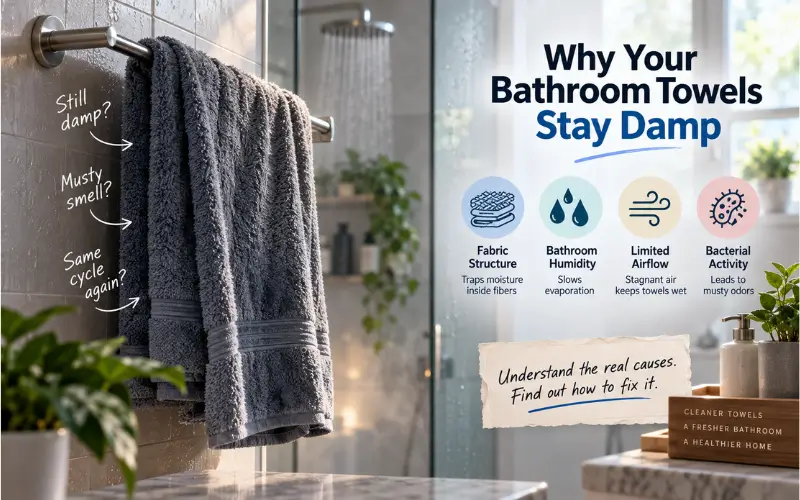
The issue isn’t how often you wash your towels. It’s a combination of fabric structure, bathroom humidity, airflow, and the invisible bacterial activity happening inside the fibers. Once you understand what’s actually causing the problem, the fix becomes straightforward.
Here’s why your bathroom towels stay damp and what to do about it.
The Hidden Structure Trapping Moisture in Your Towels
Most people assume towels stay damp because the bathroom is humid. That’s part of it, but the root cause starts inside the fabric itself.
A peer-reviewed study published in PMC conducted a six-month laboratory analysis of daily-use towels. The research found that beneath a towel’s surface loops sits a dense layer called the ground warp. This hidden layer traps moisture, organic matter, and skin cells every time you use the towel. Over time, bacterial communities form resilient biofilms in this layer that actively impair the fabric’s ability to shed water.
That’s why older towels take longer to dry than new ones. The biofilm builds up with each use and wash cycle, degrading the fabric’s ability to release moisture. A towel that felt fluffy and quick-drying when new can become a slow-drying, odor-prone fabric within months of regular use.
What This Means for Your Towel Routine
The ground warp biofilm explains why washing your towels doesn’t always fix the musty smell. Standard detergents clean the surface fibers but don’t always penetrate deeply enough to break down established bacterial communities inside the fabric structure.
Silver-treated towels disrupt this process from the start. The antimicrobial finish reduces odor-causing bacteria at the fiber level before biofilm can establish itself, so the towel stays fresher between washes and dries more effectively over time.
How Bathroom Humidity Stalls Evaporation
Even a towel with a clean fiber structure can’t dry properly in a saturated environment. Your bathroom is the most humid room in your home, and that humidity directly controls how fast moisture evaporates from any fabric hung inside it.
An engineering analysis from Eko Heat explains the thermodynamic mechanics behind this. When relative humidity in a room is high, the air near a damp surface becomes saturated with water vapor. This creates a boundary layer that stalls evaporation completely. The moisture in your towel has nowhere to go because the surrounding air is already full.
Traditional ladder-style towel racks make this worse. They allow towels to bunch and fold over the rungs, trapping pockets of stagnant, damp air between the fabric layers. The folded sections never make contact with moving air and stay wet long after the outer surface has started to dry.
How to Improve Bathroom Airflow
- Run the exhaust fan during and for at least 15 to 20 minutes after every shower
- Hang towels fully spread out with no folding or overlapping
- Open a window when weather allows to bring in drier outside air
- Use a towel ring or single bar instead of a ladder rack where possible
- Consider a heated towel rail in smaller bathrooms with limited ventilation
Airflow forces the saturated boundary layer away from the towel surface and replaces it with drier air that can absorb more moisture. Without it, even a high-quality towel sits in its own humid microclimate and stays damp.
Why Your Home’s Heating System Affects Towel Dryness
Where you hang your towels and how your home is heated both play a significant role in how quickly they dry between uses.
A residential engineering review from Westside Bathrooms explains how on-demand heating systems, like combi boilers, fail to provide the consistent background ambient heat needed to drive moisture out of fabric. These systems heat on demand then switch off, which means bathroom temperatures fluctuate rather than staying consistently warm enough to support evaporation.
Hanging towels on cold external walls compounds the problem. Cold wall surfaces accelerate condensation, pulling moisture back into the towel from the surrounding air instead of letting it escape. Towels hung on internal walls or heated rails dry significantly faster because the surface temperature stays above the dew point.
Where to Hang Your Towels for Faster Drying
- Hang on internal walls rather than external ones
- Use a heated towel rail if your bathroom has access to one
- Keep towels away from cold window frames and exterior surfaces
- Maximize the distance between your towel and any cold surface
Room temperature also matters. A bathroom that stays consistently warm between 68°F and 72°F (20°C to 22°C) provides the ambient heat needed to sustain evaporation throughout the day. A bathroom that cools rapidly after heating cycles off creates conditions where towels stay damp for hours.
The Fabric Matters More Than Most People Think
Not all cotton towels dry at the same rate. The construction of the fabric determines how efficiently it releases moisture after absorbing it.
Standard terry towels use long, dense loops that feel plush and absorb water well. The problem is those same dense loops hold onto moisture longer than lighter weaves. The more tightly packed the loops, the slower the towel dries between uses.
Sculpted terry weaves use a different approach. A structured construction creates channels in the fabric that allow air to move through the towel rather than getting trapped inside it. The result is a towel that absorbs water quickly when you use it and then releases that moisture faster as it hangs.
Long-staple cotton also performs better than short-staple cotton for drying speed. The longer fibers create a smoother surface that sheds water more readily and holds up better through repeated washing without the fiber breakdown that contributes to slow drying over time.
Your towels should dry fully between uses. If yours consistently stay damp after several hours of hanging, the fabric construction is part of the problem.
Why Damp Towels Smell Musty
The musty smell from a damp towel is bacterial. Specifically, it comes from the metabolic byproducts of bacteria feeding on the organic matter trapped in the fabric. Skin cells, body oils, and residual soap residue all provide nutrients. A consistently damp environment provides the conditions bacteria need to multiply rapidly.
Research shows that towel biofilms develop quickly and become increasingly resistant to standard washing once established. This is why some towels still smell off even after a hot wash cycle. The bacterial community is embedded in the fabric structure, not just sitting on the surface.
Silver treatment addresses this at the source. The antimicrobial finish disrupts bacteria at the fiber level before they can form the biofilm communities that cause persistent odors. A silver-treated towel that also dries faster between uses removes both conditions bacteria need to thrive: organic matter and sustained moisture.
How Often Should You Actually Wash Your Towels?
Most dermatologists recommend washing bath towels every three to four uses under normal conditions. Hand towels, which contact the face and hands more frequently, benefit from washing every two to three days.
The challenge is that standard towels start developing odor-causing bacteria well before that point in humid bathrooms with poor airflow. Silver-treated cooling sheets and towels both use the same antimicrobial technology for the same reason: to extend the window between washes without sacrificing freshness.
When you do wash towels, skip the fabric softener. Fabric softeners coat cotton fibers with a waxy layer that reduces absorbency and traps more moisture in the fabric after washing. They make towels feel soft temporarily but contribute to the exact conditions that cause slow drying and odor buildup over time.
Building a Bathroom That Keeps Towels Fresh
Solving the damp towel problem requires fixing multiple variables at once. No single change will be enough on its own.
Start with ventilation. A bathroom with poor airflow will defeat even the best towel fabric. Run the exhaust fan consistently, hang towels fully spread out, and create separation between towels so air can move around each one.
Address the hanging surface. Move towels away from cold external walls and onto internal walls or heated rails where possible. Temperature consistency matters more than peak heat.
Choose towels built to dry faster. Sculpted weaves, long-staple cotton, and silver-treated fabric all contribute to faster drying and longer freshness between washes.
Wash at the right frequency with the right detergent. Hot water, mild detergent, and no fabric softener. For heavily used hand towels, every two to three days. For bath towels, every three to four uses.
Good bedding and bath habits work together. A bedroom and bathroom that both use breathable, antimicrobial-treated fabric create a fresher home environment with significantly less laundry overall.
Damp bathroom towels aren’t inevitable. They’re a solvable problem. Fix the airflow, the fabric, and the hanging setup, and your towels will dry fully between uses and smell clean every time you reach for them.
Miracle made towels are built with exactly this in mind. Premium long-staple cotton, silver-treated to reduce odor-causing bacteria, and constructed to dry faster than traditional options so your bathroom stays fresher with less effort.